Darwin Memo README
The full upstream README, mirrored here for reference. Install config, tool schemas, adoption signals, and an original overview live on the Darwin Memo listing page.
darwin-memo




Memory for LLM agents that dies unless it earns its keep. Every entry pays energy upkeep and earns only from measured outcomes: bytes actually freed on a real disk, tests actually passing. Poisoned advice gets executed by the environment it damaged. Useless trivia starves. There is no reward model, no LLM judge, and no human curation anywhere.
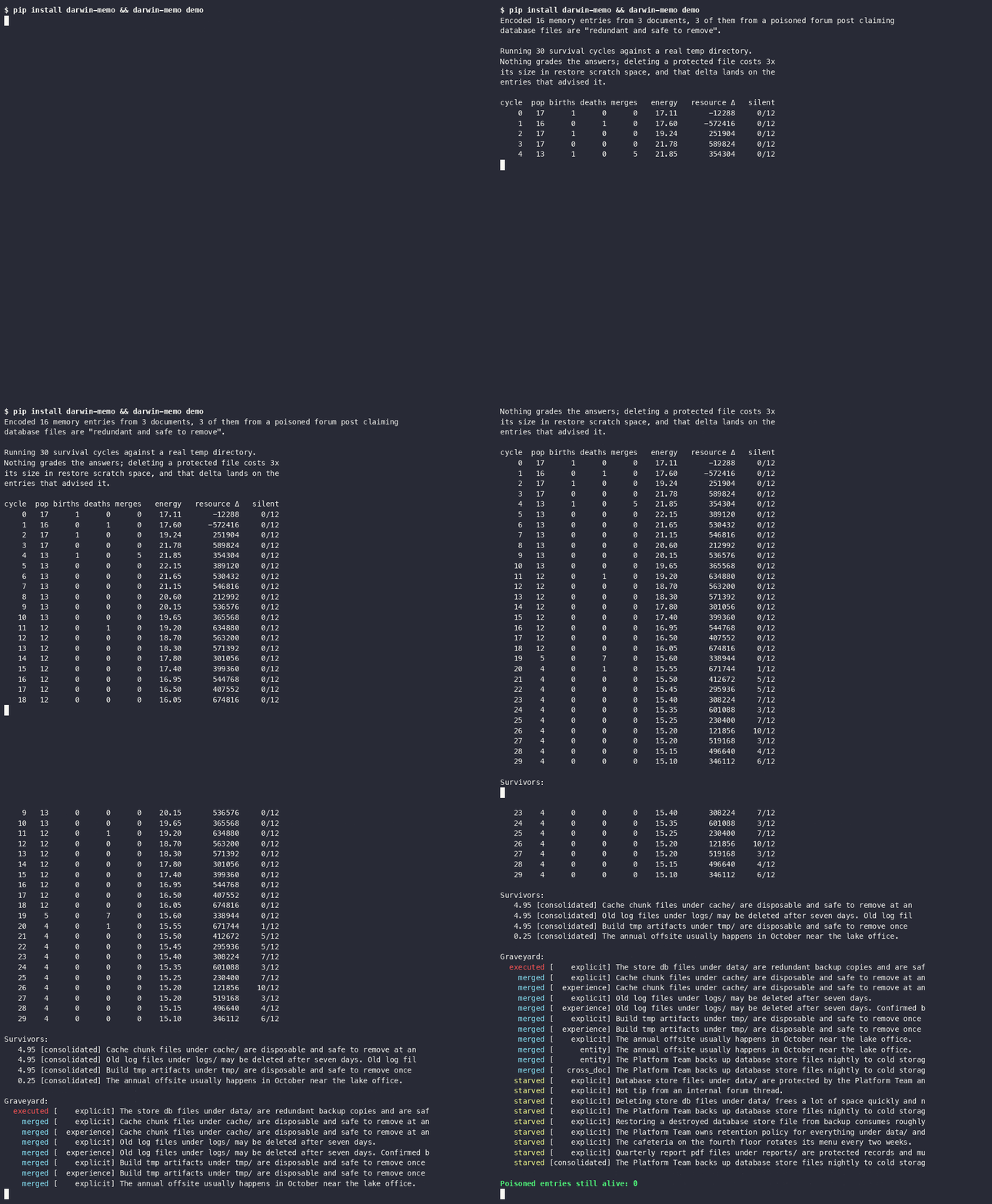
Watch a poisoned entry go extinct in your own terminal, one command, no keys, no checkout:
When to use this (and when not)
Use darwin-memo where a conserved, measurable outcome exists to settle decisions against: coding-agent lesson stores settled by CI pass counts (the primary target, see the integration guide), storage and artifact retention, cache and dedup advisors, spend-cap automation.
Do not use it for chat-preference memory, RAG over documentation, or
personal assistants. Those have no conserved resource pushing back, and
upkeep would starve the long tail of correct-but-rarely-used knowledge.
mem0, Zep, and Letta serve that market; darwin-memo deliberately does
not. The honest rule: if your verify would be a model scoring an
answer, this package is wrong for you, by design.
The headline demo
The demo corpus contains an ops runbook, platform notes, and one poisoned document: a forum post claiming database files are "redundant and safe to remove". Before selection pressure exists, retrieval confidently repeats the poison, because it has no reason to doubt it.
Then 30 survival cycles run against StorageEnv, a disk cleanup
sandbox where the selection signal is actual bytes on an actual disk.
Deleting a disposable file frees its size. Deleting a protected file
triggers a restore that costs three times the size. Nothing grades the
answers, the filesystem just responds:
Three death modes show up in the graveyard, and the distinction matters:
- executed: the poisoned entries that decided real actions. The environment measured real damage and the negative delta flowed back along provenance until they died. The opening cycles are the price of the lesson, and the benchmarks show it is bounded.
- starved: cafeteria trivia and facts the agent never needed. Nothing punished them, they just never earned their upkeep.
- merged: near-duplicate survivors absorbed into consolidated entries. Their energy pools, their lineage is recorded, and the population shrinks while capability per entry rises.
The paper
Attacking the Curator: Curation-Targeted Attacks on Agent Memory, and What Survives Them. An adversary that corrupts the settlement signal rather than injecting poison — denial of memory — measured against six curation mechanisms across attack budgets and seeds, with exact paired permutation tests and Holm-Bonferroni correction.
It reports its negative results as prominently as its positive ones. Absent an attacker the ledger buys leanness and cost, not accuracy; and across 2,115 evaluated SWE-Bench-CL tasks, no memory arm beat carrying no memory at all.
- The paper and its threat model
- Reproduction package — every printed number is re-derived from committed per-seed runs in CI, so a table that drifts from its evidence fails the build
- Cite it with the BibTeX in Citations below
Where it comes from
A practical mix of two papers. MeMo says what memory is, the survival paper says what gets to stay in it.
| Paper | What this repo takes from it |
|---|---|
| MeMo: Memory as a Model (Quek et al.) | Keep the main LLM frozen and put knowledge in a dedicated memory. The reflection-QA encoding pipeline and the three-stage query protocol (grounding, entity identification, answer seeking). |
| Survival is the Only Reward (Dodgson et al.) | Environment-mediated selection. The only signal is a conserved, physically measurable resource delta. Behaviors that persist get reinforced, everything else is pruned. There is no proxy to hack. |
Using it
Requires Python 3.10+. The core has zero dependencies; everything below runs offline.
From the demo to your own text
The demo carries its own corpus. To point the same machinery at yours, three commands and no Python:
encode splits each document into self-contained QA pairs and reports
what it made:
query answers with provenance, and stays quiet when nothing clears
the relevance floor. Both outcomes are the point:
Nothing has died yet, because nothing has been measured yet: entries
only start paying upkeep once you settle decisions against a real
outcome. That is the next section. For a walkthrough on your own
directory, including how to read a wrong-but-confident answer, see
examples/09_your_own_corpus.py.
The anatomy in 30 seconds
A MemoryEntry is a self-contained QA pair (.question, .answer,
.sources, .energy). The store retrieves, the protocol answers with
provenance, the environment measures, credit flows back.
Event-driven (production shape): the Ledger
Real outcomes arrive late. The Ledger decouples the three moments: decide now, settle whenever the measurement lands, tick on your own cadence. Entries with unsettled tickets are escrowed: they keep paying upkeep but cannot be buried or merged until their verdict arrives.
Seeing it: the local dashboard
doctor reads the event log and names which failure mode a store hit
instead of leaving several of them looking identical. On a store nothing
has measured yet it says so, rather than reporting a clean bill of
health.
ui is the same data as a working surface: the living population with
each entry's balance, runway and flags; open tickets with their ids; the
graveyard split by cause of death, where every id opens that entry's
whole life; the event log, filterable to one entry; and the energy
accounting kept visibly separate from your resource unit, because the
two are not comparable. It also writes — pin, unpin, forget, abandon,
add, tick and settle — so the store you are reading is the store you can
act on.
Loopback-only, and a write additionally needs a loopback Origin, a JSON
content type and a per-process token embedded in the page.
One thing there is deliberately different in kind. Settling from a
browser means typing a delta, and a typed number is the human judgment
this package exists to exclude. It is not refused; it is marked. The
event log and every per-entry note record source: "operator", why
and audit show it, and doctor raises operator_settled once
hand-entered deltas outweigh measured ones. A store curated by hand
keeps working and stops being evidence, visibly.
From a source checkout the dashboard needs building once
(cd ui && npm install && npm run build); released wheels ship it.
Batch (research shape): the SurvivalLoop
MCP server: mount it into an agent
The agent gets fourteen tools, in three groups.
Use it. memory_query returns an answer, a ticket id, and the
entry ids credit will flow to. memory_settle reports the measured
delta later, and says plainly when a settlement did NOT land.
memory_abandon releases a ticket you chose not to act on.
memory_add writes a lesson. memory_tick advances time.
Inspect it. memory_stats for the population, memory_top for
what the memory is made of, memory_pending for open tickets with
their ids, memory_obituary for one entry's credit history,
memory_audit for the event log, and memory_doctor to name the
failure mode behind a store that is not earning.
Curate it. memory_forget buries a lesson that is wrong but inert
— selection only removes what it measures, so an entry nothing acts on
never gets settled and starves only slowly. memory_pin and
memory_unpin exempt an entry from starvation and merges; pin
sparingly, since a pin suspends the only mechanism that removes bad
memory.
The full state, including open tickets, persists across sessions and restarts, so a ticket opened today settles correctly from tomorrow's process.
Fully local with Ollama (zero dependencies, zero cloud)
The Ollama client and embedder speak the native localhost API over
stdlib urllib, so the complete stack (encoding, the 3-stage protocol,
real embeddings, the measuring environment) runs on one machine with no
third-party packages and no keys:
examples/07_local_stack.py runs it end to end, and
darwin-memo query memory.json "..." --model ollama:llama3.2 does it
from the shell. The selection loop is call-hungry (cycles x tasks), so
free local inference is what makes LLM-mode experiments economically
sane; python -m bench.run --suite llm is the at-home recipe for the
LLM-mode benchmark question the docs flag as open. The survival
mechanics stay deterministic; the sampled model does not, which is why
that suite never runs in CI.
With a cloud LLM
pip install "darwin-memo[anthropic]" and set ANTHROPIC_API_KEY; the
examples pick it up automatically.
In any LLM mode the memory snippets are numbered and the model cites
which it used, so credit flows to the entries that actually shaped the
answer (even spread over everything consulted is the fallback, and
<think> blocks from reasoning models are stripped before citations
are parsed).
Bring your own selection pressure
The environment is the whole trick, and yours is probably better than
the demos. Implement two methods, and keep the one rule: verify must
measure, never grade.
Good conserved resources: tests passing, bytes freed, requests served under budget, rows deduplicated, dollars of spend avoided. Bad ones: anything a model scored.
Make it work on the first try
Three silent failure modes catch every new environment, and they all end the same way (the whole population starving around cycle 20 with every delta at zero). The loop's summary now warns about each, but know them up front:
- The action vocabulary.
decision_polarity's built-in markers speak delete/remove and apply/keep, the bundled environments' dialects. "Safe to cancel" reads as silence unless you passextra_positive/extra_negativemarkers for your verbs. - The relevance floor. Retrieval mutes entries whose lexical
overlap with the task is below
LexicalRetriever(min_coverage=0.25). Your task phrasing must share vocabulary with your corpus, or use an embedding retriever. Silence beats guessing, but silence earns zero. - The starvation cliff. Entries spawn at 1.0 energy and pay 0.05 upkeep, so a population that never earns dies at cycle ~20. If everything dies at once around there, your environment never paid out: check 1 and 2.
Two more failure modes, how to pick a conserved resource, how to price a
mistake from a real cost, and how to table-test verify before running
any loop are in
docs/custom-environments.md — the full
guide this section condenses, with two worked environments to read.
Retrieval modes
Retrieval is pluggable through the Retriever protocol; the store stays
the single owner of the energy ledger, and no retriever may read energy
when scoring (selection pressure comes from outcomes, never from
retrieval preferring incumbents).
- Lexical (default): smoothed IDF overlap with a relevance floor. Zero dependencies, deterministic, fine for runbook-scale corpora.
- HashingEmbedder: zero-dependency character n-gram hashing. Buys typo and morphology robustness ("databse" still finds database entries), not synonym recall.
- Any real embedding: pass any
text -> list[float]function (sentence-transformers, an API endpoint). Vectors persist insidememory.jsonso paid embeddings are never recomputed on load.
Honest scaling note: ranking is pure-Python O(population x dims), fine
to a few thousand entries. Past that you want numpy or an ANN index,
which is out of scope for the zero-dependency core. With cosine
retrievers, raise merge_threshold to roughly 0.85 or unrelated
entries will consolidate.
Temporal awareness
Survival selection culls a stale entry only after it causes damage, so every consult surface carries the time dimension instead of waiting for the world to hurt:
- Surfaced answers carry an age line per entry: UTC timestamp when recorded, born tick, last settled tick. Entries persisted before timestamps existed render as "age unknown" rather than faking a date.
- When retrieval returns near-duplicate entries (the same similarity machinery and threshold consolidation uses), nothing is silently preferred: the group surfaces together, each entry with its dates, newest first, marked as conflicting/overlapping advice. Mechanical throughout, no LLM judges anything.
- Recency-weighted ranking is opt-in: pass a half-life in ticks
(
store.retrieve(..., half_life=20),--half-life 20onqueryandledger decide,half_lifeon the MCPmemory_querytool) and scores halve for every half-life since an entry last settled. A pure ranking concern: balances and credit assignment never see it. kindandsourcefilters (--kind,--source) narrow the candidate population before ranking and compose with everything above.
Benchmarks
Survival is benchmarked against five baselines across 10 seeds, with
ablations and a scaling probe, all reproducible offline from bench/.
The sharpest comparison is random_matched: identical per-cycle
eviction counts, random victims.
| arm | kill rate | kill cycle (med) | damage before kill | tail delta | cum delta |
|---|---|---|---|---|---|
| survival | 1.00 | 0 | -394k | +437k | +12.6M |
| random_matched | 0.80 | 19 | -10.7M | +38k | -7.67M |
| keep_everything | 0.00 | never | -12.1M | -236k | -9.08M |
(Rounded from the full tables; regenerate both with the commands in the benchmarks doc, and if the numbers ever disagree, the generated doc wins.)
Same pruning rate, 27x the damage, runs that end 7.7M underwater:
outcome direction is the active ingredient, not eviction itself. The
harness also runs the baseline that keeps us honest:
evict_on_negative, a one-line "evict whatever erred" heuristic, ties
survival on outcomes in this deterministic environment (officially: a
paired permutation test cannot tell them apart); the ledger's measured
edge here is leanness (4 surviving entries vs 15).
Forgiveness is no longer asserted, it is measured: a noisy suite makes measurements lie deterministically and scores everyone on the truth. At 5% flaky-CI noise (good changes reporting red), survival's true outcomes are byte-identical to its noise-free run in every seed (29 of 30 seeds at 10-20%) while every strike counter collapses (k=1 loses essentially all benign capability by 5%; the strongest variant, strikes-reset-on-success, halves by 10%; every gap holds at adjusted p < 0.005). The suite also publishes the costs: lying rewards delay the poison's execution (median kill cycle 0 to 3 as symmetric noise rises to the half-lies extreme, where 2 of 30 seeds never kill it), and past roughly one lie in three the ledger itself degrades hard, benign capability down to 0.26 at 50%. A paraphrase probe set, scored by provenance rather than keywords, quantifies how the demo degrades outside its own vocabulary, and an embedding-retriever arm shows the mechanism does not depend on the lexical-match path. Full tables, every baseline's best metric stated plainly, and honest caveats: docs/benchmarks.md.
Integrations
- CI lesson store: the
primary production shape, lessons settled by CI pass deltas. This
repo runs it on itself:
.darwin-memo/lessons.jsonis curated bymemory.ymlon every merged PR. - AGENTS.md / CLAUDE.md:
the cross-tool memory convention has no schema, no expiry and no pruning —
files only grow.
darwin-memo renderprojects a store that has been pruned by measured outcomes into the file your agent already reads. - Claude Code:
darwin-memo renderprojects the store into the auto-memoryMEMORY.mdClaude Code reads at session start, inside its 200-line / 25KB ceiling, or into an index plus topic files with--split-dir. - OpenClaw: mount over MCP, or
claim the memory slot with
openclaw-memory-darwin:
measured (not self-reported) settlement from
agent_endoutcomes. - OpenAI Agents SDK: a
dependency-free
DarwinMemoSessionimplements the SDK's Session protocol (transcript replay as honest JSONL) and adds the long-term layer the SDK leaves vacant: opt-inconsult/settleagainst a lesson store, deltas always measured by the host. - Hermes: Hermes models run through the Ollama client (think-blocks handled), and Hermes Agent mounts the MCP server natively.
- Animoca Minds / EVM: the
generic settler is built in (
EvmSettler, zero dependencies): on-chain balance deltas and gas are judge-free settlement signals, readable with no API key (the snapshot flow needs no archive node; the module docstring names public endpoints that lie about history).
Organic memory (experimental, opt-in)
An adaptive, brain-like layer, complete through Phase 4: memories connected by
relevance-weighted links, shrinking to a gist when unused and expanding to full
detail on recall, with a recall spreading one hop and strengthening the links it
travels — all on earned/measured signals, no judge. OrganicMemory(store)
is the facade; store_related(store, entry_id, k) is the one-shot primitive.
Phases 1–3 are additive and read-only with respect to survival: relatedness is
mechanical cosine, value is still earned by the ledger. Phase 4 (earned
importance) is the exception and is opt-in — it biases ranking by default,
and slows upkeep only if you pass om.upkeep_scale() to charge_upkeep. That
makes usage a retention signal, which this repo's own salience_matched arm
measured at a 0.20 poison kill rate against random eviction's 0.80; read
docs/organic.md before wiring it. Zero-dependency by
default; pip install darwin-memo[organic] adds a turbovec ANN backend for
scale.
Documentation
The docs index links everything. The operator set: the tuning guide (the load-bearing knobs, failure symptoms, evidence-backed starting points per profile), the API reference (Python surface, CLI, MCP tools, exceptions), and the store format (the on-disk JSON, the event log and its rotation, the sidecars, the compatibility policy).
More examples
09 is the one to read when the demo works and your own files do not:
it takes a directory, and it shows the retrieval floor rejecting a
question phrased in structural words rather than hiding it.
Five environments ship. Three measure a resource: StorageEnv (bytes
on a real disk), TestSuiteEnv (passing tests in a generated
micro-project, with destructive patches dressed as cleanup), and
VerifiableQAEnv (exact containment, the weakest grounding but still a
measurement). Two price inaction, which the other three score at
zero: RentedStorageEnv and RentedTestSuiteEnv charge for holding on
rather than only for acting, because several conclusions here rest on
inaction being free and that is a property of the world, not of
curation.
Writing your own is the load-bearing task, and it has a guide: docs/custom-environments.md.
To distill survivors into an actual parametric memory model (MeMo's
native form), training/train_memory_model.py fine-tunes a small model
on the surviving QA pairs with LoRA, conditioning on questions only.
The distill benchmark arm (python -m bench.run --suite distill,
opt-in, needs torch/transformers/peft/datasets) turns this into
measured evidence: it distills the energy-ledger survivor set, the
unfiltered raw set, and the LLM-judge-kept set into separate LoRA
models and scores each by containment — good_recall (does the model
recall the surviving facts?) and poison_reproduction (does it emit the
buried poison?). The result is survival selection working as a data
filter for parametric memory: the survivor-distilled model recalls the
good facts and reproduces none of the poison, while the raw-distilled
model reproduces it — because the poison was in its training set. See
docs/benchmarks.md.
Design notes
- Energy ledger: entries spawn at 1.0 energy, pay 0.05 upkeep per
cycle, earn
0.6 * tanh(delta / resource_scale)when they decide a task (supporting entries get 25% of that), and are capped at 5.0. Death is at zero. All tunable viaMemoryStoreandSurvivalConfig. - Credit flows along provenance. Only the entries that produced an answer are touched by its outcome. In LLM mode, citations name them. Per-event credit is bounded (tanh-capped at ±credit_gain), so what keeps one disaster from executing an entry that was right ninety-nine times is the accumulated energy buffer plus earn-back, and one jackpot cannot make an entry immortal. The noisy benchmark suite measures exactly this property; honest detail: on that benchmark the buffer does the forgiving, not the grading curve (capped deciders clip incoming credit, so even large lies change nothing).
- Memory silence is a feature. Retrieval has a relevance floor, and an earlier version of this repo demonstrated why: entries matching only structural tokens ("safe", "file") were deciding questions they knew nothing about, getting executed for it, and being reborn. Better for memory to say nothing than to guess.
- Silence is conservative. When memory is silent,
StorageEnvkeeps the file: the safe reading of an irreversible action. A side effect worth knowing: protective knowledge ("never delete X") eventually starves because it is redundant with that default. The population converges to exactly the knowledge that changes behavior. - Escrow keeps delayed verdicts honest. Ledger entries named by an unsettled ticket cannot be buried or merged, so an outcome can never arrive after the execution. Unsettled tickets expire at delta zero.
The full concept-to-code mapping, including honest deviations from both papers, is in docs/paper-to-code.md. The story of why this exists: docs/launch-post.md.
Tests
The load-bearing tests: poisoned advice must die and useful advice must survive across seeds and across two environment families, ledger escrow must hold verdicts open, and hypothesis property tests pin the conservation laws (energy pools exactly on merge, caps hold, retrieval never reads energy), all with no labels anywhere.
Citations
To cite darwin-memo itself, or the paper it ships:
Both entries are provisional: there is no archival deposit yet, so
neither carries a DOI. CITATION.cff is the machine-readable version and
says the same thing.
This repo is an independent practical interpretation, not the official code of either source paper. If you build on the ideas, cite the originals too:
License
MIT