CrawlEyes MCP Server README
The full upstream README, mirrored here for reference. Install config, tool schemas, adoption signals, and an original overview live on the CrawlEyes MCP Server listing page.
CrawlEyes — Web Scraping & Search Toolkit for AI Agents


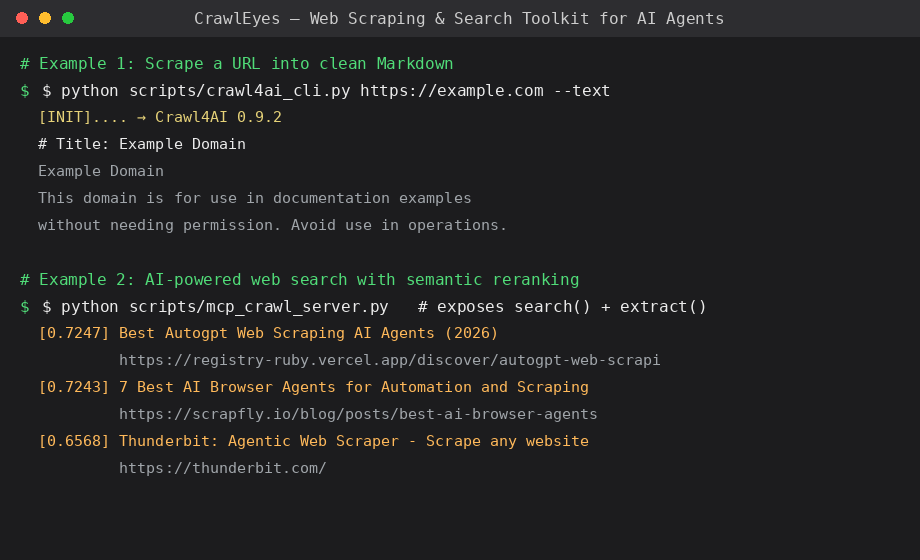
CrawlEyes gives AI agents reliable full-text extraction (web_extract) and robust search (web_search) backends — the "eyes" that let agents see and read the web. Built and tested against Hermes Agent.
Also ships as a standard MCP server, so any MCP client (Claude Desktop, Cursor, other agents) can reuse the same search + extraction capabilities.
Why CrawlEyes?
Most agent toolkits cover one slice of the pipeline. CrawlEyes is the rare all-in-one that you can actually run behind the Great Firewall without external accounts.
| Typical agent toolkit | CrawlEyes | |
|---|---|---|
| 🔍 Search | API key required, often blocked in CN | ✅ SearXNG (self-hosted) + Tavily keyless fallback — zero config, zero key |
| 📄 Extraction | Separate scraper, or Firecrawl SaaS | ✅ Built-in Crawl4AI full-text extract, ~89% noise removal |
| 🧠 Semantic rerank | Rarely included | ✅ Local fastembed rerank — no torch, ~50MB model |
| 🔌 MCP server | Often missing | ✅ Standard MCP tools (search + extract + deep_research + sitemap), any client |
| 🌐 China-friendly | Mostly English/GFW-blocked | ✅ Tested on a real mainland China server (baidu + yandex) |
Zero API keys. Zero external accounts. One command. CrawlEyes is the only toolkit in this space that combines search + extraction + semantic reranking + MCP in a single, China-friendly, self-hosted package.
Features
| Capability | Where | Why it matters |
|---|---|---|
| Full-text extraction | scripts/crawl4ai_cli.py | Headless-browser scraping → clean Markdown; handles ~80% of JS/dynamic/UA-blocked pages |
| Content denoising (P1) | crawl4ai_cli.py --noise-filter | Prunes nav/ads/comments via Crawl4AI's PruningContentFilter — measured 24.6k→2.8k chars (~89% noise removed) on a typical article |
| Retry with backoff (P3) | crawl4ai_cli.py --retry N | Exponential backoff (1s/2s/4s) on transient failures |
| Browser session reuse (P4) | crawl4ai_cli.py --session NAME | Reuses the browser context across scrapes in one process — no cold-start per URL |
| Keyword-focused extraction | crawl4ai_cli.py --bm25 KEYWORD | Keeps only paragraphs relevant to a keyword (experimental — BM25 is English-centric; works best on English docs) |
| Search (primary) | SearXNG (self-hosted meta-search) | Privacy-friendly search aggregator |
| Search (fallback) | Tavily keyless API | Zero-config, no-key fallback when SearXNG is down/empty |
| Search orchestration | plugins/searxng-tavily/ | Hermes plugin provider: SearXNG first → auto-fallback to Tavily keyless; three-state circuit breaker (3 fails → 60s cooldown → half-open) + shared SQLite cache (TTL 3600s) |
| Semantic reranking (P2) | scripts/crawl_search_standalone.py | Local embedding rerank of search results with fastembed + BAAI/bge-small-zh-v1.5 (512-dim, no torch dependency, ~50MB, cached) — puts relevant results first. Measured: crawler-relevant items 0.817/0.732 float to top, irrelevant 0.302/0.139 sink |
| MCP server (P5) | scripts/mcp_crawl_server.py | Exposes search + extract + deep_research + sitemap as standard MCP tools (stdio default, or streamable-http for remote clients). Works in any MCP client, no Hermes dependency. Extracted content is sanitized against prompt-injection (strips invisible chars + prompt-hijack lines). Unified rate limiting + exponential backoff guard every tool (sliding window, per-tool cost) so concurrent agent calls can't hammer downstream services |
| Sitemap discovery (P1) | crawleyes/sitemap.py | sitemap(origin) → parses sitemap.xml (plain / gzip / index-recursion) with robots.txt fallback, returns a deduped URL map. Zero-key way to discover a site's URL surface for whole-site fetch or deep-research seeding |
| Multi-format extract (P0) | extract(..., format=) | markdown (default) / fit (denoised) / raw (unfiltered) / markdown_with_citations — pick the level of cleanup you need |
| RAG-ready interfaces | crawleyes/rag.py | One-liners markdown(url) / search_markdown(query) → clean, sanitized, LLM-ready Markdown for RAG corpora |
| Deep research | crawleyes/deep_research.py | deep_research(topic) → decomposes topic into sub-questions → searches → extracts → synthesizes a cited Markdown report. Optional LLM (any OpenAI-compatible endpoint); degrades to evidence-aggregate mode without one |
| Verification | scripts/ | Clean subprocess scripts to verify each backend end-to-end per Hermes profile |
Project layout
Quick start
1. Install Crawl4AI (China-friendly mirrors)
2. Scrape a page
3. Use the search + rerank (standalone, no Hermes)
China-network note: the embedding model downloads from HuggingFace, which is blocked on mainland networks. Set
HF_ENDPOINT=https://hf-mirror.comandHF_HUB_DISABLE_XET=1(hf-mirror doesn't support the xet protocol and returns 401 without this).
4. Run as an MCP server (any client)
For Hermes specifically, add to config.yaml:
4b. Firecrawl-compatible /scrape endpoint
Already using Firecrawl's Python SDK? Point it at CrawlEyes and keep your code:
This is a pragmatic subset of the Firecrawl API — the core /scrape contract
(success + data.markdown + data.metadata), backed by CrawlEyes' own
extraction engine. It does not implement Firecrawl's async /crawl queue,
/search, or /map — see the design notes for the rationale.
5. Install the search plugin (Hermes)
Copy plugins/searxng-tavily/ into a Hermes plugins dir, then:
Set SEARXNG_URL in your Hermes profile .env to point at your SearXNG instance. If unset or unreachable, the provider automatically falls back to the Tavily keyless API (no API key required).
Note: the plugin only takes effect for newly started agent sessions.
6. Verify
Design notes
- Layered composition: no single tool covers everything. Crawl4AI handles extraction; SearXNG + Tavily cover search; each layer has a tested fallback.
- Tavily keyless works with zero configuration and no account — a cheap resilience net for the whole search path.
- Circuit breaker is SearXNG-only: a Tavily fallback success does not reset the breaker (otherwise it would never trip).
record_success()is only called when SearXNG itself succeeds. - Shared SQLite cache lives in the real user home (via
pwd.getpwuid, not$HOME— which Hermes profiles override), so all profiles share one cache. WAL + 5s timeout + try/except degrade-to-no-cache under concurrency. - Semantic rerank is cheap: fastembed (ONNX) avoids the ~2GB torch dependency; model loads in ~0.6s once cached, embeddings in ~50ms.
- MCP server is standalone: it does not import Hermes internals, so it runs on any Python 3.12 env and serves any MCP client.
- MCP transport is dual: stdio (default, standard MCP clients) or
streamable-http(--transport http), so a single codebase serves both local process and remote HTTP clients. - Unified rate limiting is layered: MCP tools and deep-research's internal search/extract all share one sliding-window limiter (per-tool cost), so concurrent agent fan-out can't hammer SearXNG/Tavily/Crawl4AI even through multi-round deep research.
Credits & inspiration
This project builds on a set of excellent open-source tools. All code here is an independent implementation (no copied code), but the ideas and interfaces are drawn from the following projects — full credit to their authors:
| Feature in this repo | Inspired by | License |
|---|---|---|
| Extraction engine (Crawl4AI wrapper) | Crawl4AI — direct dependency | Apache-2.0 |
| Content denoising (P1) | Readability, GeneralNewsExtractor (idea) | Apache-2.0 / MIT |
| Semantic reranking (P2) | Vane, Perplexica (idea) | MIT / MIT |
| Retry with backoff (P3) | Crawlee (idea) | Apache-2.0 |
| Browser session reuse (P4) | camoufox (idea) | MIT |
| MCP server (P5) | playwright-mcp, exa-mcp-server (idea) | Apache-2.0 / MIT |
| Search orchestration / fallback | SearXNG — self-hosted (official Docker image, no source modification), accessed via HTTP API only · Tavily keyless | AGPL-3.0 (server software, not linked/embedded) / proprietary API |
Design independence: the implementations here are written from scratch — we studied the above projects' approaches (denoising thresholds, rerank pipelines, backoff strategies, MCP tool patterns) but did not copy their source code. Dependencies are declared in
requirements.txt. If you believe any attribution is missing or incorrect, please open an issue.
Compliance
CrawlEyes is a general-purpose fetch toolkit for legitimate research and personal use. It deliberately does not include proxy pools, fingerprint rotation, or CAPTCHA-solving (anti-scraping evasion) — those are out of scope.
Robots.txt is opt-in (default off): pass respect_robots=True to extract / markdown (or --respect-robots on the CLI) to check each target's robots.txt (RFC 9309) and refuse URLs it explicitly disallows. It's default-off so legitimate scraping isn't silently blocked by aggressive or broken robots rules — compliance is the caller's informed choice per use case. Always review each site's terms of service before scraping at scale.
License
MIT — see LICENSE.