knowledgearchitecturesource-codemcpagent-tools
Provides a local MCP server indexing Claude Code's 310K lines into 32 modules with 6 tools for architecture queries and source lookup.
Quick Install
Automated & IDE SetupCopy the AI prompt to install this server into Claude Code, Cursor, or another agent — or use 1-click editor setup below.
We couldn’t automatically confirm this listing starts correctly
The install command below started, but didn't respond the way we expected when we tried to talk to it.
npx -y cc-senseiinitialize succeeded but no response to tools/list.
This is an experimental automated check and can have false negatives — missing environment variables, a slow cold install, etc. It doesn’t necessarily mean something’s wrong. Last checked 1mo ago.
Manual Client & Custom JSON ConfigExpand JSON ▾
Client Config & Setup
Choose your client or environment
Target File:
💡 Paste the JSON block into your client's configuration file under mcpServers, then restart the application.
Overview
Use cases
Query Claude Code architecture modules by natural language
Trace design concerns across multiple modules
Retrieve reusable design patterns for agent development
Access precise source code snippets with line references
List all core modules and their responsibilities
Key features
32 queryable architecture modules from Claude Code
6 specialized tools for architecture and source queries
Natural language search with adjustable depth
Cross-trace concerns across all modules
Source code reading with line numbers and ranges
Fully local operation with sub-120ms p95 latency
Capabilities & Tool Schemas
Inspect callable tools, capabilities, and parameters exposed to AI agents by Cc Sensei.
Extracted Tool Capabilities
32 queryable architecture modules from Claude Code
6 specialized tools for architecture and source queries
Natural language search with adjustable depth
Cross-trace concerns across all modules
Source code reading with line numbers and ranges
Fully local operation with sub-120ms p95 latency
Documentation Overview
🎓 cc-sensei
Inject every ounce of Claude Code's architectural wisdom into your AI's brain





Sound familiar?
😩 "I've already dug deep into Claude Code's source, but when I ask my AI to help me build an Agent, it has no idea what I'm talking about — what I read, it didn't."
😫 "I'd love to build a knowledge base so my AI can learn from Claude Code, but the moment I open it — 300K+ lines, 1,250 files — both my AI and I are scared off."
😵 "I've barely looked at Claude Code's source, but I still want an Agent just as powerful — where do I even begin?"
If any of these hit home — this project is built for you.
What it does for you
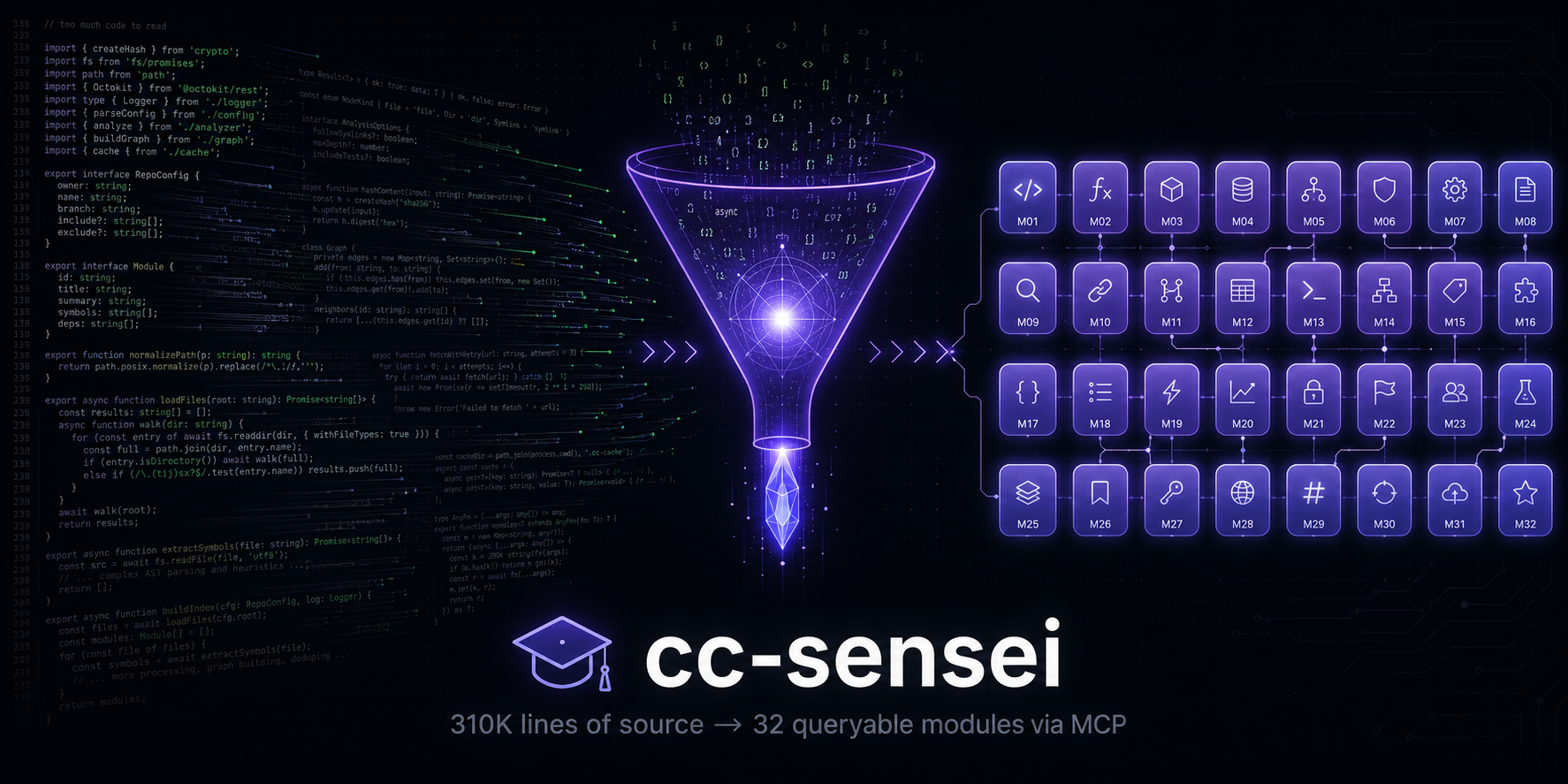
Agent Architecture Oracle distills Claude Code's 310K lines of source and 1,250 files into 32 core modules with 40K lines of structured analysis, and serves it directly to your AI through the MCP protocol.
It covers every core capability of Claude Code:
🔁 Agent main loop · 🛠️ Tool system & execution pipeline · 🛡️ Permissions & security sandbox · 🌊 Model API & streaming 🧠 Context engineering & compaction · 📂 File / Shell / Git tools · 🔌 MCP protocol · 🎨 Ink rendering engine · 🧩 Skills/plugins 💾 Persistent memory · ⚡ Prompt cache break detection · 🤖 Sub-agents & task system … (22 core + 10 deep-dive supplements)
It establishes a complete index pipeline: natural language → module → design decision → reusable pattern → corresponding source code:
After plugging it into Claude Desktop / Cursor / Qoder / your own Agent, your AI gains a "Chief Architect of Claude Code" as its consultant — whether you're cloning the whole thing or just stealing one design, it tells you exactly where to look, why it works, and how to copy it.
In one night, your AI becomes a world-class Agent architect.
🚀 Quick Start (3 steps)
Option A — Try instantly via npx (zero install)
This downloads and runs the server directly. Skip to Step 3 to connect your AI.
Option B — Clone for full control
Step 1 — Clone the project
Step 2 — Install and build
Copy-paste again:
💡 Don't have pnpm? Run
npm install -g pnpmfirst. 💡 This step parses 32 module analyses, generates the knowledge index, and compiles the server. One-time only.
When done, you should see: ✅ module-registry.json (32 modules) and ✅ Build success.
Step 3 — Connect your AI
Add this snippet to your MCP client's configuration file (replace the path with the one you just cloned to):
Don't know where the config file is? Common locations:
| Client | Config file path |
|---|---|
| Claude Desktop (macOS) | ~/Library/Application Support/Claude/claude_desktop_config.json |
| Claude Desktop (Windows) | %APPDATA%\Claude\claude_desktop_config.json |
| Cursor | Settings → MCP → Add new server |
| Qoder | Settings → MCP → Edit mcpServers |
Restart your client. Done! Your AI just gained 6 new skills.
🎯 Try it out
Just say to your AI:
"Use cc-sensei to tell me how Claude Code optimizes prompt cache."
It will call the tools on its own and return a complete analysis with source-code references. That's it.
Dive deeper
🛠️ What the 6 tools do
| Tool | One-line capability | When to use |
|---|---|---|
list_modules | List all 32 modules and their concerns | "Which modules does Claude Code break down into?" |
query_architecture | Natural-language search with 3 depth levels (brief/standard/deep) | "How do they prevent long-conversation context overflow?" |
get_module | Drill into one module's specific section (responsibility / architecture / decisions / principles / relations) | "Show me M06's design principles" |
trace_concern | Trace one concern across all 32 modules, ranked by hit count | "Which modules touch 'prompt cache'?" |
search_patterns | Bulk-extract reusable patterns with built-in size limiting | "Give me every cache-related design I can copy" |
get_source_code | Read Claude Code source directly (with line numbers, ranges, and directory listings) | "Show me services/api/claude.ts:1412-1456" |
Every tool comes with:
- ✅ Path-prefix tolerance — both
src/...and bare paths are accepted; no more copy-paste failures - ✅ Result rate-limiting — 800 chars per section and 12 sections by default, so your AI's context window stays alive
- ✅ Path-traversal protection — attacks like
../../../etc/passwdare rejected outright - ✅ Graceful degradation — bad arguments return friendly hints instead of crashes
🎬 Real scenario: "I want to add context compaction to my Agent"
A complete "understand → copy → ship" loop, averaging ~110ms.
📦 Knowledge scale
🏗️ Engineering philosophy
This project is dogfooding itself — built using the methods Claude Code teaches, made to serve Claude.
| Claude Code's design philosophy | How this project applies it |
|---|---|
| Build-time indexing + zero runtime analysis | Section line ranges, keywords, and concerns are all computed in pnpm build:index; runtime just looks up JSON |
| Path-traversal gatekeeping | validatePath runs before every file read |
| Graceful degradation > unhandled crashes | Section not found? Return the "available types" hint |
| Structured prompt-as-spec | All 32 MODULE_NOTES strictly follow a 10-section template |
| Rate-limiting by default | search_patterns defaults to 800 chars per section, 12 sections cap, configurable |
⚡ Performance
✅ Tests
| Test suite | Cases | Result |
|---|---|---|
| Baseline functionality (6 tools × multiple branches) | 30 | ✅ 30/30 |
| UX-fix regression | 11 | ✅ 11/11 |
| Real user-scenario E2E (3 personas) | 24 | ✅ 24/24 |
| Total | 65 | ✅ 65/65 |
📁 Project structure
Related MCP Servers
Adoption & maintenance
Factual signals from GitHub, npm, and our automated checks — not a rating.
GitHub stars
3
Stargazers on the source repository.
npm downloads
61
Package downloads in the last 30 days.
Last commit
2mo ago
Most recent push to the default branch.
Install check
Inconclusive
Started but did not complete the MCP handshake in our test.
Directory activity
2 views
Config copies, upvotes, and views on AllMCPs.
Reviews
No reviews yet — be the first to share how this listing worked for you.
Frequently Asked Questions about Cc Sensei
AllMCPs Directory Badge
Showcase your server listing on GitHub or your project documentation. Embed this dynamic SVG badge to highlight official listing status and live engagement.
Badge Style:
Live Dynamic SVG Preview
Markdown (GitHub README)
[](https://allmcps.com/mcp/contradictory-body-cc-sensei)HTML Embed
<a href="https://allmcps.com/mcp/contradictory-body-cc-sensei"><img src="https://allmcps.com/api/badge/contradictory-body-cc-sensei?style=directory" alt="Cc Sensei on AllMCPs" /></a>Technical Specs & Signals
CategoryKnowledge & Memory
PricingFree
10/10 checks healthy over the last 32d
52Quality signal: Good · 52/100How this signal is calculated ▾
Server availabilityNot measured
Not scored for repo-hosted servers — we can't reach the running server, only its GitHub page. Hosted MCP endpoints are health-checked live.
Verified ownership10/20
Documentation & tools24/30
Adoption & activity5/15
Community engagement0/10
A guidance signal from public completeness & health data — not a user rating. New listings start lower and rise as they add docs, get verified, and grow adoption. Signals we can't observe for a listing are skipped, not counted against it.
Supply-chain signal
No high-severity advisories surfaced by our automated scan.
Critical 0High 0Medium 0Low 0
Scanned 23d ago via OSV.dev · cc-sensei (npm)
Own this project?
This directory is pre-filled from public sources. Claim via GitHub README, site badge, or DNS TXT to unlock edit access and the Official badge — proof is checked automatically, then reviewed by our team.
Free dofollow backlink: add your website and place the AllMCPs badge on it — no claim needed. We detect it automatically and keep it verified as long as the badge stays live.
Claim & get free dofollowShare & Embed
Add our SVG badge (dark/light directory styles) or embeddable widget to your site.