
Understand unfamiliar code with evidence.
Read a Wiki of how a repository works, follow its call paths on a map,
and open the source behind every explanation.
Then give your coding agent the same index.
Browse a Wiki · Use with your agent · Thread context · Docs · Languages · Releases










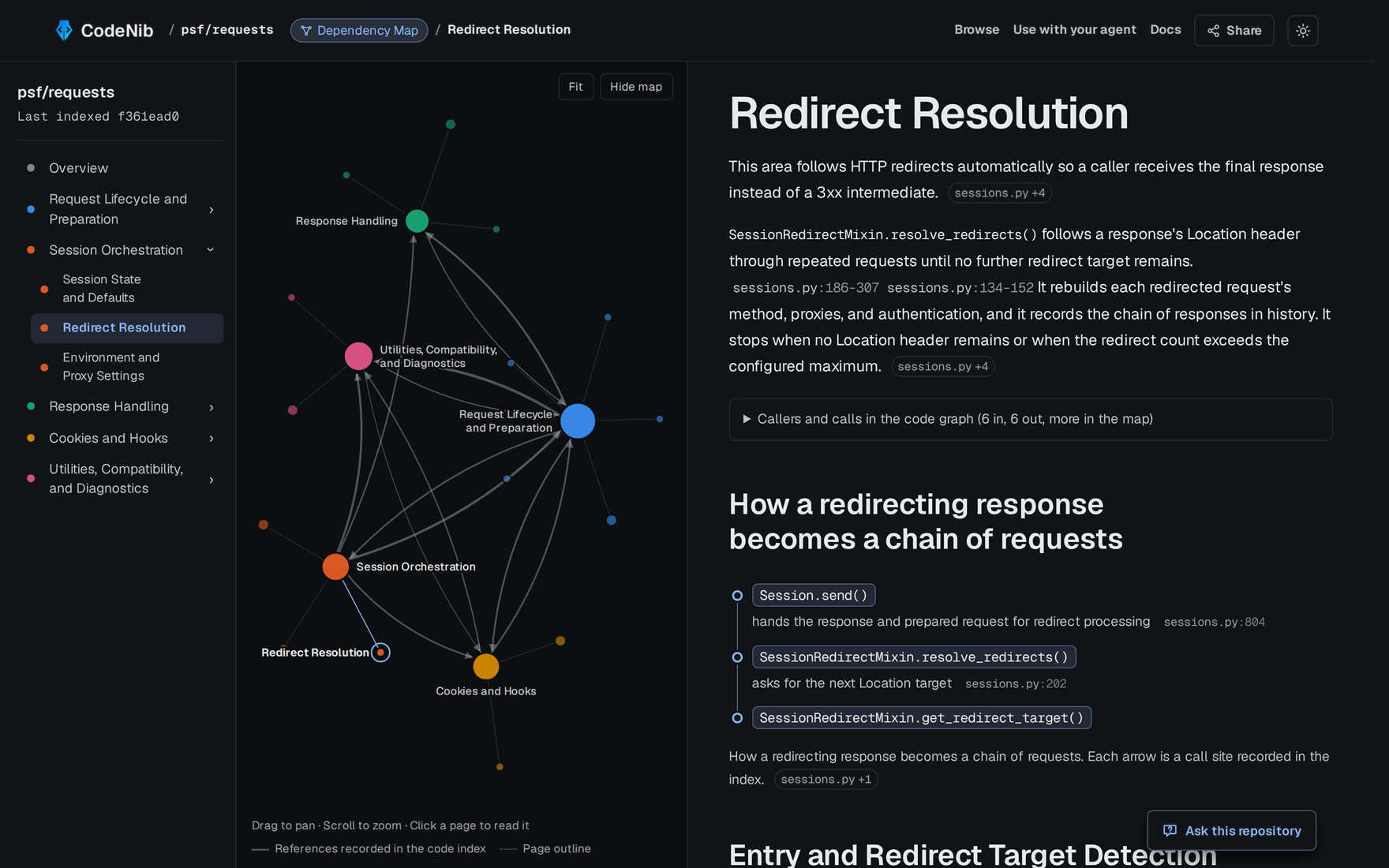
The Requests Wiki. Each node on the map is a page, and the heavy lines are references the code index recorded between areas. The page cites a file and line range for each claim.
New in 0.2.6: Wikis open as a map of their pages and lead with the main path
through the code, one GitHub Action publishes yours to GitHub Pages, plugins
connect Claude Code, Grok Build and DeepSeek Harness, graph builds get faster,
and first C/C++ and JavaScript/TypeScript builds leave the checkout alone. Two
previews serve coding agents: codenib guard lists the tests a change can
reach, and codenib threads hands your
agent a GitHub issue or pull request in one read.
Read the release notes.
A Wiki you can follow down to the source
CodeNib indexes a repository, groups its code into areas, and writes a Wiki page for each one. The map and the call paths come from the code index, so you can check every arrow against the source.
- Start from the map. Pages are nodes. Drag to pan, scroll to zoom, and click a node to read its page. Click a heavy line to read an example of the references behind it.
- Follow one path through the code. The Overview opens on the main path through the repository, one sentence per recorded call. The most important detail pages draw their longest recorded call path. No model chooses the arrows.
- Check each claim. Sentences end with the file and line range they come from, and each page lists its callers and calls in the code graph.
- Ask a follow-up. Ask this repository answers a question with source citations, using the model you configure.
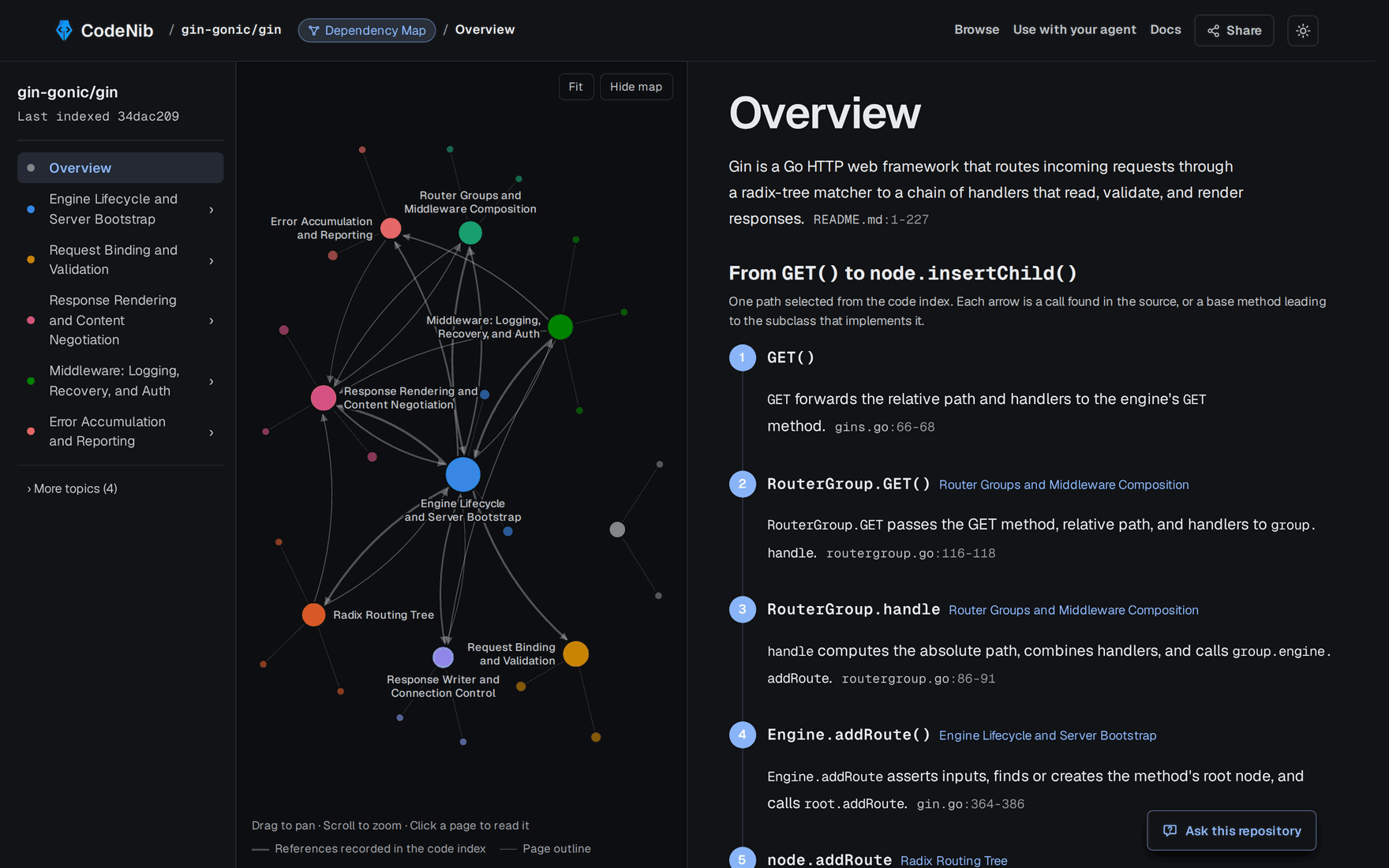
The gin Wiki opens on one
recorded path, from GET() to node.insertChild().
Open a Wiki
| To | Do this |
|---|---|
| Read one now | Open a ready Wiki for requests, scikit-learn, sympy, fmt, redis, caddy, gin, hugo and more. No account or API key. |
| Map a public GitHub repository | Paste its URL on demo.codenib.ai, or replace github.com with demo.codenib.ai in the URL. A new Wiki uses your OpenRouter account, with a $0.25–$5 spending limit you set before it starts. |
| Map your own checkout | Run the Wiki locally, as below. |
| Share it | Publish the Wiki, with its source citations, to GitHub Pages: add the CodeNib Wiki action to a workflow. Pages guide |
To build a Wiki with the map on your machine:
python -m pip install "codenib[graph]"
codenib wiki /path/to/your/repo --preset graph
This builds a search index and a symbol graph, then opens the Wiki at
http://localhost:3000. Pages are written from the index without a model.
Add --generate --model <provider/model> for model-written pages.
Local Wiki guide
Use it with your coding agent
Build the same index for Claude Code or Codex. Your agent can then find definitions, follow callers and read the source in your own checkout.

One recorded Claude Code session on Requests. Asked where Requests strips
authentication on a redirect to another host, and which public methods reach
that code, the agent found rebuild_auth() with explore_context. One
dependency_subgraph call then returned the path above, each step with its
file and line. The session took 14.1 s, 3 turns and 2 CodeNib tool calls.
▶ Watch it replay
· Pinned source, transcript and setup details
Requires Python 3.10+, Git, and Claude Code or Codex. Initialization accepts uncommitted edits and preserves the checkout.
python -m pip install "codenib[graph,mcp]"
codenib codegraph init /path/to/your/repo
Then ask your agent: “Use CodeNib's explore_context to find where request
retry behavior is implemented. Cite the files and lines.”
This builds local search and a typed symbol graph, then connects installed agent clients. CodeNib needs no model, API key, or GPU of its own; your agent uses its own model. Language toolchain and project prerequisites vary.
In Claude Code you can install the plugin instead. It connects every Git
checkout you open and adds /codenib:explain, /codenib:impact,
/codenib:thread, /codenib:setup and /codenib:wiki:
claude plugin marketplace add sysevol-ai/CodeNib
claude plugin install codenib@codenib
Codex and Grok Build install the same plugin, and DeepSeek Harness installs it as a bundle:
codex plugin marketplace add sysevol-ai/CodeNib --sparse .claude-plugin --sparse plugins/codenib
codex plugin add codenib@codenib
grok plugin install "sysevol-ai/CodeNib#plugins/codenib"
dsh plugin --profile web add "git+https://github.com/sysevol-ai/CodeNib.git#main&path:/plugins/dsh"
Codex setup · Grok Build setup · DeepSeek Harness setup
Setup and troubleshooting · Source exclusions · All MCP tools · Change guard (preview, Python: lists the tests a change reaches before your agent finishes)
Hand your agent the whole thread
codenib threads reads a GitHub issue or pull request once and writes one
document for your agent: the ask, the review comments, the failing checks, the
linked threads, and the code they point at. It runs on your machine and calls
no model. It is a preview in 0.2.6.

Each dot is the change in input tokens over all the tasks when the agent is
handed the prepared context, against reading the thread itself with gh, and
each line is its 95% interval. An agent that reads a thread itself makes one
call per piece, and every call sends the conversation so far again; the
prepared document is read once. The agents found the files to change about as
often either way: 0.75 against 0.74 and 0.85 against 0.82 with Codex, 0.80
against 0.83 with Claude Code.
cd /path/to/your/repo
codenib threads context 812     # write THREAD_CONTEXT.md before the agent starts
codenib threads open 812        # or start a ticket that remembers what it read
codenib threads inbox 812       # later: only what is new
codenib threads board           # all tickets, and other work on the same code
When several agents work on one repository, each ticket is sent only the records it has not read, and tickets whose work reaches the same function are told about each other.
Thread context guide
· How it decides what to include, with real output
· In Claude Code and Grok Build, the plugin adds it as /codenib:thread.
How it compares
What an agent can ask each tool. Peer interfaces were checked against upstream docs on 2026-09-28. This compares capabilities, not benchmark scores.
| Tool | Ask in plain language | Relationships beyond one hop | Relationships resolved by | Runs |
|---|---|---|---|---|
| grep / read | No; literal or regex | No | Text match | Local |
| CodeNib CodeGraph | Yes; ranked source anchors (explore_context) | Incoming/outgoing static references; one dependency_subgraph call, depth ≤ 8 | SCIP/LSP indexers (compiler-resolved) | Local |
| Serena | No; symbol name or regex | One level per call (find_referencing_symbols) | Live language server or IDE | Local |
| CodeGraph (colbymchenry) | Yes; FTS5 full-text (codegraph_explore) | Yes; call paths in codegraph_explore | Tree-sitter AST extraction | Local; telemetry opt-out |
| DeepWiki public MCP | Yes; generated answers (ask_question) | No structured graph tools | Generated Wiki | Hosted |
CodeNib's indexed references can include calls, fields, type uses and function values. Inspect the source to establish which references invoke a function; external and dynamic relationships may be missing. For a known string or file, your agent's native search and reads remain useful. Include indexing and rebuild costs when assessing graph navigation on your own tasks.
None of these repository tools needs its own model or API key; your agent uses its own model. Detailed comparison, sources and boundaries. CodeNib also includes an optional grep → Jev route using OpenRouter for planning and reranking; selected code goes to remote models. Authorization previews remain opt-in.
Languages
CodeNib registers 14 languages, 12 of them with a code graph.
| Support | Languages |
|---|---|
| Code graph with an incremental backend (LSP or clangd) | Python, Go, Rust, C/C++, JavaScript, TypeScript |
| Code graph | C#, Java, Ruby, PHP, Kotlin, Scala |
| Search only, no definitions or callers | Swift, Lua |
These are registered capabilities, not the tools on your machine;
codenib toolchain status shows those. The product currently reuses or
rebuilds views; file-level delta repair is not enabled. The
language matrix lists each
backend and its prerequisites.
Results and reproductions
- #1 in line recall and Pass@1 on ContextBench's Agent systems leaderboard: 77.90% line recall and 388 of 500 tasks resolved (77.60% Pass@1), as of October 23, 2026 (UTC). This is our research agent, not the Wiki or the code graph: two Claude Haiku 5.5 workers search with glob, grep and reads, then Claude Opus 5.5 repairs. How it works · Scope and evidence
- 71.4% code-block Recall@5 on 100 real issues with model-planned grep → Jev, 12.8 percentage points above the same grep candidates without reranking. This is an experimental retrieval route, separate from the model-free CodeGraph. Method and limitations
| Start here | What you can inspect |
|---|---|
| Context methods and support matrix | Every retrieval pipeline, LLM workflow and agent route, sorted by the views it reads and who controls the search |
| Benchmarks | Localization, agent-context and resolution layers, evidence levels, and the method × benchmark matrix over CodeNib Base/Synthesis, SWE-bench Lite, Loc-Bench, SWE-Explore, Agent Retrieval Bench and ContextBench |
| Agent integration matrix | Revision-pinned LocAgent, Agentless, CoSIL, OrcaLoca and RepoNavigator contracts; compatibility does not imply reproduced paper scores |
| SWE-Explore validation | 1,020/1,020 real-output metric cells match the pinned official evaluator on a fixed 20-case run |
| DGX Spark deployment | Local Wiki, CodeGraph and model serving on GB10; a deployment guide, not a token-saving benchmark |
Documentation and community
Documentation · Architecture · Contributing · CI and testing · Changelog · Discord
CodeNib is in beta; public interfaces may change before a stable release. Historical research artifacts retain their published dataset identifiers.
Citation
If you use CodeNib in your research, please cite our arXiv paper:
@misc{yu2026codenibmultiviewdataserving,
      title={CodeNib: A Multi-View Data System for Serving Repository Context to Coding Agents},
      author={Zhongming Yu and Hengjia Yu and Boqin Yuan and Shuting Zhao and Yizhao Chen and Aryan Dokania and Mihir Jagtap and Jiayu Chang and Yitong Ma and Yash Jayswal and Wentao Ni and Hejia Zhang and Zhaoling Chen and Gangda Deng and Jishen Zhao},
      year={2026},
      eprint={2607.25431},
      archivePrefix={arXiv},
      primaryClass={cs.SE},
      url={https://arxiv.org/abs/2607.25431},
}
CodeNib is licensed under Apache 2.0.