Web pages into decision-ready state: dates, numbers with units, budgeted chunks. No model, no key.
Quick Install
Automated & IDE SetupCopy the AI prompt to install this server into Claude Code, Cursor, or another agent — or use 1-click editor setup below.
One-click editor setup isn’t available for this listing yet — we don’t have a confirmed install command, and we’d rather show nothing than point your editor at the wrong package or host. Follow the project’s own setup instructions, linked above.
Manual Client & Custom JSON ConfigExpand JSON ▾
No confirmed setup config for this listing yet. We only publish a config block when the install details come from the project itself — its README, its docs, or a verified owner. We haven’t found those for codearia-sieve, and we’d rather show nothing than a guess you’d paste into your client. Follow the project’s own setup instructions for the current steps.
Documentation Overview
codearia-sieve
Parses a web page into the exact format a decision model needs.
Dates as dates. Numbers with units. Text in chunks that fit the model's window, each pointing back to where it came from.
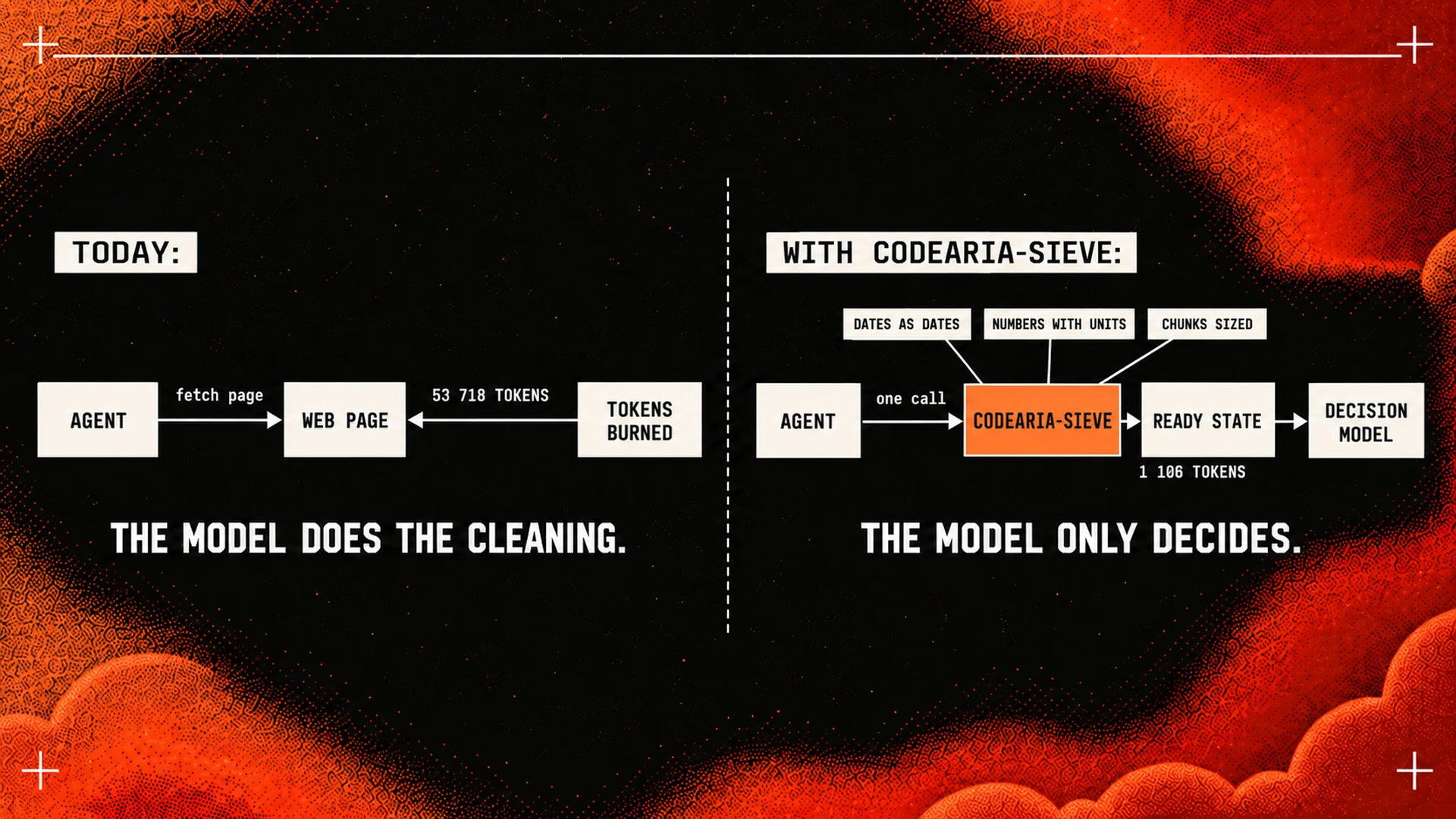
One call — and the token bill, before and after.








Measured, not promised. A live run over random pages picked the same day — fresh news from RSS feeds in several languages, random Wikipedia articles, docs, blogs, government sites, recipes, shops. Every row is in bench/analytics/, and npm run analytics reruns the whole thing. The output was then put in front of a decision model: see Checked by a judge.
What it does
An agent that needs a web page fetches the whole thing: navigation, cookie banner, footer, ad slots, a megabyte of framework markup. Then a model paid per token digs through the pile for one paragraph.
codearia-sieve does the digging before the model sees anything — and returns the page as state, not prose:
|
Dates become dates
|
Numbers become facts
|
Text becomes chunks that fit Each chunk knows its size in tokens and characters, the blocks it was built from, and the |
Everything else — menus, footers, banners, tag rows, "read more" — is removed, and with trace: true you get the list of what was removed and why.
Who it is for
People who build agents and have seen the bill. Every fetched page costs tens of thousands of tokens before the agent has read a word of it. Median page in the sample: 53 718 tokens in, 1 106 out.
People who run cheap decision models. Classifiers, rankers, System One models like Jev that judge instead of write. They are nearly free and very fast, and they have hard edges: they cannot count, they read dates as text, and their accuracy drops as irrelevant material fills the context. Every "page to markdown" tool prepares input for a reader. This one prepares input for a judge.
People who need answers they can check. A verdict from scraped text is unprovable unless each piece points back to its source. Here every fact names its block and every chunk carries an anchor.
How it works
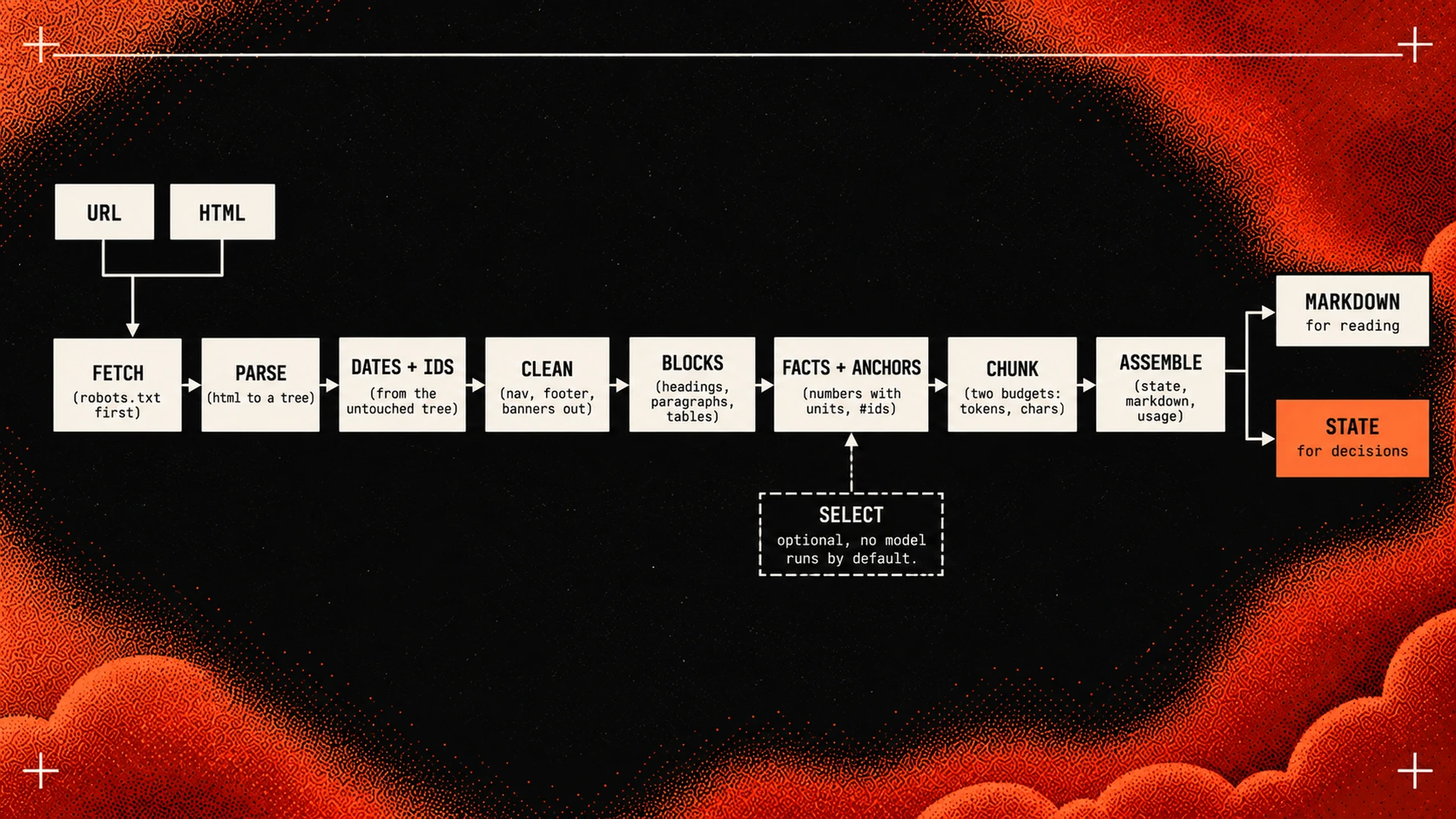
Eight steps of ordinary code. No model runs unless you plug one in. The same HTML gives the same JSON, byte for byte.
- Fetch —
robots.txtfirst; a refusal is reported, not bypassed. Plain HTTP, honest user agent. - Parse — HTML into a DOM with
linkedom. No browser. - Dates and ids from the untouched tree — cleaning strips
<head>, bylines and attributes, so both are read before it runs. - Clean — Defuddle removes chrome; Readability takes over if it comes back empty. Inline elements get a space first, so
<span>20 Sept</span><span>10 min</span>never becomes202610 min. - Blocks — headings, paragraphs, lists, tables, code, quotes, in order, with positional ids. Old pages set with
<br><br>become paragraphs too; table rows keep their column headers. - Facts and anchors — ids restored; numbers become facts only beside a unit; ranges keep both ends.
- Chunk — greedy, in order, under two budgets at once: 20 000 tokens and 50 000 characters by default.
- Assemble —
state,markdown,usage,warnings, and the trace on request.
What the result looks like
Expected outcomes never throw. They come back as warnings, each named:
| Warning | Meaning |
|---|---|
robots-disallowed | the site asks crawlers to stay out; we did not fetch |
blocked | a bot challenge or a refusal (403, 405, 429, "Just a moment…"), with the status |
http-error | a 404 or a 500 that still rendered an error page; not the page you asked for |
paywall | the page marks its article as not free; you got the teaser |
empty-without-js | the article container is empty and a script would fill it |
thin-content | a big page that yielded little prose — a front page, a listing |
block-split | one block exceeded the budget and was cut on sentence boundaries |
facts-capped | the page has more facts than the 500 listed — a long fee schedule, say |
Use it from an agent
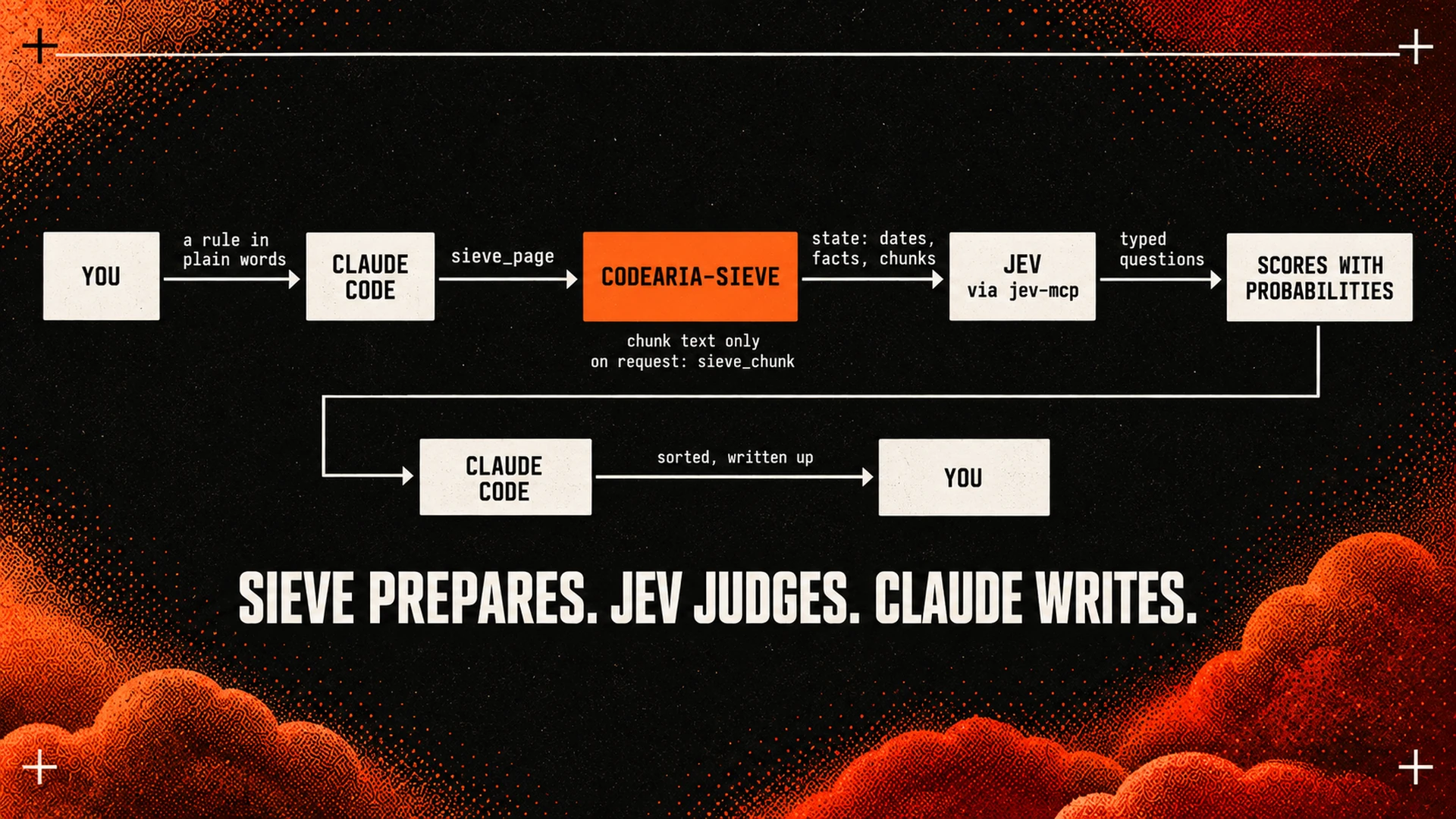
You say what you want in plain words. The agent finds the pages, calls sieve_page for each, hands the state to a decision model with a typed question, and writes up the result. Sieve prepares. The judge judges. The agent writes.
Listed in the official MCP Registry as io.github.AntonG87/codearia-sieve; clients that read the registry can install it by name.
|
Returns typed |
The text of one chunk from the last result for that URL, no refetch. Overview first, then only what is needed — the tool applies its own idea to itself. |
Pairs with jev-mcp: chunks are sized to fit its fields, so state goes straight into a typed question.
Checked by a judge
The claim is that a decision model gets better input from Sieve than from raw text. So the output was handed to one. examples/jev.ts drives both MCP servers with the official client — codearia-sieve prepares six pages (API docs, a release note, two Wikipedia articles in two languages, two pricing pages), Jev judges them through jev-mcp. Same run, 21 September 2026:
Related MCP Servers
Reviews
No reviews yet — be the first to share how this listing worked for you.
Frequently Asked Questions about Codearia Sieve
AllMCPs Directory Badge
Showcase your server listing on GitHub or your project documentation. Embed this dynamic SVG badge to highlight official listing status and live engagement.
Badge Style:
Live Dynamic SVG Preview
Markdown (GitHub README)
[](https://allmcps.com/mcp/codearia-sieve)HTML Embed
<a href="https://allmcps.com/mcp/codearia-sieve"><img src="https://allmcps.com/api/badge/codearia-sieve?style=directory" alt="Codearia Sieve on AllMCPs" /></a>