Cloudeval AI README
The full upstream README, mirrored here for reference. Install config, tool schemas, adoption signals, and an original overview live on the Cloudeval AI listing page.

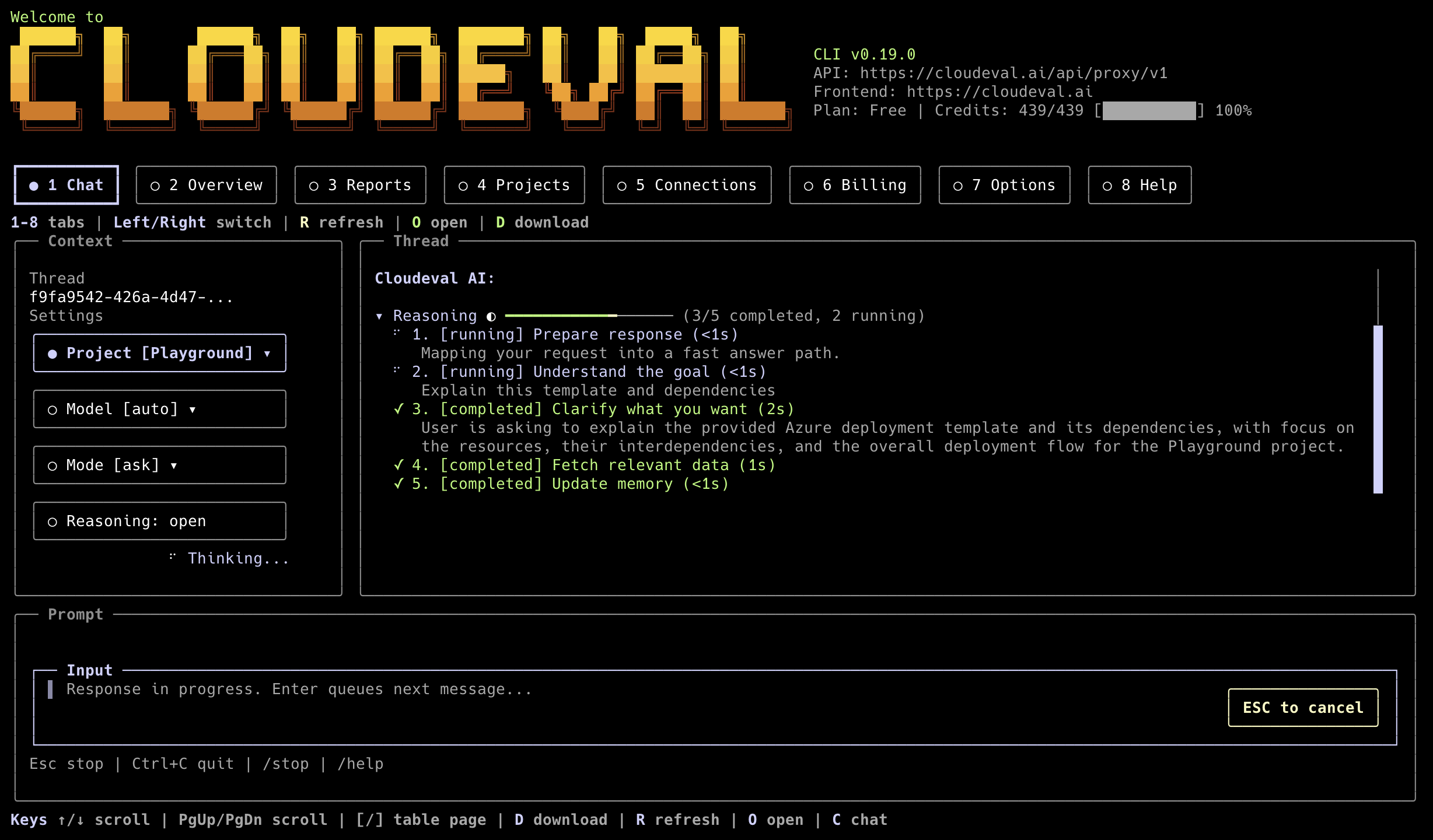
Cloudeval CLI
Your cloud, in the terminal: evaluated, reported, and agent-ready.










Cloudeval CLI turns ARM templates, GitHub-hosted IaC, and live Azure context into cost, architecture, and Well-Architected signals. Use it as a terminal UI, a scriptable automation client, or an MCP server for Codex, Cursor, Claude, VS Code, and any stdio JSON-RPC client.
Why Use It
| For | What you get |
|---|---|
| Terminal users | A full TUI with chat, Agent mode, workspace tabs, thread switching, slash commands, a context rail, task ledger, artifact chips, and local SQLite session history. |
| Automation | Stable json, ndjson, markdown, and text output; payloads on stdout; progress and prompts on stderr; predictable exit codes. |
| Agents and CI | Scoped access-key credentials, redacted output by default, MCP toolsets, recipes, and machine-readable capability metadata. |
Install
Node.js 20+ users can install from npm:
macOS, Linux, WSL2, Git Bash, and PowerShell 7+ on Windows or Linux can use the standalone release installer:
Then reload your shell and sign in:
Device login goes through cloudeval.ai and always asks the browser auth provider to show the account chooser, so users can choose the intended work email even when another account is already signed in. No local Azure app registration is needed for normal CLI use.
Installer behavior and controls
The installer:
- downloads checksum-verified GitHub release assets and installs
cloudeval; - creates the
evaandcloudaliases on non-Windows platforms; - can install shell completions for bash, zsh, and fish;
- can offer concise MCP setup for detected Codex, Claude Desktop, Cursor, and VS Code clients, skipping clients where Cloudeval MCP is already configured and avoiding prompts when only manual-only setup remains;
- asks whether to share limited CLI telemetry, defaulting to yes; declining writes
telemetry.enabled=false; - explains credential setup but does not create access keys or write secrets into MCP client config;
- shows compact labeled progress bars in interactive terminals;
- uses connect/stall timeouts so slow CDN transfers fail clearly.
Useful controls:
The bash installer can also detect agent clients and offer MCP setup. The
PowerShell installer installs the verified binary, yoga.wasm, license
notices, PATH, and optional PowerShell tab completions. Run cloudeval mcp setup afterward when you want MCP client configuration.
Telemetry
Cloudeval CLI sends curated custom events to Azure Application Insights by default. Events cover command family, success, duration, safe option enums, CLI version, Node/runtime version, OS major version, architecture, install source, update/install outcomes, MCP tool names, and TUI launch/exit metadata. After login, events may include the signed-in email and first/last/full name.
Telemetry never sends raw prompts, command output, tokens, local paths, project or resource identifiers, account/session/tenant identifiers, cloud resource names, stack traces, or raw error messages. Disable or re-enable it anytime:
Environment overrides take precedence for a single run:
Update later with:
After an update, restart or reload configured MCP clients when you are ready to load newly exposed Cloudeval tools, resources, or prompts. Cloudeval does not restart Codex, Claude, Cursor, VS Code, or other MCP hosts automatically.
Uninstall local installer-owned artifacts while keeping Cloudeval config, sessions, and auth by default:
Start Here
Full docs: Get started with the CLI and CLI command reference.
Inside the Terminal UI, use the Thread control or /thread to switch open chat
sessions, recent Cloudeval chat threads, and local CLI sessions. /thread new
starts another independent open session, and /open jumps to the same chat
thread in Cloudeval when the active session has a thread id. Roomy terminals show
a context rail with project, thread, model, mode, profile, report artifact
chips; narrower terminals keep the
chat first and expose the same controls through the composer and slash commands.
Typing / opens a bottom command completion strip; use Tab or Up/Down to move,
Right to accept the ghost text, and Enter to choose the highlighted command.
Streaming work appears as a task ledger in the thread, and the bottom composer
stays docked so prompt entry does not compete with the transcript. Grounded
answers show numbered citations and a Sources section instead of raw
[S_tool_...] tags, with citation numbers highlighted inline; /copy copies
the latest assistant response and /download writes a Markdown transcript with
the same references. Graph insight blocks render as bordered terminal cards
instead of exposing raw graph-insight markers; when a card contains a
conservative Mermaid flowchart, --graph-diagram auto renders a terminal
diagram in roomy TTYs, unicode or ascii force a mode, and off keeps the
Mermaid source fallback. Unsupported Mermaid syntax stays visible as source
instead of breaking the transcript. Negotiated chat visualizations render
directly in the TUI:
line/area trends use Unicode plots; bar, column, histogram, pie, doughnut,
radar, and polar data use width-aware bars; scatter and heatmap data use compact
terminal grids; unsupported chart families use the artifact's table fallback.
Mermaid flow edges render as an edge list, with bounded Mermaid source as the
fallback when no edges can be extracted. HITL approval prompts require an
explicit option selection or typed answer; pressing Enter on a blank approval
prompt does not choose the recommended option. Project and Connection tabs show
a selected-item detail pane for backend fields, report coverage, sync state, and
linked records; use J/K or Up/Down on Projects and Connections to move the
selected row, then Enter to confirm it. The billing header separates credits left from observed
credits used so usage does not look like the current budget. Use the Profile
control or /profile cost to run the current prompt with an Agent Profile;
selecting a profile switches the TUI to Agent mode, and selecting Ask mode
clears the profile back to the default chat flow. Starter prompts stay hidden
until you run /starter. Press Esc from the prompt to leave text editing so
tab, arrow, and number shortcuts move through controls and tabs; type again to
resume editing. Busy loaders and the input cursor can be disabled with
--no-anim. The banner details
include the logged-in user. Focused controls and the active top tab use the
shared warm banner-yellow accent, with the active tab filled across its full
button interior.
The CLI advertises cloudeval.visualization/v1, flint-v1, and
mermaid-v11 capabilities on chat requests. The backend compiles chart intent;
the CLI validates the bounded artifact and renders terminal-safe output without
a browser or native SVG helper. ask and agent JSON results include
data.visualizations when present, and NDJSON emits a visualization event as
well as including the artifacts in the final result. Final JSON/NDJSON responses,
Markdown output, and local conversation history retain validated artifact fences
even when streamed prose omits or corrupts the chart payload. Text output remains
the live prose stream. See the
visualization artifact contract.
Core Workflows
| Goal | Terminal UI | Script or CI | MCP |
|---|---|---|---|
| Grounded cloud chat | cloudeval or cloudeval chat | cloudeval ask "..." --format json | ask |
| Deeper analysis | Agent mode in the TUI | cloudeval agent "..." --format json | planner-style tool flows |
| Agent Profiles | TUI Profile control and Chat picker | cloudeval agents list/show/run | agent_profiles_* tools |
| Reusable workflow | prompt suggestions | cloudeval recipes list/show/run | recipes_* tools |
| Projects and reports | workspace panels | projects, reports, open | projects_*, reports_* |
| Issues | /app/issues | issues list/get/open | n/a (use CLI; MCP has report/deeplink tools) |
| Graph intelligence | project graph views | projects graph ... | projects_graph_* tools |
| Template validation | n/a | validate, rules | template_*, rules_* |
| Billing | billing panel and links | billing, credits | billing_* toolset |
| Automation discovery | n/a | capabilities --format json | capabilities_get |
Agent Profile ids include architecture, cost, triage, remediation,
visual-explainer, scripter, change-reviewer, evidence-auditor, and
security-reviewer. Display names may contain spaces. The Architecture profile
includes the Well-Architected review lens, so there is no separate Well-Architected
Agent Profile. When agents run omits a prompt, the CLI uses a starter prompt for
the selected project source and profile mode: template or live sync, ask or
agent. The choice is deterministic for automation. Profile runs send only
agent_profile_id; Cloudeval applies profile instructions, planning lens, and
response defaults on the backend. agents list and agents show first try the
backend profile catalog; if the profile catalog endpoint requires sign-in or is
not available, they fall back to the bundled public catalog so discovery still
works. agents run still requires authenticated backend access. In the TUI,
the Profile selector uses the same canonical IDs and sends the selected
agent_profile_id with chat streams.
Run cloudeval <command> --help for exact flags.
Access Keys For CI And Agents
Use cloudeval login for humans. The browser approval page requests an
account chooser on every login. Use scoped access keys for CI, hosted agents,
and long-running automation.
Stored device-login sessions refresh automatically before authenticated
requests. If the TUI or cloudeval ask receives an expired-token response from
the chat stream, the CLI refreshes the stored session and retries that request
once. If the refresh token is revoked or expired, run cloudeval login again.
Create an access key after login and project selection:
--format github-actions prints CLOUDEVAL_ACCESS_KEY and CLOUDEVAL_PROJECT_ID once. The raw key is not shown again by credentials list or credentials inspect.
Test a scoped access key without putting it in shell history:
Credential rules:
- prefer
--access-key-stdinorCLOUDEVAL_ACCESS_KEY; --access-keyis accepted but warns because process arguments and shell history can leak;- old beta names
--api-key,--api-key-stdin, andCLOUDEVAL_API_KEYfail with a migration error; - access-key-shaped strings, authorization headers, and sensitive URL query parameters are redacted by default;
- credential create output files are written with private permissions on POSIX systems.
MCP For Coding Agents
Start MCP after signing in, or provide a scoped CLOUDEVAL_ACCESS_KEY in the host environment:
Client setup examples:
MCP rules:
- tool names use underscores such as
projects_list,recipes_list, andbilling_summary; - dotted tool names remain compatibility aliases;
- stdout is JSON-RPC only and
[cloudeval-mcp]diagnostics go to stderr; - MCP tool schemas do not accept per-call access-key arguments;
mcp servedoes not support--access-key-stdinbecause stdin is the protocol stream.readonlyincludes safe inspection tools for projects, reports, billing, connections, credentials, config, models, sessions, auth, status, doctor, and recipes; generation, downloads, checkouts, credential mutation, browser opens, and diagram file writes stay explicit.
For billing inspection, use billing_ledger for individual usage attempts and
credit charges, billing_usage for aggregates, and billing_summary for current
entitlement. Ledger filters default to 30 calendar days; startAt and endAt
override their corresponding range bounds. Pass data.next_cursor back as
cursor with the same filters while data.has_more is true. Ledger page size
defaults to 25 and is clamped to 1–100.
billing_invoices returns subscription invoices, paid top-up history and
billing-cycle status. Fetching this data can create missing provider invoice
records for already-paid top-ups and persist receipt links. It therefore
requires explicit --toolset billing or --toolset all selection and is
excluded from readonly. Its result limit defaults to 25, is clamped to 1–50
per collection, and has no pagination cursor. These tools require billing read
access through the server's configured credential; they do not initiate a
purchase or change the subscription.
Developer setup details: cli.cloudeval.ai/developer/.
Recipes And Skills
Cloudeval recipes are reusable workflows for agents and humans. Current recipes cover cost review, WAF triage, architecture review, template project review, report summaries, report generation planning, report export packs, billing review, top-up readiness, project inventory and healthchecks, connection audit, credential setup and rotation, model selection, session recovery, CLI onboarding checks, frontend workspace links, architecture/dependency diagram exports, and MCP setup.
Ask/agent-backed recipes may consume model credits. Recipes that would create projects, write report or diagram files, change MCP config, mutate credentials, open browsers, or start checkout flows print explicit commands instead of performing those side effects implicitly. Portable agent instructions live under skills/; MCP remains the preferred execution path for Codex, Cursor, Claude, and other agents.
Project Example
Use --template-url when you do not want a local file. Follow with reports run, reports download, and projects export-diagram as needed.
Output, Auth, And Privacy
Output contract:
cloudeval loginopens or prints acloudeval.ai/device/loginapproval URL with an account chooser hint for the web auth provider;- machine-readable commands write payloads to stdout;
- prompts, progress, browser-open messages, and warnings go to stderr;
askandagentsupport--progress none,--quiet, or--format ndjson --progress ndjson;validate templateandvalidate testssupport--progress stderror--progress ndjsonwith--wait; validation progress always goes to stderr so final JSON/NDJSON remains parseable on stdout. Completed progress includes failing check/test details such as message, recommendation, severity, and file/template or resource location when available. If a completed backend result only has a worker-local temp file path, Cloudeval reports the submitted template filename instead;- with
--non-interactive, human approval exits with code6and returnsHITL_REQUIRED; - interactive HITL prompts require an explicit option number, yes/no-style answer, or typed response; blank Enter does not approve the recommended option;
--show-sensitive-idsshows full account/session-style IDs only on trusted machines. It does not unredact tokens.
Docs
| Link | Purpose |
|---|---|
| Get started with the CLI | Install, login, create a project, and ask a grounded question |
| CLI command reference | Full command and flag list |
| Terminal UI | TUI navigation and keyboard model |
| MCP client setup | Codex, Cursor, Claude, VS Code, and generic MCP hosts |
| Agent behavior and automation safety | Safe automation conventions |
| Troubleshooting | Sign-in, onboarding, reports, and billing |
Build From Source
Read AGENTS.md before touching auth, credentials, smoke artifacts, or user-facing command behavior.
Build a standalone binary for the current OS:
Run checks:
Community
License
Cloudeval CLI is proprietary software provided under the Cloudeval CLI License.
Production third-party package attribution is tracked in
THIRD_PARTY_NOTICES.md, with a release SBOM in
sbom.spdx.json. Published installer releases also download
these notice files under ~/.local/share/cloudeval/licenses. The release
policy is documented in License compliance.