C
Claw Orchestrator
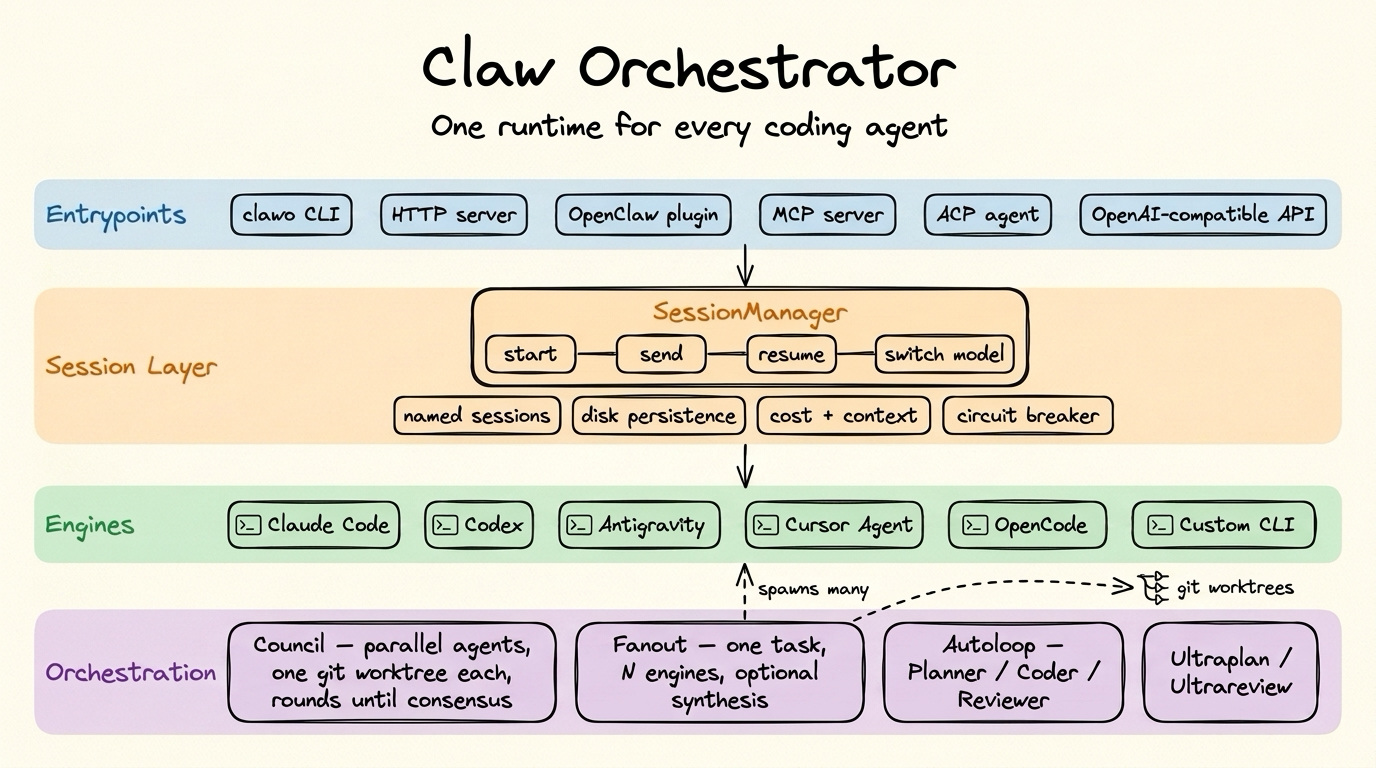
Run Claude Code, Codex, Antigravity, Grok Build and OpenCode behind one runtime, and a run only counts as done when checks it didn't write pass. Cross-engine fan-out, councils, session handoff, spend caps, MCP server, ACP agent.
Install Claw Orchestrator
Pick your client, then add it in one click or paste the config.
No confirmed install command yet
We only publish a config when the install details come from the project itself — its README, its docs, or a verified owner. We haven’t found those for claw-orchestrator, and we’d rather show nothing than a guess you’d paste into your client.
Open setup steps on GitHubOverview
From the project README
Claw Orchestrator
Run Claude Code, Codex, Antigravity, Grok Build and OpenCode behind one runtime, and a run only counts as done when checks it didn't write pass.




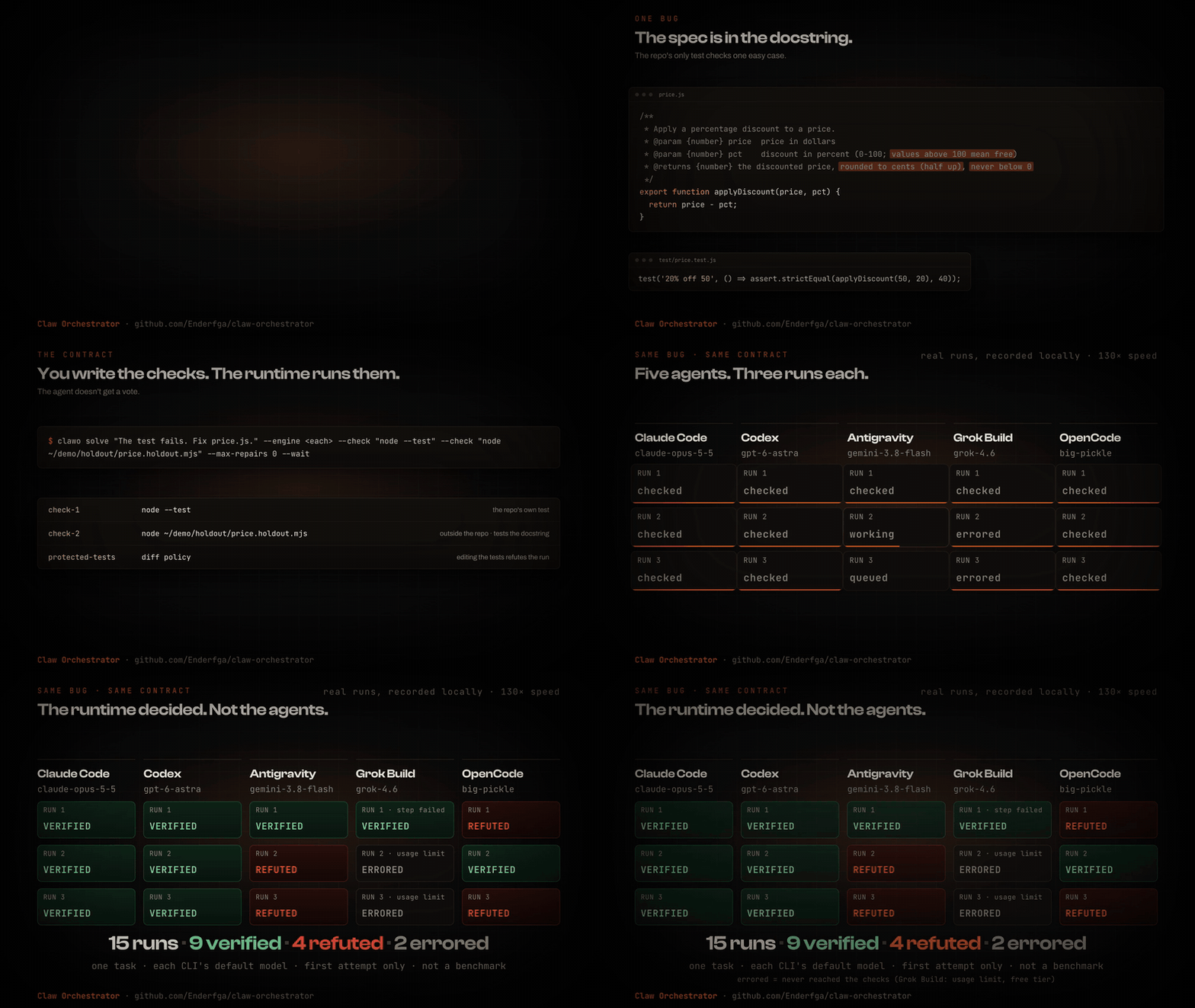
One bug, one acceptance contract, five engines, three runs each, first attempt only. The runtime ran the checks itself: 9 verified, 4 refuted, 2 errored (Grok Build hit its free-tier usage limit). One task, not a benchmark. Real runs, recorded locally — how the film was made, and how to re-run it.
▶ The 40-second film, with sound
https://github.com/user-attachments/assets/5bf9bea8-e5ac-4632-a292-a80a45831dff
Coding agents grade their own work: "All tests pass ✓". Claw Orchestrator runs them as persistent sessions behind one API and keeps the verdict out of their hands. You declare the checks, the runtime executes them and reads the exit codes, and the evidence stays on disk.
npm install -g @enderfga/claw-orchestrator
clawo serve &    # local runtime + dashboard on 127.0.0.1:18796

clawo solve "The test fails. Fix price.js." --engine codex \
  --check "npm test" --check "node ../holdout/price.spec.mjs" --wait
clawo verify <runId>    # each check, why it failed, the files that changed
clawo runs --since 1h   # every turn on every engine: model, tokens, cost, verdict
What you get
| You want to… | Claw Orchestrator gives you |
|---|---|
| Stop trusting "All tests pass ✓" | Acceptance contracts — commands, HTTP probes, screenshots, diff policy, file assertions — that the runtime runs itself. A run with a contract ends verified, refuted or unverified, never "the agent said so". Editing the tests a contract runs refutes the run. → verification |
| Use more than one vendor | Persistent sessions for Claude Code, Codex, Antigravity, Grok Build, OpenCode and custom CLIs behind one interface. clawo fanout asks several of them the same question at once. → multi-engine |
| Switch engines mid-task | session_handoff replays a live conversation onto another engine in the same workspace. → sessions |
| Know what it cost | A durable per-turn ledger across engines (clawo runs) and a maxBudgetUsd cap the runtime enforces on every engine. → observability |
| Runs that survive a crash | Durable workflows: every transition is checkpointed; resume, retry, timeout, cancel and steer come from the kernel. → workflow |
| Call it from your own tools | An MCP server (clawo-mcp), an ACP agent (clawo acp) for Zed, JetBrains and other ACP editors, an OpenAI-compatible endpoint, a TypeScript SDK, and the CLI. → integrations |
How it relates to other tools. claude-squad, Conductor and Vibe Kanban are interfaces for running agents side by side in worktrees; Claude Code subagents and Codex's parallel attempts stay within one vendor. Claw Orchestrator is a headless runtime: several vendors behind one API, durable workflows, and a verification step the agents cannot edit. They can be used together.
Quick Start
Requires Node 22+ and at least one engine CLI installed and logged in (claude, codex, agy, grok or opencode).
npm install -g @enderfga/claw-orchestrator
clawo serve   # dashboard at http://127.0.0.1:18796/dash
The server writes an access token to ~/.openclaw/server-token; the CLI reads it from there. Open http://127.0.0.1:18796/login?token=<token>&redirect=/dash once to sign in the browser.
From a terminal:
clawo solve "Fix the failing tests" --engine claude --check "npm test" --wait
clawo fanout "How would you speed up this test suite?" --engines claude,codex,grok --synthesize --wait
clawo workflow list
From Claude Code, or any MCP host:
claude mcp add clawo -- clawo-mcp
Then ask for workflow_start with template solve, a task, and a contract such as {"checks":[{"type":"command","cmd":"npm","args":["test"]}]}.
From TypeScript:
import { SessionManager } from '@enderfga/claw-orchestrator';

const manager = new SessionManager();
await manager.startSession({ name: 'fix-tests', engine: 'claude', cwd: '/project' });
const result = await manager.sendMessage('fix-tests', 'Fix the failing tests');
All features
Security & health
What it can reach and how reliably it runs — from our own checks, not the maintainer’s claims.
Not checked yetNo health check has run yet.
We have not completed a health check for this listing yet.
Reviews
No reviews yet — be the first to share how it worked for you.
Frequently Asked Questions about Claw Orchestrator
We don't have a confirmed install command for claw-orchestrator yet, so we don't publish a generated one — a guessed package name would point at the wrong package or none at all. Follow the project's own README or setup instructions (https://github.com/Enderfga/claw-orchestrator) for the current steps.
Run Claude Code, Codex, Antigravity, Grok Build and OpenCode behind one runtime, and a run only counts as done when checks it didn't write pass. Cross-engine fan-out, councils, session handoff, spend caps, MCP server, ACP agent.
We don't have confirmed pricing for claw-orchestrator. Listing it on AllMCPs is free, but that says nothing about what the server itself costs — check the project's own site for current pricing.
Related MCP servers
Add a badge to your READMEShow it’s listed — live SVG, Markdown or HTML.
AllMCPs Directory Badge
Showcase your server listing on GitHub or your project documentation. Embed this dynamic SVG badge to highlight official listing status and live engagement.
Badge Style:
Live Dynamic SVG Preview
Markdown (GitHub README)
[](https://allmcps.com/mcp/claw-orchestrator)HTML Embed
<a href="https://allmcps.com/mcp/claw-orchestrator"><img src="https://allmcps.com/api/badge/claw-orchestrator?style=directory" alt="Claw Orchestrator on AllMCPs" /></a>