Route coding work across Claude Code, Codex, Cursor, and OpenCode with shared context.
Quick Install
Automated & IDE SetupCopy the AI prompt to install this server into Claude Code, Cursor, or another agent — or use 1-click editor setup below.
Manual Client & Custom JSON ConfigExpand JSON ▾
Client Config & Setup
Choose your client or environment
Target File:
💡 Paste the JSON block into your client's configuration file under mcpServers, then restart the application.
Documentation Overview
Claudexor







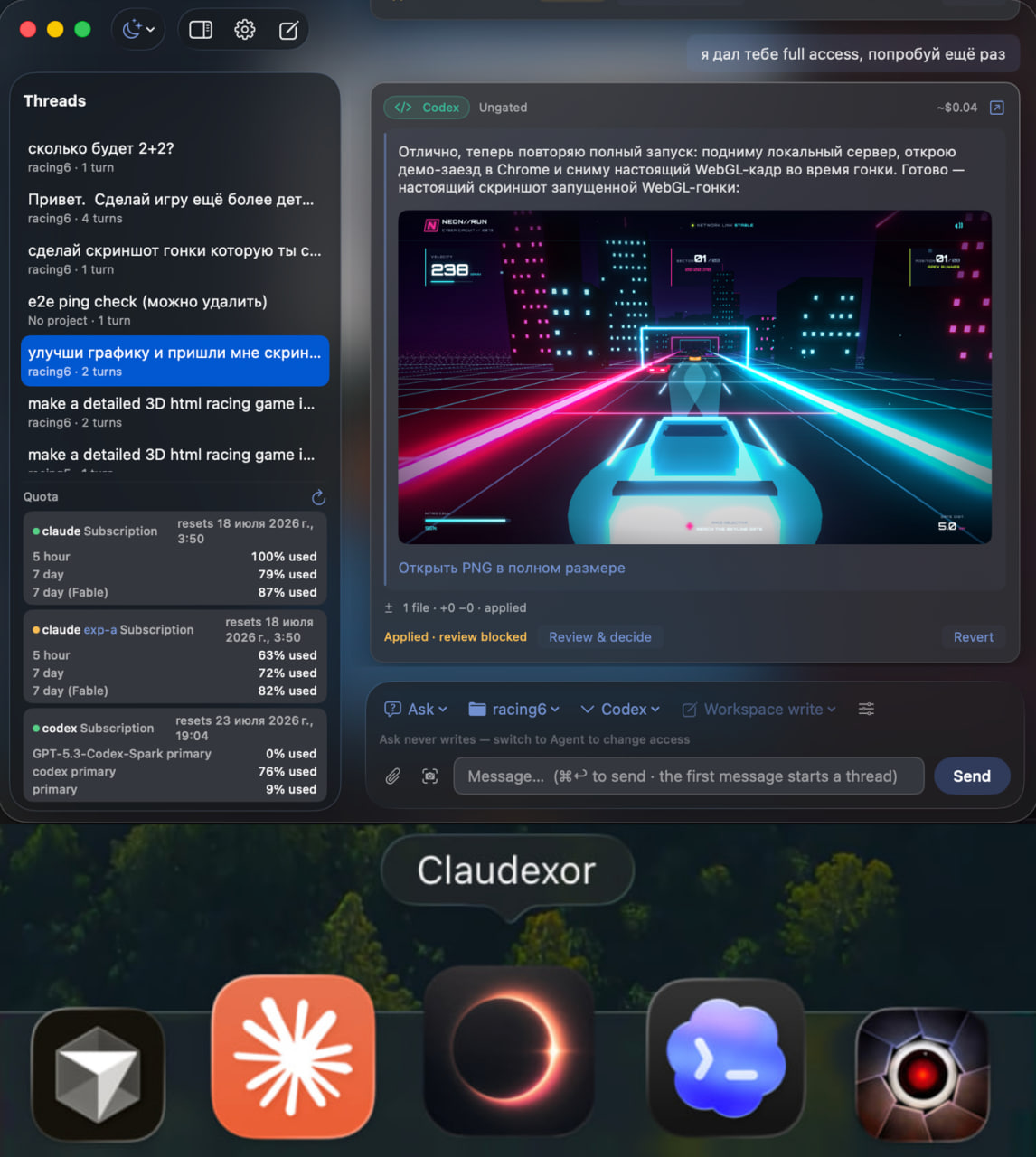
Claudexor is a local-first control plane for the AI coding agents you already pay for. It runs Codex CLI, Claude Code, Cursor CLI, OpenCode, Antigravity CLI, and raw API adapters behind one typed interface: a chat of turns where read-only questions resume the vendor's own native session, write turns land as inspectable patches, races pit harnesses against each other with cross-family review, and every claim — cost, quota, web evidence, auth route — is a typed fact you can audit, never a vibe.
Compared to driving a bare Codex or Claude Code session, Claudexor adds the
layer the vendors do not ship: best-of-N races with independent reviewers and
arbitration; honest budget/quota accounting (unknown cost is never $0);
deterministic gates and protected paths; and — since 2.1 — credential
profiles: named Antigravity/Claude/Codex/Cursor subscription bindings side
by side, each with Claudexor-scoped state and platform-declared credential
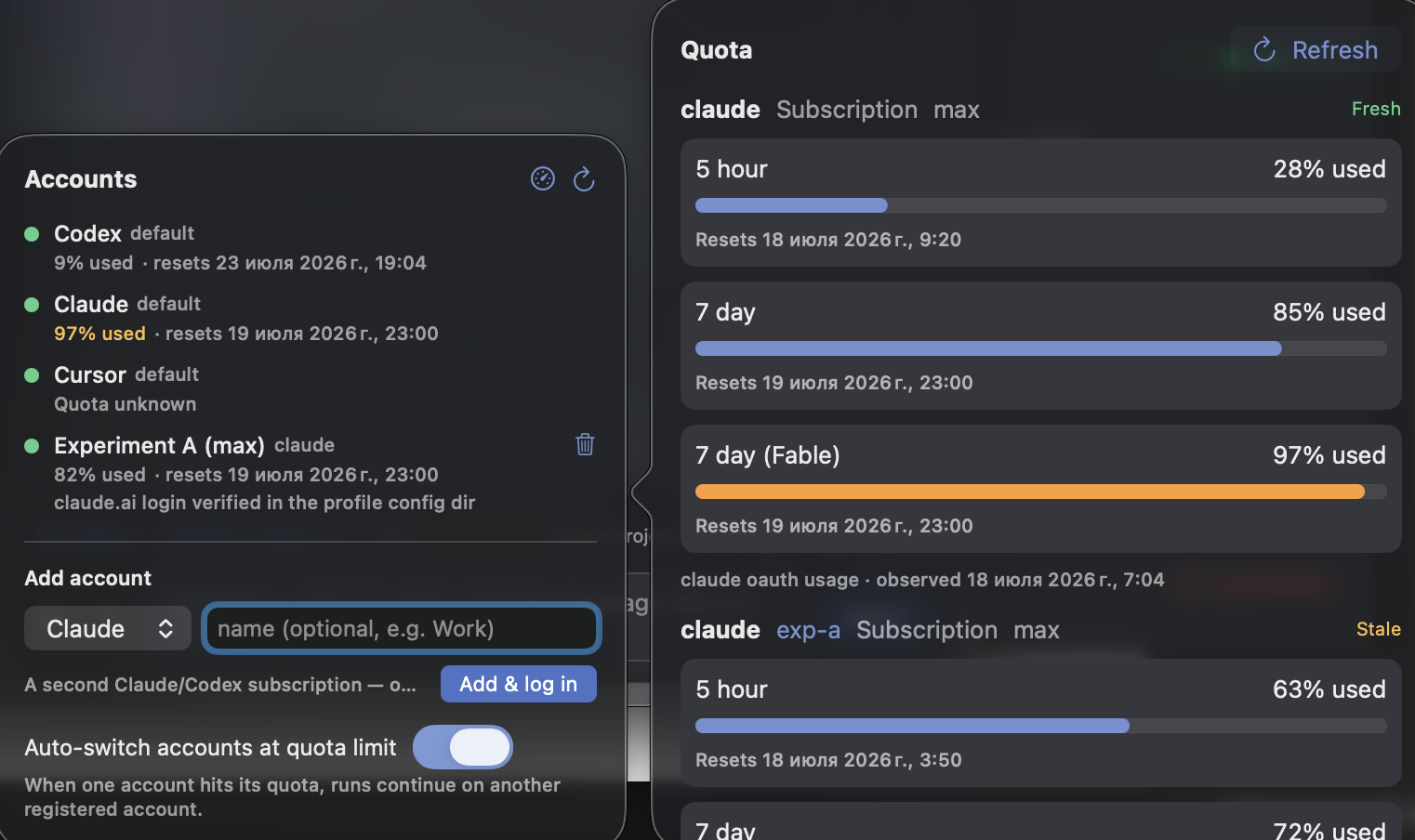
custody. Live subscription-quota tracking — and the opt-in policy that rotates
a spent account out of the way on typed vendor limits — covers the harnesses
with a vendor usage source (Antigravity, Claude, and Codex); Cursor has none
yet. Everything runs on your machine, files are the source of truth, and there
is no telemetry.
Current status: v3.10.0. See "Stability at 2.0" below for what is a stable contract and what remains experimental; retired verbs and mode ids hard-error with the new spelling instead of silently aliasing.
Claudexor also runs as the exact-pinned delegated execution layer inside Ouroboros, a persistent self-developing agent. Ouroboros owns its tasks, memory, review, and final integration. Claudexor runs the connected coding harnesses and returns durable execution evidence. See Ouroboros in action.
Embedding callers can also make a single model request through a managed Codex subscription, using the same account as Agents. The caller supplies its own system prompt and tools and executes those tools itself. This is a typed engine operation, not a public OpenAI-compatible server or a second agent loop. Model catalogs and context limits are account-specific; subscription access does not guarantee zero incremental charges or enable provider-paid credits. See model operations for the transport, retention and unsupported-parameter contract.
Thanks to Praxis Relay and CLIProxyAPI for prior work exploring subscription-backed model transports. They informed this design; neither runs as an embedded relay or owns credentials in this integration.
If you use Claudexor — or you are an agent whose human does — a star is the one-click way to say it works.
- Prerequisites
- Install
- Remote SSH
- Quickstart
- Modes
- Credential Profiles And Quota
- Web, Budgets, And Gates
- Routing, Auth, And Secrets
- Daemon And Control API
- Artifact Layout
- Integrations
- Architecture
- Development
- Stability at 2.0
- For External Agents
- Privacy
- Uninstall / where your data lives
Prerequisites
- Node.js >= 20.19 (the daemon, CLI, and every surface run on Node)
- pnpm (via corepack:
corepack enable pnpm) - Git for isolated workspaces, candidate envelopes, and delivery. Supported in-place non-Git paths remain available; Doctor reports Git availability, and the app's Workspace Git check explains whether the selected shape is admitted.
- At least one logged-in vendor CLI —
codex,claude,cursor-agent,opencode, oragy(Antigravity, for a Gemini subscription) — OR a provider API key (adapters acceptOPENAI_API_KEY,ANTHROPIC_API_KEY, ... as fallbacks; the raw-API route needs only a key). Log in through Claudexor, not the bare vendor CLI — see Install And Login - macOS for the desktop app; the CLI/daemon also run on Linux
Install
CLI + daemon from npm (installs the claudexor and claudexord bins):
You can also build from source — see Quickstart below.
On a Mac, the app is the easiest way in — it ships as a signed and notarized DMG, so it installs like any ordinary Mac app, with no Gatekeeper warnings:
- Download
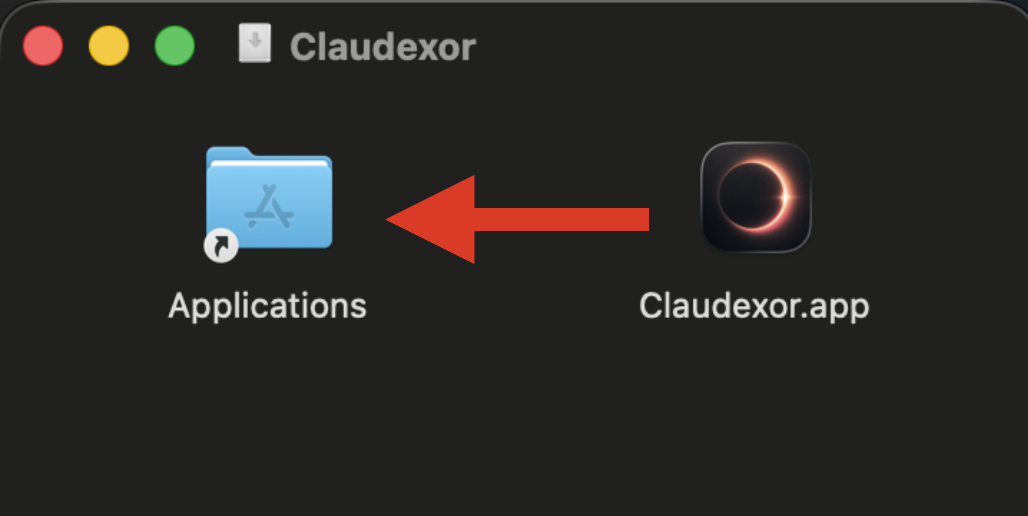
Claudexor-<version>.dmgfrom Releases. - Drag
Claudexor.appintoApplications. - Open it. The app starts its bundled Claudexor engine, then onboarding checks the external Git and harness route needed by the work you select.
The app bundles its own daemon runtime and starts it on launch; installing the Claudexor CLI is only needed for terminal use. Git and vendor harnesses remain separate capabilities checked before a run starts. (The v1.0.0 DMG was unsigned — if you kept it, either upgrade or approve it via System Settings → Privacy & Security → Open Anyway.)
Host integrations may install one vendor CLI into Claudexor's managed local
toolchain with
claudexor harness install <harness> --target local --yes --json; a host may
bind that explicit unattended authorization to the user's Connect action.
Exact npm pins install under ~/.claudexor/node; Cursor remains unpinned, so
the JSON receipt records the downloaded installer's SHA-256 and byte length.
Every successful executed receipt also records the absolute installed launcher
and its verified version; a zero-exit installer without that postcondition is a
typed failure.
Omitting --target preserves the disclosed remote-host flow, its prefix and
its exit-code contract; the install lease and the post-install proof are part
of the unattended local contract and do not apply there.
Remote SSH
The macOS app can run a thread on a Linux or macOS SSH host while keeping the
UI local. In Settings → Connections, pick a concrete alias from
~/.ssh/config or create one in-app — the form appends a plain Host block
to ~/.ssh/config (after a timestamped backup), never a key or password.
Connect it, then choose a saved folder or Browse on <host>… from the
project picker. The thread is permanently bound to that
host and folder; changing either creates a new draft.
Claudexor uses the system /usr/bin/ssh, so existing keys, ssh-agent,
known_hosts, MFA and ProxyJump remain OpenSSH's responsibility. On first
connection the app verifies and installs a signed, no-sudo runtime under
~/.claudexor/remote/, then reaches its loopback-only control API through an
SSH local forward. Vendor CLIs and their credentials remain on the server and
with the vendors. Claudexor can install a harness CLI on the host for you
through a disclosed, exact-pinned flow — claudexor harness install, or
Settings → Harnesses for a connected host: Claude, Codex, and OpenCode
install one exact pinned npm version, while the Cursor and Antigravity vendor
scripts are downloaded in full and run in the visible terminal where you watch
them; nothing executes before the exact package/version/destination install
recipe is disclosed and confirmed. An embedding host may instead pass
--target local --yes, which installs into the managed toolchain root and
must prove the launcher it installed before reporting success.
(Installing them on the host yourself works too.) Then sign in from the app,
which runs each vendor's own login in an embedded SSH terminal (Codex uses
device auth). Remote threads include an embedded SSH terminal and an
explicit-port preview tunnel.
Updates
Related MCP Servers
Reviews
No reviews yet — be the first to share how this listing worked for you.
Frequently Asked Questions about Claudexor
AllMCPs Directory Badge
Showcase your server listing on GitHub or your project documentation. Embed this dynamic SVG badge to highlight official listing status and live engagement.
Badge Style:
Live Dynamic SVG Preview
Markdown (GitHub README)
[](https://allmcps.com/mcp/claudexor)HTML Embed
<a href="https://allmcps.com/mcp/claudexor"><img src="https://allmcps.com/api/badge/claudexor?style=directory" alt="Claudexor on AllMCPs" /></a>