Claude Webcache README
The full upstream README, mirrored here for reference. Install config, tool schemas, adoption signals, and an original overview live on the Claude Webcache listing page.
claude-webcache




Persistent cross-session WebFetch cache for Claude Code. Cached reads in ~0.07ms — orders of magnitude faster than re-fetching.
Claude Code's built-in cache lasts 15 minutes, within one session. Every new session re-fetches from scratch. claude-webcache persists results across sessions in a local SQLite database — instant cache hits, zero network cost.
v0.1.5+: every WebFetch is automatically saved via PostToolUse hook — nothing to configure.
Install
Works in: Claude Code CLI · Desktop (Mac/Windows) · VS Code extension · JetBrains plugin — same command everywhere.
Done. Every WebFetch is auto-cached from now on.
Optionally add the usage pattern to ~/.claude/CLAUDE.md to also check the cache before fetching (saves the WebFetch call entirely on repeat URLs).
Plugin TUI not working? There's an open Claude Code bug (#41653) where
/plugin installrejects third-party sources with "source type not supported." Use the CLI command above — it bypasses the TUI and works fine.Fallback (no marketplace):
Option 2 — npm global
Requires Node.js 22.5+ (uses built-in node:sqlite — no native deps, no install step).
Then register in ~/.claude/settings.json (replace path with output of npm root -g):
Option 3 — clone (contributors)
See CONTRIBUTING.md.
Usage pattern (optional — for pre-fetch cache checks)
v0.1.5+ auto-caches every WebFetch automatically. The pattern below is optional: add it to ~/.claude/CLAUDE.md to also check the cache before making a WebFetch — this saves the WebFetch call entirely on repeat URLs.
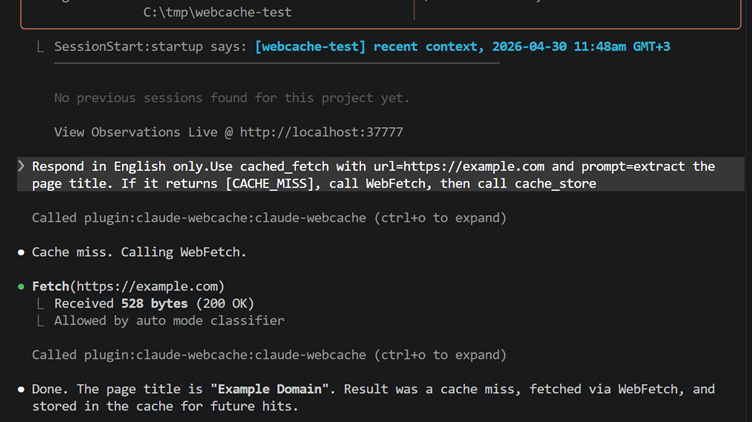
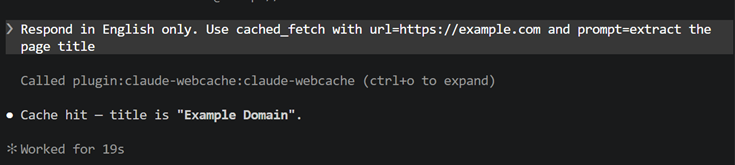
Auto-read (v0.5+): nothing to do. A PreToolUse hook checks the cache before every WebFetch/WebSearch. On a hit it serves the cached copy and skips the network; on a miss the call runs normally and the PostToolUse hook stores the result. Same URL + same prompt (or same search query) in any future session = instant hit, zero network cost.
Manual lookup is still available if you want it: call cached_fetch(url, prompt) (or cached_search(query)) — returns the cached text, or [CACHE_MISS] … if absent. Disable auto-read with WEBCACHE_AUTOREAD=0.
⚠ Security — authenticated URLs
The cache stores the URL alongside the response in ~/.webcache/cache.db. By default, claude-webcache strips obvious credentials from the stored URL before write (user:pass@host and query params named token, api_key, apikey, access_token, auth, secret, password, key, signature, etc.).
That's display-level redaction, not key-level. The cache key still hashes the original URL, so re-fetching the same authenticated URL hits the cache. If you want a stricter trade-off:
With WEBCACHE_STRICT_REDACT=1, the cache key is computed from the redacted URL too — endpoints differing only in ?token=A vs ?token=B collide in one slot. Safe for pass-through auth (identical content), unsafe for personalized endpoints (different users see each other's cached data).
Bottom line: prefer header-based auth (Authorization: headers) over URL-embedded tokens. Don't commit ~/.webcache/cache.db to git.
Namespaces
Multiple projects sharing one machine? Isolate per-project caches:
Default namespace is the empty string "" (shared cache for v0.3 behavior). Inspect/manage per-namespace via CLI: claude-webcache namespaces, claude-webcache --namespace gosdelo stats.
Tools (MCP)
| Tool | Args | Returns |
|---|---|---|
cached_fetch | url, prompt | cached text, or [CACHE_MISS] <url> |
cached_search | query | cached WebSearch results, or [CACHE_MISS] <query> (websearch namespace, short TTL) |
cache_store | url, prompt, output | stored |
cache_stats | global? | { namespace, total, hits, misses, hit_rate, last, db_size_bytes, evicted, oversize_skipped, last_hook_error_at, top_urls, ... } |
cache_list | limit?, offset?, global? | recent URLs (most recent first) |
cache_invalidate | url | { deleted: N } — drops every entry for that URL in current namespace |
cache_clear | older_than_days?, confirm? | { deleted: N } — partial wipe by age, or full wipe with confirm:"YES" |
cache_warm | entries: [{url,prompt}] or urls[]+prompt | { hits, misses, invalid } — bulk pre-flight in one call |
cache_refresh | url, prompt | [CACHE_MISS] <url> — invalidates and signals re-fetch |
CLI
The npm package ships a claude-webcache binary for ad-hoc inspection and a local web dashboard:
The dashboard renders top URLs by hits, top domains (with avg hits / last fetch / entry counts), full search-able paginated list with one-click invalidate + refresh buttons. Pure stdlib — no extra deps to install.
Configuration (env vars)
| Variable | Default | Effect |
|---|---|---|
WEBCACHE_TTL_DAYS | unlimited | Global TTL in days. 0 or unset = unlimited. |
WEBCACHE_MAX_SIZE_MB | unlimited | Above this size, LRU eviction drops ~20% of oldest-by-last_hit_at entries on next write (debounced every 100 writes). |
WEBCACHE_DOMAIN_TTL | none | Per-domain TTL JSON: {"news.com":1,"reuters.com":1,"arxiv.org":0}. Days; 0 = unlimited. Suffix-matches subdomains. Overrides global TTL when matched. |
WEBCACHE_NAMESPACE | "" (shared) | Isolate the cache per project. Different namespaces never see each other's entries. |
WEBCACHE_MAX_OUTPUT_MB | 10 | Reject WebFetch responses larger than N MB. Stats track oversize_skipped counter and last_oversize_url. |
WEBCACHE_COMPRESS | off | 1 enables gzip on responses ≥4 KB. Stored as base64 in TEXT column. Existing uncompressed rows read fine (BC). |
WEBCACHE_STRICT_REDACT | off | 1 makes the cache key use the redacted URL — collides per endpoint regardless of token value. See Security above. |
WEBCACHE_QUIET | off | 1 suppresses hook stderr output (file log at ~/.webcache/hook.log still written). |
WEBCACHE_DEBUG | off | 1 enables verbose tracing in the auto-cache hook. |
WEBCACHE_SEARCH_TTL_HOURS | 6 | TTL for cached WebSearch results (the websearch namespace). Search rankings drift, so this is short by default. 0 = never expire. |
WEBCACHE_AUTOREAD | on | 0 disables the PreToolUse auto-read hooks (cache still fills via PostToolUse; you read it manually via cached_fetch/cached_search). |
SessionStart hook
Every new session injects a one-liner so Claude knows the cache exists:
No output if cache is empty. [ns=...] is omitted when using the default namespace.
Storage
SQLite at ~/.webcache/cache.db (WAL mode, synchronous=NORMAL, busy_timeout=5000).
Cache key = SHA256(namespace + "|" + canonical(url) + "|" + prompt). Default TTL: unlimited (set WEBCACHE_TTL_DAYS=N for N-day expiry).
URL canonicalization (v0.4+): lowercase hostname, strip default ports (:80/:443), strip fragment, sort query parameters alphabetically. So https://EXAMPLE.com/p?b=2&a=1#frag and https://example.com/p?a=1&b=2 produce the same cache key — no silent miss on URL formatting variance.
| Field | Type |
|---|---|
key | TEXT PRIMARY KEY |
url | TEXT (redacted) |
prompt_hash | TEXT |
output | TEXT (gzip+base64 when compressed=1) |
cached_at | INTEGER (ms epoch) |
hit_count | INTEGER |
last_hit_at | INTEGER |
namespace | TEXT (default "") |
compressed | INTEGER (0/1) |
Concurrent-safe via WAL + 5-second busy_timeout — multiple Claude Code sessions can read/write simultaneously without SQLITE_BUSY errors.
Limits
- Cache key includes the prompt — use consistent prompts to maximize hit rate.
- Output is whatever WebFetch returns (already summarized). No re-processing.
- No semantic search. Exact
(namespace, canonical_url, prompt)match only.
Benchmarks
Single-process latency on a populated DB (N=10000 entries, 1KB output each), measured via npm run bench:
| Op | p50 | p95 | p99 | ops/sec |
|---|---|---|---|---|
write | 0.09ms | 0.15ms | 2.66ms | 5,800 |
read_hit | 0.07ms | 0.12ms | 0.23ms | 7,600 |
read_miss | 0.04ms | 0.07ms | 0.13ms | 17,600 |
list_50 | 0.11ms | 0.16ms | 0.53ms | 7,400 |
Storage overhead: ~2 KB per entry for a 1 KB payload (key + indexes + WAL + new v0.4 columns). With WEBCACHE_COMPRESS=1 on text-heavy responses, expect 3-7× reduction.
WebFetch over the network typically takes 1-5 seconds — a cached hit is ~15,000-70,000× faster. Reproduce on your hardware: npm run bench. See bench/README.md for methodology and full results metadata (CPU, RAM, OS, commit) saved per run.
Related
- claude-mem — persistent memory across sessions (complements claude-webcache: memory vs. web cache)
- WWmcp — catalog of 46 MCP servers for non-Western APIs
License
MIT — see LICENSE.