Chaos Cypher README
The full upstream README, mirrored here for reference. Install config, tool schemas, adoption signals, and an original overview live on the Chaos Cypher listing page.
Chaos Cypher Knowledge Engine





Turn your documents into a knowledge graph you can inspect, search, chat with, and take with you — all running on your own machine.
Chaos Cypher is a local-first GraphRAG platform — knowledge you can see,
trust, and own. Point it at your sources (documents, audio, video, images,
pasted text, web pages — 30+ formats, auto-detected), and it extracts entities
and relationships into a knowledge graph you can actually see and explore —
not a black-box vector blob. Search it, chat with it, refine it, and export the
result as a portable Lexicon knowledge package (.ccx) you can back up,
share, or load into another instance.
Why Chaos Cypher
- Local-first GraphRAG — sources → extraction → graph → search & chat, with embeddings generated on your own system. Bring your own LLM, or run fully offline with Ollama.
- Inspectable knowledge graphs — every entity and relationship is visible and traceable back to its source. You can correct extractions, not just trust them.
- Portable knowledge packages — import and export your graph as a self-contained package. Your knowledge is yours to move, version, and keep.
- MCP server built in — plug Claude Desktop, Cursor, or any MCP client straight into your graph: 36 tools for search, traversal, and graph building.
- Self-hosted control — you choose where data lives and which models touch it. The all-in-one container runs the whole stack on hardware you control.
Feature highlights
Core intelligence
- Knowledge graph canvas — typed, filterable, zoomable from corpus overview down to a single entity and its sources
- GraphRAG search — graph traversal fused with vector search (Personalized PageRank + Reciprocal Rank Fusion), plus keyword, semantic, and hybrid modes
- AI chat with citations — answers grounded in your content, traceable back to the sources that produced them
Data foundation
- Quality analysis — score graph richness on a 0–100 scale, with breakdowns that flag weak sources
- 30+ source formats — PDF, DOCX, Markdown, HTML, EPUB, audio (MP3/WAV/FLAC), video (MP4/MKV/MOV), images, ZIP archives, and more
- Mix-and-match LLMs — Ollama, OpenAI, Anthropic, or Gemini, configurable per operation
Automation & integration
- Automations — visual workflow builder with triggers and conditional logic
- MCP server — 36 tools for Claude Desktop, Cursor, ChatGPT, and other MCP clients
- Plugin system — drop-in Python document loaders, extraction domains, and workflow tools
What data leaves your machine?
By default, nothing leaves your machine except the LLM calls you configure. Embeddings are computed locally; your documents, graph, and exports stay on disk in a Docker volume you own. If you point Chaos Cypher at a hosted LLM provider (OpenAI, Anthropic, Gemini), the text sent for extraction and chat goes to that provider — choose a local model like Ollama to keep everything on-device.
Read the Self-Hosted Threat Model for exactly what Chaos Cypher defends against, what it accepts by design, and how to harden a LAN or internet-facing deployment.
📸 See It in Action
A quick tour — from dropping in a document to asking a question and tracing the answer back to the exact highlighted sentence in your source:
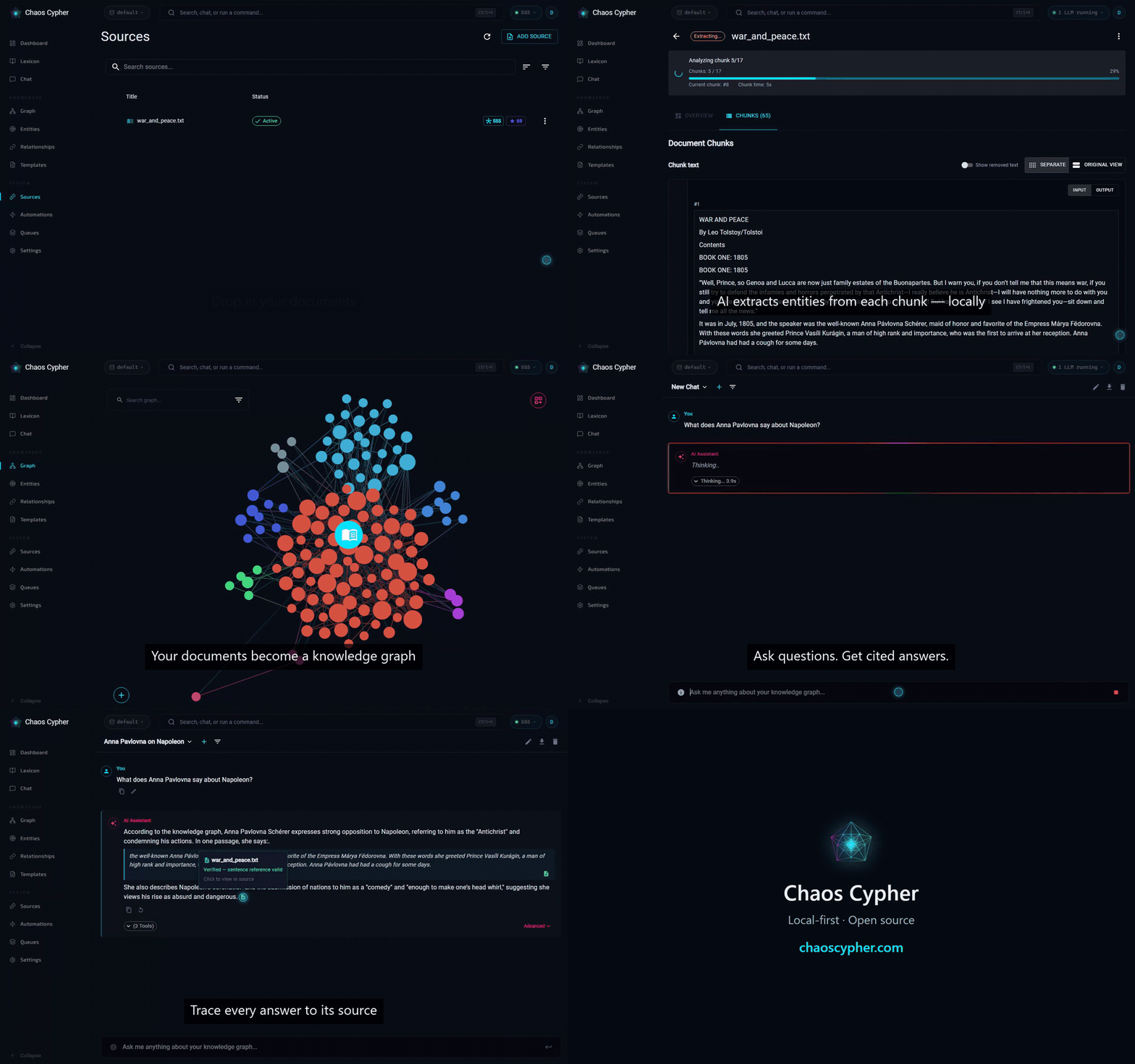
▶️ Watch the full tour (with audio-free narration captions) on chaoscypher.com.
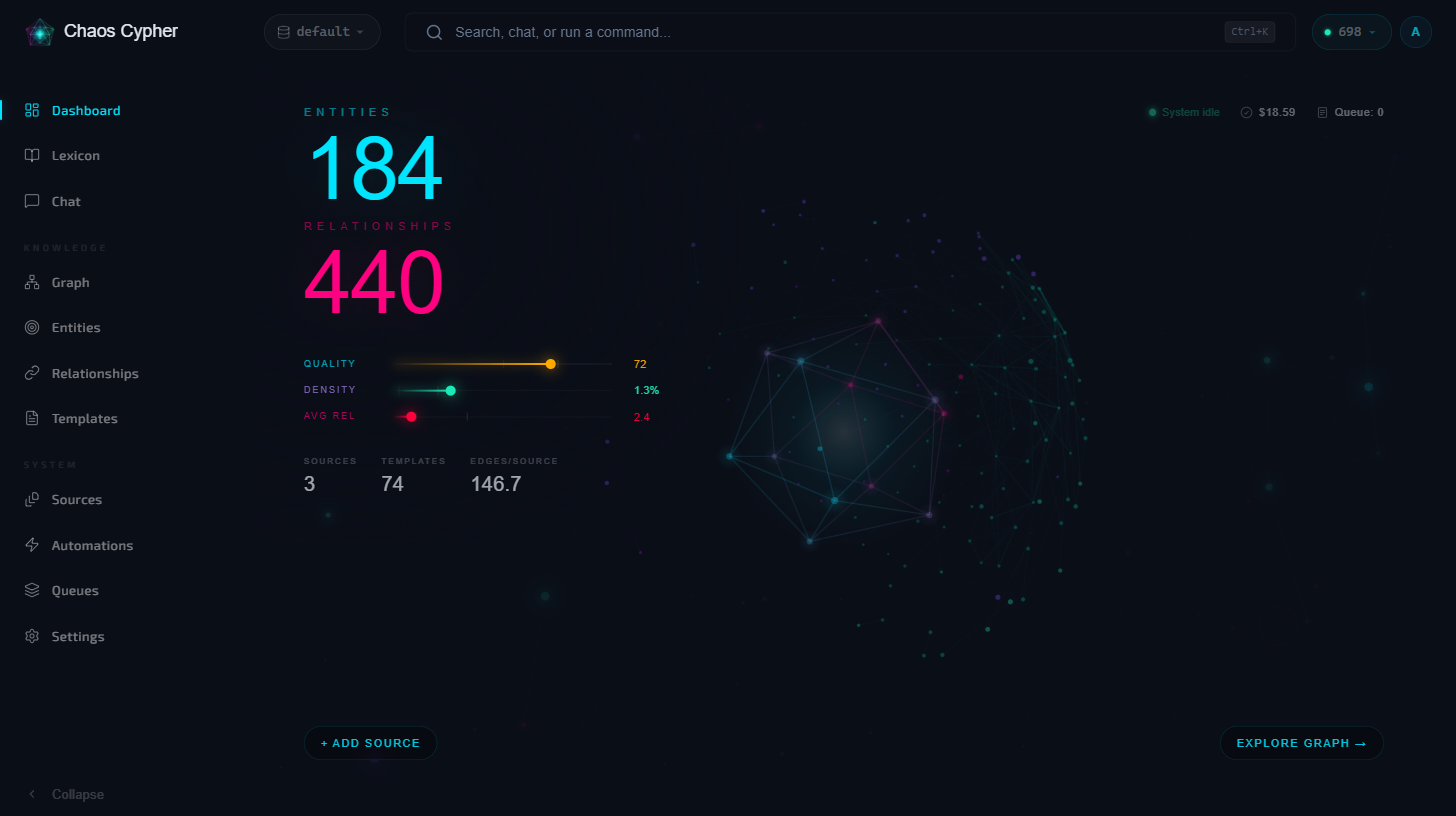
Dashboard — your knowledge base at a glance: entity and relationship counts, quality and density scores, and a live graph preview.
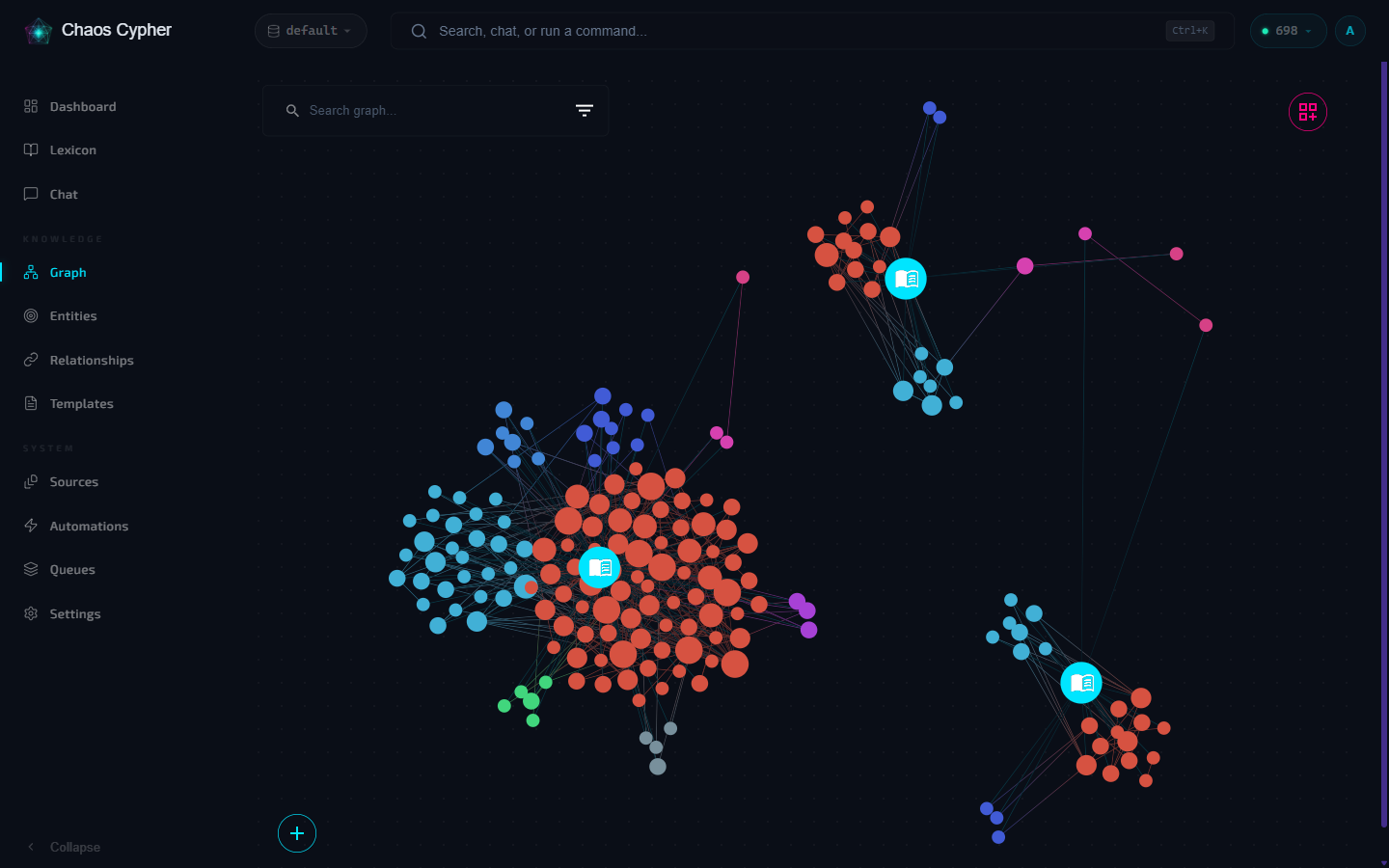
Knowledge graph — every source becomes an explorable, color-coded graph. Pan, zoom, search, and filter to see exactly what was extracted.
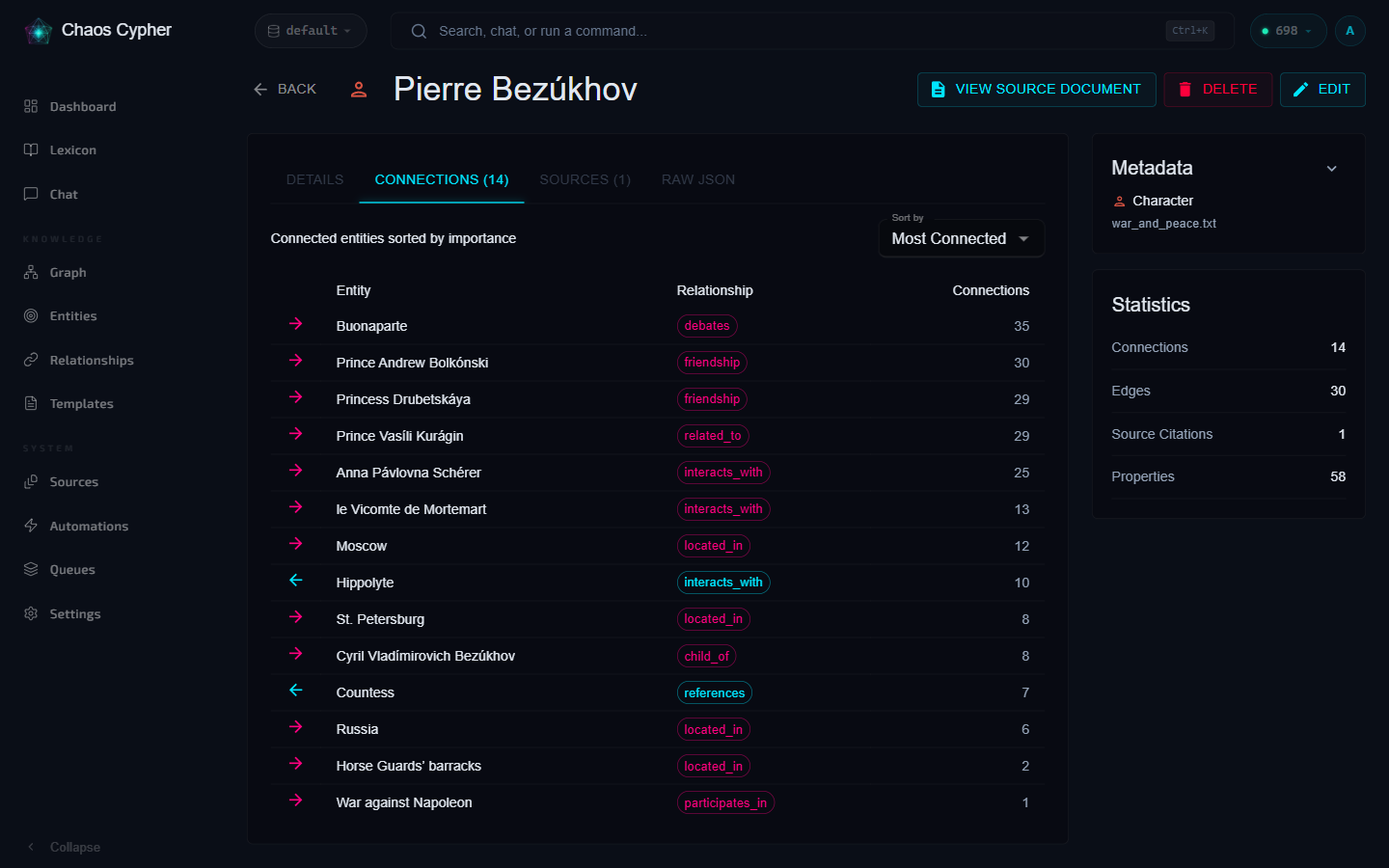
Entities — inspect any extracted entity: typed, directional relationships ranked by importance, with stats and provenance back to the source document.
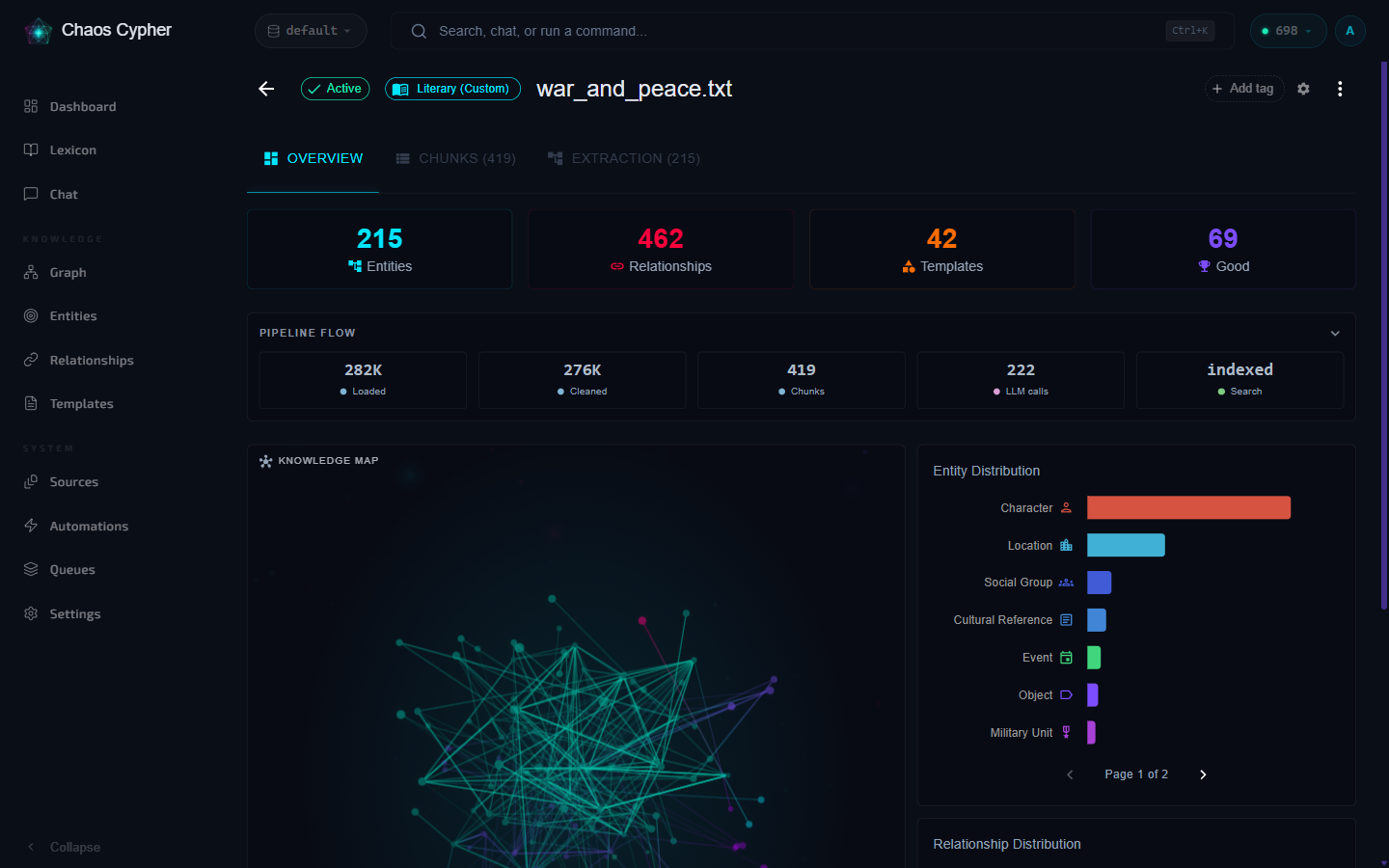
Sources — each document gets a transparent pipeline view: loaded → cleaned → chunked → extracted → indexed, plus per-source entity distribution.
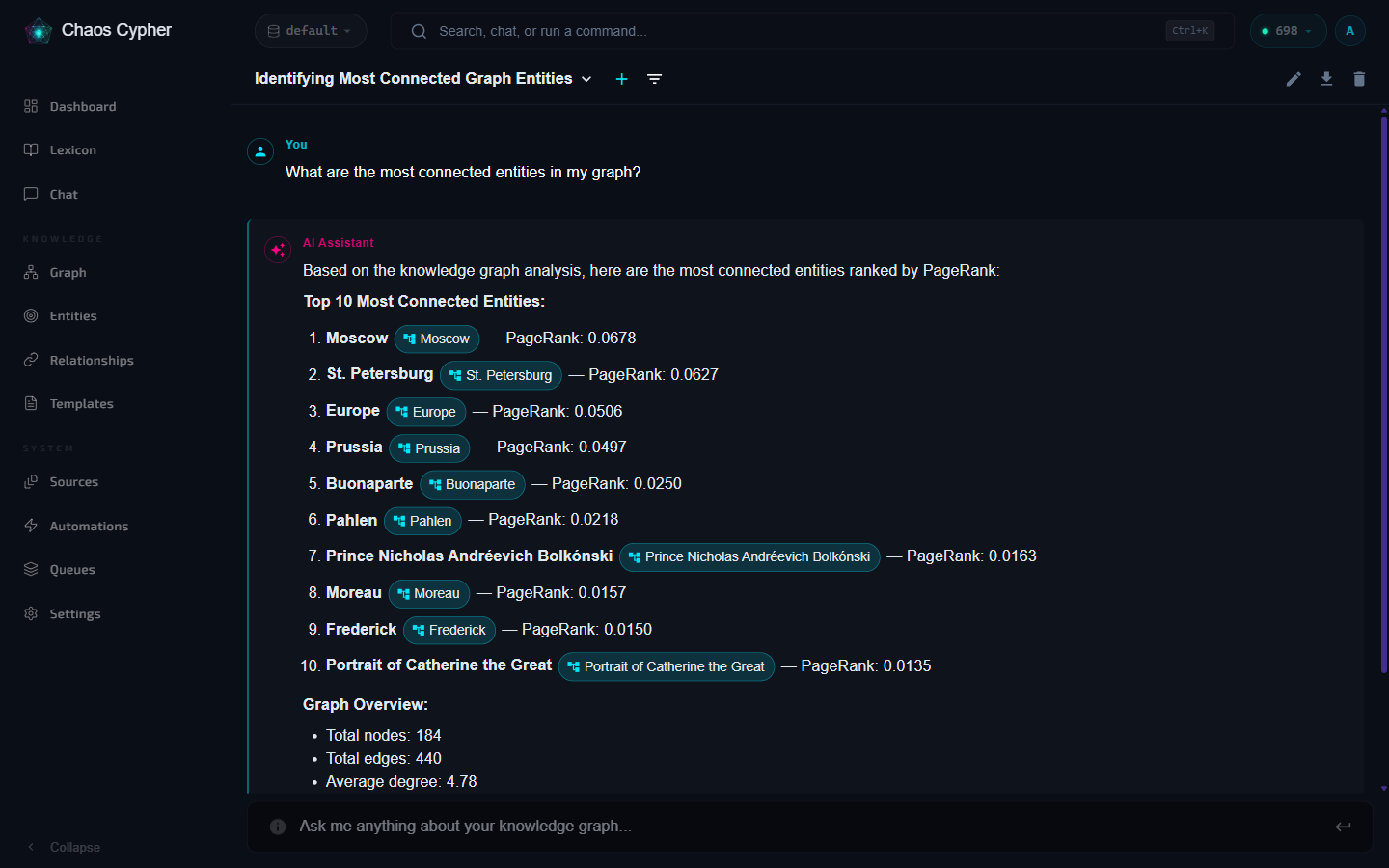
Chat — ask questions in plain language and get GraphRAG answers with inline entity citations you can click through to the graph.
🚀 Quick Start
Prerequisites: Docker (with Compose). That's it for end users — embeddings run locally on CPU. You'll also want an LLM provider; Ollama keeps everything on-device.
Run the published container (recommended)
The recommended install path is the all-in-one image published to the GitHub Container Registry:
Prefer Compose? Save this as docker-compose.yml and run docker compose up -d:
The image is built and pushed on every
vX.Y.Zrelease by.github/workflows/publish-ghcr.yml.
Install the CLI from PyPI
Terminal-first? The standalone CLI installs with pipx (or plain pip):
All four Python packages (chaoscypher-core, -cortex, -neuron,
-cli) are published to PyPI on
every release — chaoscypher-core gives you the same extraction and search
engine as an embeddable library. See the
developer quickstart.
Build from source (alternative / development)
Clone and build the all-in-one image locally — no published image required:
Try it in about 5 minutes
The quickstart covers this in detail — import and search work within about 5 minutes; extraction and chat come online once your LLM provider is set up (for Ollama, after a one-time model download).
- Start the app with one of the paths above and open http://localhost.
- Create your single-user login on the first-run setup page.
- Pick an LLM provider in Settings — point at a local Ollama model to stay fully offline, or add an API key for OpenAI / Anthropic / Gemini.
- Add a source — upload a document or paste text. Chaos Cypher extracts entities and relationships in the background (watch progress in the Queue Monitor).
- Explore the graph — open the knowledge graph view to see what was extracted, search across it, and chat with your sources.
- Export a knowledge package when you're happy with the result, so you can back it up or load it elsewhere.
Development setup (with hot-reload)
For contributors who need per-service hot-reload (requires Python 3.14+,
Node.js 22+, and uv 0.11+ — uv replaces pip and
reads the committed uv.lock):
📦 Monorepo Structure
🛠️ Common Commands
Docker
View Logs
Testing
Individual Packages
📖 Documentation
- Published Docs Site - Full user and developer documentation
- Contributor Guide - Contribution workflow, PR checklist, and review expectations
- AI Contributor Guide - Public guidance for AI coding assistants
- Core Architecture - Hexagonal architecture deep dive
- Documentation source - Docusaurus documentation site source
- Architecture Decisions - Public ADRs
- Self-Hosted Threat Model - What data stays local, and how to harden exposure
Documentation Site (Docusaurus)
🏗️ Architecture Highlights
Chaos Cypher is organized using a brain-inspired metaphor, with each package mapped to a specialized role:
- 🧠 Core (
packages/core/) — framework-agnostic business logic (hexagonal architecture) - 🎛️ Cortex (
packages/cortex/) — FastAPI backend with vertical-slice architecture - ⚡ Neuron (
packages/neuron/) — background workers for LLM and operations processing - 💻 Interface (
packages/interface/) — React + TypeScript web UI - 🔧 CLI (
packages/cli/) — standalone command-line interface - 🐳 Docker (
packages/docker/) — orchestration (docker-compose files)
In plain English: the UI talks to one API, the API delegates all the real work to a framework-agnostic core, and slow jobs (extraction, exports) run in background workers so the app stays responsive.
Vertical Slice Architecture (Cortex Backend)
Features are self-contained vertical slices with complete functionality from API → Service → Repository → Database.
Hexagonal Architecture (Core Library)
The packages/core/ library uses Hexagonal Architecture for maximum flexibility and reusability.
- Ports: Protocol definitions (contracts)
- Adapters: Storage implementations (SQLite, file, LLM, web)
- Services: Business logic (framework-agnostic)
- Repositories: Domain repositories using storage adapters
Queue System
- LLM Worker (1 concurrent) - Chat, embeddings, tool LLM calls
- Operations Worker (8 concurrent) - Source processing, exports, workflows
Monitor: http://localhost/queues (all-in-one; dev stack: http://localhost:3000/queues)
🔄 Development Workflow
🤝 Contributing
- Fork the repository
- Create a feature branch (
git checkout -b feature/amazing-feature) - Make changes and add tests
- Ensure all tests pass
- Commit your changes following Conventional Commits (
git commit -m 'feat(scope): add amazing feature') - Push to the branch (
git push origin feature/amazing-feature) - Open a Pull Request
💬 Community & Support
- Questions, ideas, show-and-tell → GitHub Discussions
- Bugs and feature requests → Issue Tracker
- What's shipping → Blog · Changelog · Roadmap
If Chaos Cypher is useful to you, a ⭐ on the repo genuinely helps other self-hosters find it.
📄 License
Chaos Cypher is licensed under the GNU Affero General Public License v3.0 only
(AGPL-3.0-only) — see the root LICENSE file. A separate
proprietary enterprise edition is available; external contributions are accepted
under the project CLA.