@chanmeng666/archlang-mcp
A Model Context Protocol server for ArchLang — author, inspect, and repair architectural floor plans written as code, from any MCP-speaking host.
It is a thin stdio shim over the @chanmeng666/archlang library (no subprocess,
no re-implementation): each tool wraps one pure, exported function. The core stays
zero-dependency — the MCP SDK lives only in this package.
Try it
Floor plans as code. Your AI writes ArchLang; the compiler draws a precise, dimensioned plan and tells it what's wrong.
- ChatGPT, no install: ArchLang app in ChatGPT, then ask, for example: "Draw a two-bedroom flat of about 75 m² as an ArchLang plan, and check it."
- claude.ai, no install: add
https://mcp.archlang.uk/mcpas a custom connector (the steps) - Coding agent:
claude mcp add --transport http archlang https://mcp.archlang.uk/mcp; locally,claude mcp add archlang -- npx -y @chanmeng666/archlang-mcp; skills,npx -y skills add ChanMeng666/archlang --yes(skills.sh) - VS Code: Marketplace or Open VSX
- Playground, in the browser: https://playground.archlang.uk
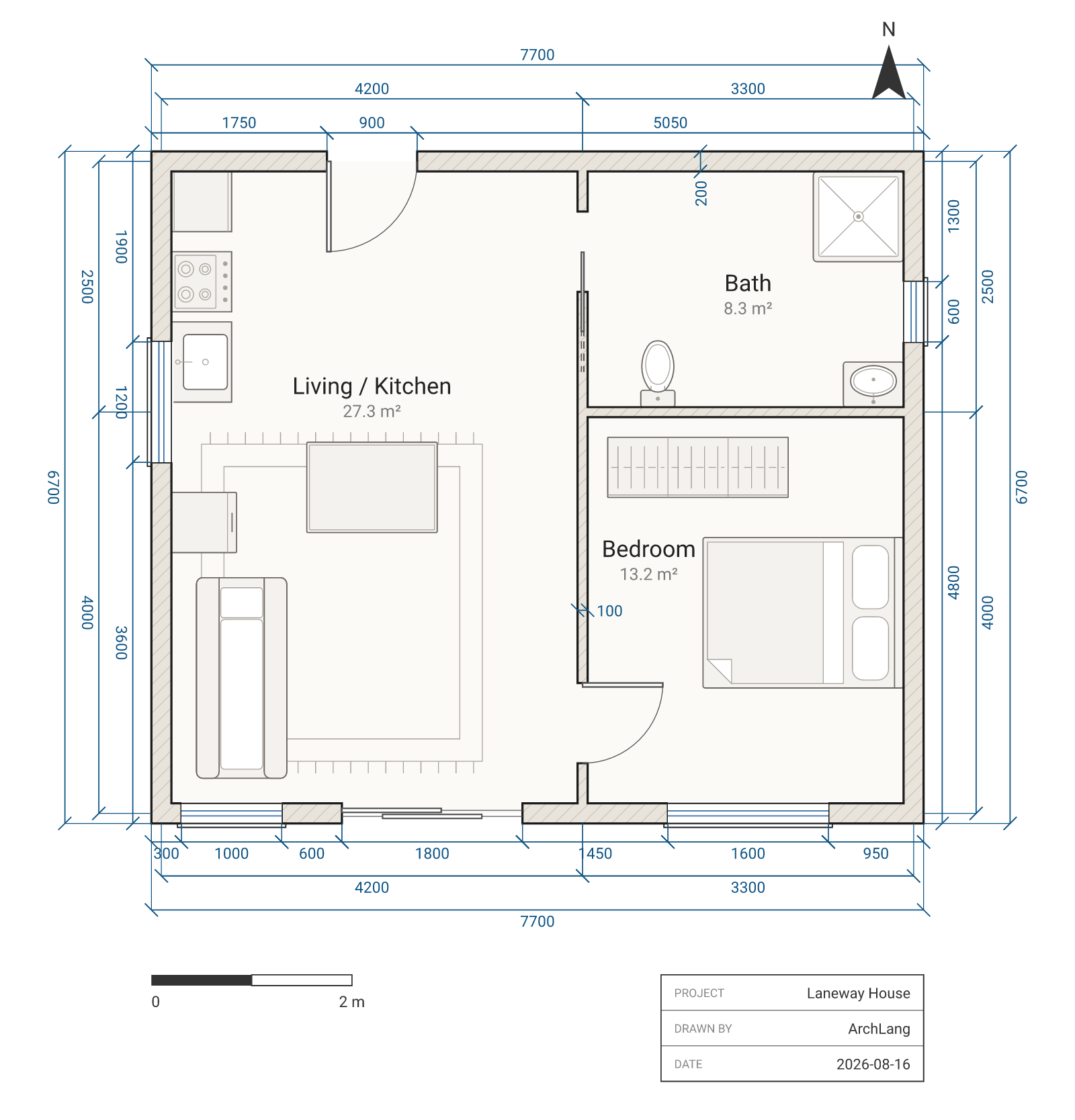 Plan | 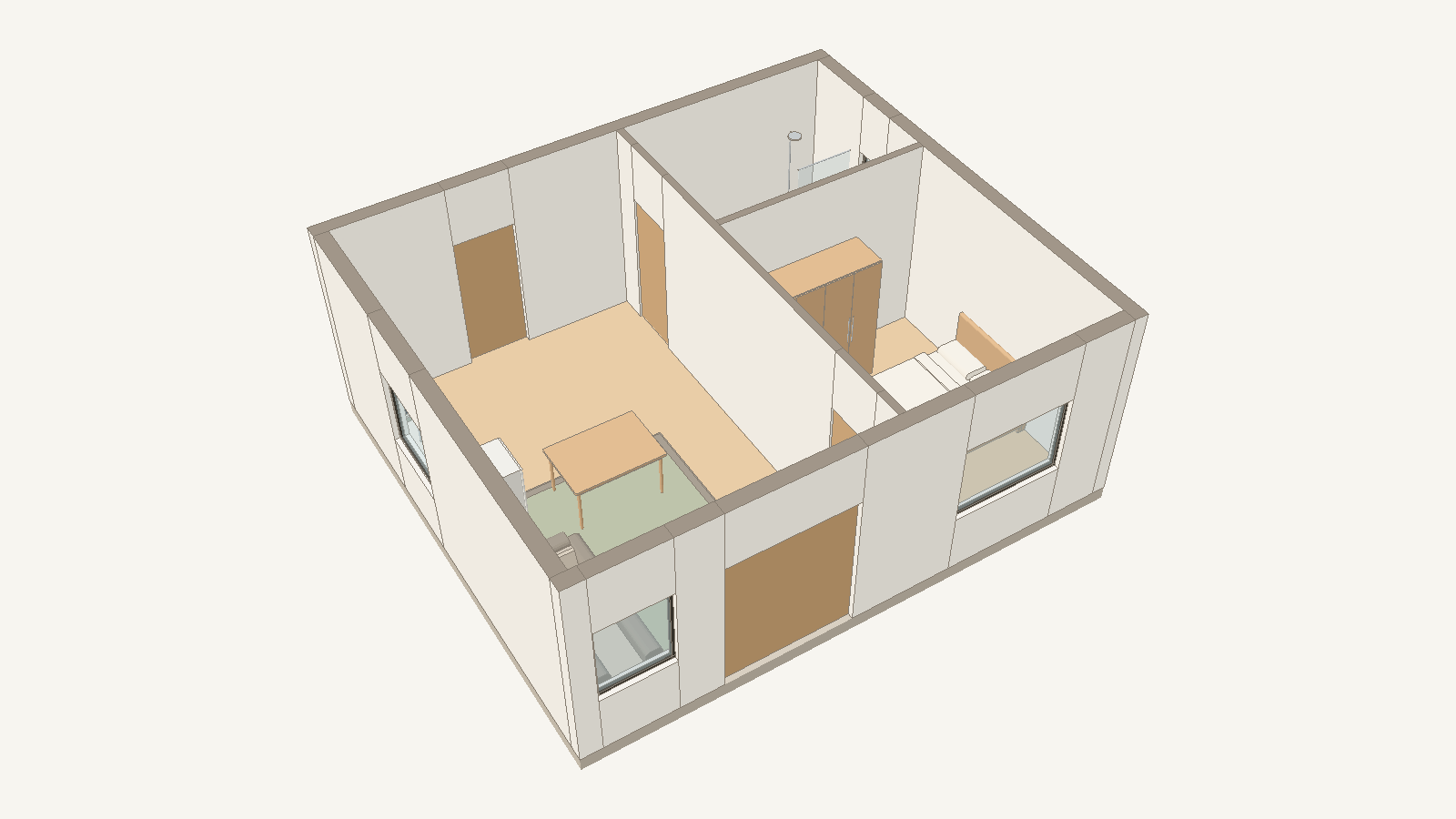 3D preview |
Same source, plan and 3D preview. The 3D preview is extruded from the same .arch file by the separate archlang-3d package, and checked against the plan: every 3D element comes from the plan's elements, and every solid is closed. What the 3D preview shows →
3D preview: walls, openings, floors, stairs, furniture, outdoor surfaces and fences in plain colours; the ground and the soft contact shadows are the viewer's, not part of the building and not in the file; no pitched roofs or balcony railings yet, and no sections, elevations or BIM.
If your agent has a shell
ArchLang's primary agent interface is the agent-native archlang CLI, not this
server. A CLI costs nothing in an agent's context window until it is called,
whereas an MCP tool schema sits in the window permanently. If your agent already has
a shell, prefer:
npx -y @chanmeng666/archlang context     # the whole language + workflow + CLI + errors, one call
npx -y @chanmeng666/archlang compile plan.arch -o out.svg --json
After npm i -g @chanmeng666/archlang the same calls are archlang context and
archlang compile …. The package also installs an arch alias, but on Linux, macOS and
Git Bash coreutils ships its own arch, so a bare arch there runs the wrong program.
This MCP server exists so MCP-native hosts can discover ArchLang through the
registry and drive it without a shell. It is listed on the official MCP registry as
io.github.ChanMeng666/archlang-mcp. It is the discoverability channel, not a
replacement. See ADR 0012
(which amends ADR 0009's distribution-over-protocol stance).
Server instructions
At initialize the server sends a short instructions string, which hosts that support it
add to the model's context: read the archlang://spec resource first, then write .arch →
compile (and fix) → describe → validate with strict:true → finish before export.
It is SKILL.md's loop, condensed, and a test holds the commands it names to the CLI manifest
and to that loop's order.
Tools
Every tool takes ArchLang source (a plan "…" { … } string) and returns
structured JSON. compile also accepts plan_json (the Plan-JSON / RPLAN shape).
Every result of a call that passed source ends with source_hash, the SHA-256 (hex) of that
input's UTF-8 bytes; repair, fix and finish, which return a rewritten source, add
output_hash, the SHA-256 of exactly that returned text. The tools write no files. The hashes are
for the CLI's --expected-hash, which refuses to rewrite a file whose bytes no longer hash to the
value given (E_STALE_SOURCE): write the returned source to the file, then pass its
output_hash. For a file that is valid UTF-8 and holds the text unchanged (a BOM and CRLF line
ends included) the MCP hash and the CLI's agree.
| Tool | What it does |
|---|---|
compile | Render source (or plan_json) to SVG, or to zero-dep ASCII (format:"txt"), Plan JSON as an object (format:"json", the shape plan_json takes) or a PNG image (format:"png", at archlang preview's width unless width overrides it, within a clamped range; needs the optional @resvg/resvg-js, which the .mcpb bundle leaves out). accessible, overlay:"circulation" opt-ins. Returns output + diagnostics. A multi-storey plan returns every storey in pages[]; level renders one. |
describe | Semantic facts (rooms, areas, adjacency, doors, circulation, zones, storeys, the exact floor_polygon/floor_circle shape, and a freedom report of which positions are hand-authored vs resolver-derived) — verify intent without an image. |
lint | Advisory W_* soundness warnings (may include the fix-carrying W_ALIAS_MATCH for a room use inferred from an indirect label alias); profile selects a ruleset. |
validate | Parse + resolve + lint, the ship gate. strict fails on warnings; graph checks interior-door adjacency against an intended room graph; intent gates on a brief's contract (per archlang://intent-schema); profile and taste add a lint ruleset and a taste score; next names the one item to fix first. |
score | The continuous intent METER: how much of a brief a plan satisfies (satisfied/total/score/subscores). Measures, never gates. |
repair | Explicit corrector: furniture out of walls/doorways/swings → new .arch source + change log. Never adds doors/windows. |
finish | Complete the drawing: furnish the rooms that hold no furniture, then add the missing paper, scale, dims auto, title, schedule rooms and legend → new .arch source + change log. Fills only what is missing; only runs one stage (furnish or sheet); reissue may replace paper/scale. |
fix | Apply the machine-applicable fixes on a plan's diagnostics (syntactic corrector; bounded fixpoint). unsafe widens to maybe-incorrect. |
suggest | Advisory door/window statements (each referencing its wall by a stable ref — an authored id or a unique category — or absolute coordinates, never a re-bindable positional id) to resolve unreachable rooms / windowless bedrooms — data, never applied. |
complete | LSP completion items in scope at a source byte offset. |
explain | A diagnostic code's catalogue entry: message, cause, fix, an example that raises it and, for most codes, fixed, the example corrected (the CLI's explain --json). |
link | Two URLs that show the plan in a browser with nothing to install: playground (the hosted editor, rendered) and embed (the plan alone, for an iframe), plus bytes, the compressed plan's size, and ok (with an errors count when the plan does not compile; it still links and the page shows the diagnostics). The plan rides in the URL fragment. Needs a core that exports ./link; an older one gets ok:false and the version it needs. |
What compile's accessible does here — and what it does not
accessible: true gives the SVG its <title>/<desc> pair and role="img" on the root, which
is the whole of the option as this shim exposes it. The v1.36 element controls are not reachable
through MCP. They need annotate alongside accessible, and this tool passes annotate only
for format:"txt"; it also takes accessible as a boolean, so the { idPrefix } form that keeps
several plans on one HTML page from sharing arch-title/arch-desc cannot be requested either.
A host that needs a keyboard- and screen-reader-operable drawing — data-arch-primary,
role="button", aria-label on each element — has to call the library. The CLI cannot
produce it either: annotate has no flag, so archlang compile --accessible stops at the
<title>/<desc> pair too.
import { compile } from "@chanmeng666/archlang";
compile(src, { annotate: true, accessible: { idPrefix: "plan-7" } });
The output contract, what an embedder still owns, and the known screen-reader limitations are in the language reference.
Resources
| URI | Content |
|---|---|
archlang://spec | The whole language in one page (spec.llm.md). |
archlang://context | Full agent context: spec + workflow + CLI reference + error catalog (llms-full.txt). |
archlang://schema | JSON Schema (2020-12) for the Plan-JSON compile input. |
archlang://grammar | GBNF constrained-decoding grammar for guaranteed-parseable generation. |
archlang://intent-schema | JSON Schema (2020-12) for a brief's Intent — the shape validate's intent and score's brief take. |
archlang://capabilities | Every tool (and the hosted server's extra read_me) and CLI command, the codes fix resolves by applicability, the export formats, the limits, what ArchLang does not do, and the authoring loop, generated from the tool lists, the CLI manifest and the fix producers. |
Install
Claude Code
claude mcp add archlang -- npx -y @chanmeng666/archlang-mcp
Claude Desktop
Add to claude_desktop_config.json (Settings → Developer → Edit Config):
{
  "mcpServers": {
    "archlang": {
      "command": "npx",
      "args": ["-y", "@chanmeng666/archlang-mcp"]
    }
  }
}
Cursor
Add to .cursor/mcp.json (project) or ~/.cursor/mcp.json (global):
{
  "mcpServers": {
    "archlang": {
      "command": "npx",
      "args": ["-y", "@chanmeng666/archlang-mcp"]
    }
  }
}
VS Code
Add to .vscode/mcp.json:
{
  "servers": {
    "archlang": {
      "type": "stdio",
      "command": "npx",
      "args": ["-y", "@chanmeng666/archlang-mcp"]
    }
  }
}
License
MIT © Chan Meng