Cfgd README
The full upstream README, mirrored here for reference. Install config, tool schemas, adoption signals, and an original overview live on the Cfgd listing page.

cfgd
Declare your entire machine (packages, dotfiles, system settings, secrets) with composable profiles and shareable, cross-platform modules.




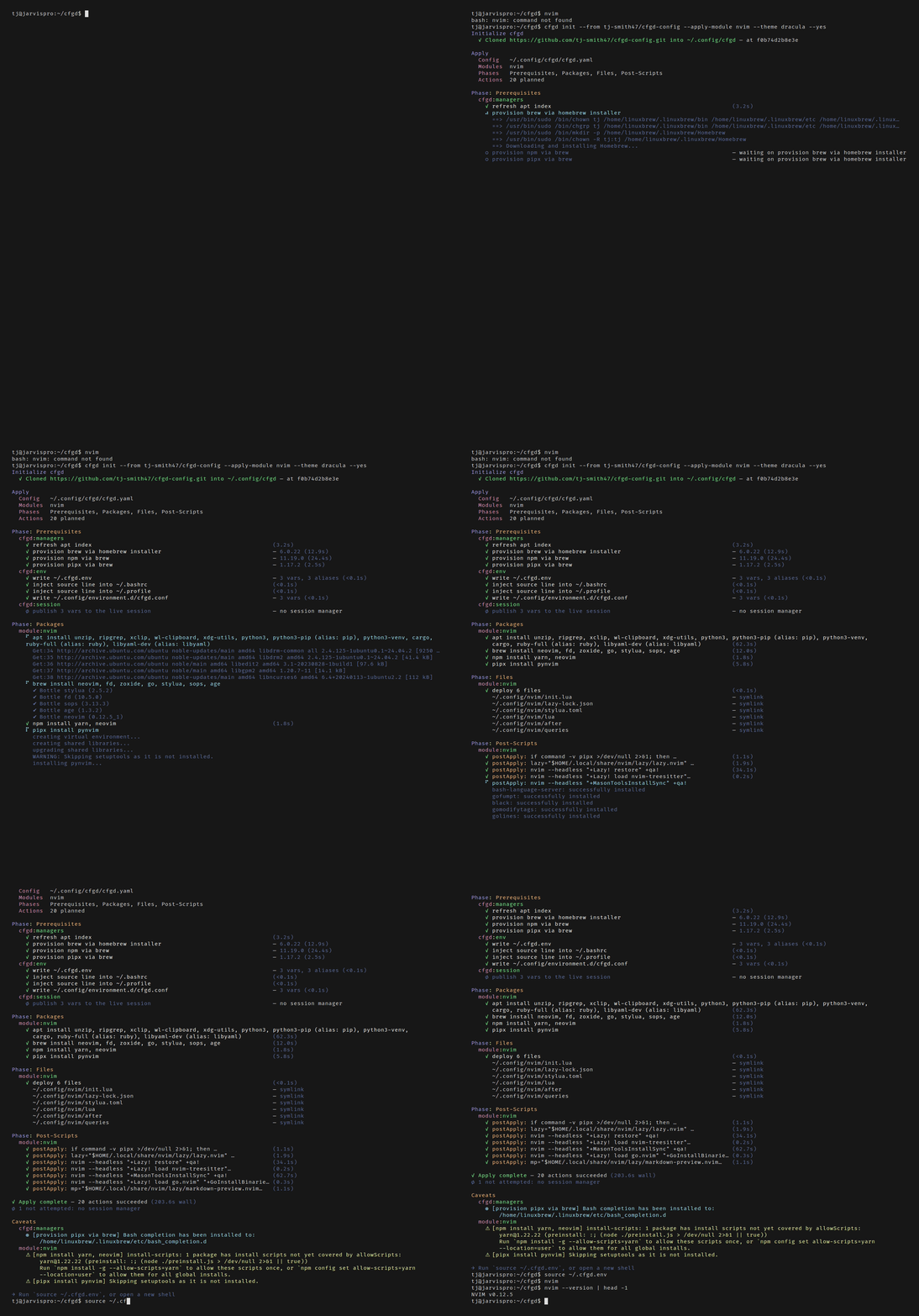
A bare ubuntu:24.04 container with no Neovim, no Homebrew and no config. One cfgd init later, nvim opens a fully configured LazyVim. Recorded with VHS.
Status: Alpha. APIs may change.
- What is cfgd
- How It Works
- Quick Start
- Why cfgd exists
- Shareable Modules
- How cfgd compares
- Features
- Documentation
- Distribution
What is cfgd
Most dotfile managers track files. cfgd manages your entire machine. You declare packages, files, secrets, and system settings in version-controlled YAML. cfgd diffs what you want against what you have, builds a plan, and reconciles continuously. If something drifts, it is detected and corrected.
How It Works
Profiles declare your machine's desired state: packages, files, system settings. They compose via inheritance: share a common base across machines, then specialize per context. See docs/profiles.md.
Modules are shareable, self-contained config packages. Install someone else's dev environment or publish your own. Cross-platform package resolution picks the right manager automatically. See docs/modules.md.
Reconciliation continuously ensures machines match their declared state. Drift is detected, reported, and optionally auto-corrected. Failed actions don't abort; they're logged and skipped. See docs/reconciliation.md, or watch two machines converge through the daemon.
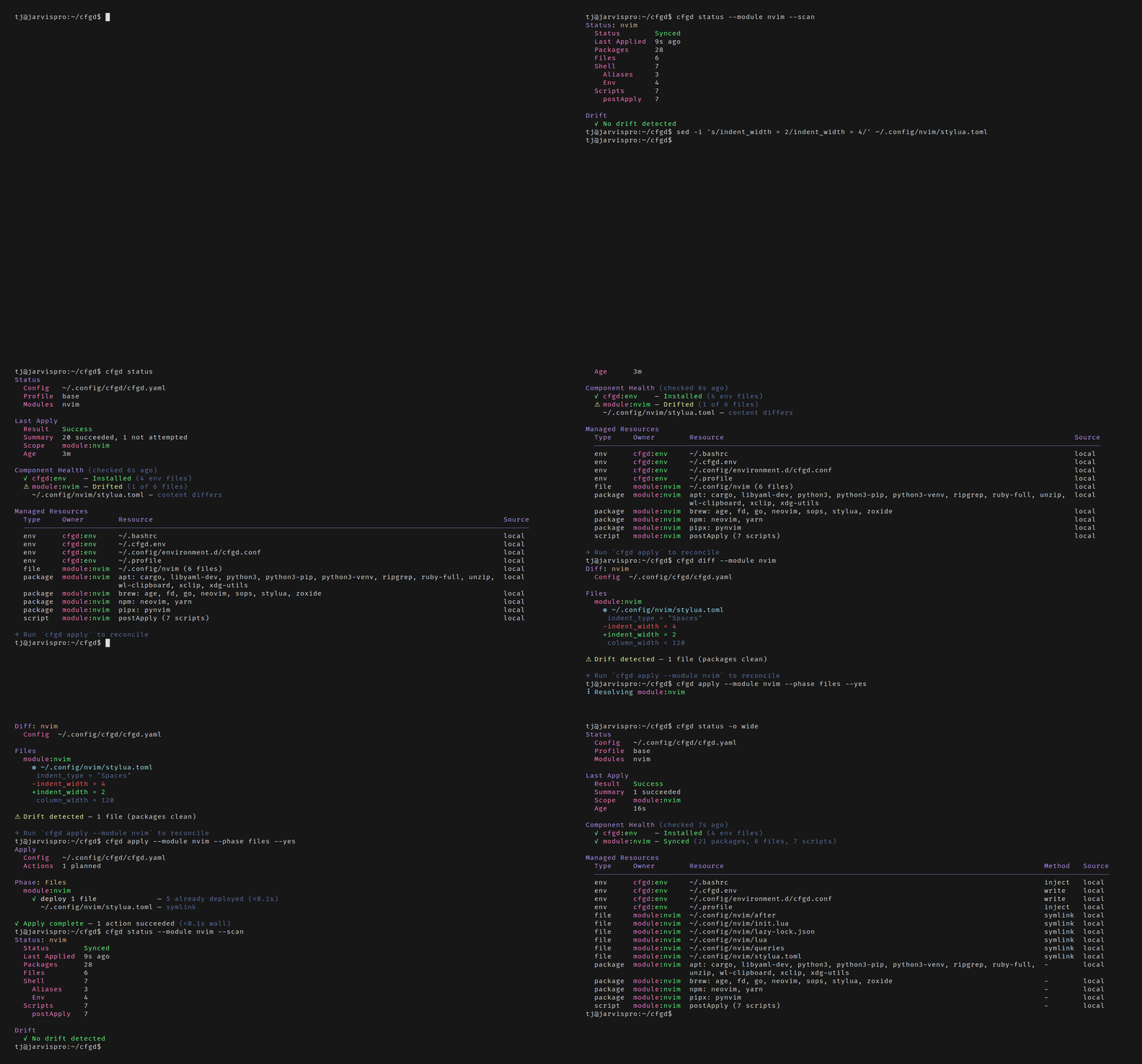
Quick Start
Why cfgd exists
I recently switched jobs, and spent the last week of my old job backing up scripts and dotfiles, parsing out company-specific info, and composing a tarball to transfer. At the new job, I spent another few days getting my new machine reconfigured. Over time I kept discovering things I'd forgotten, and things (System Settings, for one) I wished the backup had covered. It all felt manual and incomplete: I should be able to clone a repo and have my entire workstation (packages, scripts, dotfiles, system settings) feel familiar again. Better still, to keep parts of that feeling in sync between my home and work laptops.
The other inspiration was devcontainers. At my previous company I had set up custom scripts to inject dotfiles into the devcontainer so a user could replicate their dev environment once they shell in. At minimum, I wanted my full Neovim setup available in any ephemeral container without modifying the devcontainer config in every team's repository to accommodate it. I needed something that could bootstrap my config into any environment from the outside, regardless of whose repo I was working in. Plus, I had some coworkers in need of education about the superiority of vim-motions, and wanted a quick way to share my exact setup, down to the alias.
cfgd borrows from the best ideas across practices:
- Kubernetes: declarative reconciliation loop, KRM resource model
- Terraform: plan/apply workflow, state tracking, drift detection
- Puppet: continuous enforcement via daemon, module ecosystem
- Nix: reproducible machine state from a single source of truth
- Ansible: YAML-driven config management, idempotent task execution
- Kustomize: layered overrides and patches
- chezmoi: dotfile management
Shareable Modules
This is my favorite feature: a single packaged config for a tool that works anywhere.
A module declares packages with cross-platform resolution, config files, shell environment variables and aliases, and lifecycle scripts:
See docs/modules.md for the full spec including git file sources, registries, and dependency resolution.
How cfgd compares
| cfgd | chezmoi | Nix Home Manager | Ansible | Puppet | |
|---|---|---|---|---|---|
| Focus | Full machine state | Dotfiles | Dotfiles + packages (Nix) | General automation | Server/infra state |
| Packages | 18 managers | None | Nix only | Any (via tasks) | Any (via providers) |
| Drift detection | Continuous (daemon) | Manual | On rebuild | Manual | Continuous (agent) |
| Cross-platform resolution | Per-package manager mapping | N/A | Nix-only | Per-task conditionals | Per-OS Hiera data |
| Shareable modules | First-class | Templates only | Flakes | Roles (Galaxy) | Forge (server-oriented) |
| Team config | Policy tiers + Crossplane | N/A | Flake inputs | N/A | Puppet Enterprise |
| Infrastructure | Single binary, zero servers | Single binary | Nix daemon | SSH (or AWX) | PuppetServer + PuppetDB + CA |
| Learning curve | YAML + CLI | Go templates | Nix language | YAML + Jinja2 | Puppet DSL (Ruby) |
Puppet is the closest philosophical match: declarative state, continuous enforcement, module ecosystem. If that model clicked for you but standing up a JVM server and writing a Ruby-era DSL to manage your dotfiles in 2026 doesn't, cfgd is what that idea looks like rebuilt from scratch for developer workstations.
cfgd is a good fit when you want: one-liners for cross-platform machine bootstrapping, shareable dev environment modules, continuous reconciliation between machines or subscribed sources, or team config distribution with policy enforcement.
Features
For developers:
- One-command bootstrap:
cfgd init --from <repo> --applyon a new machine - AI-guided generation:
cfgd generatescans your system and builds profiles/modules; MCP server for AI editor integration - MCP server:
cfgd mcpserves the CLI itself as tools, so an assistant can reconcile a machine, not only write config for one - Authoring skills:
cfgd skill installteaches your coding agent (Claude Code, Gemini, Copilot, Codex, Cursor) to author high-quality cfgd resources - Shareable modules: cross-platform dev environment packages with dependency resolution and registries
- 18 package managers: brew, apt, dnf, pacman, cargo, npm, pipx, snap, and more, with automatic platform-aware resolution
- Secrets: SOPS/age encryption + 1Password, Bitwarden, HashiCorp Vault; secret-backed environment variables
- Tera templates: render dotfiles with variables, OS detection, custom functions
- Continuous drift detection: daemon watches for changes, auto-syncs, notifies or auto-corrects
For platform & infrastructure engineers:
- Multi-source config: publish team baselines with policy tiers (locked/required/recommended/optional)
- Kubernetes operator: CRDs for MachineConfig, ConfigPolicy, DriftAlert; admission webhook; device gateway with fleet dashboard
- Node configuration: sysctl, kernel modules, containerd, kubelet, AppArmor, seccomp, certificates
- CSI driver: OCI-based module injection into pods via volumes
- Crossplane integration: TeamConfig XR for self-service team environment distribution
- kubectl plugin:
kubectl cfgd debug/exec/inject/statusfor node inspection
For security & compliance:
- Compliance snapshots: continuous machine state capture with JSON/YAML export for Vanta, Drata, or custom integrations
- Key provisioning: declarative SSH key generation, GPG key management, and git signing configuration
- Encryption enforcement: per-file encryption requirements with SOPS/age backend validation
- Policy enforcement: locked files, required packages, encryption constraints on target paths
- Drift remediation: daemon detects and auto-corrects configuration drift with per-module policies
- Fleet visibility: device gateway aggregates compliance scores across enrolled machines
Documentation
| Document | Description |
|---|---|
| Configuration | Root config (cfgd.yaml), file strategies, aliases, themes |
| Profiles | Profile YAML, inheritance, merge rules, variables |
| Modules | Module spec, cross-platform packages, dependencies, git file sources, registries |
| Reconciliation | Phase ordering, failure handling, state store |
| Packages | All package managers, skip behavior, dry-run |
| Templates | Tera template system, context variables, custom functions |
| Secrets | SOPS/age backends, 1Password, Bitwarden, Vault |
| System Configurators | Shell, macOS defaults, systemd, sysctl, kubelet, and more |
| Sources | Multi-source config, policy tiers, composition, subscriptions |
| Daemon | File watching, reconciliation loop, sync, notifications, service install |
| Operator | CRD-based machine management, device gateway, DaemonSet node agent |
| Team Config | Crossplane-powered team config distribution |
| Safety | Atomic writes, backups, rollback, apply locking, path safety |
| Declarative Backups | spec.backups[] snapshots, hook ordering, retention, restoring |
| CLI Reference | Complete command reference with flags and examples |
| Installation | Every install channel, verifying signed downloads, self-upgrade |
| Bootstrap | cfgd init flow, apply options, install script |
| AI Generate | AI-guided config generation, both MCP servers (mcp-server for authoring, mcp for driving the CLI) |
| Authoring Skills | cfgd skill installer, supported agent providers, choosing between generate and skills |
| Releasing | CI-cut release pipeline, pre-release checklist, failure recovery |
| Image Pack | Packing a directory into an OCI image volume, signing, pinning deployments |
| Multi-Tenancy | Namespace isolation and tenant boundaries for the operator |
| Lifecycle Scripts | run: resolution, hook phases, timeouts, interactive scripts |
Distribution
In addition to publishing binaries to GitHub Releases (Linux, macOS, Windows on amd64 + arm64; FreeBSD on amd64), each release also publishes to:
| Channel | Artifact |
|---|---|
| Homebrew | brew install tj-smith47/tap/cfgd |
| crates.io | cargo install cfgd (or cargo binstall cfgd for the pre-built binary) |
| AUR | yay -S cfgd (Arch Linux; builds from source) |
| winget | winget install --id TJSmith.cfgd |
| Scoop | scoop bucket add tj-smith47 https://github.com/tj-smith47/scoop-bucket; scoop install cfgd |
| Chocolatey | choco install cfgd |
| Nix | nix profile install github:tj-smith47/nix-pkgs#cfgd |
| deb / rpm / apk | Static-binary native packages, also mirrored to CloudSmith |
| GHCR | Docker images: cfgd, cfgd-operator, cfgd-csi |
| Helm | helm install cfgd oci://ghcr.io/tj-smith47/charts/cfgd |
| Krew | kubectl krew install cfgd (the kubectl plugin for node debugging and fleet inspection) |
| OLM | Operator bundle for OLM-managed clusters |
| Crossplane | function-cfgd composition function for team config distribution |
| MCP Registry | io.github.tj-smith47/cfgd: the cfgd mcp-server stdio server, for AI agents and editors |
CI/CD integrations:
| Integration | Description |
|---|---|
| cfgd Setup | GitHub Action: bootstrap a runner with a module from your config repo |
| cfgd Plan | GitHub Action: run cfgd plan on PRs, post the diff as a comment |
| GitLab CI | Includable .cfgd-ci.yml template with .cfgd-plan and .cfgd-apply jobs |
| Tekton | cfgd-apply Task for Tekton Pipelines |
Modules can also be exported as DevContainer Features for injection into devcontainers:
Building from source:
License
Licensed under either of
- Apache License, Version 2.0 (LICENSE-APACHE or http://www.apache.org/licenses/LICENSE-2.0)
- MIT license (LICENSE-MIT or http://opensource.org/licenses/MIT)
at your option.
Contribution
Unless you explicitly state otherwise, any contribution intentionally submitted for inclusion in the work by you, as defined in the Apache-2.0 license, shall be dual licensed as above, without any additional terms or conditions.