C
Caura
Caura (formerly MemClaw) — governed shared memory for AI agent fleets. Multi-agent, multi-tenant, MCP-native. Trust tiers, keystone policies, audit trails, knowledge graph, self-improving retrieval. Apache 2.0.
Install Caura
Pick your client, then add it in one click or paste the config.
No confirmed install command yet
We only publish a config when the install details come from the project itself — its README, its docs, or a verified owner. We haven’t found those for caura, and we’d rather show nothing than a guess you’d paste into your client.
Open setup steps on GitHubOverview
From the project README
Caura — Shared governed memory for AI agents
Fleet memory for AI agents — governed, shared, self-improving.
MemClaw is now Caura — same product, one name.
Existing memclaw_* tool calls and supported MEMCLAW_* environment aliases continue to work; use caura_* names and current Caura URLs for new configuration. The PyPI name memclaw-client is kept only as a redirect shell (0.5.1) that installs caura-client; it provides no memclaw_client import and no MemClaw class. The npm package @caura/memclaw-client was never published.




Quick Start · Features · Fleet Memory Guide · Performance · MCP · API Reference · Plugin Docs · Contributing · Discord
Caura (formerly MemClaw) — the shared governed memory layer for AI agent fleets
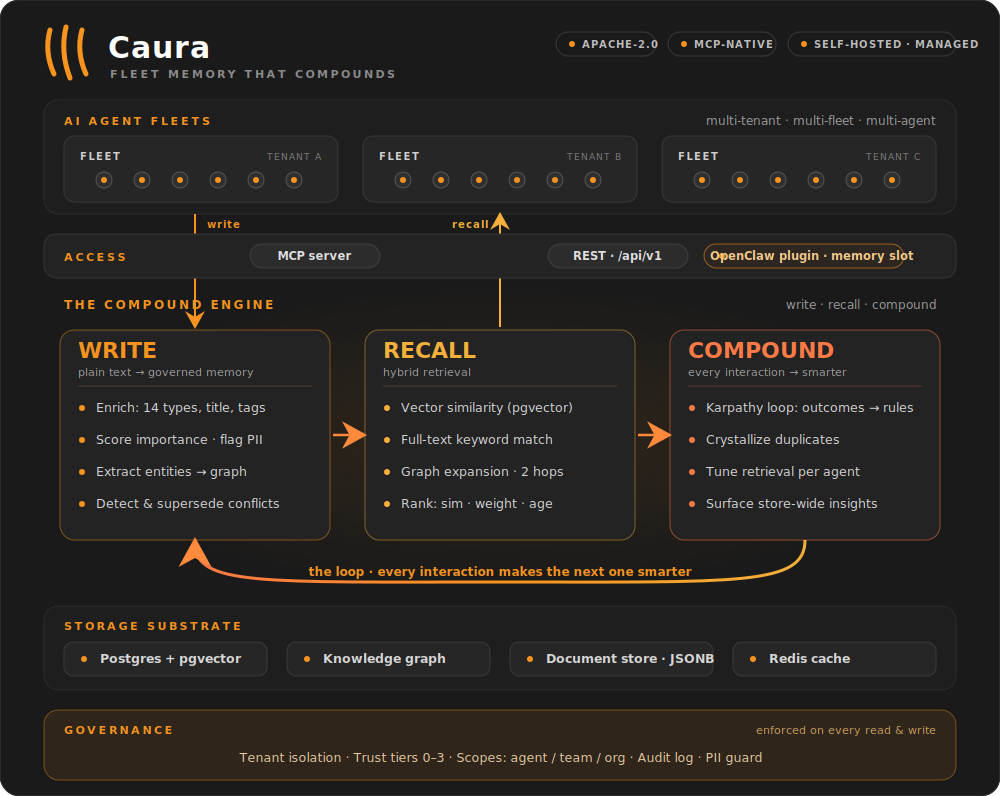
Caura — formerly MemClaw — is open-source memory for multi-tenant, multi-agent AI fleets. Your agents store what they learn, find what the fleet knows, and get smarter with every interaction — learning from each other instead of repeating mistakes.
Agents write plain text. Caura turns it into searchable, governed, self-improving memory.
One loop, three pillars: write, recall, compound — every interaction makes the next one smarter.
Built for fleets. One agent works, and that's where most teams start — nothing below changes for a single-agent setup. What Caura adds is headroom: scoped memory, cross-agent outcome propagation, and fleet-wide trust tiers are there from the first write, and they keep paying off as agents multiply. Public agent-memory benchmarks (LoCoMo, LongMemEval) measure one agent, one user, one long conversation — the single-chatbot shape. Fleet governance and workload-specific latency still need validation in the environment where they matter. See the generated Performance block and evidence registry for approved benchmark results, or read the benchmarks write-up.
Production case study: eToro uses Caura as a governed shared-memory layer for its AI-agent work. Architecture deep-dive →
Quick Start
Try it locally — no API key, no signup
The fastest way to see Caura work. Standalone mode runs single-tenant with auth bypassed — start Caura, write a memory, and find it again. (With no key there's nothing to configure: memories are stored without embeddings and found by keyword. Add an AI provider key for semantic search — see Self-Hosted below.)
git clone https://github.com/caura-ai/caura.git
cd caura
cp .env.example .env && echo "IS_STANDALONE=true" >> .env   # single-tenant, no API key
docker compose up -d --wait                                 # Postgres + pgvector + Redis + API + scheduler (~30s)
# Write a memory — no API key needed
curl -X POST http://localhost:8000/api/v1/memories \
  -H "X-API-Key: standalone" -H "Content-Type: application/json" \
  -d '{"tenant_id": "default", "agent_id": "quickstart", "write_mode": "strong", "content": "Our auth service uses JWT with 15-minute expiry."}'

# Find it by keyword — no provider key needed
curl -X POST http://localhost:8000/api/v1/search \
  -H "X-API-Key: standalone" -H "Content-Type: application/json" \
  -d '{"tenant_id": "default", "query": "JWT expiry"}'
The keyless strong-write response includes memory_type, title, status, and weight — plus a summary under metadata — all derived by a deterministic local heuristic from the single content field. With a configured AI provider, those values are model-inferred and metadata can also include tags.
Want semantic paraphrases? The keyless query deliberately reuses words from the memory. After configuring an embedding provider in the next section, try
"authentication token lifetime"instead — matching that phrase to "JWT with 15-minute expiry" exercises semantic recall.
See the fleet effect
For the architecture, evaluation checklist, and a stable GitHub-native citation target, see Shared persistent memory for AI agent fleets.
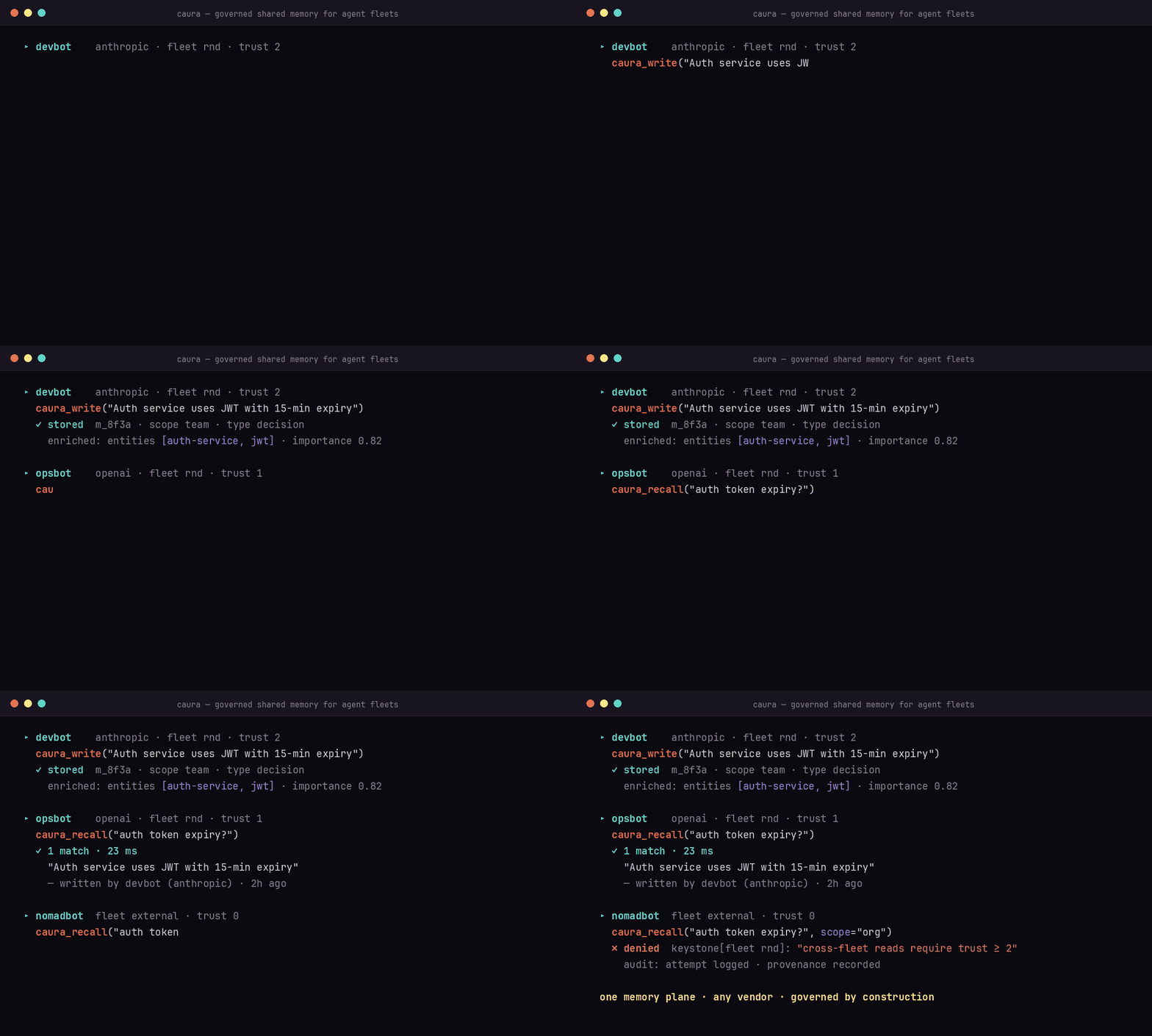
Connect two MCP clients to the same fleet. Agent A records an operational
lesson with caura_write:
{
  "agent_id": "deploy-agent",
  "fleet_id": "platform",
  "visibility": "scope_team",
  "content": "Roll back auth-service with: deployctl rollback auth-service --to <version>."
}
Agent B asks caura_recall from that fleet:
{
  "agent_id": "incident-agent",
  "fleet_ids": ["platform"],
  "query": "How do I roll back auth-service?"
}
The result identifies deploy-agent as the author: one agent learned it, and
another reused it. scope_agent would keep the memory private;
scope_team shares it within the fleet; scope_org enables governed
cross-fleet recall subject to the trust ladder.
For production, give each client its own
agent-scoped credential.
Ready for semantic recall, multi-tenant, a managed host, or an OpenClaw fleet? Pick a path below.
Four paths — pick the one that matches your setup:
| Path | When | Time to first memory |
|---|---|---|
| Managed platform | Quickest. We host the DB + scaling. | ~2 min |
| Self-hosted (Docker) | Privacy / on-prem / air-gapped. | ~5 min |
| OpenClaw plugin | You already run an OpenClaw fleet — install Caura as a plugin against any of the above. | ~3 min |
| Rail SDK | You write the agent yourself, in Python or TypeScript, and want it to recall rules and facts before every turn and store what it learned after. Works against any of the above. | ~2 min |
Managed Platform
Get up and running in minutes — no infrastructure, automatic updates, usage analytics, and enterprise-grade security included.
- Sign up free on caura.ai.
- Create an API key in the dashboard under Connect › Keys.
- Connect through MCP or REST:
{
  "mcpServers": {
    "caura": {
      "url": "https://caura.ai/mcp",
      "headers": { "X-API-Key": "mc_your_api_key_here" }
    }
  }
}
For a production fleet, provision one agent-scoped credential per agent. See Integrating without the OpenClaw plugin for credential scopes, headers, and provisioning.
Using the tenant-scoped dashboard key? Pass an explicit agent_id on every MCP
tool call; the gateway rejects the reserved mcp-agent default on that path.
Self-Hosted (Open Source)
Docker Compose starts PostgreSQL + pgvector, Redis, the storage service, the
REST/MCP API, and the core-operations lifecycle scheduler (nightly expiry,
archival, purge and crystallization). The keyless example above is the shortest
path; add a provider for semantic recall.
- Complete self-hosting guide — providers, auth, service topology, security, offline operation, and tests
- Local embedder — fully local semantic search with no cloud API calls
- Manual deployment without Docker
OpenClaw Plugin
Already running an OpenClaw fleet? Install Caura as a plugin against either the managed platform or your self-hosted stack:
The plugin claims OpenClaw's memory slot and exposes the same agent-facing
memory tools. Use the
agent installer's one-line setup,
then see the OpenClaw integration guide for
agent prompts and trust levels. Already have nodes running? Keeping them current
— auto-upgrade and the manual re-install — is covered in
docs/plugin-upgrade.md.
Security & health
What it can reach and how reliably it runs — from our own checks, not the maintainer’s claims.
ActiveLast checked Today
Recent health check succeeded.
Adoption & maintenance
Factual signals from GitHub, npm, and our automated checks — not a rating.
GitHub stars505Stargazers on the source repository.
Last commitTodayMost recent push to the default branch.
Reviews
No reviews yet — be the first to share how it worked for you.
Frequently Asked Questions about Caura
We don't have a confirmed install command for caura yet, so we don't publish a generated one — a guessed package name would point at the wrong package or none at all. Follow the project's own README or setup instructions (https://github.com/caura-ai/caura) for the current steps.
Caura (formerly MemClaw) — governed shared memory for AI agent fleets. Multi-agent, multi-tenant, MCP-native. Trust tiers, keystone policies, audit trails, knowledge graph, self-improving retrieval. Apache 2.0.
We don't have confirmed pricing for caura. Listing it on AllMCPs is free, but that says nothing about what the server itself costs — check the project's own site for current pricing.
Related MCP servers
Add a badge to your READMEShow it’s listed — live SVG, Markdown or HTML.
AllMCPs Directory Badge
Showcase your server listing on GitHub or your project documentation. Embed this dynamic SVG badge to highlight official listing status and live engagement.
Badge Style:
Live Dynamic SVG Preview
Markdown (GitHub README)
[](https://allmcps.com/mcp/caura)HTML Embed
<a href="https://allmcps.com/mcp/caura"><img src="https://allmcps.com/api/badge/caura?style=directory" alt="Caura on AllMCPs" /></a>