Canicode
Analyze Figma designs for dev & AI readiness. 39 rules, scoring, HTML reports.
Install Canicode
Pick your client, then add it in one click or paste the config.
~/Library/Application Support/Claude/claude_desktop_config.json{
"mcpServers": {
"canicode": {
"command": "npx",
"args": [
"-y",
"canicode"
]
}
}
}
Settings → Developer → Edit Config, merge this into mcpServers, then fully quit and reopen Claude Desktop.
We couldn’t confirm it starts correctly
We ran the install command but it didn't respond within our test window — this can mean a slow first-time install rather than a real problem.
npx -y canicodeNo response to initialize.
This is an experimental automated check and can have false negatives — missing environment variables, a slow cold install, etc. It doesn’t necessarily mean something’s wrong. Last checked 7d ago.
Overview
Security & health
What it can reach and how reliably it runs — from our own checks, not the maintainer’s claims.
Recent health check succeeded.
Supply-chain signal
No high-severity advisories surfaced by our automated scan.
Scanned 13d ago via OSV.dev · canicode (npm)
Adoption & maintenance
Factual signals from GitHub, npm, and our automated checks — not a rating.
From the project README
CanICode




Ship your Figma design exactly as you intended — without learning CSS.
Try it in your browser — no install needed.
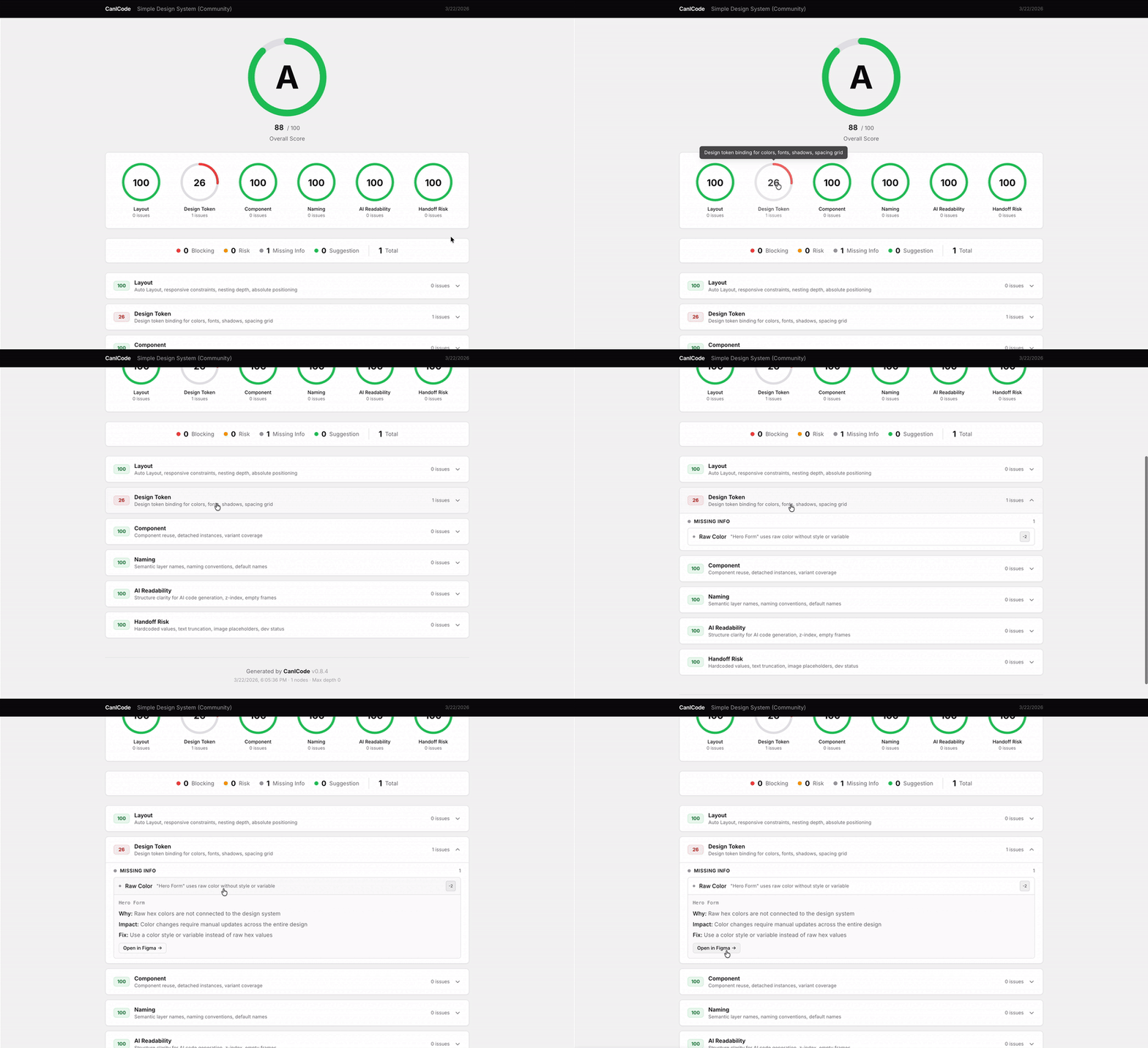
What canicode does
You designed it in Figma. You know exactly how it should look and behave — but the AI codegen guesses, and half the time it guesses wrong. The cards don't stack on mobile. The hover state disappears. The padding gets normalised. That's not what I designed.
canicode is the pre-implementation interview between your Figma file and AI codegen. It asks the questions a developer would ask before they implement — in plain language you can answer:
"The three cards are side-by-side at desktop width — what should happen when the screen is narrow?"
You answer in plain words ("좁아지면 한 줄에 하나씩" / "stack them vertically"). canicode translates that into the exact technical spec the codegen needs, and writes it back into your Figma file as a structured annotation so the next run no longer has to guess.
You stay in Figma. You never type a CSS selector. The intent ships.
→ Full thesis: docs/POSITIONING.md
The three layers
- Linter — 17 rules surface the gaps your craft instinct senses but can't name. "Something's off with this spacing." → it finds the one card with 14px padding while the rest are 16px.
- Q&A scaffolding — for every gap, canicode asks in your vocabulary, not the developer's. You answer, it spec'ifies.
- Roundtrip persistence — answers live in the Figma file as Dev Mode annotations. Next run, next person, next codegen — they all see the intent.
The linter is deterministic (no LLM tokens consumed for the analysis itself), ablation-validated at 94% pixel accuracy with 5× fewer tokens than raw JSON, and calibrated against real Figma designs.
Why canicode (vs Claude Design)
Claude Design launched in April 2026 and covers the prompt → app path beautifully — AI designs from your prompt and hands the result to Claude Code. canicode covers a different workflow:
| Claude Design | canicode | |
|---|---|---|
| Who designs | AI (from a prompt) | The designer (in Figma) |
If you want the AI to design for you, use Claude Design. If you already designed it and want it implemented exactly the way you intended, canicode is for you. The two are not in competition — they assume different things about who owns the design.
See docs/POSITIONING.md for the full thesis (target persona, the workflow assumption, and what canicode is not for).
The Roundtrip Workflow
Skills: canicode-gotchas = survey answers saved locally in SKILL.md only (memo). canicode-roundtrip = same analysis path plus writes to Figma (annotations / properties). Pick gotchas for capture-only; pick roundtrip when the design file should change.
- Analyze — run the 17 rules against the Figma design (report includes grade).
- Surface gotchas — the analyzer emits questions for design information it can't infer (missing states, unclear variants, responsive intent).
- Apply fixes to Figma — the
/canicode-roundtripskill writes answers back viause_figma. Each write shows up in the summary with one of three outcome markers:- ✅ scene write succeeded — the property was written directly to the scene node or instance override.
- 📝 annotated the scene node — the skill left a structured annotation instead of writing the property. This is the default for instance-child layout writes, because propagating a property to the component definition (and therefore every instance of it) is almost never what the user wants. A summary full of 📝 markers is correct behavior, not failure.
- 🌐 definition write propagated — the property was written to the component definition and every instance inherited it. Only happens when the user opted in up front with
allowDefinitionWrite.
- Re-analyze — verify gotchas were captured (annotations / acks); repeat step 2 if new gotchas surface.
- Hand off to
figma-implement-design— canicode's scope ends at design augmentation. Figma's official code-generation skill takes the now-clean design and produces code. - Close out with a Code Connect mapping — after
figma-implement-designreturns, the roundtrip asks whether the generated code is satisfactory. Ony, canicode registers a Code Connect mapping pointing the Figma component at the just-generated code so future roundtrips on screens containing this component reuse the implementation instead of regenerating markup. Skipped if Code Connect is not set up in your repo — the roundtrip warns about this up front, before the gotcha survey, so you can decide whether to install prerequisites first or proceed without mapping.
Try it in 30 seconds
- Open the web app — paste any Figma URL, get a report. No install, no token, no AI cost. This is the linter view (Layer 1) — useful by itself.
- Then if you want the full Q&A roundtrip, install the Claude Code skill below.
Run the full roundtrip (Claude Code)
npx canicode init
# saves your Figma token + installs /canicode-roundtrip
# (the prompt asks for the token; never paste it into agent chat)

/canicode-roundtrip https://www.figma.com/design/ABC123/MyDesign?node-id=1-234
# in your Claude Code session
The roundtrip calls the Figma MCP server to read and write your design — install it once with claude mcp add -s project -t http figma https://mcp.figma.com/mcp and restart Claude Code.
Cursor / Claude Desktop / other MCP host: also supported. CLI install path (
npx canicode init --cursor-skills), bare MCP server install, GitHub Action for CI gates, and other channels are listed in the Installation matrix below.
Optional — Code Connect (for the closing Step 6 mapping): install
@figma/code-connectand createfigma.config.jsonat your repo root per Figma's setup guide, then runcanicode doctor. If you skip this, the roundtrip still works — it just does not register the mapping. It warns you up front so you can decide.
What It Checks
| Category | Rules | What it measures |
|---|---|---|
| Pixel Critical | 3 | Can AI read the layout? (Auto Layout, absolute positioning, groups) |
| Responsive Critical | 2 | Will it work at different viewports? (fixed sizing, size constraints) |
| Code Quality | 5 | Is the design efficient for AI context? (components, variants, nesting, Code Connect coverage) |
| Token Management | 2 | Can AI reproduce exact values? (raw values, spacing grid) |
| Interaction | 2 | Can AI know what happens? (state variants, prototypes) |
| Semantic | 3 | Can AI infer meaning? (semantic names, conventions) |
Each issue is classified: Blocking > Risk > Missing Info > Suggestion.
Installation — pick one
Token safety: never paste your Figma token into Claude / Cursor / agent chat — session logs can retain it. Use the CLI prompt (
npx canicode init),--token, or theFIGMA_TOKEN=…env var.
Each row below is a complete install. Don't run more than one — they cover overlapping use cases.
| If you use… | Install |
|---|---|
| Claude Code (recommended for the roundtrip workflow) | npx canicode init (interactive prompt for the token in a TTY) or npx canicode init --token figd_xxxxxxxxxxxxx (CI / non-TTY) — saves the token AND drops /canicode, /canicode-gotchas, /canicode-roundtrip skills into ./.claude/skills/. The skills already know how to call canicode via npx canicode …, so no canicode MCP install is needed; the Figma MCP is still required for the /canicode-roundtrip apply step — see the prereq below. To rotate the token later without reinstalling skills: npx canicode config set-token. |
| Cursor / Claude Desktop / other MCP host | Add canicode to the host’s MCP config — see docs/CUSTOMIZATION.md. Example (Cursor project file): npx + canicode-mcp via --package=canicode. |
| OpenClaw / other AgentSkills-compatible host | Manual skill copy — see Other agents (manual install). Best-effort docs, not a support commitment. |
| Just the CLI (CI, scripts) | Nothing. npx canicode analyze "<figma-url>" works directly. Run canicode init --token … once if you want the token persisted to ~/.canicode/config.json. To rotate the token later, use canicode config set-token (no skill reinstall). |
Reviews
No reviews yet — be the first to share how it worked for you.
Frequently Asked Questions about Canicode
Related MCP servers
Add a badge to your READMEShow it’s listed — live SVG, Markdown or HTML.
AllMCPs Directory Badge
Showcase your server listing on GitHub or your project documentation. Embed this dynamic SVG badge to highlight official listing status and live engagement.
[](https://allmcps.com/mcp/canicode)<a href="https://allmcps.com/mcp/canicode"><img src="https://allmcps.com/api/badge/canicode?style=directory" alt="Canicode on AllMCPs" /></a>