AllMCPs
BrowseBestCategoriesStackCompareToolsGuidesBlog Log in Submit MCP

Stay in the loop

Get new MCP servers and top picks in your inbox.

AllMCPs

The open directory for discovering and installing Model Context Protocol servers.

Explore

  • Browse servers
  • Best MCP servers
  • Categories
  • MCP clients
  • Agent prompts
  • Stack Builder
  • Compare servers
  • Tags index
  • Submit a server
  • Pricing

Learn

  • Guides hub
  • What is MCP?
  • Install guide
  • Troubleshooting
  • Security
  • Blog
  • Blog RSS

Tools

  • All tools
  • Config generator
  • Config validator
  • MCP playground
  • OpenAPI β†’ MCP
  • Badge generator

For agents

  • API docs
  • Trust & traffic
  • llms.txt β†— (opens in a new tab)
  • Catalog JSON β†— (opens in a new tab)
  • Remote MCP β†— (opens in a new tab)

Company

  • About
  • Contact
  • X (@AllMCPs) β†— (opens in a new tab)
  • GitHub β†— (opens in a new tab)
  • Terms
  • Privacy
AllMCPs VerifiedAllMCPs VerifiedFeatured on Nick LaunchesFeatured on Nick LaunchesLaunch Llama NewsletterLaunch Llama NewsletterVerified DR - allmcps.comVerified DR - allmcps.comFeatured on SaaSGrowFeatured on SaaSGrowFeatured on Twelve ToolsFeatured on Twelve ToolsFeatured on Saaspa.geFeatured on Saaspa.geFeatured on Findly.toolsFeatured on Findly.toolsFeatured on Startup FameFeatured on Startup FameFeatured on LaunchKiwiFeatured on LaunchKiwiFeatured on ScrollLaunchFeatured on ScrollLaunchFeatured on DailyPingsFeatured on DailyPingsFazier badgeFazier badgeFeatured on NewTool.siteFeatured on NewTool.siteFeatured on saasfame.comFeatured on saasfame.comDR Checker - Domain RatingDR Checker - Domain RatingListed on Turbo0Listed on Turbo0Launched on LaunchBoard - Product Launch PlatformLaunched on LaunchBoard - Product Launch PlatformList on SimilarlabsList on Similarlabshttps://codetrendy.comhttps://codetrendy.comListed on DevTool.ioFeatured on BuildlistFeatured on BuildlistAllMCPs VerifiedAllMCPs VerifiedFeatured on Nick LaunchesFeatured on Nick LaunchesLaunch Llama NewsletterLaunch Llama NewsletterVerified DR - allmcps.comVerified DR - allmcps.comFeatured on SaaSGrowFeatured on SaaSGrowFeatured on Twelve ToolsFeatured on Twelve ToolsFeatured on Saaspa.geFeatured on Saaspa.geFeatured on Findly.toolsFeatured on Findly.toolsFeatured on Startup FameFeatured on Startup FameFeatured on LaunchKiwiFeatured on LaunchKiwiFeatured on ScrollLaunchFeatured on ScrollLaunchFeatured on DailyPingsFeatured on DailyPingsFazier badgeFazier badgeFeatured on NewTool.siteFeatured on NewTool.siteFeatured on saasfame.comFeatured on saasfame.comDR Checker - Domain RatingDR Checker - Domain RatingListed on Turbo0Listed on Turbo0Launched on LaunchBoard - Product Launch PlatformLaunched on LaunchBoard - Product Launch PlatformList on SimilarlabsList on Similarlabshttps://codetrendy.comhttps://codetrendy.comListed on DevTool.ioFeatured on BuildlistFeatured on Buildlist
Β© 2026 Jackalope Digital LLC. All rights reserved.
  1. Home
  2. πŸ€– Coding Agents
  3. Call Copilot
C
Health: Not checked yetWe have not completed a health check for this listing yet.Last checked 8/10/2026, 11:46:10 PM

Call Copilot

Enrichment pendingWe haven’t run our AI enrichment pass on this listing yet, so the overview, use cases, and FAQ below may be sparse or missing. We work through the catalog over time β€” check back soon.
View Repository

Search and read locally-recorded meeting transcripts over stdio. Read-only, no network.

Quick Install

Automated & IDE Setup

Copy the AI prompt to install this server into Claude Code, Cursor, or another agent β€” or use 1-click editor setup below.

Add to CursorAdd to VS Code
Manual Client & Custom JSON ConfigExpand JSON β–Ύ

Install Config Generator

Choose your client
claude_desktop_config.json
{
  "mcpServers": {
    "call-copilot": {
      "command": "npx",
      "args": [
        "-y",
        "call-copilot"
      ]
    }
  }
}

πŸ’‘ Paste into ~/Library/Application Support/Claude/claude_desktop_config.json (macOS) or %APPDATA%\Claude\claude_desktop_config.json (Windows)

Install Directory Badge Claim listing AlternativesπŸ€– More in Coding Agents

Documentation Overview

Call Copilot

call-copilot MCP server call-copilot MCP server

One thing. Done really well. Record meetings. Save transcripts. Don't break audio.

Call Copilot is a terminal command (rec) that records your meeting audio and, when you stop it, transcribes locally and saves a clean markdown transcript. Everything runs on your machine β€” no cloud, no API keys, no account. Audio and transcripts never leave the computer.

Call Copilot demo

Code
$ rec setup         # one-time: verify macOS + grant capture permission
$ rec start         # starts recording, you keep working
$ rec stop          # stops, transcribes, saves markdown
$ rec list          # shows past recordings

How it captures audio (no BlackHole, no Multi-Output Device)

By default, rec captures both the microphone (your voice) AND system audio (other participants / anything apps play) β€” so a real meeting where you speak gets recorded, not just the audio coming out of your speakers. Both sources are tapped directly via Apple's Core Audio taps API (macOS 14.2+) using the audiotap library. There is:

  • no virtual audio driver to install (no BlackHole),
  • no Multi-Output Device to create in Audio MIDI Setup,
  • no system output device to switch and restore,
  • and therefore no silent-recording failure that the old driver-based approaches produce when routing breaks.

The mic and system streams are recorded as two separate WAVs (each at its own true rate), transcribed separately, and merged into one transcript with [Mic] / [System] labels so you can tell who said what. Want just one source? rec start --mic-only or --system-only.

Grant capture permission (one-time, per terminal app)

macOS ties capture permission to the app you run rec from (Terminal, iTerm, Warp, VS Code, …). You need two grants:

  1. Microphone (your voice): System Settings β†’ Privacy & Security β†’ Microphone β†’ enable your terminal app.
  2. System audio (grouped under Screen Recording on macOS 14.2+): System Settings β†’ Privacy & Security β†’ Screen Recording β†’ enable your terminal app, then quit and reopen it (required for the change to take effect).

Until mic is granted, rec start records system audio only and skips the mic (it tells you so). rec setup checks the current mic-permission status.

After rec stop (or Ctrl+C from rec start), the recording(s) are transcribed locally with faster-whisper (CPU, int8 β€” no API, no data leaves your machine) and written to a markdown transcript.

Code
recording.wav ──> faster-whisper (local, free) ──> transcript.md

Requirements

  • macOS 14.2 or later (Sonoma β€” the Core Audio process taps API rec records through landed in 14.2). Apple Silicon recommended. Intel works.
  • Python 3.11+ only needed for the pipx install; the Homebrew formula brings its own.

No virtual audio driver (no BlackHole), no Multi-Output Device, no manual Audio MIDI Setup. The tap reads system output directly. rec checks the macOS version itself and refuses to run below 14.2 with a one-line message β€” you don't have to guess.

Install

Homebrew (recommended β€” no Python to manage):

bash
brew install AnisurRahmann/tap/call-copilot

pipx (if you prefer a plain Python install, no Homebrew):

bash
pipx install call-copilot

Either way you get a rec command on your PATH. Then jump to One-time setup.

Using rec on a machine below macOS 14.2 prints Error: rec requires macOS 14.2 or later ... and exits β€” no traceback, no mystery. See docs/HOMEBREW.md if you're setting up the tap yourself.

Recording consent & privacy

Call Copilot records audio from your meetings, which may include other participants. Recording laws vary by jurisdiction and many require the consent of everyone being recorded (one-party vs. all-party consent). Obtaining that consent is your responsibility β€” check your local laws and your organization's policy before recording.

On the technical side, your data stays put:

  • Transcription runs 100% locally with faster-whisper (CPU, int8) β€” no API, no cloud.
  • Audio and transcripts never leave your machine. The only network access is the first run of a given Whisper model, which downloads its weights from Hugging Face; after that it's fully offline.
  • Recordings live under ~/.local/share/rec/sessions/ (XDG data home), outside any repo.

One-time setup

bash
rec setup

Verifies your macOS version, that the audiotap library + its bundled dylib load, saves your config, and tells you about the one-time capture permission prompt.

Recording a meeting

bash
rec start                          # mic + system (default); Ctrl+C to stop & transcribe
rec start --system-only            # just what apps play (not your voice)
rec start --mic-only               # just your voice (not system audio)
rec list                           # browse past sessions
rec transcribe 2026-07-27_14-30-00 --model medium    # re-transcribe at higher quality
rec diagnose 2026-07-27_14-30-00                      # bundle debug info for an AI agent

By default rec start records both your microphone and system audio; the transcript labels each line [Mic] or [System]. Use --system-only / --mic-only to narrow.

rec start shows a live indicator while recording:

Code
● REC  2026-07-28_14-30-00
elapsed 03:47   size 18.2 MB
press Ctrl+C to stop & transcribe

Press Ctrl+C when your meeting ends β€” it stops the recording and transcribes in the same command, then prints the transcript path. One command, start to finish.

Want the old background behavior instead? rec start --detach spawns the recorder and exits immediately; stop it later from another terminal with rec stop (or check progress with rec status).

Tip: if a transcript comes back empty, the recording was silent β€” nothing was playing, or the capture permission was revoked. rec start (and rec stop) warn you about this immediately, and rec diagnose <session> bundles the audio levels + logs.

Use your meetings from Claude Code

rec ships an MCP server (the open protocol Claude Code, Cursor, Zed, Cline, and other AI tools speak). Point any MCP client at your locally-recorded transcripts and ask questions about them β€” answers come back with the session id cited, so you can check the exact moment. Nothing leaves your machine: the server is strictly read-only and makes no network calls.

bash
rec mcp install     # writes the server entry into Claude Code's config

Then restart Claude Code and ask, for example:

  • "What did the client actually ask for on Tuesday's call?" β€” it searches the transcripts, finds the line, and cites the session id (e.g. 2026-07-28_12-25-20) with a timestamp.
  • "List my meetings from last week with their durations." β€” it lists sessions, narrowing by date.
  • "Show me the full transcript of the standup where we discussed the API migration." β€” it finds the session, then reads the whole transcript.

Three tools are exposed: list_sessions (find a meeting by date), get_session (read a whole transcript), and search_transcripts (find specific lines across long transcripts β€” pass it keywords like pricing discount, not a full sentence). The search index lives at ~/.local/share/rec/index.db; it builds lazily on first search and is a disposable cache β€” rec index refreshes it, rec index --rebuild recreates it from scratch.

Other MCP clients (Cursor, Zed, Cline, …)

rec mcp install prints a config block that works in any MCP client. For Cursor, paste it into .cursor/mcp.json; for Zed, into settings.json under mcp_servers. It looks like:

config.json
{
  "call-copilot": {
    "type": "stdio",
    "command": "rec",
    "args": ["mcp"]
  }
}

You can also run the server directly with rec mcp (stdio transport) if a client prefers a raw command.

Official MCP Registry

Call Copilot is listed on the official MCP Registry under io.github.AnisurRahmann/call-copilot. Any MCP client that speaks the registry can discover and add it from there. The registry entry runs the server with:

bash
uvx --from call-copilot rec mcp

(The PyPI package is call-copilot; the command it installs is rec, so the server is launched as rec mcp.)

Browser UI

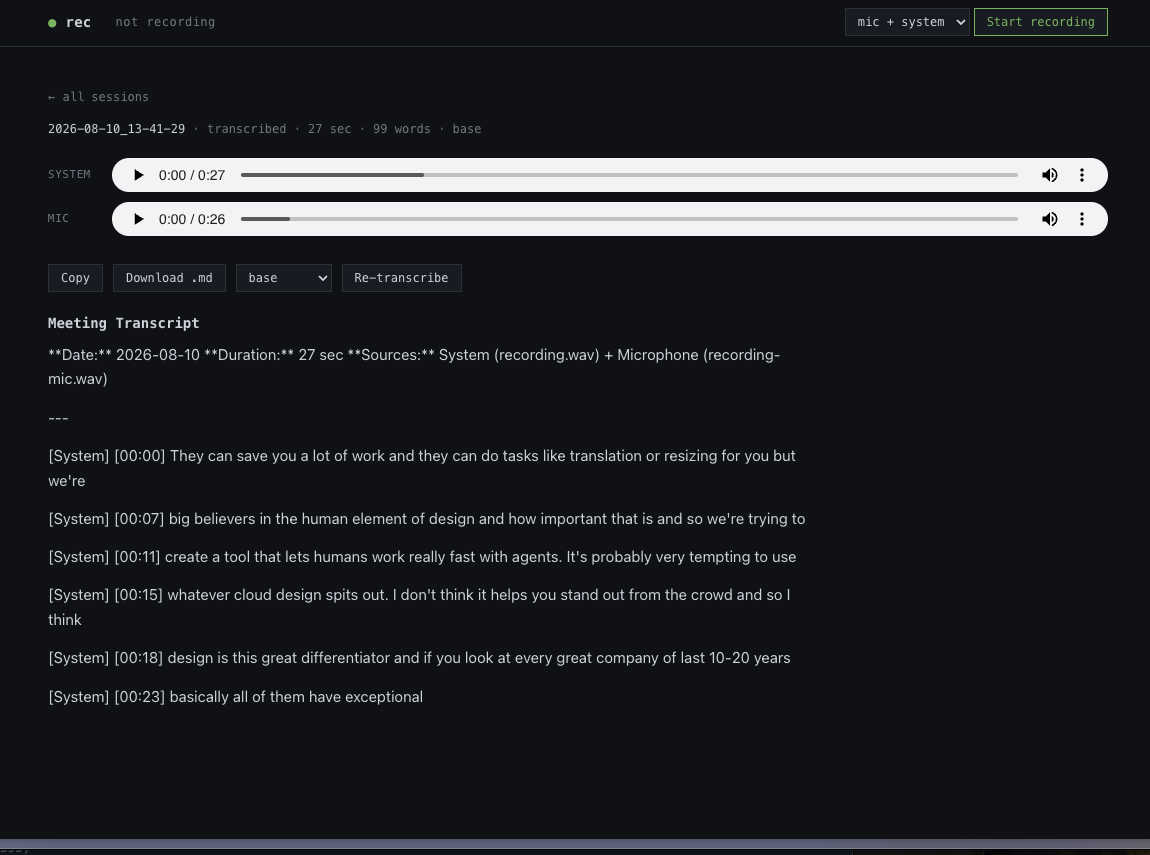
rec web opens a local browser tab β€” a read-mostly viewer for sessions you've already recorded, plus Start/Stop controls. It's modelled on the qBittorrent / Transmission web UI: a loopback HTTP server serves a single-page app that drives the same session store the CLI uses. The terminal can't show a live capture meter, a seekable audio player beside its transcript, or a session list you can skim in one glance β€” the browser can, so the UI exists for exactly those three things.
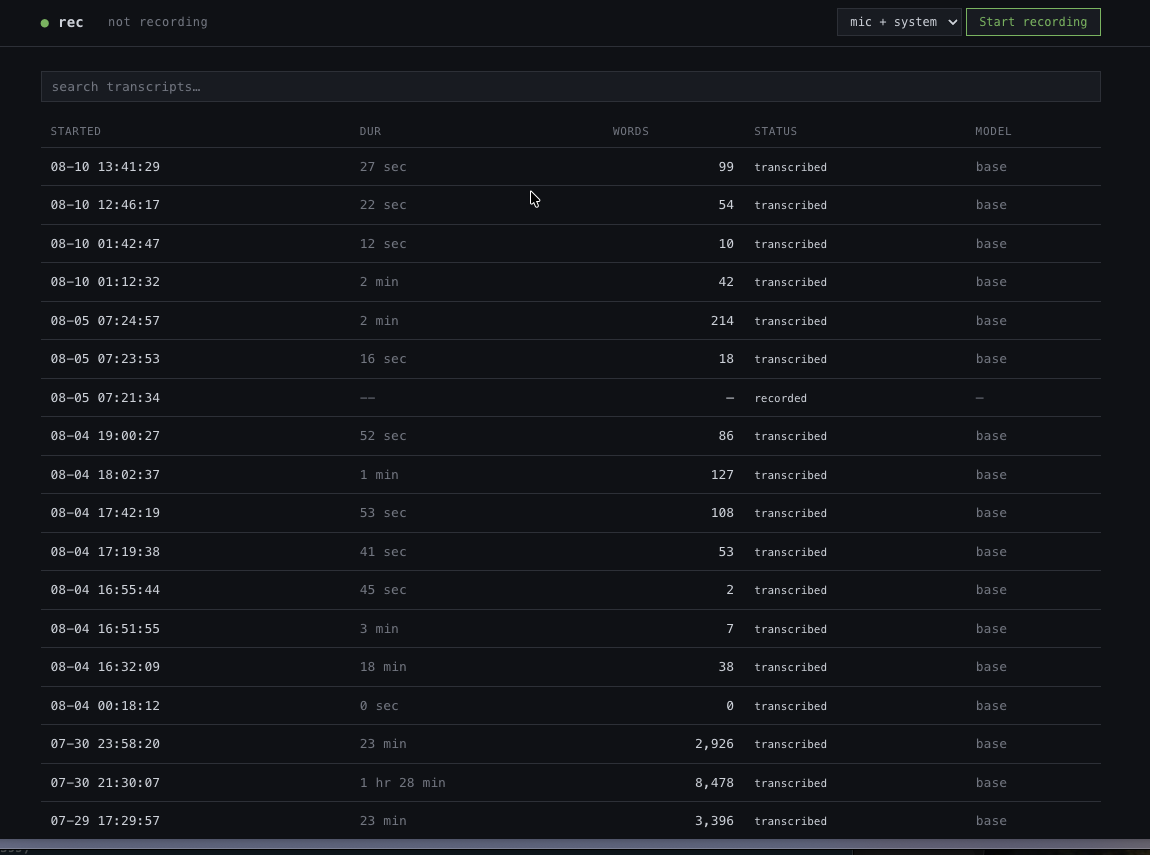
rec web β€” session list

rec web β€” session detail with audio and transcript

bash
rec setup            # one-time, in a terminal (the UI can't grant capture permission)
rec web              # opens a browser tab at http://127.0.0.1:7717

From the tab you can browse sessions, play and seek the audio next to its transcript, search across every transcript, and Start/Stop a recording. Start calls the same recorder the CLI does; Stop queues transcription and the page polls until the transcript is ready. If no config is found, the Start button tells you to run rec setup in a terminal first.

The server binds to 127.0.0.1 only β€” the host is not configurable, by design (a local tool must not become an open transcript server). --port overrides the default port; --no-open skips the automatic browser tab.

What this is not. The UI is still not a real-time transcription surface β€” the transcript arrives after Stop, exactly as in the CLI, and there is still no cloud, no sync, and no account. Every action in the browser maps to a command that already exists; if a feature has no CLI equivalent, it is not in the UI.

Configuration

Stored at ~/.config/rec/config.json (XDG). Recordings live under ~/.local/share/rec/sessions/{id}/. Override the XDG roots with XDG_CONFIG_HOME / XDG_DATA_HOME if needed.

config.json
{
  "sample_rate": 16000,
  "channels": 1,
  "whisper_model": "base",
  "capture": "system",
  "sessions_dir": "~/.local/share/rec/sessions"
}

16 kHz mono float32 is Whisper's native input format β€” no resampling, smallest files (~7.5 MB/min), best transcription accuracy.

A note on sample rate (why your recordings play at the right speed)

audiotap's sample_rate parameter is not honored β€” the tap always delivers audio at your output device's native rate (typically 48 kHz), regardless of what we request. rec handles this transparently: the recorder measures the true capture rate when the tap starts and writes the WAV at that rate (so playback is the correct speed), and the transcriber resamples to 16 kHz before feeding Whisper (so transcription is accurate). You don't need to do anything; this section exists to explain the capture_sample_rate field in session.json (which may differ from the sample_rate in your config).

A note on VAD (voice activity detection)

Transcription runs without faster-whisper's Silero VAD pre-filter by default. The VAD is tuned for close-mic speech and aggressively rejects system-audio capture (speakers/headphones via a tap, which has a different character) β€” we've seen it discard 100% of a clearly-audible recording and return an empty transcript. Whisper's own no_speech_threshold handles silence adequately without that risk.

If you have clean close-mic input and want long silences skipped (faster, cleaner output), enable it per run:

bash
rec stop --vad              # VAD on for this transcription
rec transcribe <id> --vad   # re-transcribe with VAD

Stack

ToolRole
audiotapCore Audio taps β†’ captures system audio directly (macOS 14.2+)
soundfileStreams WAV chunks to disk (constant memory)
faster-whisperLocal speech-to-text (CPU int8)
rich + clickTerminal UI + CLI

Everything is free and open-source. Transcription runs 100% locally β€” no API cost, no data leaves the machine. (The first run of a given whisper model downloads its weights from Hugging Face; after that it's offline.)

Logging & debugging

Every activity β€” the audio tap lifecycle, chunk writes, transcription, formatting, each CLI decision β€” is logged. Logs flow to three destinations:

DestinationPathLevelWhat it's for
Console (stderr)your terminalWARNING*User-facing; clean by default
Global log~/.local/share/rec/logs/rec.logDEBUGMonitor surface β€” tail -f it
Session log~/.local/share/rec/sessions/<id>/recorder.logDEBUGPer-session post-mortem

* WARNING by default: -v β†’ INFO, -vv β†’ DEBUG, --quiet β†’ CRITICAL, REC_LOG_LEVEL=DEBUG.

Every command failure is logged at ERROR with the reason + exit code; unexpected crashes include the full traceback.

Hand a session to an AI agent to debug

bash
rec list                                 # find the session id
rec diagnose 2026-07-27_14-30-00        # β†’ writes sessions/<id>/diagnose.md
rec diagnose 2026-07-27_14-30-00 --stdout | <your-ai-tool>   # pipe straight to an agent

The bundle contains the session metadata, the daemon's recorder.log, the global-log lines tagged with that session, the transcript if it exists, and the config β€” followed by a debugging checklist. (rec diagnose accepts a unique prefix too, e.g. 2026-07-27.)

Note on the recording loop: the audio callback runs on Core Audio's real-time thread and deliberately logs nothing β€” it copies each chunk to a queue and a writer thread does the disk I/O. The daemon logs only at tap start/stop and on signals.

Development

You only need this if you're hacking on rec itself. End users should use the Install commands above.

bash
git clone https://github.com/AnisurRahmann/call-copilot.git && cd call-copilot
make install          # creates .venv and installs `rec` in editable mode + dev deps
make test             # unit tests (offline β€” no audio device or model download needed)
make run              # rec start, using the dev venv's rec

make install requires Python 3.11+ on your PATH (it pins python3.11 for the venv). For everything else β€” releasing, the Homebrew tap, code style β€” see CONTRIBUTING.md and docs/HOMEBREW.md.

Contributing

Issues and pull requests are welcome at github.com/AnisurRahmann/call-copilot. Please read CONTRIBUTING.md before opening a PR, and report security issues privately per SECURITY.md.

What this is NOT

  • Not a real-time transcription tool (transcription happens after you stop).
  • Not a meeting summarizer (just the transcript).
  • Not a Zoom/Meet plugin (it captures system audio generically).
  • Not cross-platform (macOS 14.2+ only).

License

MIT β€” see LICENSE. Β© Anisur Rahman.

Related MCP Servers

View all in Coding Agents View all alternatives
  • Reassign logoReassign

    Reassign β€” circular 24-hour calendar & time-tracking copilot with ADHD-friendly scheduling.

    πŸ€– Coding Agents0 views
    Compare vs Reassign β†’
  • S
    ServiceNow MCP Server (NowAIKit)

    ServiceNow MCP server: 450+ tools for Claude, ChatGPT, Copilot & any AI. Read-only by default.

    πŸ€– Coding Agents0 views
    Compare vs ServiceNow MCP Server (NowAIKit) β†’
  • Ssh Mcp logoSsh Mcp

    MCP server exposing SSH control for Linux and Windows servers via Model Context Protocol. Securely execute remote shell commands with password or SSH key authentication.

    πŸ€– Coding Agents2 views
    Compare vs Ssh Mcp β†’
  • A
    Agent Skill

    An MCP Server that provides identity verification and anti-fraud tools for AI agents via deepidv.

    πŸ€– Coding Agents0 views
    Compare vs Agent Skill β†’

Frequently Asked Questions about Call Copilot

Add the following block to your claude_desktop_config.json under mcpServers: "mcpServers": { "call-copilot": { "command": "npx", "args": ["-y", "Call Copilot"] } }

AllMCPs Directory Badge

Full Badge Customizer

Showcase your server listing on GitHub or your project documentation. Embed this dynamic SVG badge to highlight official listing status and live engagement.

Badge Style:
Live Dynamic SVG PreviewCall Copilot AllMCPs Directory Badge

Markdown (GitHub README)
[![AllMCPs](https://allmcps.com/api/badge/call-copilot?style=directory)](https://allmcps.com/mcp/call-copilot)
HTML Embed
<a href="https://allmcps.com/mcp/call-copilot"><img src="https://allmcps.com/api/badge/call-copilot?style=directory" alt="Call Copilot on AllMCPs" /></a>

Technical Specs & Signals

CategoryπŸ€–Coding Agents
More technical detailsExpand β–Ύ
TransportSTDIO
RuntimeNode.js
Views0
Unique ViewsTotal visits recorded for this listing page on AllMCPs.
Installs0
Installs & Copy ActionsTotal times users copied install commands or configuration snippets for this server.
27Quality signal: Emerging Β· 27/100How this signal is calculated β–Ύ
Server availabilityNot measured

Not scored for repo-hosted servers β€” we can't reach the running server, only its GitHub page. Hosted MCP endpoints are health-checked live.

Verified ownership8/20
Documentation & tools11/30
Adoption & activity1/15
Community engagement0/10

A guidance signal from public completeness & health data β€” not a user rating. New listings start lower and rise as they add docs, get verified, and grow adoption. Signals we can't observe for a listing are skipped, not counted against it.

β˜… Spotlight Slot

Feature Your MCP Server

Get maximum visibility for your server across our directory, search results, and detail pages.

Spotlight Your Server

Own this project?

This directory is pre-filled from public sources. Claim via GitHub README, site badge, or DNS TXT to get the verified badge and attach your website.

Free dofollow backlink: after claiming, verify your product site and place a dofollow AllMCPs badge β€” we recheck it stays live.

Claim & get free dofollow

Share & Embed

Add our SVG badge (dark/light directory styles) or embeddable widget to your site.

Explore more

More in πŸ€– Coding Agents β†’Best MCP servers for Coding Agents β†’Alternatives to Call Copilot β†’Install in Claude DesktopInstall in CursorInstall in VS Code