Schedule a GitHub Projects backlog into Google Calendar, as a CLI or an MCP server.
Quick Install
Automated & IDE SetupCopy the AI prompt to install this server into Claude Code, Cursor, or another agent — or use 1-click editor setup below.
One-click editor setup isn’t available for this listing yet — we don’t have a confirmed install command, and we’d rather show nothing than point your editor at the wrong package or host. Follow the project’s own setup instructions, linked above.
Manual Client & Custom JSON ConfigExpand JSON ▾
No confirmed setup config for this listing yet. We only publish a config block when the install details come from the project itself — its README, its docs, or a verified owner. We haven’t found those for cal-auto-python, and we’d rather show nothing than a guess you’d paste into your client. Follow the project’s own setup instructions for the current steps.
Documentation Overview
Automatic Calendar in Python
mcp-name: io.github.danielsousaoliveira/cal-auto-python




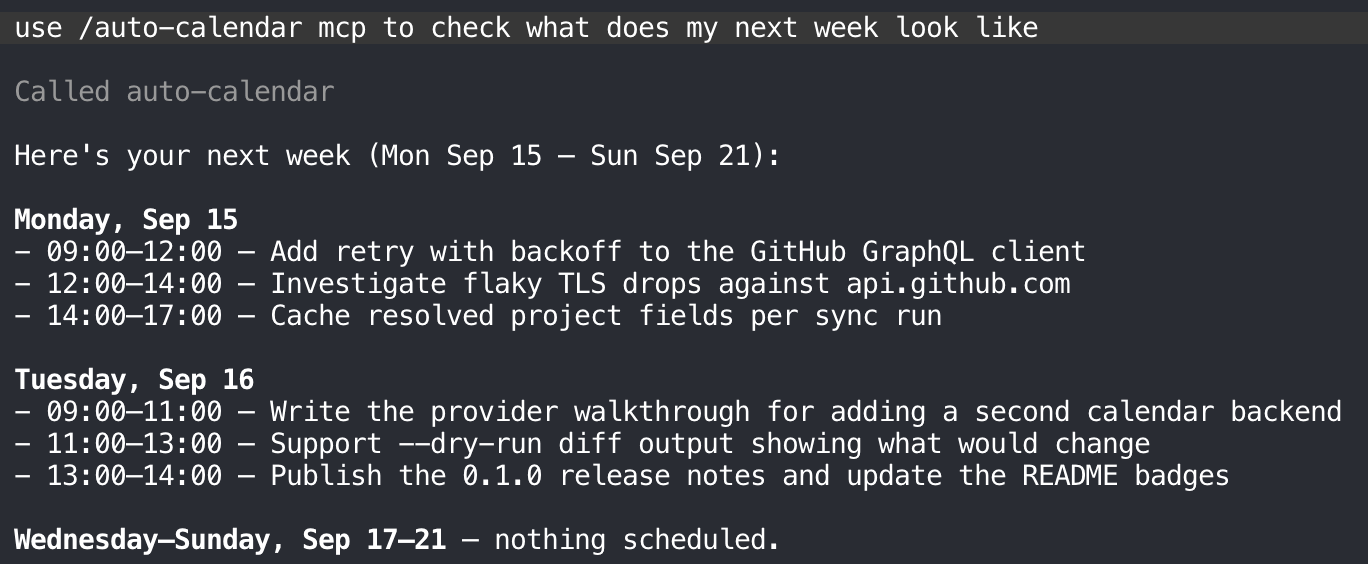
An MCP server that connects your GitHub Projects backlog to Google Calendar and Google Tasks. Point your assistant at it and ask it to show what's on your calendar, list your backlog, plan a week of work into your free time, or turn that plan into real events and to-dos.
A backlog board on the left becomes a scheduled week on the right, with each markdown checkbox carried across as its own to-do:
| Before | After |
|---|---|
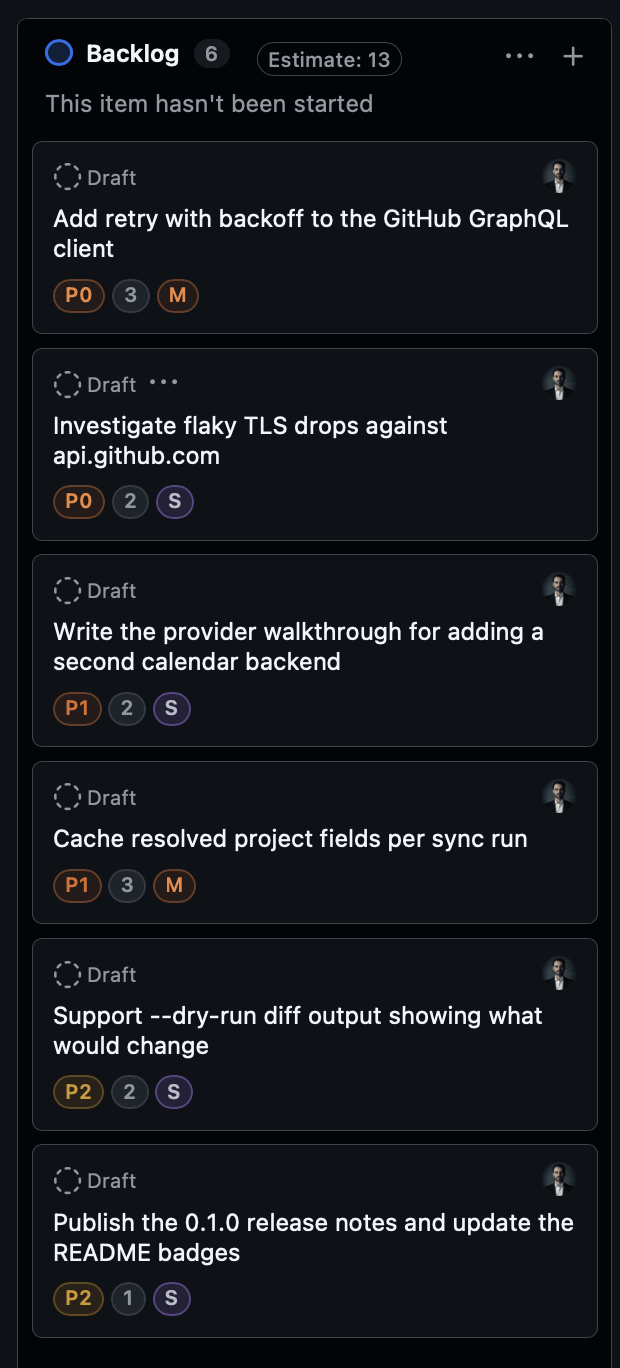 | 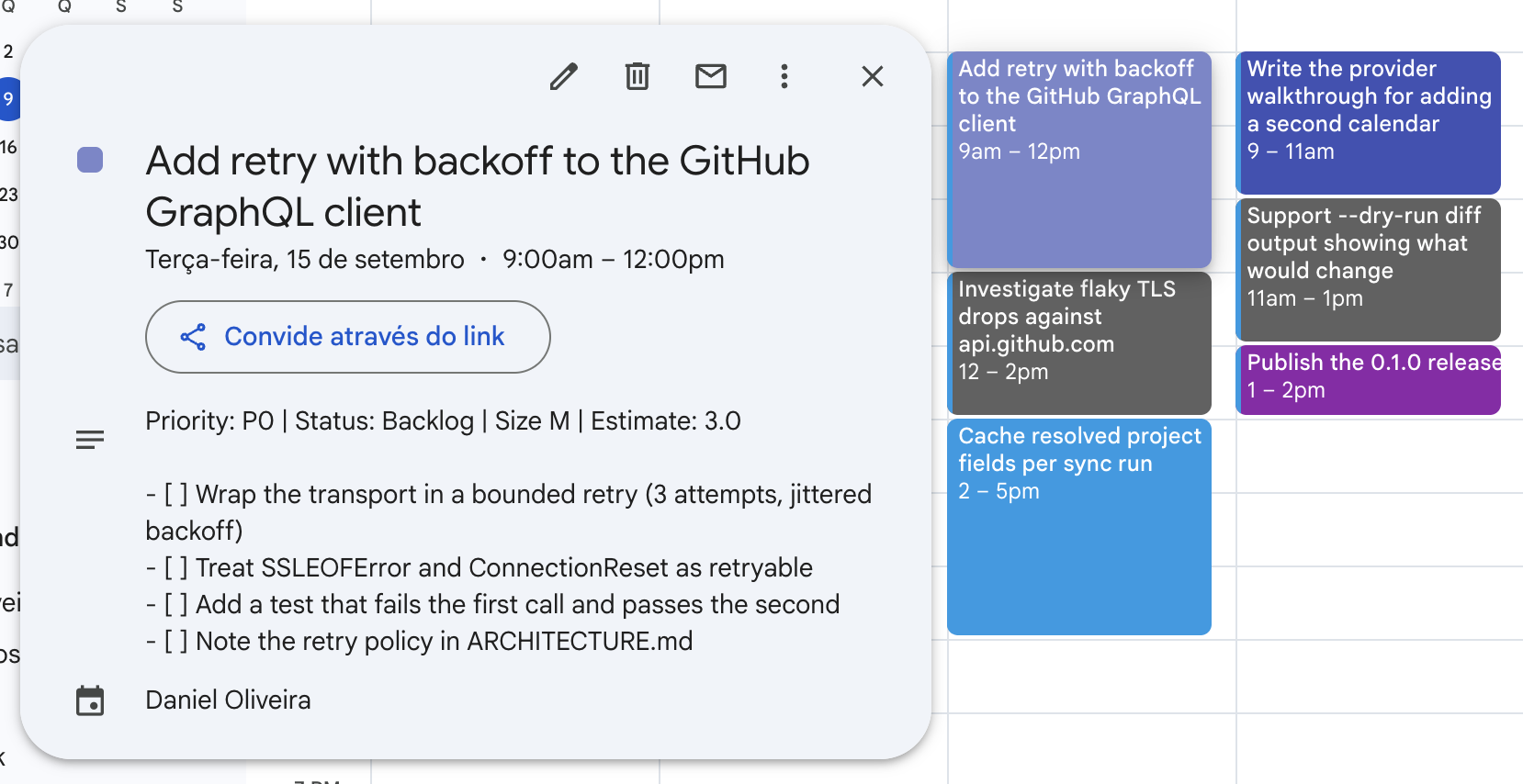 |
Install
This installs the cal-auto-python command, which runs both the CLI and the MCP server.
One-off authorisation
Before the server can read or write your calendar, you authorise it once against your Google account:
This opens a browser window, asks you to sign in and grant calendar/tasks access, and stores the
resulting token on disk (token.json in the config directory below). Do this before starting the
server for the first time, and again any time authorisation expires — see
Troubleshooting.
Authorisation needs a Google OAuth client:
- In the Google Cloud Console, create a project (or reuse one) and enable the Google Calendar API and Google Tasks API.
- Under APIs & Services → Credentials, create an OAuth client ID of type Desktop app, and download the resulting JSON.
- Save it as
credentials.jsonin the config directory (see Configuration for where that is and how to change it).
Connect it to your assistant
The server speaks MCP over stdio by default, which is what these clients expect. Every capability behaves the same regardless of client.
Claude Code
Register it in one command:
Add -s user to make it available in every project instead of only the current one. To keep the
token out of ~/.claude.json and out of the process list, put your settings in a file and pass
that instead — note that the path must be absolute, since Claude Code starts the server from
whichever directory you launch it in:
Then /mcp lists the server and its tools, and the prompts appear as /auto-calendar:plan-week
and /auto-calendar:whats-scheduled. Use claude mcp list to check registration and
claude mcp remove auto-calendar to undo it.
Claude Desktop
Add to claude_desktop_config.json:
Cursor
Add to .cursor/mcp.json in your project (or the global ~/.cursor/mcp.json):
Generic (any stdio-capable MCP client)
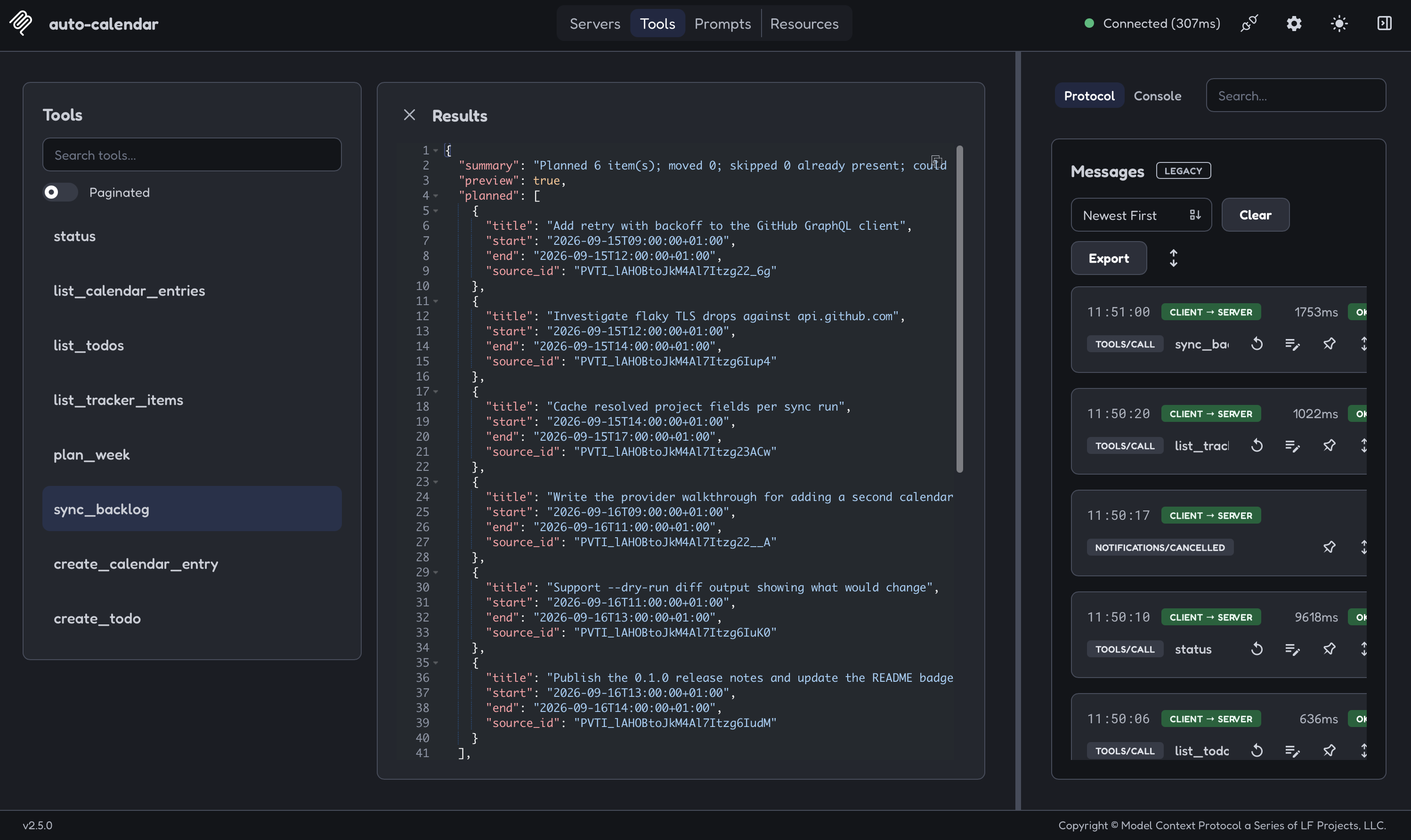
To poke at the server without a client, point the MCP Inspector at it:
Web-based clients, or anyone wanting to run the server on one machine and talk to it from another, can't launch a stdio child process. For them, run the server over HTTP instead:
HTTP mode is single-user and intended for local use only. The server reads one person's stored
Google authorisation from disk and has no notion of separate users; it adds no authorisation of its
own on top of the HTTP endpoint. Exposing it on a shared or public network would hand everyone who
can reach it access to that one calendar, so only bind it to 127.0.0.1 or a private, trusted
network.
Prerequisites
- A GitHub personal access token with read access to the Projects V2 board you want to
schedule from: a classic token with the
read:projectscope (plusrepoif the board tracks items in private repositories), or a fine-grained token granted read access to Projects. Set it asGITHUB_TOKEN. - The board's Projects V2 node ID, e.g.
PVT_xxxxxxxxxx. Find it by querying the GitHub GraphQL API for the project, or from its URL and the Projects API docs. Set it asGITHUB_PROJECT_ID. - A Google OAuth client (Desktop app type) as described in One-off authorisation above.
Capabilities
| Tool | Arguments | What it does |
|---|---|---|
status | — | Reports which integrations are configured and whether Google authorisation is present. Reveals no secrets. |
list_calendar_entries | start, end (YYYY-MM-DD, inclusive) | Lists calendar events and all-day items in the date range. |
list_todos | — | Lists outstanding (not completed) items from the configured Google Tasks list. |
list_tracker_items | statuses (optional list, e.g. ["Backlog", "In Progress"]) | Lists work items from the GitHub Projects board, optionally filtered by status. Omit to list everything. |
plan_week | items, start_date, end_date, working_day_start, working_day_end, timezone (optional), commitments (optional) | Plans work into free working-hour slots for the given items and existing commitments. Pure computation — does not touch any configured account. |
sync_backlog | start_date, end_date, apply (default false) | Fetches the schedulable backlog, fits it around existing calendar commitments, and returns the result. Previews by default; pass apply=true to create the events and to-dos. Already-scheduled items are skipped. |
create_calendar_entry | summary, start, end, timezone, description (optional), attendees (optional) | Creates one calendar event. Does not schedule or deduplicate. |
create_todo | title, note (optional), due (optional) | Creates one Google Task. Does not deduplicate. |
Two prompts wrap the common workflows, so they show up as one-click starting points in clients
that support them (slash commands in Claude Code and Claude Desktop, for instance). Both take
optional start_date and end_date (YYYY-MM-DD) and default to the next seven days.
| Prompt | What it asks for |
|---|---|
plan-week | Reads the backlog and existing commitments, previews a schedule, and waits for your confirmation before anything is written. |
whats-scheduled | Summarises calendar entries and outstanding to-dos by day, flagging overloaded days and to-dos with no calendar time. |

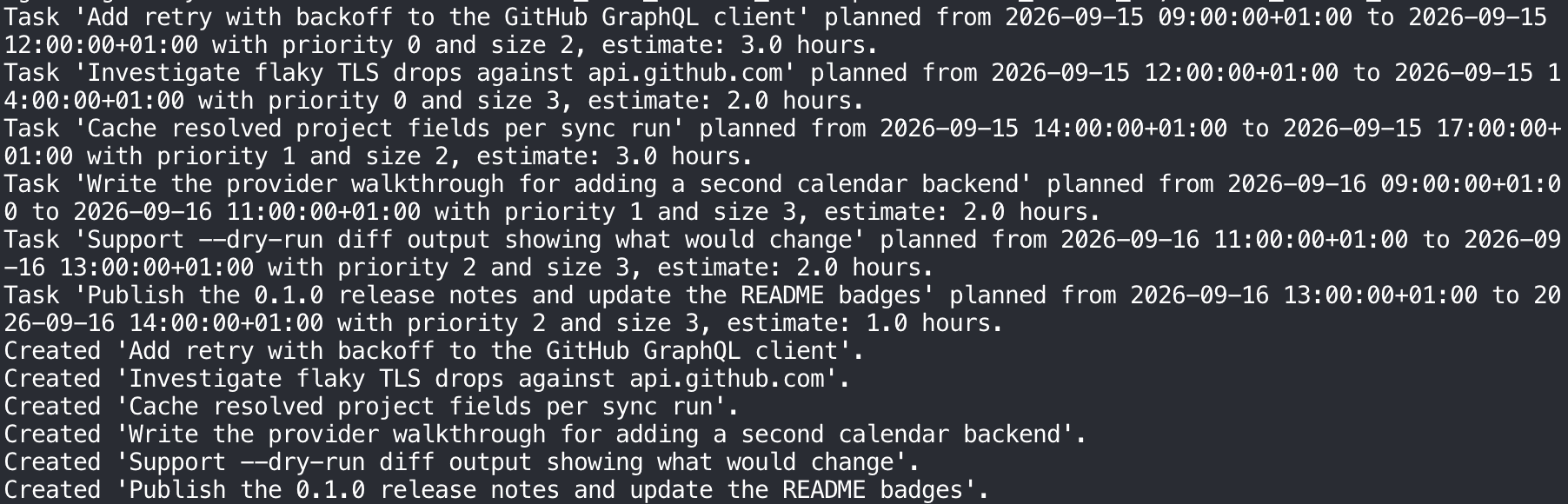
The CLI exposes the same scheduling logic directly:
sync previews by default; pass --apply to create events and tasks, and --start/--end
(YYYY-MM-DD) or --working-day-start/--working-day-end (HH:MM) to override the default
range (today plus the next two days) and working hours.
Configuration
Every variable below is optional except GITHUB_TOKEN, GITHUB_PROJECT_ID, and
CAL_AUTO_TIMEZONE, which has no default and must be set.
Configuration is read from the process environment. MCP clients pass these in the env block of
their server config. For CLI use you can either export them, or copy .env.example to .env and
point the command at it explicitly:
--env-file loads the given file (and only when passed — nothing is read from the working
directory automatically). Only CAL_AUTO_* and GITHUB_* keys are applied; anything else in the
file is ignored with a warning. Variables already set in the environment win over the file.
Related MCP Servers
Reviews
No reviews yet — be the first to share how this listing worked for you.
Frequently Asked Questions about Cal Auto Python
AllMCPs Directory Badge
Showcase your server listing on GitHub or your project documentation. Embed this dynamic SVG badge to highlight official listing status and live engagement.
Badge Style:
Live Dynamic SVG Preview
Markdown (GitHub README)
[](https://allmcps.com/mcp/cal-auto-python)HTML Embed
<a href="https://allmcps.com/mcp/cal-auto-python"><img src="https://allmcps.com/api/badge/cal-auto-python?style=directory" alt="Cal Auto Python on AllMCPs" /></a>