Plain-English browser tests for AI agents: real Chrome, deterministic verdicts. Free, no API keys.
Quick Install
Automated & IDE SetupCopy the AI prompt to install this server into Claude Code, Cursor, or another agent — or use 1-click editor setup below.
One-click editor setup isn’t available for this listing yet — we don’t have a confirmed install command, and we’d rather show nothing than point your editor at the wrong package or host. Follow the project’s own setup instructions, linked above.
Manual Client & Custom JSON ConfigExpand JSON ▾
No confirmed setup config for this listing yet. We only publish a config block when the install details come from the project itself — its README, its docs, or a verified owner. We haven’t found those for browserbash, and we’d rather show nothing than a guess you’d paste into your client. Follow the project’s own setup instructions for the current steps.
Documentation Overview
BrowserBash
Plain-English browser automation. No selectors. Free and open-source.




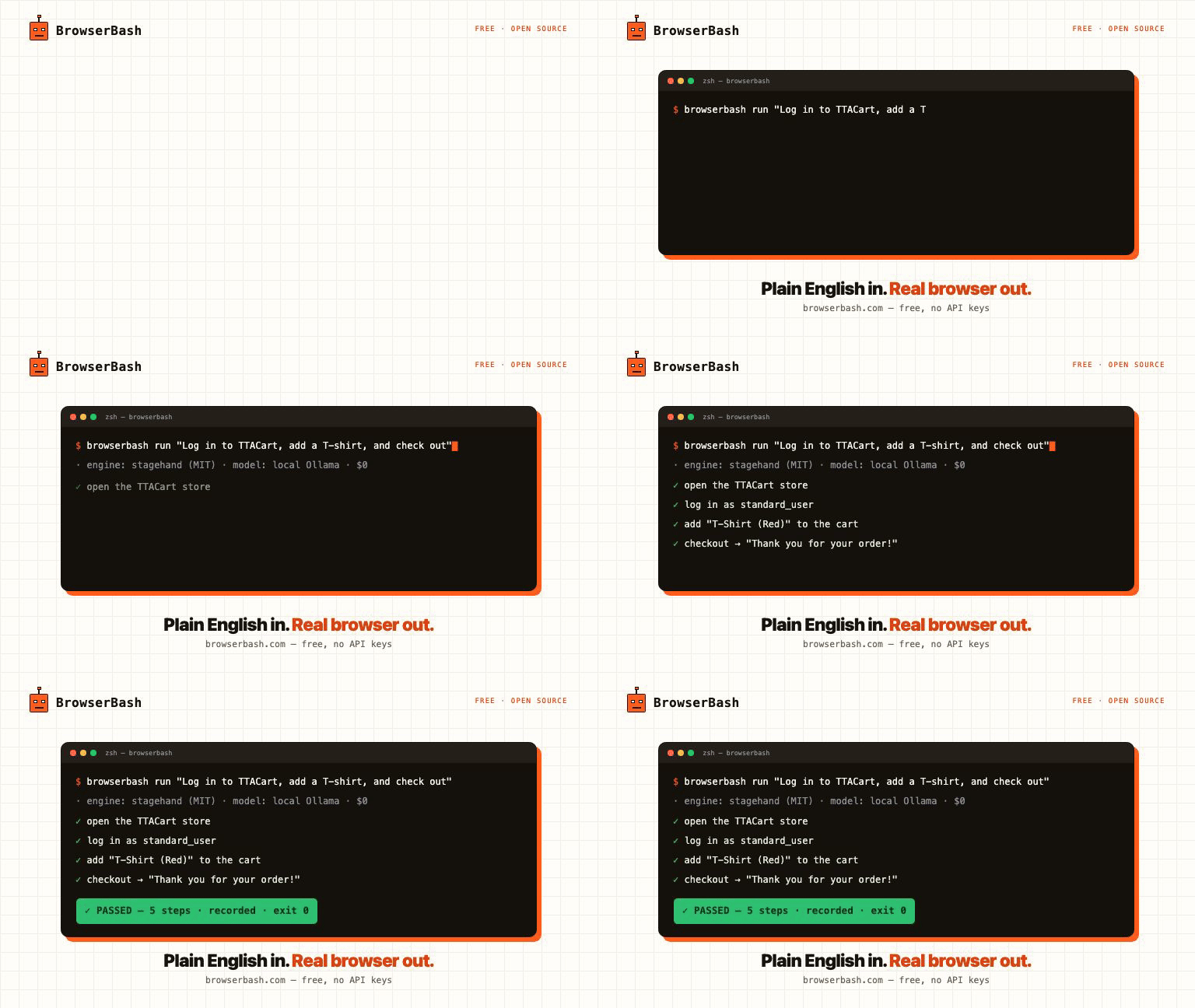
You write a plain-English objective. An AI agent drives a real Chrome browser step by step — no selectors, no scripts. Ollama-first, so it runs on free local models with no API keys and nothing ever leaves your machine.
Website · Docs / Learn · Tutorials · npm
Both layers are swappable: the engine interprets the English, the provider runs the browser.
Engines (who interprets the English)
| Engine | What it is | License |
|---|---|---|
stagehand (default) | Stagehand — open-source AI browser automation framework by Browserbase. act/extract/observe/agent primitives, self-healing, supports Anthropic/OpenAI/Google models. | MIT |
builtin | In-repo Anthropic tool-use loop driving Playwright. Used automatically for grids Stagehand can't attach to (LambdaTest, BrowserStack). | Apache-2.0 |
Providers (where the browser runs)
| Provider | Where the browser runs | Engine | Auth |
|---|---|---|---|
local (default) | Chromium/Chrome on this machine | stagehand or builtin | none |
cdp | Any Chrome DevTools Protocol endpoint (your grid, docker, Playwright MCP-managed browser) | stagehand or builtin | none |
browserbase | Browserbase cloud browsers | stagehand only | BROWSERBASE_API_KEY / BROWSERBASE_PROJECT_ID |
lambdatest | LambdaTest / TestMu AI cloud grid | builtin (auto) | LT_USERNAME / LT_ACCESS_KEY |
browserstack | BrowserStack Automate cloud grid | builtin (auto) | BROWSERSTACK_USERNAME / BROWSERSTACK_ACCESS_KEY |
LLM backends (who does the thinking) — open source first
Default model is auto, resolved in this order:
- Ollama running locally →
ollama/<OLLAMA_MODEL or first installed model>— free, open source, no keys ANTHROPIC_API_KEYset →claude-opus-4-8OPENAI_API_KEYset →openai/gpt-4.1- otherwise: error with setup guidance
| Backend | Model flag | Needs |
|---|---|---|
| Ollama — local, free, OSS (preferred) | auto or ollama/<model> e.g. ollama/qwen3 | Ollama running; OLLAMA_BASE_URL to override http://localhost:11434/v1, OLLAMA_MODEL to pin auto-detection. Same flag works for any OpenAI-compatible server (vLLM, LM Studio, llama.cpp). |
| Anthropic | claude-opus-4-8 | ANTHROPIC_API_KEY |
| OpenAI / Google | openai/gpt-4.1, google/gemini-2.5-flash | provider key (Stagehand engine) |
| OpenRouter — hundreds of models, one key | openrouter/<vendor>/<model> e.g. openrouter/anthropic/claude-sonnet-4-6, openrouter/meta-llama/llama-3.3-70b-instruct | OPENROUTER_API_KEY (https://openrouter.ai/keys); override endpoint with OPENROUTER_BASE_URL |
| Anthropic-compatible gateway | claude-* + ANTHROPIC_BASE_URL | builtin engine routes through any Anthropic-compatible endpoint (e.g. a LiteLLM proxy fronting local models) |
Fully free / open-source stack (the default)
Stagehand engine (MIT) + local Chromium + Ollama (MIT) — zero cloud cost, no API keys. Tip: small models (≤8B) are flaky on multi-step objectives; Qwen3 / Llama 3.3 70B class works best.
Note: cloud-grid providers (lambdatest, browserstack) use the builtin engine, which speaks the Anthropic API — pair them with ANTHROPIC_API_KEY or an ANTHROPIC_BASE_URL gateway.
Install
Requires Node ≥ 18 and Google Chrome stable (for the local provider).
Quick start
Agent mode (for AI coding tools & CI)
--agent switches stdout to NDJSON — one JSON object per line, stable schema:
- Progress events:
{"type":"step","step":1,"status":"passed","action":"navigate","remark":"...","cached":false} - Terminal event:
{"type":"run_end","status":"passed|failed|error|timeout","summary":"...","final_state":{...},"duration_ms":...,"provider":"local","cache":"hit|miss|off","tokens_in":...,"tokens_out":...,"test_url":"..."}
Exit codes: 0 passed · 1 failed · 2 error · 3 timeout. cached, cache, tokens_in/tokens_out are additive fields (present when relevant), so existing consumers are unaffected.
Full agent integration guide: docs/agents.md.
MCP server (agents consume BrowserBash natively)
BrowserBash is a validation layer for AI agents: your coding agent builds a feature, BrowserBash proves it works in a real browser. One line plugs it into any MCP host:
Tools exposed: run_objective (one plain-English objective), run_test_file (a *_test.md), run_suite (a folder, parallel). Each returns the structured verdict JSON: status, summary, final_state, assertions, cost_usd, duration_ms. A failed test is a successful validation, so the tool call succeeds and the agent reads the verdict. No extra dependencies, stdio only, nothing leaves your machine.
Dashboards
Every run is kept in a private on-disk store (~/.browserbash/runs, secrets masked, capped at 200). Two ways to see them:
Local dashboard — free, no account, fully local:
Left panel lists your runs; the main pane shows the verdict, extracted values and the recording — with --record you get a screenshot plus a session video (stagehand engine, video needs ffmpeg, bundled) or a native Playwright trace you can open at trace.playwright.dev (builtin engine). Nothing leaves your machine.
Cloud dashboard — optional, opt-in per run: a hosted dashboard at browserbash.com/dashboard with run history across machines and shareable per-run pages.
Without --upload nothing is sent to the cloud. BrowserBash is free and open source; cloud runs are kept 15 days.
Replay cache (warm runs skip the model)
A green run records the actions it took. The next identical run replays them with zero model calls, and the agent only steps back in when the page actually changed. Steady-state suites run at close to script speed and cost.
run_end.cache reports hit / miss / off. On by default; config set cache.enabled false to disable, cache.dir to relocate (default .browserbash/cache, gitignored by init). Secrets never enter the cache: values arrive through the variables channel (Stagehand) or are re-templatized to {{name}} tokens (builtin), and any cached action that types a secret is origin-pinned — replaying it on a different origin fails closed. Builtin journals are also HMAC-signed with a per-machine key (~/.browserbash/cache.key); an edited or foreign journal is ignored and simply re-recorded. CI fleets that want to share committed caches can set the same BROWSERBASH_CACHE_KEY (64 hex chars) on every runner.
Parallel suites (run-all)
Run a whole folder of *_test.md files at once with memory-aware scheduling:
Related MCP Servers
Adoption & maintenance
Factual signals from GitHub, npm, and our automated checks — not a rating.
GitHub stars
2
Stargazers on the source repository.
Last commit
2mo ago
Most recent push to the default branch.
Directory activity
1 views
Config copies, upvotes, and views on AllMCPs.
Reviews
No reviews yet — be the first to share how this listing worked for you.
Frequently Asked Questions about Browserbash
AllMCPs Directory Badge
Showcase your server listing on GitHub or your project documentation. Embed this dynamic SVG badge to highlight official listing status and live engagement.
Badge Style:
Live Dynamic SVG Preview
Markdown (GitHub README)
[](https://allmcps.com/mcp/browserbash)HTML Embed
<a href="https://allmcps.com/mcp/browserbash"><img src="https://allmcps.com/api/badge/browserbash?style=directory" alt="Browserbash on AllMCPs" /></a>Technical Specs & Signals
CategoryBrowser Automation
32Quality signal: Emerging · 32/100How this signal is calculated ▾
Server availabilityNot measured
Not scored for repo-hosted servers — we can't reach the running server, only its GitHub page. Hosted MCP endpoints are health-checked live.
Verified ownership10/20
Documentation & tools11/30
Adoption & activity3/15
Community engagement0/10
A guidance signal from public completeness & health data — not a user rating. New listings start lower and rise as they add docs, get verified, and grow adoption. Signals we can't observe for a listing are skipped, not counted against it.
Own this project?
This directory is pre-filled from public sources. Claim via GitHub README, site badge, or DNS TXT to unlock edit access and the Official badge — proof is checked automatically, then reviewed by our team.
Free dofollow backlink: add your website and place the AllMCPs badge on it — no claim needed. We detect it automatically and keep it verified as long as the badge stays live.
Claim & get free dofollowShare & Embed
Add our SVG badge (dark/light directory styles) or embeddable widget to your site.