browser-gateway
The open router for cloud browsers.
One endpoint that routes across every browser provider you use: automatic failover, persistent profiles, session replay, REST API, MCP server, dashboard.
Works unchanged with Puppeteer, Playwright, Stagehand, browser-use, and any MCP client.










Website · Quick start · MCP · Profiles · Replays · REST API · Dashboard · Discord
Overview
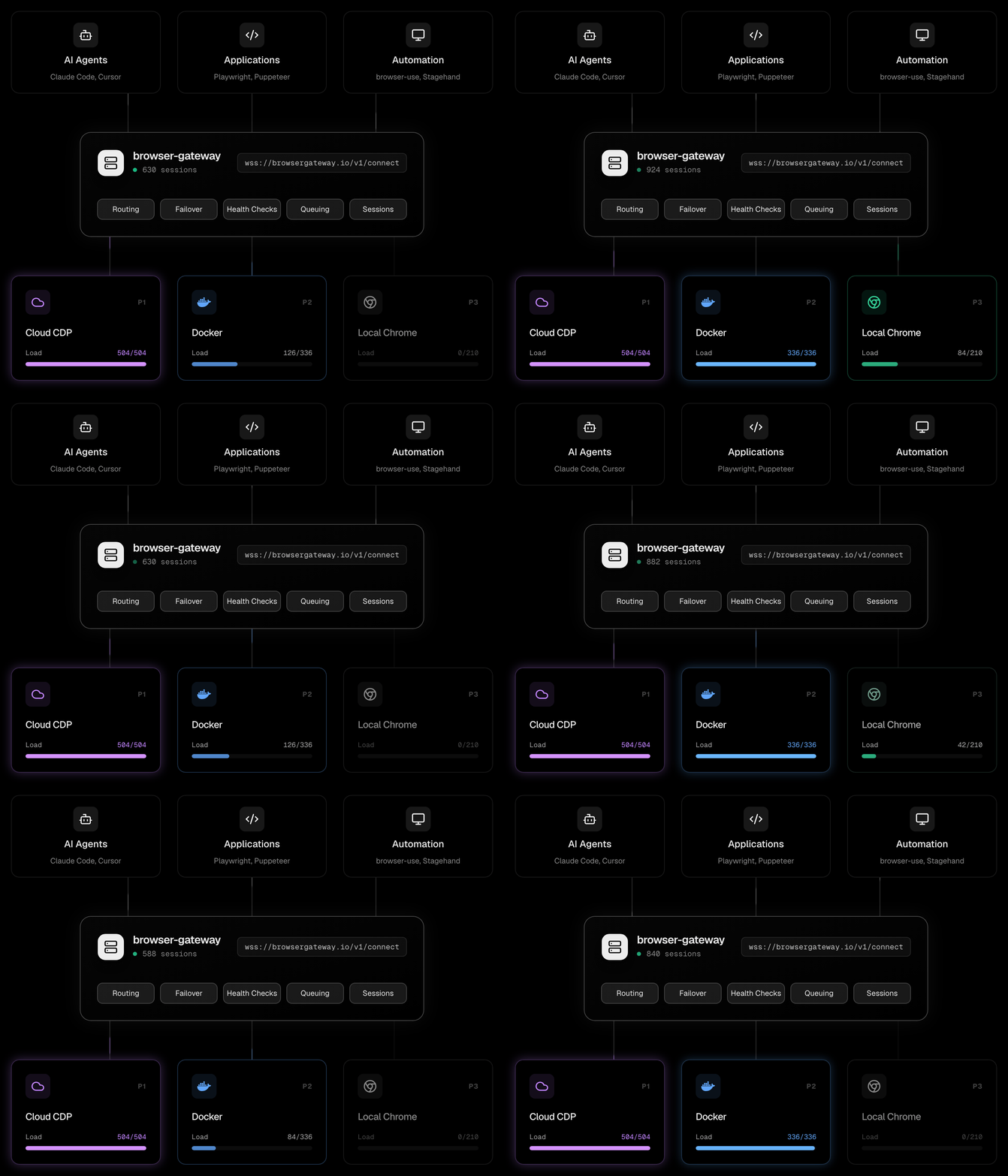
One endpoint. Multiple providers. Automatic failover when one is saturated or goes down.
Your app connects to ws://gateway:9500/v1/connect. The gateway picks the best available provider based on health, capacity, and your routing strategy. Providers can be cloud CDP services, Docker containers, or local Chrome instances.
Dashboard
A web dashboard ships with every install. Open http://localhost:9500/web after starting the gateway.
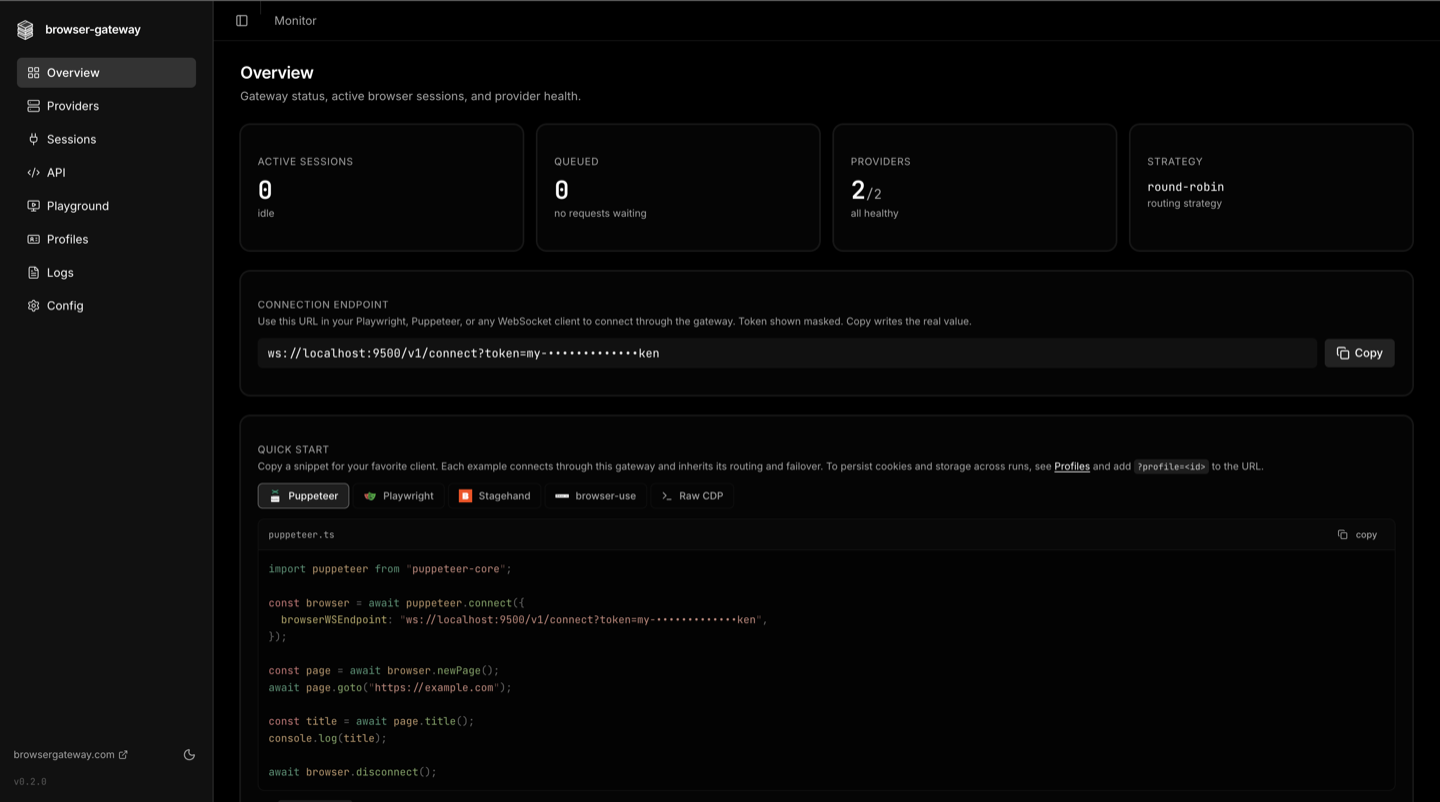
Overview. Active sessions, queue depth, provider health, connection endpoint, and a copy-paste quickstart for Puppeteer, Playwright, Stagehand, browser-use, and raw CDP.
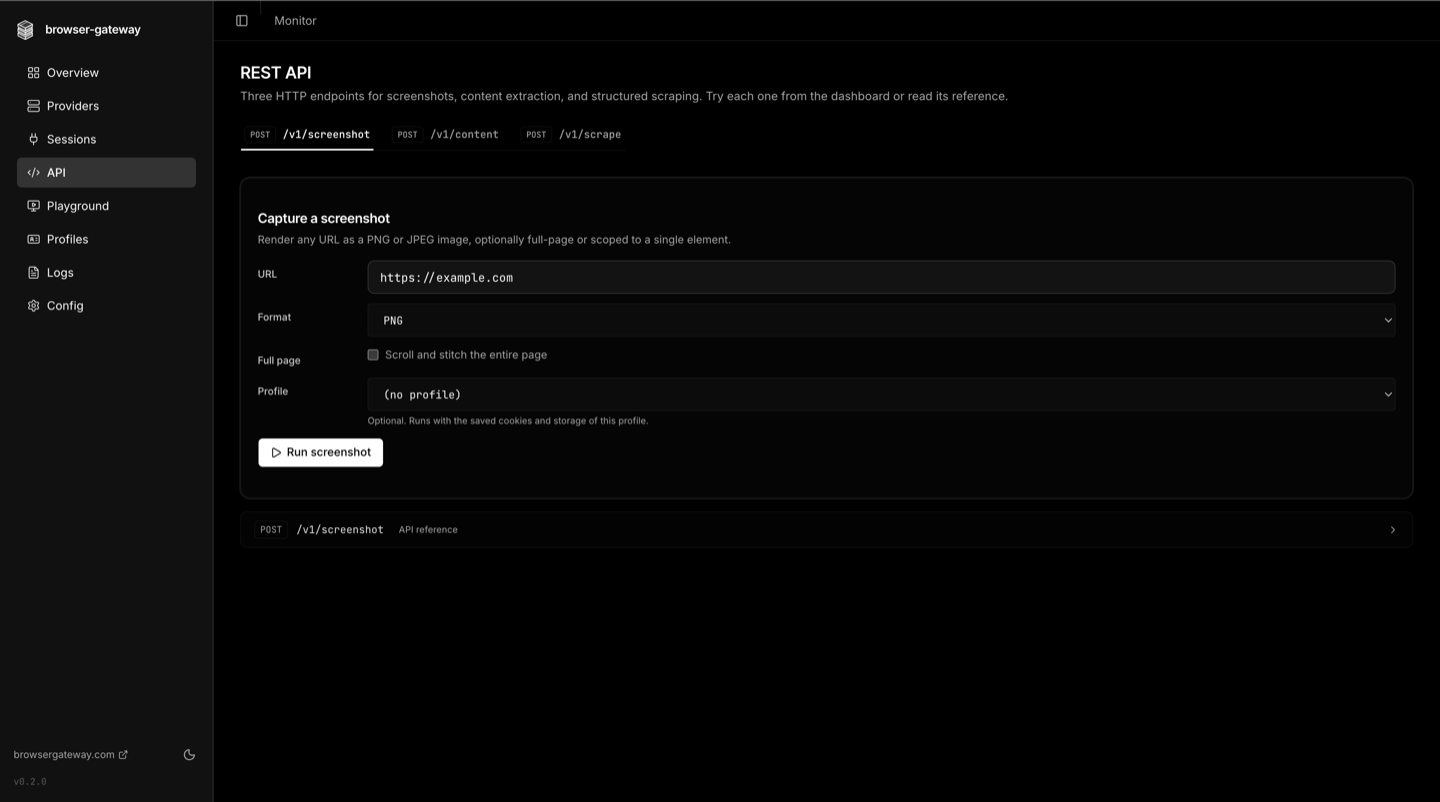
REST API. Run screenshot, content extraction, and structured scraping endpoints from a form-driven UI, with profile selection and parameter reference inline.
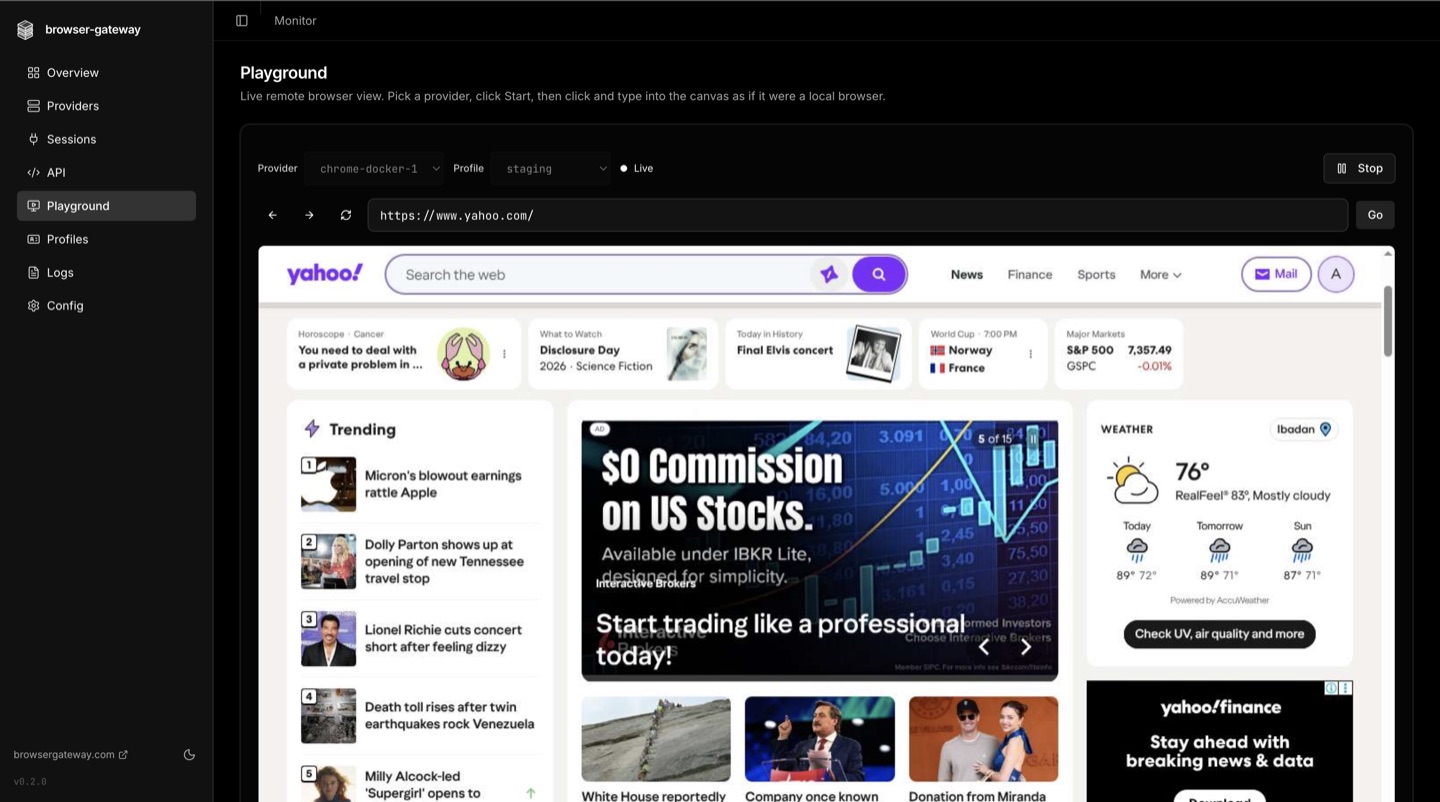
Playground. Drive any provider live from the browser. Pick a provider and profile, type into the canvas as if it were a local browser, and watch the remote session in real time.
Features
Routing & reliability
- Automatic failover - the next provider takes over the instant one fails, no client changes
- Five load-balancing strategies - priority chain, round-robin, least-connections, latency-optimized, weighted
- Per-provider concurrency limits - the gateway enforces
maxConcurrenton every backend - Request queue - connections wait when every provider is saturated instead of failing immediately
- Cooldown - failing providers are skipped and recover automatically after a TTL
- Health checks - periodic connectivity probes mark providers unhealthy before clients hit them
- Graceful shutdown - active sessions drain cleanly on SIGTERM and SIGINT
- Session reconnect - a dropped client reconnects with
?sessionId=<X-Session-Id>; on a provider that issues a resume token (browserserve with its resume window on) it gets the same browser back with its pages, cookies and storage, otherwise a new browser on the same provider - Webhooks - fire on provider down, recover, and queue-overflow events
REST API
- Screenshot -
POST /v1/screenshotreturns any URL as PNG or JPEG, full-page or scoped to a selector - Content extraction -
POST /v1/contentreturns markdown, plain text, HTML, or a cleaned article - Scrape -
POST /v1/scrapeextracts structured data via CSS selectors or full-page formats - Pooled sessions - browser connections are reused across requests, like a database pool
- Automatic retry - failed requests retry against a fresh page
Profiles — persistent browser state
- Survive across sessions - cookies and
localStorageare captured as you leave each page and on disconnect, and replayed on the next connect with the same id (IndexedDBtoo on browserserve) - Saved on any provider - every provider can load and save any profile; pin a provider to one profile only to route that profile's sessions there
- Profiles never mix - a browser that still holds a different profile is refused. Anything else already in a reused browser (from sessions without a profile) is saved with the profile
- One-line opt-in - add
?profile=acmeto the WebSocket URL, the rest is automatic - Encrypted at rest - AES-256-GCM with envelope encryption, anti-swap binding, and a scrypt-derived KEK
- Provider-agnostic - state is captured at the CDP level, so it replays against any provider
- Per-profile locking - concurrent connects to the same id return HTTP 409 to prevent corruption
- Export and import - encrypted
.bgpblobs are portable between gateway installs - One-click enable - the dashboard wizard generates a strong key in your browser and writes it to config
See the Profiles docs for the full guide, security model, REST endpoints, and limitations.
Session replay — see what the agent saw
- Frame-accurate visual record of every routed session, captured via CDP
Page.startScreencast - Zero injection - no script runs inside the customer page, capture is fully out-of-band
- Provider-agnostic - works with any backend that supports page screencast
- Dashboard player - scrub through the recorded frames, switch between captured browser targets
- Retention controls - configurable horizon, per-session byte cap, daily cleanup
See the Replays docs for the storage layout, REST endpoints, and tuning knobs.
MCP server for AI agents
- One-call tools -
fetch_pagereads any url as markdown andscreenshot_pagecaptures it, each in a single call that opens and closes its own browser - Session tools -
browser_session,browser_navigate,browser_snapshot,browser_act,browser_extract,browser_screenshot,browser_wait,browser_tabs,browser_evaluate,browser_observefor logins, forms and multi-step work - Fallback for coding agents - a Claude Code plugin sends Claude to
fetch_pagewhen its built-in web fetch is blocked, empty or needs JavaScript (/plugin marketplace add browser-gateway/browser-gateway); setup for Codex, Cursor and Gemini CLI in plugins/browser-gateway - Zero config - auto-detects Chrome and launches it on first tool use
- Concurrent sessions - every agent gets its own browser, no shared state
- Raw CDP - no Playwright or Puppeteer dependency
- Compatible - Claude Code, Cursor, and any MCP-compatible client
Computer use for Claude and Gemini
- Any browser for the model's own browser tool - runs Claude's browser and computer use tools and Gemini computer use on any provider behind the gateway
- About ten lines -
runClaudeLoop/runGeminiLooptake your own model call and handle actions, screenshots and results - Safe defaults - http and https only, private networks blocked, optional site allowlist, Gemini's confirm step for risky actions
- No extra dependencies -
browser-gateway/agent-tools/computer-use, tested on Node.js, Bun, Deno and the Cloudflare Workers runtime
Management
- Dashboard - manage providers, watch sessions, and edit config from the browser
- Provider CRUD - add, edit, delete, and test providers from the dashboard or API
- Config editor - edit
gateway.ymlin-browser with syntax highlighting and validation - Auth - token-based, with a secure HttpOnly cookie for the dashboard
- Protocol-agnostic - works with Playwright, Puppeteer, and any WebSocket protocol
Quick Start
As a WebSocket Proxy (for applications)
npm install -g browser-gateway
Create gateway.yml:
version: 1

providers:
  primary:
    url: wss://provider.example.com?token=${PROVIDER_TOKEN}
    limits:
      maxConcurrent: 5
    priority: 1

  fallback:
    url: ws://my-playwright-server:4000
    limits:
      maxConcurrent: 10
    priority: 2
browser-gateway serve
Connect from your app:
// For CDP providers
const browser = await chromium.connectOverCDP('ws://localhost:9500/v1/connect');

// For Playwright run-server providers
const browser = await chromium.connect('ws://localhost:9500/v1/connect');
Or use the REST API — no WebSocket management needed:
# Screenshot
curl -X POST http://localhost:9500/v1/screenshot \
  -H "Content-Type: application/json" \
  -d '{"url": "https://example.com"}' --output screenshot.png

# Extract content as markdown
curl -X POST http://localhost:9500/v1/content \
  -H "Content-Type: application/json" \
  -d '{"url": "https://example.com", "formats": ["markdown"]}'
These endpoints accept http and https URLs on public hosts only. Loopback,
link-local and private-range addresses are refused, and hostnames are resolved and
re-checked. To reach an internal host, list it under rest.allowedPrivateHosts in
gateway.yml.
Dashboard at http://localhost:9500/web.
As an MCP Server (for AI agents)
Add to your Claude Code or Cursor config:
{
  "mcpServers": {
    "browser-gateway": {
      "command": "npx",
      "args": ["browser-gateway", "mcp"]
    }
  }
}
No config files needed. The agent gets navigate, snapshot, screenshot, click, type, and evaluate tools through the gateway's routing layer.
See the MCP docs for all options.
Authentication
Set BG_TOKEN to require a token (or put it in a .env file):
BG_TOKEN=my-secret-token browser-gateway serve
- WebSocket clients pass the token as
?token=query param - API clients use
Authorization: Bearer <token>header - Dashboard shows a login form, sets a secure HttpOnly cookie
- Health endpoint (
/health) is always public
Without BG_TOKEN every /v1/* route is unauthenticated, so the gateway binds to
127.0.0.1 instead of all interfaces. Set a token (or set HOST explicitly) to
serve other machines. BG_ALLOWED_HOSTS allows extra Host values on /mcp
when no token is set.
CLI
# Proxy server
browser-gateway serve                    # Start the gateway + dashboard
browser-gateway serve --port 8080        # Custom port
browser-gateway serve --config path.yml  # Custom config

# MCP server for AI agents
browser-gateway mcp                      # Auto-detect Chrome, zero config
browser-gateway mcp --headless           # Headless mode (for CI/Docker)
browser-gateway mcp --cdp-endpoint ws:// # Connect to existing browser
browser-gateway mcp --config gateway.yml # Multi-provider with failover

# Utilities
browser-gateway check                    # Test provider connectivity
browser-gateway version                  # Print version
browser-gateway help                     # Show help
API
| Endpoint | Method | Description |
|---|---|---|
/v1/connect | WebSocket | Connect to a browser (the core feature) |
/v1/screenshot | POST | Take a screenshot of any URL (docs) |
/v1/content | POST | Extract page content as markdown, text, or HTML (docs) |
/v1/scrape | POST | Extract data via CSS selectors or full-page formats (docs) |
/v1/status | GET | Gateway health + provider status + pool status |
/v1/sessions | GET | Active sessions |
/v1/providers | GET/POST | List or add providers |
/v1/providers/:id | PUT/DELETE | Update or remove a provider |
/v1/providers/:id/test | POST | Test provider connectivity |
/v1/config | GET/PUT | Read or save config |
/v1/config/validate | POST | Validate YAML without saving |
/mcp | POST | MCP Streamable HTTP endpoint |
/json/version | GET | CDP discovery (for browser-use, Playwright, Stagehand) |
/health | GET | Health check |
Docker
Recommended: Docker Compose. The bundled docker-compose.yml mounts a named volume for state and a read-only gateway.yml from the host.
# Drop your gateway.yml next to docker-compose.yml, then:
docker compose up -d
Plain docker run:
docker run -d \
  -p 9500:9500 \
  -v bg_data:/data \
  -v ./gateway.yml:/app/gateway.yml:ro \
  -e PROVIDER_TOKEN=xxx \
  ghcr.io/browser-gateway/server:latest
Persistence
Everything the gateway writes to disk lives under a single directory, BG_DATA_DIR (defaults to /data inside the image). Mount that as a named volume or a bind mount and all state survives container restarts and image upgrades. Today it contains:
profiles/— encrypted profile blobs (when profiles are enabled)
Future versions may add more subdirectories under the same root (cooldown state, session snapshots, captures). Mounting BG_DATA_DIR as one volume keeps every subsystem persistent without follow-up config changes.
Upgrades
State lives in the volume, code lives in the image. Pull the new image, recreate the container — no data lost:
docker compose pull
docker compose up -d
The container reads the same BG_DATA_DIR and the same gateway.yml. Profile blobs are versioned and the gateway reads older formats transparently.
Image tags
| Tag | Updated on |
|---|---|
:0.3.0 (and every subsequent version) | published manually after a release |
:latest | always points at the newest version |
Images are multi-arch (linux/amd64, linux/arm64), signed with Sigstore build provenance, and ship an SBOM. Verify with the GitHub CLI:
gh attestation verify oci://ghcr.io/browser-gateway/server:0.3.0 \
  --repo browser-gateway/browser-gateway
How It Works
Sessions without profile / recording / observability (the default) take the byte-pipe fast lane:
- Client connects to
ws://gateway:9500/v1/connect - Gateway selects a provider using your routing strategy
- Gateway opens a raw TCP connection to the provider
- HTTP upgrade forwarded, provider responds with
101 Switching Protocols - Bidirectional TCP pipe:
client <-> gateway <-> provider - All WebSocket messages forwarded transparently (never parsed or modified)
- On disconnect: session cleaned up, slot released, metrics updated
- If all providers full: connection waits in a queue until a slot opens
Sessions with profile inject, session recording, live view, or observability (e.g. ?profile=X, ?session_record=true, /v1/live) run through a CDP-aware pipeline instead — one WebSocket per session, N plugins observing the wire. Same routing + failover, byte-perfect passthrough at rest, plugins only fire when their feature is requested. Architecture + plugin-authoring guide: docs/PIPELINE.md.
Self-hosted provider: browserserve
browserserve is the stack's own self-hosted browser server: one container that hands out isolated Chrome sessions over CDP. Add it like any other provider:
providers:
  browserserve:
    url: ws://your-host:9222
  cloud-provider:
    url: <websocket-url-with-auth>
    priority: 2
Because the gateway controls that runtime, a browserserve provider is auto-detected and unlocks two things no external provider gets:
- Auto capacity. You do not set
maxConcurrent. browserserve measures its host (memory, thread, and CPU limits) and advertises a safe ceiling, which the gateway adopts. The dashboard shows it as(auto). - Complete profiles. Every session is a fresh browser, and a saved profile carries the whole browser state, including IndexedDB and service workers. Other providers save cookies and site storage.
A common shape: browserserve as the primary provider on your own hardware, with a cloud provider at a lower priority for failover.
Works With
browser-gateway is compatible with existing browser tools. Just pass the gateway URL — it auto-resolves via /json/version.
AI Agent Frameworks:
# browser-use (Python) — HTTP URL auto-resolves
BrowserSession(cdp_url="http://localhost:9500")
// Stagehand (TypeScript)
new Stagehand({ env: "LOCAL", localBrowserLaunchOptions: { cdpUrl: "http://localhost:9500" } })
Playwright MCP (all 70 Playwright tools through gateway routing):
{
  "mcpServers": {
    "playwright": {
      "command": "npx",
      "args": ["@playwright/mcp@latest", "--cdp-endpoint", "http://localhost:9500"]
    }
  }
}
Puppeteer / Playwright:
// Playwright — HTTP or WebSocket
const browser = await chromium.connectOverCDP("http://localhost:9500");

// Puppeteer — WebSocket
const browser = await puppeteer.connect({ browserWSEndpoint: "ws://localhost:9500/v1/connect" });
Documentation
Full docs live at docs.browsergateway.com.
- Getting Started
- Configuration Reference
- Supported Providers
- Profiles — Persistent Browser State
- Session Replays
- Session Lifecycle
- REST API
- MCP Server for AI Agents
- Computer Use (Claude and Gemini)
- CLI Reference
- Web Dashboard
- How Failover Works
- Load Balancing Strategies
- Request Queue
- Webhooks
- Docker Deployment
- Integrations — Playwright, Puppeteer, browser-use, Stagehand, Playwright MCP
Contributing
Contributions welcome. See CONTRIBUTING.md for guidelines.
License
MIT - see LICENSE.
Links
Contact
Questions, security reports, or partnership inquiries: hello@browsergateway.com.