Windows AutoCAD MCP server for handle-first CAD automation, validation, and drawing exports.
Quick Install
Automated & IDE SetupCopy the AI prompt to install this server into Claude Code, Cursor, or another agent — or use 1-click editor setup below.
Manual Client & Custom JSON ConfigExpand JSON ▾
Client Config & Setup
Remote HTTPChoose your client or environment
Target File:
💡 Paste the JSON block into your client's configuration file under mcpServers, then restart the application.
Documentation Overview
best-cad-mcp




A local, handle-first MCP server for agents that work with real AutoCAD drawings.
Inspect a DWG, reason over structured geometry, plan guarded edits, validate the result, and export visual evidence without hiding agent state inside the drawing.
简体中文 · Live demo · Install · Workflow · Tool profiles · Safety · Limitations
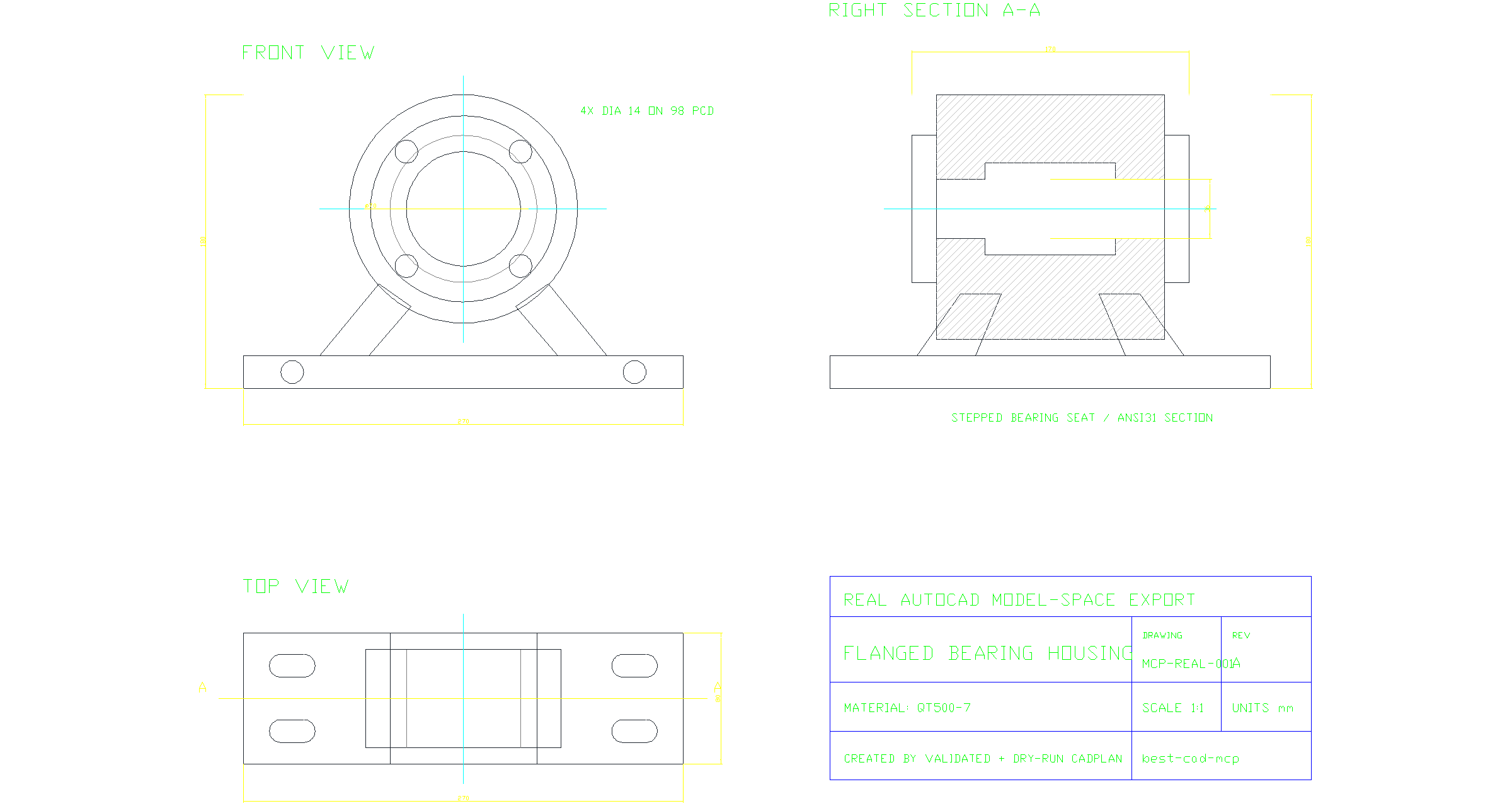
A real AutoCAD model-space export created by a validated, dry-run CADPlan: front and top projections, a sectioned side view, centerlines, dimensions, feature callouts, hatches, and a title block. Download the source DWG or inspect the executed CADPlan.
[!IMPORTANT] best-cad-mcp is beta software. It is designed for controlled local workflows where an operator can review plans and evidence, not unattended changes to valuable production drawings.
Why best-cad-mcp
Most CAD automation stops at drawing primitives. Useful agent workflows also need to know exactly what they are changing, why a target was selected, and whether the result is correct.
| Handle-first control | Drawing understanding | Evidence before trust |
|---|---|---|
| Scan real AutoCAD handles, query exact entities, and edit those handles instead of guessing from labels or pixels. | Build CAD-IR, semantic objects and graphs, dimension bindings, constraints, and validation reports in a local workspace. | Validate and dry-run CADPlans, execute explicitly, rescan, and compare structured and visual results. |
The server runs on the same Windows account as AutoCAD and communicates over MCP stdio. It runs natively on the official MCP Python SDK 2.x, negotiates the 2026-07-28 protocol, and retains legacy client negotiation. AutoCAD remains the source of truth; SQLite stores model-private context, scan results, and review artifacts alongside the workspace. AutoCAD-facing tool calls are intentionally serialized on one event-loop thread to preserve COM apartment safety.
Live AutoCAD demo
Prompt: Create a production-style A3 landscape bolted flange-coupling assembly drawing at true 1:1 size, with a longitudinal half-section, aligned end view, exploded schematic, true dimensions, differentiated hatching, an eight-item BOM, matching item leaders, technical requirements, and a controlled title block.

This is the result of a live AutoCAD session, not a hand-authored SVG. The MCP
client loaded the shipped precise_draw_from_spec prompt, then ran 18 bounded
generation phases (162 steps). Its autonomous visual-repair loop used two
layout-repair plans (4 steps); three separately recorded, operator-authorized
presentation-only release-QA plans added 10 steps. Every plan was validated and
dry-run before transactional execution. The final
rescan indexed 91 entities; structured verification detected 129 semantic
objects, processed 7 true dimension annotations, and checked 134 constraints
(127 satisfied, 7 unknown, and none violated). Post-repair geometry validation reported zero
issues. The release plot was independently checked as a one-page landscape A3
PDF.
For reproducibility, the checked-in MCP client builds the deterministic CADPlans used for this recorded run. The demo shows live execution of the optimized prompt's guarded workflow, not an unscripted one-shot LLM generation.
DXF · A3 PDF · Exact prompt · CADPlan bundle · Verification report · MCP client
The drawing follows the repository's generic mechanical assembly practice and
is marked DEMO - NOT FOR MANUFACTURE; it does not claim formal ISO, GB, ASME,
or other standards compliance.
Quick start
Requirements
- Windows
- AutoCAD 2020 or newer recommended, installed and licensed
- AutoCAD and the MCP client running as the same Windows user
- Python 3.11 or newer
- An MCP-compatible local client
Install the package
For rendered overlays and visual-review helpers:
Keep AutoCAD open, then configure your MCP client to launch cad-mcp.
Codex
Codex supports both global ~/.codex/config.toml and trusted,
project-scoped .codex/config.toml files. This minimal installed-package
configuration uses the curated core tool profile:
Restart Codex after editing the file, then inspect the connected server with
/mcp. See the
official Codex MCP configuration guide
for configuration scopes and current options.
Claude Code and other JSON-configured clients
Save this as .mcp.json in the CAD project root and start the client from that
project. CAD_MCP_WORKSPACE_ROOT should point to the CAD project being worked
on, not to this repository. With an installed package, setting both the process
cwd and workspace root to the project keeps runtime files together.
Install from source
For a source checkout, start python -m src.server from the repository or
set the MCP server cwd to the repository. Keep
CAD_MCP_WORKSPACE_ROOT pointed at the separate CAD project you want to
index.
The guarded workflow
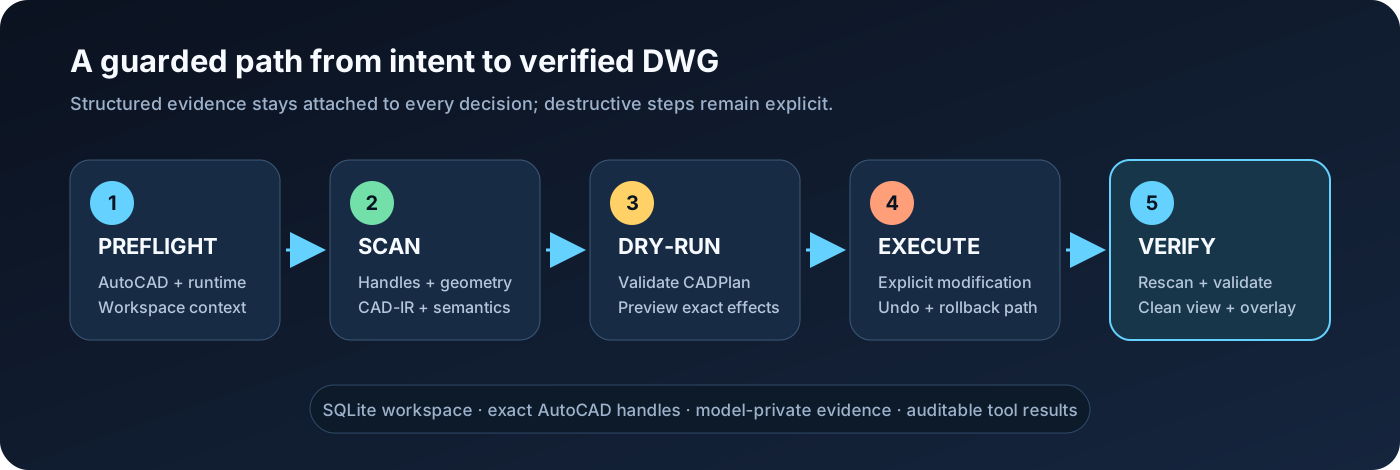
- Preflight — run
check_runtime_environment(check_autocad=true)orcad-mcp-doctor --check-autocad; stop when the result reportsok=false. - Scan — run
scan_all_entitiesbefore reasoning about an existing DWG. Usetopology_detail="full"for primitive grounding or cross-entity profiles. - Understand — build CAD-IR, summarize the drawing, query semantics, and
confirm important targets with
explain_entity. - Plan — express multi-step changes as a CADPlan, then call
validate_cad_plananddry_run_cad_plan. - Execute explicitly — only after authorization and an acceptable dry-run,
call
execute_cad_plan(..., allow_modify=true, transactional=true). - Verify — rescan, run geometric validation, export a clean view and overlay, and save only when the operator intends to persist the DWG.
For precise edits, prefer handles returned by AutoCAD over names inferred from screenshots. For visual findings, treat grounding as evidence: confirm the candidate entity and its geometry before changing it.
What it can do
Related MCP Servers
Adoption & maintenance
Factual signals from GitHub, npm, and our automated checks — not a rating.
GitHub stars
22
Stargazers on the source repository.
Last commit
1mo ago
Most recent push to the default branch.
Reviews
No reviews yet — be the first to share how this listing worked for you.
Frequently Asked Questions about Best Cad MCP
AllMCPs Directory Badge
Showcase your server listing on GitHub or your project documentation. Embed this dynamic SVG badge to highlight official listing status and live engagement.
Badge Style:
Live Dynamic SVG Preview
Markdown (GitHub README)
[](https://allmcps.com/mcp/best-cad-mcp)HTML Embed
<a href="https://allmcps.com/mcp/best-cad-mcp"><img src="https://allmcps.com/api/badge/best-cad-mcp?style=directory" alt="Best Cad MCP on AllMCPs" /></a>Technical Specs & Signals
CategoryArchitecture & Design
4/8 checks healthy over the last 45d
41Quality signal: Fair · 41/100How this signal is calculated ▾
Server availabilityNot measured
Not scored for repo-hosted servers — we can't reach the running server, only its GitHub page. Hosted MCP endpoints are health-checked live.
Verified ownership10/20
Documentation & tools16/30
Adoption & activity5/15
Community engagement0/10
A guidance signal from public completeness & health data — not a user rating. New listings start lower and rise as they add docs, get verified, and grow adoption. Signals we can't observe for a listing are skipped, not counted against it.
Own this project?
This directory is pre-filled from public sources. Claim via GitHub README, site badge, or DNS TXT to unlock edit access and the Official badge — proof is checked automatically, then reviewed by our team.
Free dofollow backlink: add your website and place the AllMCPs badge on it — no claim needed. We detect it automatically and keep it verified as long as the badge stays live.
Claim & get free dofollowShare & Embed
Add our SVG badge (dark/light directory styles) or embeddable widget to your site.