Learns your writing voice from your own prompt history, then makes the model write like that.
Quick Install
Automated & IDE SetupCopy the AI prompt to install this server into Claude Code, Cursor, or another agent — or use 1-click editor setup below.
Manual Client & Custom JSON ConfigExpand JSON ▾
Client Config & Setup
Choose your client or environment
Target File:
💡 Paste the JSON block into your client's configuration file under mcpServers, then restart the application.
Documentation Overview
being-human
Your assistant writes like a press release because it doesn't know who you are. This tells it.
being-human reads the prompts you've already typed, measures how you actually write, and hands the model a description of your voice specific enough to follow. It also builds a list of words to avoid, computed by contrast against the model's own output, so it's personal to you rather than borrowed from a blog post about ChatGPT tells.
Local, stdlib Python 3, no dependencies, no network calls.

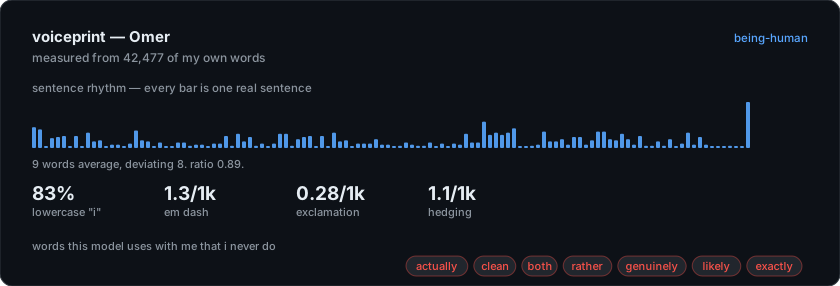
my own writing, measured by this tool. every bar is one real
sentence. make your own with being-human card.
quickstart
No Claude Code history? Point it at a ChatGPT export or your own files:
what comes out
Instructions with numbers attached, because "be concise" is not actionable and "your median message is 12 words" is:
the contrast trick
Your transcripts contain both sides of every conversation. So every word can be scored by log-odds: how much more likely you are to use it than the model is, on the same topics, in the same threads. The top of that list is your voice. The bottom is the model's.
Mine came back actually, clean, rather, genuinely, exactly, roughly. None of
those appear on any published list of AI words. They're the specific tics this
model has when talking to me. Yours will differ, because the contrast is against
your writing.
two checks, not one
They catch different failures, and passing one says nothing about the other:
check | is this generic AI writing? tells, rhythm, structure |
verify | is this you? authorship distance, Burrows's Delta against a length-matched null resampled from your own corpus |
Measured on my own corpus:
| authorship | slop | |
|---|---|---|
| my own writing | 6th pct, me | 99/100 |
| generic LinkedIn slop | 19th pct, me? | 0/100 |
| a README by someone else | 94th pct, not me | 97/100 |
Row two is the catch: slop has unremarkable grammar, so authorship distance passes it. Row three is clean prose with no tells that is plainly a different hand. The second case is the one nobody else tests for, and it's the one that bites.
Held-out chunks of real writing sit at the 49th to 60th percentile, with a 1-6% false-positive rate above p97. Thresholds are personal. Em dashes get flagged against your measured rate rather than a universal rule, which is why this doesn't punish people who genuinely use them.
mcp server
Seven tools, two resources, two prompts. Configs for Claude Desktop, Cursor, Codex and Zed are in mcp/README.md.
MCP tools are model-invoked and nothing forces a model to call one, which is awkward when the payload is instructional. So every tool returns the voice rules alongside its own result. There's no path through the server that hands back a score without the target attached.
There's a Claude Code plugin too, via
/plugin marketplace add Syedomershah99/being-human. It adds
/being-human:learn, :check, :write, :verify, :export, and a hook that
grows the corpus as you type.
privacy
Everything is local. Grep for urllib, requests or socket and you'll find
nothing. Secrets are redacted at harvest time before anything touches disk, and
.being-human/ is gitignored. The voiceprint is safe to share. The corpus it was
built from is not.
prior art
This space got crowded in 2026. inside-lago framed the thesis, slop-guard is a mature slop linter, idiolect is architecturally closest, and writer-persona had the best idea of the lot: validate the profile with a backtest instead of trusting it.
Two things here I couldn't find elsewhere. The user-vs-model contrast, which derives the avoid-list from both sides of your own transcripts rather than from a curated list. And a deterministic impostor test. writer-persona uses an LLM judge across 8 axes; this is arithmetic, so it costs nothing and returns the same answer every time.
Burrows's Delta and log-odds with a Dirichlet prior are both established methods. The claim is the application and the calibration, not the statistics.
license
MIT. The tell list is data/slop-lexicon.json. If you keep seeing something that isn't in there, send a PR.
mcp-name: io.github.Syedomershah99/being-human
Related MCP Servers
Reviews
No reviews yet — be the first to share how this listing worked for you.
Frequently Asked Questions about Being Human
AllMCPs Directory Badge
Showcase your server listing on GitHub or your project documentation. Embed this dynamic SVG badge to highlight official listing status and live engagement.
Badge Style:
Live Dynamic SVG Preview
Markdown (GitHub README)
[](https://allmcps.com/mcp/being-human)HTML Embed
<a href="https://allmcps.com/mcp/being-human"><img src="https://allmcps.com/api/badge/being-human?style=directory" alt="Being Human on AllMCPs" /></a>Technical Specs & Signals
CategoryDeveloper Tools
27Quality signal: Emerging · 27/100How this signal is calculated ▾
Server availabilityNot measured
Not scored for repo-hosted servers — we can't reach the running server, only its GitHub page. Hosted MCP endpoints are health-checked live.
Verified ownership8/20
Documentation & tools11/30
Adoption & activity1/15
Community engagement0/10
A guidance signal from public completeness & health data — not a user rating. New listings start lower and rise as they add docs, get verified, and grow adoption. Signals we can't observe for a listing are skipped, not counted against it.
Own this project?
This directory is pre-filled from public sources. Claim via GitHub README, site badge, or DNS TXT to unlock edit access and the Official badge and attach your website — proof is checked automatically, then reviewed by our team.
Free dofollow backlink: add your website and place the AllMCPs badge on it — no claim needed. We detect it automatically and keep it verified as long as the badge stays live.
Claim & get free dofollowShare & Embed
Add our SVG badge (dark/light directory styles) or embeddable widget to your site.