knowledgememoryfilesystemagentcognitive-substrate
Agent-first cognitive substrate managing cross-session memory as a self-validating filesystem graph with 18 manifest-driven verbs.
Quick Install
Automated & IDE SetupCopy the AI prompt to install this server into Claude Code, Cursor, or another agent — or use 1-click editor setup below.
One-click editor setup isn’t available for this listing yet — we don’t have a confirmed install command, and we’d rather show nothing than point your editor at the wrong package or host. Follow the project’s own setup instructions, linked above.
Manual Client & Custom JSON ConfigExpand JSON ▾
No confirmed setup config for this listing yet. We only publish a config block when the install details come from the project itself — its README, its docs, or a verified owner. We haven’t found those for Battam1111/Myco, and we’d rather show nothing than a guess you’d paste into your client. Follow the project’s own setup instructions for the current steps.
Overview
Use cases
Ingest and integrate knowledge from files, URLs, or text paragraphs
Maintain persistent cross-session and cross-project memory for AI agents
Run mechanical lint checks enforcing knowledge contract invariants
Traverse and analyze the knowledge graph connectivity
Evolve and reshape the cognitive substrate as knowledge grows
Key features
18 manifest-driven verbs for knowledge lifecycle management
25 lint dimensions enforcing 7 contract invariants
Cross-session and cross-project memory via filesystem graph
Provider-agnostic design forbidding LLM-SDK imports
Editable kernel substrate maintained by the agent itself
Supports integration with Claude Code, Cursor, Windsurf, Zed, VS Code, and any MCP client
Capabilities & Tool Schemas
Inspect callable tools, capabilities, and parameters exposed to AI agents by Myco.
Extracted Tool Capabilities
18 manifest-driven verbs for knowledge lifecycle management
25 lint dimensions enforcing 7 contract invariants
Cross-session and cross-project memory via filesystem graph
Provider-agnostic design forbidding LLM-SDK imports
Editable kernel substrate maintained by the agent itself
Supports integration with Claude Code, Cursor, Windsurf, Zed, VS Code, and any MCP client
Documentation Overview
⚠️ Deprecated: Myco has been reborn as v0.9-genesis
This PyPI package (
myco, v0.4–v0.8.x) is the Agent-First cognitive-substrate embryo: a 20-verb tool framework for an AI agent's memory. It is doctrinally a dead embryo, sealed at the git tagv0.8.8-final-embryo.The project has been reborn as a different conception: a decades-long symbiotic partnership between one human and a substrate that carries memory, character, and doctrine across LLM model generations. v0.9 is not a
pip install. It is a clone-and-build substrate (Rust + Python + TypeScript).👉 See github.com/Battam1111/Myco
Branch
v0.9-genesis, with itsGETTING_STARTED.md. ThismycoPyPI package is no longer the project; it remains only as the predecessor lineage.
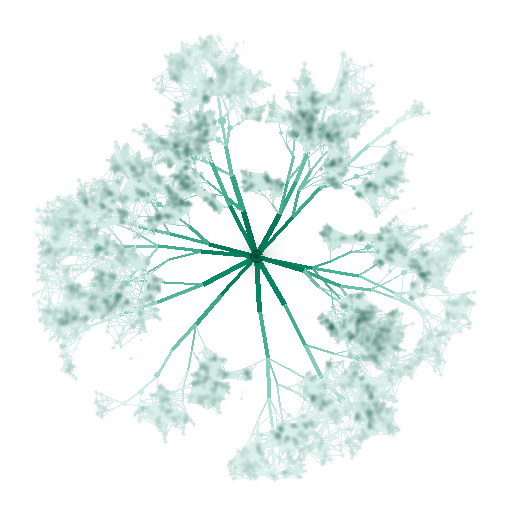
Myco
Devour everything. Evolve forever. You just talk.



Claude Code /plugin install myco@myco · Claude Desktop myco-install host cowork · Any MCP host pip install 'myco[mcp]'
What it is · How it lives · Quick start · Verbs · Self-validation
LangChain. LangGraph. CrewAI. DSPy. Claude Code skills. OpenHands. OpenClaw. Every few months the next framework drops and you migrate again.
Your notes rot too. The API you read three weeks back has changed. The doc you wrote last year is wrong now. Your AI does not even remember last week's decisions. Every new conversation starts from zero.
Now imagine one living substrate. It ingests the frameworks, the papers, the APIs, the codebases, the datasets, the decisions, the frictions. It keeps them connected in a graph the agent actually reads. It catches its own drift. It reshapes itself when your work outgrows its old form. For six months. For six years. No migration.
This is Myco.
What it is
Myco is a living cognitive substrate for your AI agent.
Everything the agent reads or writes, every piece of code and every paper and every decision and every friction, lives on your filesystem as plain markdown + YAML. Files cross-reference each other by name, forming a graph the agent actually reads. The agent eats raw material, digests it into integrated knowledge, immune-checks its own work against drift, propagates learning across your projects, and when the shape of the substrate no longer fits the shape of the work, reshapes the substrate itself. The kernel that runs all of this is itself a substrate, editable by default, maintained by the same agent that uses it.
Not a framework. Not a vector database. Not a managed service. A living filesystem for an agent you talk to.
The idea is older than the implementation. What changed is the agent. Today's models are finally capable of keeping their own tooling alive. Every earlier attempt at a self-maintaining knowledge system died in the same place, where the human in the loop could no longer keep up. Myco puts the loop inside the agent. Every surface, every verb, every rule assumes the maintainer is an agent, so the human in the loop is no longer load-bearing.
How it lives
You speak. The agent listens. Between your turns, Myco runs a metabolism.
- Ingestion.
hungerasks what is missing.eatabsorbs whatever you point at, whether a path, a URL, or a paragraph.senseandforagescan what is already here.excretesafely removes a raw note captured by mistake, moving it to an audit tombstone instead of silently deleting.intake(v0.6.0) bulk-ingests a whole directory, composing forage + eat with strict-mode failure visibility. - Digestion.
assimilatecooks raw notes into integrated knowledge.digestpromotes a single note.sporulateconcentrates integrated notes into a dispersible proposal. - Circulation.
traversewalks the graph and reports on its connectedness.propagatepublishes learning to a downstream substrate. - Homeostasis.
immuneruns a 47-dimension lint against the seven hard rules.senescewinds down each session cleanly. - Evolution. When the substrate's shape no longer fits the work, whether a canon field is missing, a new lint dimension is needed, or a verb must change,
fruitdrafts a three-round craft proposal,winnowgates its shape, andmoltships the contract bump.
Twenty verbs, one manifest, two faces: a CLI for you to observe, an MCP server for the agent to drive. You memorize nothing. The agent drives.
Five principles
- Only for the agent. Every surface, every message, every verb shape is primary material for the agent. Not documentation for a human reader.
- Devour everything. No filter on intake. Missing a signal costs more than eating one too many.
- Self-evolving shape. Canon, lint dimensions, verbs, the contract itself, all of it mutable, all of it changed through a single governed craft loop.
- Nothing is final.
integratedis a state, not an endpoint. Today's conclusion is tomorrow's raw material. - Mycelium network. Every node links to every other node by traversal. Orphans are dead tissue.
The kernel IS a substrate
Myco's own source tree is a substrate. .myco/canon.yaml at .myco/. .myco/MYCO.md as the agent entry page. .docs/primordia/ holding the three-round craft document that justifies every contract bump. The Python code under src/myco/ is the innermost ring of its own ecosystem. Not a read-only artifact someone else wrote.
So the normal install clones the source and runs pip install -e on it. The agent that uses Myco is the same agent that maintains Myco. When it needs a new lint dimension, it scaffolds one with myco ramify, writes the case with myco fruit, gates the shape with myco winnow, and ships the bump with myco molt. No fork. No waiting PR. No long-lived feature branch. 永恒进化.
PyPI exists for bootstrap and for library embedding. It is not the normal install path.
Quick start
This clones the repository to ~/myco, runs pip install -e on it, and leaves you with a writable kernel. Then germinate a substrate inside any project:
Hook Myco into your agent host in one command:
- Claude Code. Run
/plugin marketplace add Battam1111/Myco, then/plugin install myco@myco. - Claude Desktop / Cowork. Run
myco-install host coworkto write the MCP entry, then downloadmyco-<ver>.zipand drag it into Claude Desktop → Settings → Plugins → Upload. Claude Desktop uploads it to your private Cowork marketplace and every subsequent session auto-installs themyco-substrateonboarding skill. (v0.7.4 hotfix: artifact extension is.zip, not.plugin— Anthropic GitHub issue #40414.) - Any other MCP host. Run
myco-install host <cursor | windsurf | zed | vscode | openclaw | claude-desktop | gemini-cli | codex-cli | goose>, or pass--all-hoststo auto-detect every host on this machine. - Via the official MCP Registry. Use the namespace
io.github.Battam1111/mycofor clients that auto-resolve it.
Per-host snippets for the nine hosts with divergent schemas, Python-framework adapters (LangChain, CrewAI, DSPy, Smolagents, Agno, PraisonAI, MS Agent Framework, Claude Agent SDK), and library-embedding examples all live in INSTALL.md.
Optional extras
pip install 'myco[mcp]'— MCP server stack (recommended baseline).pip install 'myco[adapters]'— PDF / HTML / URL ingestion adapters (~10 MB).pip install 'myco[multimedia]'— v0.8.0: audio / image-OCR / video-frame ingestion adapters. Heavy footprint (~500 MB once PyTorch + Whisper weights download); strictly opt-in. Default install stays lean — without this extras the three multimedia adapters cleanly emit install-extras failed-stubs when forage encounters a.mp3/.png/.mp4, soeatnever silently drops a media file. Image and video OCR additionally require the systemtesseractbinary on PATH (install viaapt-get install tesseract-ocr/brew install tesseract/ Windows installer).
The twenty verbs
Related MCP Servers
Adoption & maintenance
Factual signals from GitHub, npm, and our automated checks — not a rating.
GitHub stars
63
Stargazers on the source repository.
Last commit
1mo ago
Most recent push to the default branch.
Directory activity
1 views
Config copies, upvotes, and views on AllMCPs.
Reviews
No reviews yet — be the first to share how this listing worked for you.
Frequently Asked Questions about Myco
AllMCPs Directory Badge
Showcase your server listing on GitHub or your project documentation. Embed this dynamic SVG badge to highlight official listing status and live engagement.
Badge Style:
Live Dynamic SVG Preview
Markdown (GitHub README)
[](https://allmcps.com/mcp/battam1111-myco)HTML Embed
<a href="https://allmcps.com/mcp/battam1111-myco"><img src="https://allmcps.com/api/badge/battam1111-myco?style=directory" alt="Myco on AllMCPs" /></a>Technical Specs & Signals
CategoryKnowledge & Memory
PricingFree
49Quality signal: Fair · 49/100How this signal is calculated ▾
Server availabilityNot measured
Not scored for repo-hosted servers — we can't reach the running server, only its GitHub page. Hosted MCP endpoints are health-checked live.
Verified ownership10/20
Documentation & tools21/30
Adoption & activity6/15
Community engagement0/10
A guidance signal from public completeness & health data — not a user rating. New listings start lower and rise as they add docs, get verified, and grow adoption. Signals we can't observe for a listing are skipped, not counted against it.
Own this project?
This directory is pre-filled from public sources. Claim via GitHub README, site badge, or DNS TXT to unlock edit access and the Official badge — proof is checked automatically, then reviewed by our team.
Free dofollow backlink: add your website and place the AllMCPs badge on it — no claim needed. We detect it automatically and keep it verified as long as the badge stays live.
Claim & get free dofollowShare & Embed
Add our SVG badge (dark/light directory styles) or embeddable widget to your site.