Baron Munchausen README
The full upstream README, mirrored here for reference. Install config, tool schemas, adoption signals, and an original overview live on the Baron Munchausen listing page.
Baron Munchausen — local memory that outlives the chat
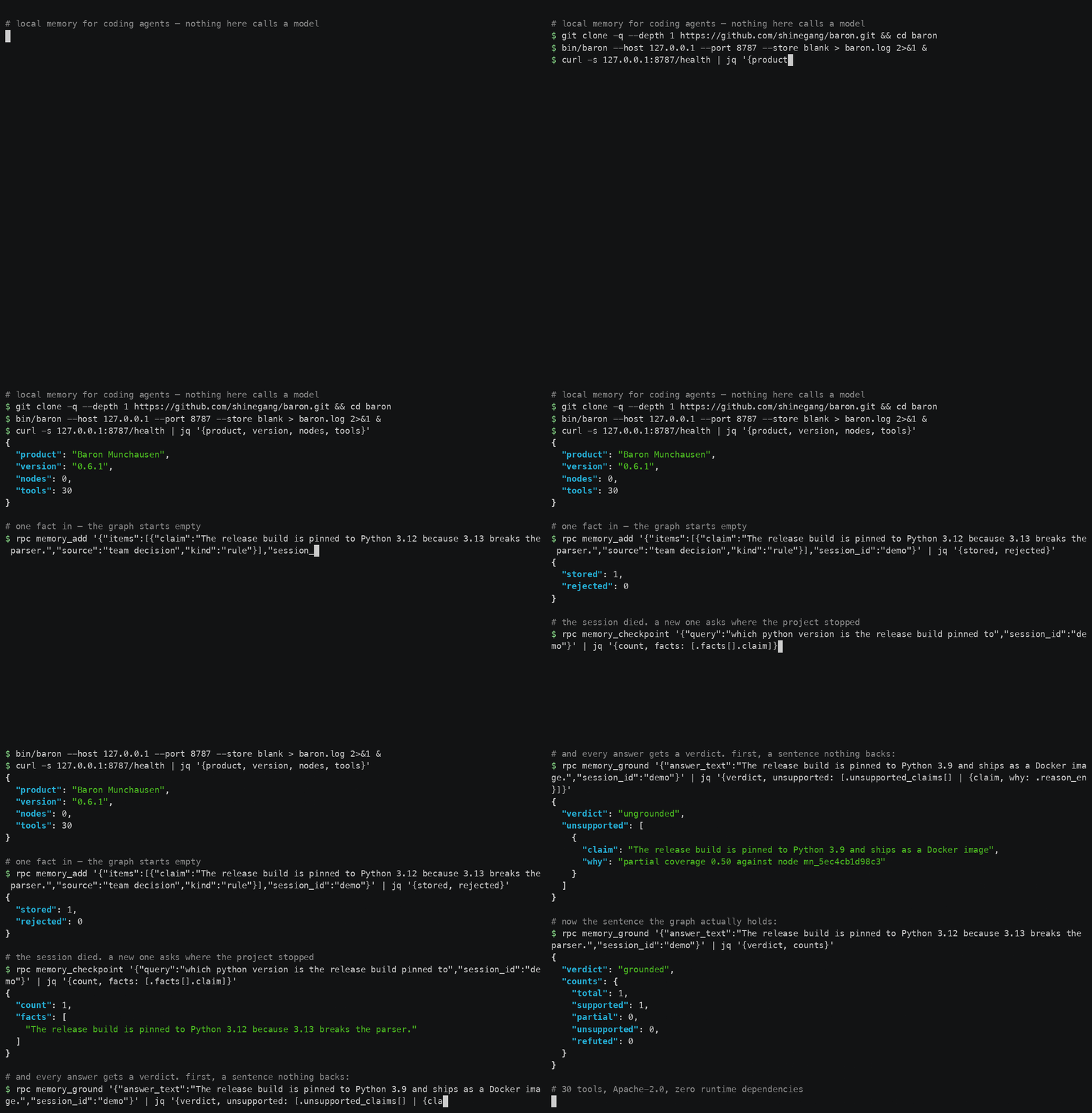
Everything above is a real run against a clean clone. rpc is the two-line
curl wrapper defined in docs/demo/baron-demo.sh;
re-record the whole thing with cd docs/demo && ./record.sh.
Public alpha (0.6.1). The engine has run daily in the authors' own work for months; this repository is one day old. The code is Apache-2.0 and complete — the packaging, the docs and the install path are what "alpha" refers to. Report anything that breaks.
Your session ends. Your project doesn't. One call brings back where the
project stopped, what was decided and what comes next — after a closed tab, a
spent limit or a change of model. And every answer built on that memory comes
back with a verdict: grounded, partial or ungrounded, with the sentences
nothing backs named one by one.




A memory server in Python 3.12 with no third-party runtime dependency. MCP over
stdio for your client, JSON-RPC on 127.0.0.1:8765 for everything else. Nothing
here calls a model and nothing leaves your machine. A fresh install starts with
an empty graph: we ship the tools, never the data.
Why
Three numbers, each one measured, each one with what it does not say written next to it.
1. One context return: 7 146 tokens → 2 388. The 7 146 is a real compaction
summary out of a session transcript; the 2 388 is the slice a live
memory_ground_prepare returned for the same moment of the same project. Both
counted with tiktoken/cl100k_base on 2026-09-10. What it does not say: it
is one pair of instances, not a distribution — a second summary from the same
corpus came to 5 913 tokens, which would make the same slice a 60 % cut instead
of a 67 % one.
2. Claude Opus 5: −69.6 % input tokens, measured. Not arithmetic on the
figures above — this is what the models' own usage reports came back with on
live runs of the same tasks, 2026-09-10. Sonnet 5 came to −61.7 %, Haiku 4.5 to
−66.3 % on the same runs. What it does not say: these are the authors' graph
and the authors' tasks. Your ratio depends on how much of your context is
recoverable from a graph at all, and nobody has run this on a public benchmark
yet.
3. Thirty tools, zero runtime dependencies. curl -s 127.0.0.1:8765/health reports "tools": 30 on a fresh clone — the same 30 over
MCP stdio and over JSON-RPC, with requirements.txt empty of third-party
runtime packages. What it does not say: nothing about quality. It is a count.
What those percentages are worth in money depends on your model and your volume: the savings calculator on shinegang.click does that arithmetic with current list prices, and shows which figures are measured and which are calculated.
Install in two minutes
Step 2 prints {"product": "Baron Munchausen", "version": "0.6.1", "nodes": 0, "tools": 30}. Without jq, drop the pipe and read the raw JSON.
Write a fact and get a verdict without any client at all — this is the same JSON-RPC the demo above runs:
Installing the package (pip install .) puts the same server on PATH as
baron; python3.12 -m baron works from a checkout.
Clients
Any client that takes the standard mcpServers JSON block can use Baron. These
are the ones with a file in integrations/
already written:
| Client | How | File |
|---|---|---|
| Claude Code | bash integrations/baron_add.sh | baron_add.sh |
| Codex | bash integrations/codex/register.sh | codex/ |
| Cursor | copy into ~/.cursor/mcp.json | baron_cursor_mcp.json |
| llama.cpp | copy next to your server config | baron_llama_cpp_mcp_servers.json |
| LangChain | a working call against the HTTP endpoint | langchain_example.py |
| Claude Desktop | copy into claude_desktop_config.json | baron_claude_desktop.json |
| Anything else | python3.12 bridge/mnemos_bridge.py for stdio, http://127.0.0.1:8765 for JSON-RPC | — |
Claude Code can go further than registration: the PreCompact and
SessionStart hooks in tools/hooks/claude/ re-inject a
slice of the graph when the context window is compacted, so what the window
drops the graph still holds.
What it does, with the number and where it is checked
Every number below was measured on 2026-09-10 on the authors' own graph and their own machine, and every one of them can be re-measured from this repository. Where a number does not exist yet, this page says so.
| What it does | Measured | |
|---|---|---|
| 1. Sessions do not break | One memory_checkpoint returns the head of the thread, the last 3 sessions, every open loose end and the last 5 decisions. | docs/QUICKSTART.md |
| 2. A verdict on every answer | grounded / partial / ungrounded, each unsupported sentence named. Thresholds: 0.60 backed, 0.30 partial, 0.80 of sentences for grounded. | mnemos/grounding.py, tests/test_grounding.py |
| 3. The slice has a budget | 30 real queries against an 11 342-node graph: median prompt 1 070 tokens, max 1 166, ceiling 1 200, over budget 0 times; median 5 nodes in the slice. | mnemos/slice.py, mnemos/context_engine.py |
| 4. It is fast enough to be in the loop | Same 30 queries, local: median 115 ms to build the slice, p90 221 ms, max 394 ms. | mnemos/context_engine.py |
| 5. Any model, any client | 30 tools over MCP stdio and JSON-RPC on 127.0.0.1:8765. Claude Code, Codex, Cursor, llama.cpp, LangChain and a curl one-liner are equal clients. | integrations/ |
| 6. It checks itself, without a model | The pulse walks the whole graph continuously: 3 300 nodes in 571.7 s at 0.72 % of one core; on a 3 455-node graph its first circuit filed 52 incidents. | mnemos/pulse.py |
| 7. Memory can forget by rule | memory_retract closes a fact's validity window and drops it out of search, the slice and grounding; nothing is deleted from disk and undo=true restores it. | mnemos/store.py, tests/test_memory_retract.py |
| 8. It survives context compaction | Claude Code hooks re-inject a slice of the graph on PreCompact and SessionStart, so what the window drops the graph still holds. | tools/hooks/claude/ |
Numbers this project does not have. No LongMemEval or LoCoMo score: those harnesses have not been run here, and until they are, the honest word is "not measured". In fourteen days of live use the verdict distribution on the authors' own journal was 81 ungrounded, 41 partial, 20 grounded over 142 passes — that is a measurement of how often agents answered without consulting the graph first, not a quality score, and it is published because hiding it would be the kind of thing this tool exists to catch.
How grounding actually works
| Step | Tool | What it does |
|---|---|---|
| 1 — before the answer | memory_ground_prepare(query, session_id) | Searches the graph, builds a prompt from the nodes it found, registers the pre-pass. Returns graph_first: if the answer is already in memory, take it and skip the model. |
| 2 — the answer | (your model) | Generates from that excerpt — or does not generate at all. |
| 3 — after the answer | memory_ground(answer_text, session_id) | Splits the answer into claims, checks each against the graph, returns the verdict plus unsupported_claims. |
| one call | memory_checkpoint(query, session_id, agent) | Steps 1 and search together, with the project thread. |
| write | memory_add(items=[{claim, source}, …]) | Up to 50 facts per call, gated per item. |
| retract | memory_retract(node_id, reason) | The fact stopped being true. Reversible. |
| audit | memory_ground_log | Append-only journal of every pass. |
No pre-pass, no credit. Call memory_ground without a matching
memory_ground_prepare and the verdict is ungrounded (notes: no_pre_pass),
however many claims the text happens to support.
Full detail: docs/GROUNDING.md.
Your graph starts empty
blank never overwrites an existing file, and the graph you get really is
empty. When the two collide, the server refuses to start and tells you what to
do. Configuration: docs/CONFIGURATION.md.
Install from directories
Baron is published in the official MCP Registry as
io.github.shinegang/baron:
Registries that mirror the official index (Glama, and clients that read it directly) pick the entry up from there. This repository carries the metadata those directories read:
| File | Directory | What it holds |
|---|---|---|
server.json | official MCP Registry | reverse-DNS name, version, repository, website |
smithery.yaml | Smithery | stdio start command for bridge/mnemos_bridge.py and its config schema |
glama.json | Glama | maintainer, for the ownership claim |
There is no package on PyPI or npm yet, so the registry entry points at the
source repository rather than at an installable artifact: install with the
git clone in Install in two minutes, or pip install . from the
checkout. When baron-munchausen lands on PyPI, a packages block goes into
server.json and the same directories will offer one-command installs.
Contributing
Issues and pull requests are welcome. Two house rules, and they are the rules the software enforces on itself:
- A claim comes with its source. A bug report with the command that reproduces it is worth ten without one.
- "I could not check" is a valid answer and a better one than a guess.
unknownis a status here, not a failure.
Run python3.12 -m pytest tests -q before opening a pull request.
License
Apache-2.0 — LICENSE.