BagOS README
The full upstream README, mirrored here for reference. Install config, tool schemas, adoption signals, and an original overview live on the BagOS listing page.

BagOS 🚦
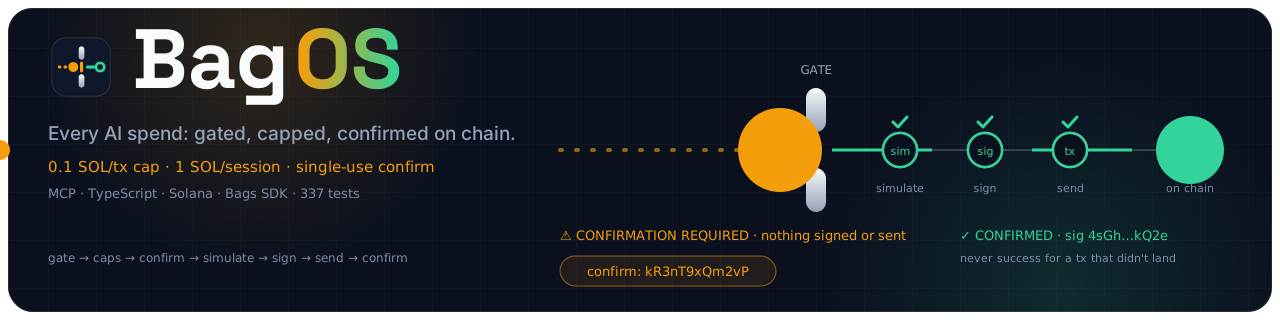
An MCP server that lets an AI assistant trade on Solana — and signs nothing until you say so.



🚀 Install
Claude Desktop — ~/Library/Application Support/Claude/claude_desktop_config.json
(macOS) or %APPDATA%\Claude\claude_desktop_config.json (Windows):
Claude Code:
Restart the client, then ask it: "show me the top Bags creators". The server prints a configuration report to stderr on startup; if something is missing it tells you which variable and why.
An API key alone gives you 8 of the 11 read tools. Three of them — bags_heartbeat,
bags_get_claimable_fees and bags_authenticate — report on your wallet, so they also
need BAGS_KEYPAIR_PATH and will error without it. Writes stay off until you configure
them (Getting Started).
🔒 Why this is safe to hand an assistant
- Nothing signs on the first call. A write tool answers with a preview and a single-use token fingerprinted to those exact arguments; nothing reaches the chain until you call again with it.
- Hard SOL caps. 0.1 per transaction and 1 per session by default, refused before the Bags SDK is called.
- Devnet by default. Writes are mainnet-only, so an unconfigured install cannot spend real money.
Full threat model, disclosure policy and the limits of each control: .github/SECURITY.md.
⚠️ If you used 1.x — v2.0.0 corrected a serious defect
v2.0.0 corrects a serious defect. In 1.x the write tools built transactions, discarded them, and reported success — nothing was ever signed or submitted. If you used 1.x and believed a trade or claim executed, it did not. See CHANGELOG.md.
2.x is live on npm and is what
npx bagos-mcp-serverinstalls — see the latest release. Every release ships with npm provenance — the tarball is cryptographically attested to this repository and the commit that built it. 1.x is deprecated on npm. If you are still on it, upgrade.
📦 Where it's listed














💡 The Problem & Solution
The Problem
An MCP server that can move money gives an AI assistant a signing key. The assistant decides, and the transaction is already on chain by the time a human reads about it. Nothing in the protocol makes the model pause, and nothing bounds what a single misunderstood instruction can spend.
The Solution
Bags is a Solana token launchpad whose defining feature is creator fee sharing: a token's trading fees are split on-chain between the people who launched and promote it, claimable at any time. That makes "who earns from this token, how much is claimable, and claim it" a real workflow — and the one BagOS automates.
BagOS lets an AI assistant read Bags/Solana token data and — with explicit confirmation — execute swaps and claim creator fees from your wallet. Writes are off unless you configure them, they are mainnet-only, and the first call to a write tool signs nothing: it returns a preview and a single-use token that only authorizes the exact arguments it was issued for.
🏗️ Architecture & Tech Stack
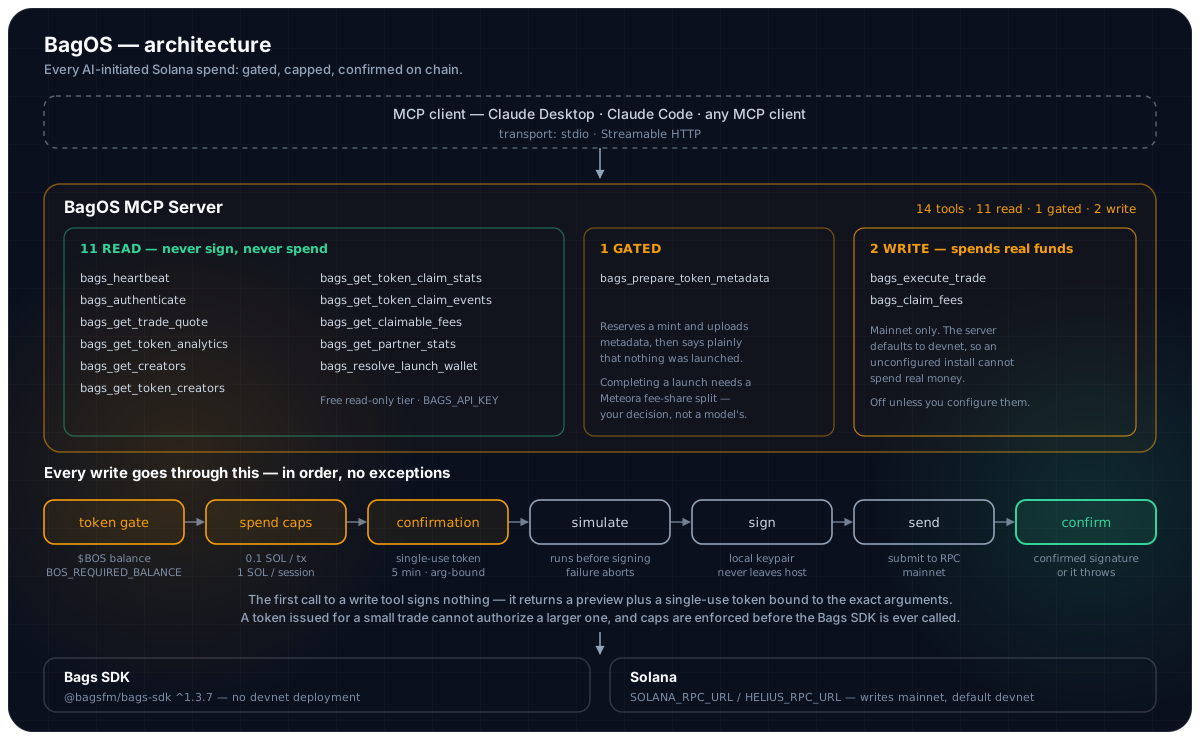
Every write goes through this:
| Tool | Type | What it does |
|---|---|---|
bags_heartbeat | read | Server status and wallet reachability |
bags_get_token_analytics | read | Lifetime fee data for a token mint |
bags_get_creators | read | Top token creators by lifetime fees |
bags_get_trade_quote | read | Price quote for a swap. Does not trade. |
bags_get_claimable_fees | read | Fees currently claimable by your wallet |
bags_get_partner_stats | read | Partner config claim statistics |
bags_get_token_claim_stats | read | Per-creator claim totals — the royalty roster with amounts claimed |
bags_get_token_claim_events | read | The claim audit trail for a token, paginated |
bags_get_token_creators | read | Who shares a token's fees, and in what proportion |
bags_resolve_launch_wallet | read | Social handle (twitter/tiktok/kick/github) → fee-share wallet |
bags_authenticate | read | Verify wallet ownership via Ed25519 signature |
bags_prepare_token_metadata | gated | Creates token info + metadata. Does not launch a token. |
bags_execute_trade | write | Swap tokens. Signs and submits. |
bags_claim_fees | write | Claim creator/LP fees. Signs and submits. |
bags_prepare_token_metadata reserves a mint and uploads metadata. Completing a
launch also requires a Meteora fee-share config, whose fee-claimer split has to
be your decision — so this server does not implement that step rather than
guessing at it. Finish the launch at bags.fm.
🔐 Write Tools & Spend Controls
Writes are off unless you configure them, and they are mainnet-only.
Bags has no devnet deployment. Its API endpoint and its Meteora/fee-share program IDs are all mainnet. This server nonetheless defaults to devnet, so an unconfigured install cannot spend real money. Calling a write tool on devnet returns an explanation, not a cryptic program error.
The first call to a write tool signs nothing. It returns a preview and a single-use token:
The token is a fingerprint of the tool name plus the exact arguments, so one issued for a 0.01 SOL swap cannot authorize a 10 SOL one. It expires in five minutes and is consumed on every outcome, so it cannot be replayed.
On success you get a real signature and explorer link — never a success message for a transaction that did not land.
Set BAGS_ALLOW_UNCONFIRMED=true to skip the preview. Spend caps still apply.
The caps only bind on SOL. A swap whose input is some other token cannot be
valued in SOL, so no cap can limit it. Those swaps are refused by default; set
BAGS_ALLOW_UNCAPPED_TOKEN_SWAPS=true to permit them, and the preview will say
plainly that the trade is uncapped.
⛓️ Live Deployment
A real transaction, landed through the production write path and re-fetched from the chain rather than trusted from a return value:
| Signature | 2kvu25xW…U5Dm |
| Cluster | devnet |
| Slot | 484219564 |
| Status | err: null |
| Captured | 2026-08-16 |
Reproduce it yourself with npm run proof:devnet — it funds a throwaway keypair from the
faucet, pushes a transfer through the same simulate → sign → send → confirm path the write
tools use, then re-fetches the signature from the chain. A function returning success is
a claim; a signature you can open on an explorer is evidence. Full method in
DEMO.md.
📊 Engineering Rigor
345 tests. The bypass tests around the spend caps and the confirmation step are load-bearing; treat a change there as a security change. They were checked by hand against deliberate mutations: deleting the cap guard, the confirmation check, the decimals lookup, or the spend recorder each makes the suite fail. That was a manual exercise, not an automated mutation-testing stage — there is no mutation config in this repo to re-run.
| Layer | Status | Details |
|---|---|---|
| Real default path | ✅ | No kill-switch flag in any documented command. USE_MOCK_DATA defaults off; when on, it affects only the bags_get_claimable_fees tool, stamping ⚠️ [MOCK DATA ENABLED] on that tool's own response. The other 13 tools ignore it. Live-run receipts in DEMO.md |
| Code quality | ✅ | ESLint + tsc --noEmit, both clean |
| Unit testing | ✅ | Jest, 345 tests / 17 suites, 100% statements · branches · functions · lines, enforced |
| High-signal tests | ✅ | Mutation-checked cap/confirmation bypass tests · a leak-channel regression test (the API key used to be echoed into tool output) · network-mismatch refusal |
| Security | ✅ | CodeQL SAST · Dependabot SCA · gitleaks over full history (fetch-depth: 0) · secret scanning + push protection on · npm audit in CI as a ratchet — see below |
| Dependency debt | ⚠️ | 6 advisories, 0 critical — down from 90. Everything patchable was cleared with version-scoped overrides (see package.json). The 6 that remain are one root cause, bigint-buffer GHSA-3gc7-fjrx-p6mg, counted once at each level of the chain it travels up to @bagsfm/bags-sdk. No patched bigint-buffer exists — 1.1.5 is the installed version, the latest version, and vulnerable. CI blocks any critical and any increase over .audit-baseline.json. Note: npm honours overrides only in a root project, so these protect this repo and CI, not consumers of the published package. |
| CI | ✅ | 4 stages (Quality → Security ∥ Test → Build) with cancel-in-progress concurrency; Node 22 + 24 matrix; packaged-artifact and entrypoint checks |
| CD | ✅ | Release → tarball audit → npm publish --provenance → deprecate the superseded version. A second workflow submits server.json to the MCP registry via OIDC. Both gated on the full CI suite. 1.0.0 is deprecated on npm with a pointer to the defect it carried. |
| On-chain proof | ✅ | npm run proof:devnet lands a real transaction through the production write path and re-fetches it from the chain. Captured 2026-08-16: 2kvu25xW…U5Dm, slot 484219564, err: null. Anyone can re-verify it — see DEMO.md |
| Community standards | ✅ | Code of Conduct · Contributing · Security policy · issue + PR templates |
E2E browser tests and Lighthouse budgets are deliberately absent: this is a stdio/HTTP MCP
server with no web UI, so both would measure nothing. The nearest end-to-end coverage is
npm run demo, which drives five read tools — bags_heartbeat, bags_get_creators,
bags_get_trade_quote, bags_get_partner_stats and bags_authenticate — over real MCP
JSON-RPC against the live API. The remaining read tools are covered by unit tests only.
🚀 Getting Started
Prerequisites
You need a Bags API key from dev.bags.fm. That alone enables the read-only tools. For trading and fee claims you also need a Solana keypair file and the gating token — see Write Tools & Spend Controls.
Enabling writes
Writes stay off until all of these are set:
⚠️
BOS_TOKEN_MINTcurrently does two jobs. It is the token the gate requires you to hold ($BOS, above), and it is the default output mint for a swap that does not name one (ExecuteTrade.ts). Those want opposite properties — a gate wants a token you hold, a swap target wants a token with liquidity, and $BOS has almost none. Always passoutputMintexplicitly onbags_execute_traderather than relying on the default. Splitting these into two variables is tracked as a known issue.
Configuration
| Variable | Required | Default | Notes |
|---|---|---|---|
BAGS_API_KEY | yes | — | From dev.bags.fm |
BAGS_NETWORK | no | devnet | devnet or mainnet. Writes need mainnet. |
SOLANA_RPC_URL | no | public cluster RPC | Must agree with BAGS_NETWORK or the server refuses to start |
BAGS_KEYPAIR_PATH | writes only | ~/.config/bags/keypair.json | JSON byte-array keypair file |
BOS_TOKEN_MINT | writes only | — | Gating token mint |
BOS_REQUIRED_BALANCE | no | 10000 | Minimum gating-token balance. 0 disables the gate (any balance passes); a non-numeric value is refused at startup rather than silently defaulting. |
BAGS_MAX_SOL_PER_TX | no | 0.1 | Per-transaction spend cap |
BAGS_MAX_SOL_PER_SESSION | no | 1.0 | Per-process spend cap |
BAGS_ALLOW_UNCONFIRMED | no | false | Skip the confirmation step |
BAGS_ALLOW_UNCAPPED_TOKEN_SWAPS | no | false | Permit swaps whose input is not SOL. The caps are SOL-denominated and cannot limit these. |
HELIUS_RPC_URL | no | — | Alias for SOLANA_RPC_URL, read only if that is unset |
USE_MOCK_DATA | no | false | true makes bags_get_claimable_fees return fabricated balances, stamped as such. No other tool is affected. |
BAGS_API_URL | no | https://public-api-v2.bags.fm/api/v1 | Override the Bags API base URL used by bags_authenticate |
PORT | no | 3050 | HTTP listener port. Only read when started with --http. |
🧪 Testing & CI
proof:devnet uses a persisted throwaway keypair (.proof/, gitignored), funds
it from the devnet faucet when needed, and pushes a transfer through the same
simulate/sign/send/confirm path the write tools use — then re-fetches the
signature from the chain instead of trusting the function's return value. That
last step is the whole point: a function returning success is a claim, and a
signature you can open on an explorer is evidence.
📽️ Demo Materials
- DEMO.md — receipts from a real run against the live Bags mainnet API: 7 scenarios, 8 steps, per-step latency, plus the network-mismatch guard and the token gate caught refusing a write.
- docs/examples.md — prompts you can type at your assistant and what each should do.
- docs/KNOWN_ISSUES.md — what is currently broken and why, including what has already been ruled out. Open advisories are explained there rather than left for you to discover.
🛡️ Security
Read SECURITY.md before pointing a funded wallet at this.
Summary: your private key is read from disk, used to sign, and never logged,
never sent anywhere, and never placed in an error message. Tool errors return
a message only — no stack traces — with key-shaped strings redacted. The startup
report strips credentials from the RPC URL. If the RPC endpoint's cluster
disagrees with BAGS_NETWORK, the server refuses to start rather than sign
mainnet transactions under a devnet banner.
The same rule now covers the Bags API key: bags_authenticate writes it to
~/.config/bags/credentials.json and echoes only a four-character tail. It used
to print the key in full, which published a live credential into the assistant's
context and every transcript downstream of it. If you ran bags_authenticate on
a version before this change, rotate that key at dev.bags.fm.
Known limits of these controls
Two are worth stating here rather than leaving in SECURITY.md:
- HTTP mode has no authentication. Started with
--http, the server listens on0.0.0.0with permissive CORS and no auth, so any caller that can reach the port can invoke the write tools — sharing one spend counter. Do not run HTTP mode on a funded wallet. stdio is the default and the only transport this project recommends; it is also why the Smithery listing is stdio-only rather than hosted. - The session cap is not concurrency-safe. Two writes racing can both pass the check before either records its spend. The per-transaction cap still binds on each.
Report vulnerabilities via GitHub security advisories.
📄 License
MIT — see LICENSE.