Attestari README
The full upstream README, mirrored here for reference. Install config, tool schemas, adoption signals, and an original overview live on the Attestari listing page.
Attestari
The auditable memory layer for AI agents. Give your agent long-term memory — like any memory layer — except every fact carries a receipt (where it came from, when), it runs on plain Postgres, the audit trail is tamper-evident, and any user's data can be provably deleted with a signed certificate.




No database, no API key, no model download required to run that — the core engine has zero dependencies.
Contents
- Why it's different
- What you get
- Quickstart (30 seconds)
- The Python API
- Run it for real — Postgres · server + console · MCP · TypeScript
- REST API
- Configuration
- Provable deletion + tamper-evident audit, in one demo
- Already using Mem0 or Zep? Wrap it
- For auditors and DPOs
- How it works
- Project layout
- Docs & contributing
Why it's different
Hosted memory is a black box: you can't see where a "memory" came from, you can't cleanly delete one user's data, and you can't prove the history wasn't altered. For a bank, hospital, or insurer — and under GDPR / the EU AI Act — that's a dealbreaker. Attestari is the neutral, self-hostable layer that fixes exactly that.
| Attestari | Typical memory layer | |
|---|---|---|
| Runs on plain Postgres (no graph DB) | ✅ | ✗ (needs Neo4j / a vector service) |
| Provenance on every fact | ✅ | partial |
| Bi-temporal ("what did it know on date D?") | ✅ | ✗ |
| Provable deletion + certificate (GDPR) | ✅ | ✗ |
| Tamper-evident audit trail (hash chain) | ✅ | ✗ |
| Works across model vendors | ✅ | usually locked to one |
The last two rows are the moat. Deletion you can prove: each user's data is
encrypted with their own key; forget() destroys the key, so the content is
unrecoverable — while an immutable log and a signed certificate remain as proof.
A history you can verify: every event is hash-linked, so verify_audit()
catches any edit, insert, or delete — and the proof survives deletion.
What you get
- Provenance on every fact — each memory traces back to the exact source message, with a character span, confidence, and timestamps.
- Bi-temporal time travel — query memory
as_ofany past instant; corrections supersede old facts without erasing them, so history is always reconstructable. - Provable deletion —
forget(subject_id)crypto-shreds a user's data and returns a signedDeletionCertificate; content backups and replicas are covered (key storage needs its own backup policy — see the threat model). - Tamper-evident audit — a hash-linked event chain;
verify_audit()detects any edit/insert/delete, and the proof survives crypto-shred. - Conflict resolution — single- vs multi-valued predicates; conflicts are
surfaced via
conflicts(), not silently dropped. - Entity resolution — merge "the same entity, many surface forms," reversibly.
- Hybrid retrieval — semantic (pgvector) ⊕ keyword (full-text) ⊕ graph, with the bi-temporal filter built in.
- Runs anywhere — zero-dependency in-memory engine, or durable on one Postgres
- pgvector container. No graph database. Works across model vendors.
Quickstart (30 seconds)
You'll see facts change over time, a bi-temporal query answer differently "as of"
different dates, a provenance trace back to the source, and a forget() that
issues a certificate. No install, no API key, no database.
The Python API
One facade, Memory, covers the whole surface:
| Method | Returns | What it does |
|---|---|---|
add(text, *, subject_id, valid_from=…, source_ref=…) | list[str] | Ingest a message; extract, dedup, and supersede facts. |
search(query, *, subject_id, as_of=…, limit=5) | list[SearchResult] | Hybrid retrieval with an optional time filter. |
answer(query, **kwargs) | str | None | The single top object for a query. |
timeline(*, subject_id) | list[Edge] | Every fact for a subject, live and superseded. |
get_provenance(fact_id) | Provenance | None | Trace a fact to its source episode + span. |
conflicts(*, subject_id=None) | list[dict] | Conflicts resolved by predicate cardinality. |
resolve_entities(names=None, *, auto=True) | ResolutionResult | Merge duplicate entities (reversible). |
forget(subject_id) | DeletionCertificate | Crypto-shred a subject; return proof. |
verify_audit(deep=False) | AuditReport | Verify the tamper-evident hash chain; deep=True also catches silent edits to event content. |
Run it for real
Three storage tiers, one engine — every guarantee (audit chain, crypto-shred, deep verification, time travel) holds on all three:
| Tier | Storage | For | Setup |
|---|---|---|---|
Memory() | in-memory | tests, demos, determinism | none |
Memory.local() | one SQLite file (~/.attestari/attestari.db) | a personal agent, MCP, prototypes — durable, single-process | none (stdlib) |
Memory.postgres() | Postgres + pgvector | production: concurrent access, indexed hybrid search | one container |
Durable with zero infrastructure (survives restarts; nothing to install or run):
Durable, on Postgres + pgvector (one container, no graph DB):
Already have a Postgres (managed or local)? The schema ships inside the pip package — no clone needed:
As a REST API + visual console:
As an MCP server (any agent — Claude, frameworks — can use it) — exposes
add_memory / search_memory / get_provenance / forget_subject over stdio.
Register it in your MCP client's config (e.g. Claude Desktop's
claude_desktop_config.json); the client launches the process for you:
Only command/args are required. Durable by default (memories go to the local
SQLite file, so they survive app restarts); the env block is where per-server
config lives — add ATTESTARI_DATABASE_URL to use Postgres instead of SQLite,
ANTHROPIC_API_KEY to upgrade extraction to Claude, ATTESTARI_KEK to enable
crypto-shred. To run it standalone (e.g. to debug): attestari-mcp (or
python -m attestari.mcp). Without a local install, MCP clients can spawn it
straight from PyPI: uvx --from "attestari[server]" attestari-mcp.
From TypeScript — the TS client talks to the REST API, so start the server
first (see above; it defaults to http://localhost:8000). Then see
clients/ts (@attestari/client), a thin typed client mirroring the
Memory surface.
With LangChain: see clients/langchain (attestari-langchain)
— a AttestariRetriever (recall facts with provenance) and AttestariChatMessageHistory
(drop-in memory for RunnableWithMessageHistory) for any chain or agent.
With real Claude extraction (instead of the zero-dep deterministic extractor):
Enable crypto-shred deletion (turn forget() from a logical delete into
cryptographic erasure). Encryption is opt-in via a root key-encryption key
(KEK); with none set, forget() still works but only drops the data from reads.
Mint a KEK once and set it in the environment:
Now each subject's PII is encrypted at rest under a per-subject key, and
forget() destroys that key — the ciphertext is unrecoverable, while the audit
proof survives. With the KEK set, the DeletionCertificate is also signed
(HMAC-SHA256 under a KEK-derived key); anyone holding the KEK can verify it
offline — verify_certificate(cert, kek) — and a certificate with any altered
field fails. Without a KEK, forget() is a logical delete and the certificate
is issued unsigned. Keep the KEK out of the database and its backups (env
var or a KMS) — storing it next to the data defeats the shred. See the backup
boundary in docs/the-moat.md.
Deploying for real. A production checklist:
- Storage: use
Memory.postgres()(concurrent access); apply the schema withpython -m attestari.initdb "$ATTESTARI_DATABASE_URL".Memory.local()(SQLite) is single-process — great for one agent or an MCP server, not a shared service. - Server: run under a process manager, e.g.
uvicorn attestari.server:app --host 0.0.0.0 --port 8000 --workers 4behind a reverse proxy; put your own auth in front (the API ships without auth). - Extraction & embeddings: set
ANTHROPIC_API_KEY(extraction auto-upgrades to Claude) and install[embeddings]for real semantic vectors. - Keys: inject
ATTESTARI_KEKfrom a KMS/secrets manager as an env var — never bake it into an image or the DB. Back thekeyringtable up on a separate, short-retention policy (or rotate the KEK) so a restored data backup can't resurrect a shredded subject — see docs/the-moat.md. - Backups: exclude the derived projection tables (
edge,entity) as well — they hold plaintext fact text for retrieval and are fully rebuildable from the (ciphertext) event log, so backing them up only weakens the shred. - Secrets: nothing is read from a
.envfile automatically — export the vars (or use your orchestrator's secret injection) before starting the process.
REST API
uvicorn attestari.server:app serves:
| Method & path | Purpose |
|---|---|
GET /healthz | Liveness check. |
POST /v1/add | Ingest a message. |
GET /v1/search | Hybrid retrieval (q, subject_id, as_of, limit). |
GET /v1/timeline | Full bi-temporal history for a subject. |
GET /v1/provenance/{fact_id} | Trace a fact to its source. |
POST /v1/forget/{subject_id} | Provable deletion → certificate. |
GET /v1/conflicts | Surfaced conflicts. |
GET /v1/audit/verify | Verify the audit hash chain. |
GET /v1/graph | The memory graph (for the console). |
GET / | The visual graph console. |
Configuration
Environment variables (all optional — the engine runs with none of them):
| Variable | Effect |
|---|---|
ATTESTARI_DATABASE_URL | Postgres DSN; the server/MCP use Postgres instead of local SQLite. |
ATTESTARI_SQLITE_PATH | Where Memory.local()-backed server/MCP keep the SQLite file (default ~/.attestari/attestari.db). |
ATTESTARI_KEK | Root key-encryption key; turns on crypto-shred deletion. |
ATTESTARI_PG_PORT | Host port for the bundled docker compose Postgres (default 5432). |
ATTESTARI_WRAP_UPSTREAM | Base URL of a memory service to govern; mounts the /v1/wrap/* endpoints (unset = no wrap routes). |
ATTESTARI_WRAP_UPSTREAM_TOKEN | Sent to the upstream as Authorization: Bearer …. |
ATTESTARI_WRAP_*_PATH | Override the upstream paths — ADD, SEARCH, DELETE, GET_ALL (defaults /add, /search, /delete, /get_all). Set GET_ALL empty to disable the post-delete read-back. |
ANTHROPIC_API_KEY | Enables Claude fact extraction — the server/MCP upgrade from the regex extractor automatically. |
ATTESTARI_EXTRACTOR_MODEL | Override the extraction model (default claude-opus-4-8). |
Install extras (pip install -e ".[extra]"):
| Extra | Adds |
|---|---|
postgres | psycopg + pgvector — the durable event store. |
embeddings | sentence-transformers — real semantic embeddings. |
crypto | cryptography — crypto-shred deletion. |
server | FastAPI + uvicorn + MCP — the REST server and MCP server. |
anthropic | The Anthropic SDK — Claude fact extraction. |
dev | pytest + ruff — tests and linting. |
Provable deletion + tamper-evident audit, in one demo
Don't trust the bullet points — break the properties and watch them get caught.
This runs with no database, no API key, no model download, and is self-verifying
(every claim ends in an assert; it crashes if any property is false):
It adversarially proves all three differentiators: a silently rewritten fact is
caught at the exact seq by verify_audit(deep=True); a crypto-shredded
subject's ciphertext is provably unrecoverable while the audit proof survives;
and a corrected fact is queryable in the past without erasing history. (Runs on a
bare clone; pip install "attestari[crypto]" upgrades claim 2 from logical erasure to
cryptographic crypto-shred.) See
docs/the-moat.md for the threat model and honest boundaries.
For the full crypto-shred against a real encrypted Postgres row:
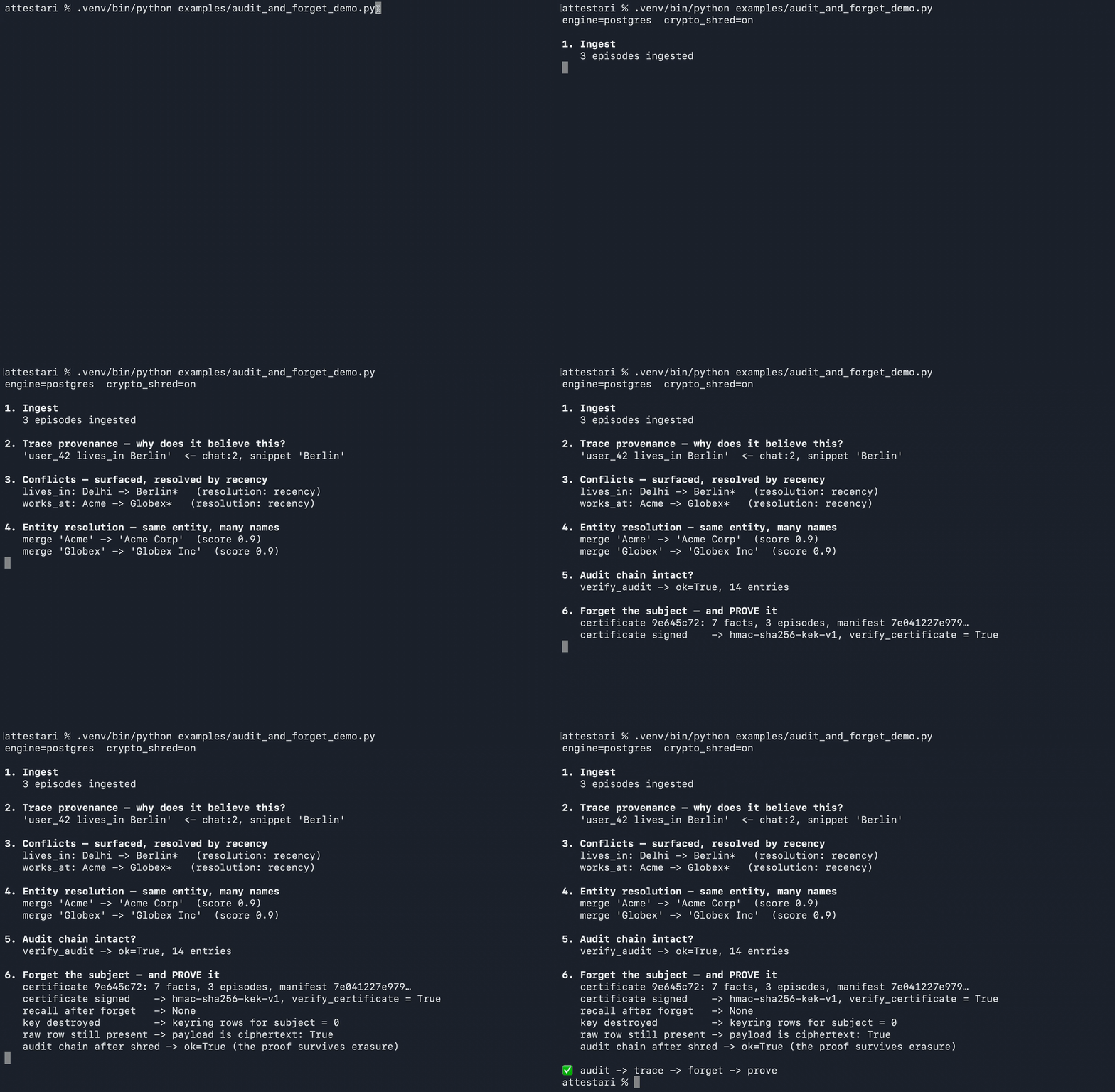
It shows: a fact traced to its source, a subject forgotten, the raw row confirmed to be unreadable ciphertext, recall returning nothing — and the audit chain still valid after the erasure.
Already using Mem0 or Zep? Wrap it
You don't have to replace your memory layer to get an audit trail. wrap() puts
Attestari in front of the client you already use:
Not on Python? Point your app at the Attestari server instead of at your memory service and get the same guarantees over REST:
A partial erasure returns 409, not 200 — a caller checking only the status
code must never read a half-completed deletion as success. The routes appear
only when an upstream is configured. See attestari.wrap_http for the small
JSON contract the upstream is expected to speak (stdlib-only, no new deps).
It doesn't take the delete call's word for it. After deleting, forget()
reads the subject back out of the wrapped store. A store that returns
{"deleted": true} and keeps the rows is caught right there —
downstream_verified is False, complete is False, and the discrepancy
goes into the audit chain. If the adapter has no read-back operation,
downstream_verified is None rather than True: "nobody checked" and
"checked and clean" are different claims, and only one of them is evidence.
Writes are recorded in the tamper-evident chain before being passed downstream;
reads pass through untouched (retrieval is why you kept your store); forget()
deletes downstream, crypto-shreds Attestari's copy, and records what the
downstream store actually did — including failure. Method names and the subject
keyword are configurable via Adapter, so this works against a bare vector
store too.
What wrapping does and doesn't prove. Attestari can't cryptographically shred data inside someone else's service — it doesn't hold their keys. A wrapped deployment proves the deletion was requested, that the downstream delete was called and what it returned, that Attestari's own copy is unrecoverable, and that none of that was altered afterwards. That's an auditable deletion record across both systems, not crypto-shred everywhere: a wrapped store is only as erasable as its own delete endpoint is honest, and wrapping turns that endpoint's behaviour into evidence instead of a promise. For full cryptographic erasure, the data has to live in Attestari itself.
For auditors and DPOs
The people who have to answer for an AI system's memory get their own docs in auditor/ — a plain-language one-pager (what's guaranteed, what isn't, how to check it yourself), an EU AI Act Art. 12 mapping, and a GDPR Art. 17 note on cryptographic erasure and the deployment policies it depends on.
Any deployment can produce a dated snapshot of its own verifiable state:
The bundle carries the audit-chain result and head hash, an erasure register with every request re-checked against the current ledger, and the retained deletion certificates. Every claim is re-derived from the live ledger when the bundle is generated — it's evidence because you can regenerate it, with read access and no cooperation from whoever runs the system.
How it works
The source of truth is an append-only event log; everything you query (the knowledge graph, the vector index, the keyword index) is a projection you can rebuild from it. That's why audit, time-travel, provenance, and provable deletion fall out of the design instead of being bolted on.
- ARCHITECTURE.md — the design, end to end.
- LEARN.md — the same ideas explained from scratch, for newcomers.
Project layout
Docs & contributing
- ARCHITECTURE.md — the design
- auditor/ — for DPOs, compliance, and internal audit
- LEARN.md — how Attestari works, from scratch
- CONTRIBUTING.md — dev setup, good first issues
- SECURITY.md — reporting vulnerabilities
Status
The engine and its differentiators — verifiable deletion, tamper-evident audit, bi-temporal provenance, Postgres-native retrieval — are built and tested (122 tests; Postgres p95 ≈ 1 ms).
License
Apache-2.0. The core stays permissively licensed; the hosted cloud and enterprise/governance features are the commercial layer.