DXF drawings for AI agents: structured facts, PNG renders, and an interactive in-chat viewer.
Quick Install
Automated & IDE SetupCopy the AI prompt to install this server into Claude Code, Cursor, or another agent — or use 1-click editor setup below.
Not yet automatically verified
We haven't yet run this listing's install command through our automated sandbox check. This isn't a red flag — we're steadily working through the catalog.
Manual Client & Custom JSON ConfigExpand JSON ▾
Client Config & Setup
Choose your client or environment
Target File:
💡 Paste the JSON block into your client's configuration file under mcpServers, then restart the application.
Documentation Overview

Aspicio
Drawing understanding for people, applications, and AI agents — DXF and vector PDF.
Aspicio (Latin: "I look at")








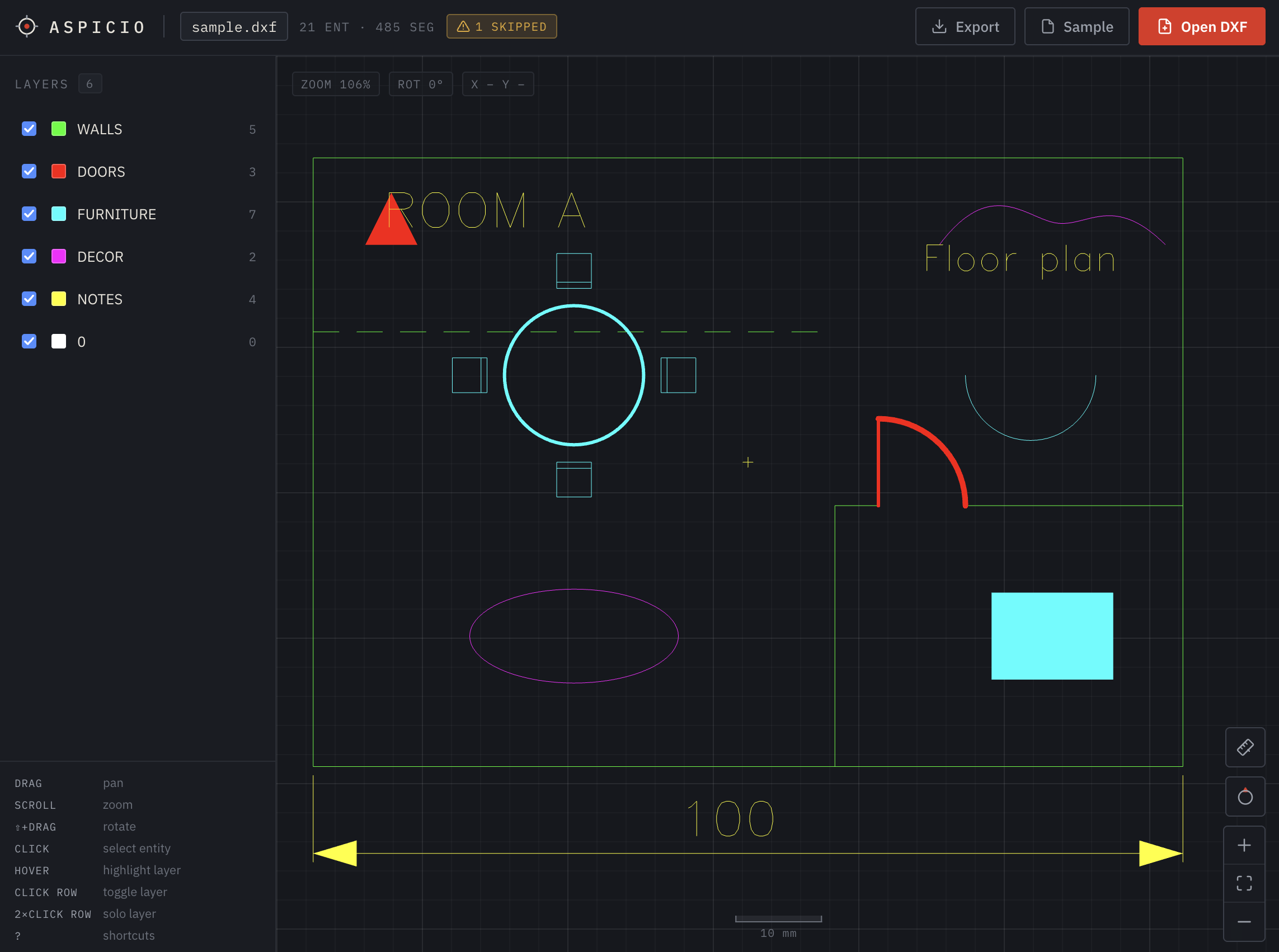
Aspicio is an open-source (MIT), TypeScript-first drawing engine: one
framework-free parse → tessellate pipeline that runs in the browser, in
Node, and in serverless runtimes. It reads DXF and the vector content of
PDF — the kind of PDF that carries artwork and dielines rather than a
scan. A person gets an interactive WebGL viewer of a CAD drawing; an AI
agent gets structured JSON facts and a rendered PNG of the same file.
Every surface — the browser viewer, the web components and their React,
Vue, and Svelte bindings, the headless renderer, the HTTP API, and the MCP
server — is a thin adapter over the same engine, so a drawing is equally
readable everywhere.
How it's built: docs/architecture.md · behavior specs: docs/product-specs/
Embed it
One embed, every flavor — and every path below renders the same web components, so the result is pixel-identical no matter which you pick.
Web components — plain HTML, any framework
One tag gives you the layer panel plus an interactive preview; no bindings needed:
Formats are opted into by import: the package brings the components, the
formats/* entry brings the parser. That is what keeps a DXF app from
shipping every other format's code — and every flavor below does the same.
React
The same embed with idiomatic props and a ref exposing the full
viewer, via @aspicio/react:
Vue
Typed props and emits with unwrapped payloads, via
@aspicio/vue:
Svelte
The same components as raw Svelte 5 source with typed callback props,
via @aspicio/svelte:
Vanilla TypeScript
Skip the ready-made UI and drive the viewer directly from
@aspicio/core — bring your own chrome:
Headless — Node and serverless
Parse, describe, and render with no browser at all (server-side previews, thumbnails, pipelines):
What you get: WebGL rendering batched to one draw call per layer (large drawings stay interactive), broad entity coverage (lines, arcs, circles, ellipses, polylines with bulges, splines, TEXT/MTEXT, DIMENSION, SOLID/HATCH fills, nested INSERT blocks — anything unsupported is counted and reported, never fatal), a layer list with the colors that are actually drawn (per-entity overrides included, not just the layer table), measure with object snap, entity picking, paper-space layouts, SVG/PNG export, and first-class touch. Out of scope: editing and 3D.
Hand it to an agent
The same engine speaks MCP and HTTP, so an agent can read a drawing instead of guessing at it:
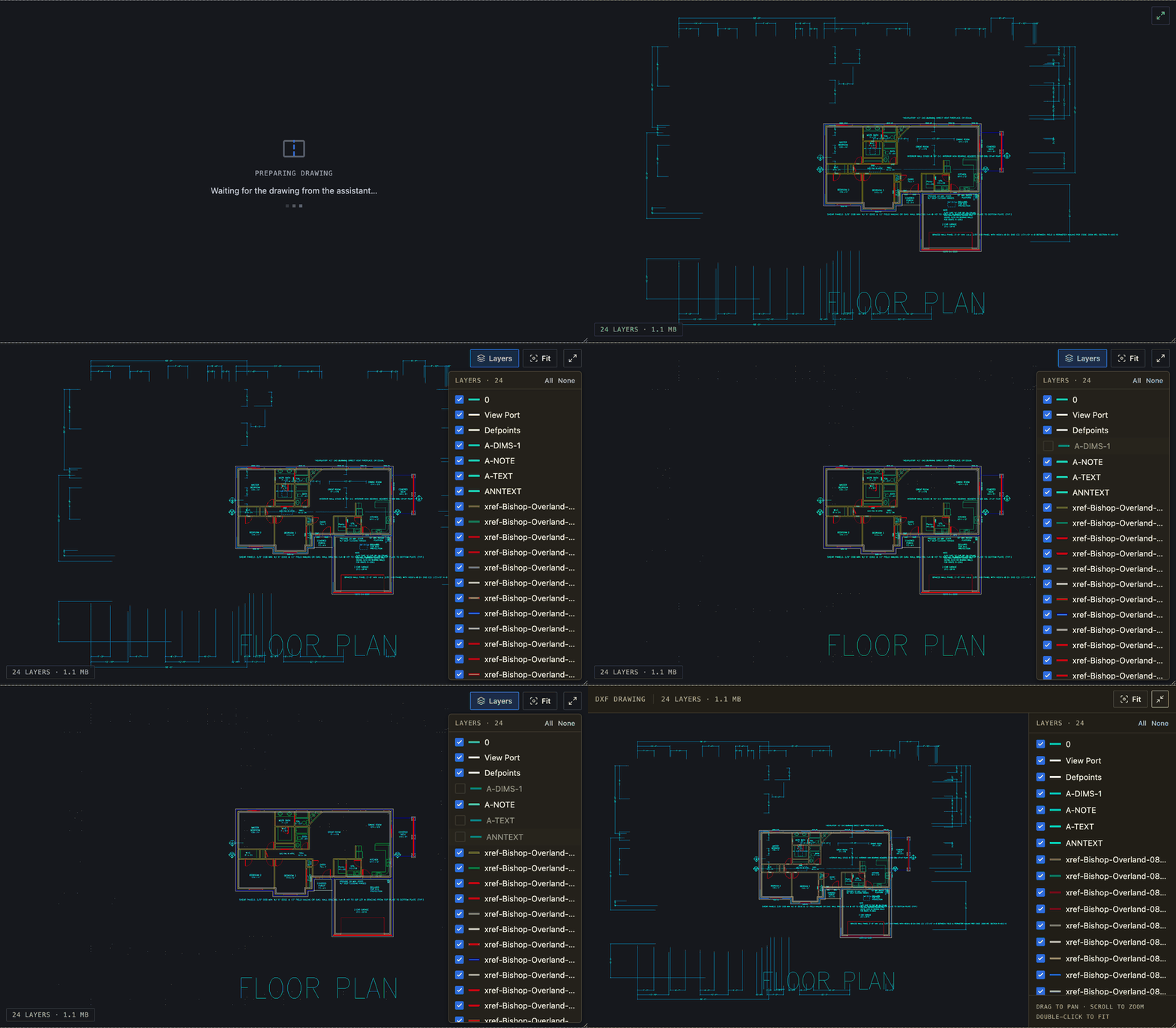
describe_dxf— units, bounds, size, layers with effective colors, entity counts, and the drawing's text content. An agent reads a title block or a dimension value directly — no OCR, no vision round-trip.render_dxf— a PNG of the drawing the model can look at.view_dxf(hosted server) — an interactive in-chat viewer for the person in the conversation, via the open MCP Apps extension: pan, zoom, layer toggles, fullscreen, host light/dark theming. The widget is locked to the drawing the tool call delivered and makes no network requests; hosts without MCP Apps still get the structured facts.
| Surface | Local files | URLs | Inline DXF |
|---|---|---|---|
stdio MCP — npx -y @aspicio/mcp | ✅ | ✅ | ✅ |
Hosted MCP — aspicio-api.frontsail.app/mcp | — | ✅ | ✅ |
HTTP API — /describe, /render | POST body | ✅ | ✅ |
Connect:
- Claude Code — one step installs the MCP server plus the bundled
skills (
aspicio-inspect-dxf,aspicio-embed):/plugin marketplace add frontsail-ai/aspiciothen/plugin install aspicio@aspicio - Codex — the same repo doubles as a Codex marketplace:
codex plugin marketplace add https://github.com/frontsail-ai/aspicio,codex plugin add aspicio@aspicio, thencodex mcp add aspicio -- npx -y @aspicio/mcp - Any client that launches stdio MCP servers — register
npx -y @aspicio/mcp - Any client that supports remote MCP (Streamable HTTP) — point it
at
https://aspicio-api.frontsail.app/mcp(no install; speaks MCP, not a browser page) - Plain HTTP —
GET /describe?src=<dxf-url>,GET /render?src=<dxf-url>&format=png|svg; the API self-describes at/openapi.json
URL fetches are guarded (private-network blocking, size caps, redirect validation, timeouts). The stdio server reads local files in-process and never uploads the DXF to any Aspicio service — though, as with any tool result, your MCP client passes the returned summary or image to its model provider. Full details: privacy policy · terms.
Available today · direction
Everything above is shipped and live: viewer + demo, core, web components, React, Vue, and Svelte packages, headless describe/render, stdio and hosted MCP, the in-chat MCP Apps viewer, the HTTP API with OpenAPI, and plugin packaging for Claude Code and Codex.
Direction (intent, not commitments — see issues): MCP registry listings, structured entity queries and focused rendering, and an upload flow so remote surfaces can handle local files.
Packages
Related MCP Servers
Reviews
No reviews yet — be the first to share how this listing worked for you.
Frequently Asked Questions about Aspicio
AllMCPs Directory Badge
Showcase your server listing on GitHub or your project documentation. Embed this dynamic SVG badge to highlight official listing status and live engagement.
Badge Style:
Live Dynamic SVG Preview
Markdown (GitHub README)
[](https://allmcps.com/mcp/aspicio)HTML Embed
<a href="https://allmcps.com/mcp/aspicio"><img src="https://allmcps.com/api/badge/aspicio?style=directory" alt="Aspicio on AllMCPs" /></a>Technical Specs & Signals
CategoryDeveloper Tools
37Quality signal: Fair · 37/100How this signal is calculated ▾
Server availabilityNot measured
Not scored for repo-hosted servers — we can't reach the running server, only its GitHub page. Hosted MCP endpoints are health-checked live.
Verified ownership10/20
Documentation & tools16/30
Adoption & activity2/15
Community engagement0/10
A guidance signal from public completeness & health data — not a user rating. New listings start lower and rise as they add docs, get verified, and grow adoption. Signals we can't observe for a listing are skipped, not counted against it.
Own this project?
This directory is pre-filled from public sources. Claim via GitHub README, site badge, or DNS TXT to unlock edit access and the Official badge — proof is checked automatically, then reviewed by our team.
Free dofollow backlink: add your website and place the AllMCPs badge on it — no claim needed. We detect it automatically and keep it verified as long as the badge stays live.
Claim & get free dofollowShare & Embed
Add our SVG badge (dark/light directory styles) or embeddable widget to your site.