Arthor Agent README
The full upstream README, mirrored here for reference. Install config, tool schemas, adoption signals, and an original overview live on the Arthor Agent listing page.

Anime cyber kitsune sentinel for the DocSentinel console and documentation.
DocSentinel
AI-powered SSDLC platform — Secure your software from requirements to operations








What is DocSentinel?
DocSentinel is an AI-powered SSDLC (Secure Software Development Lifecycle) platform for security teams. It automates security activities across all six phases of the software development lifecycle using intelligent AI agents orchestrated by LangGraph and powered by LangChain. It automates the review of security-related documents, forms, and reports — from requirements and design through development, testing, deployment, and operations — comparing inputs against your policy and knowledge base to produce structured assessment reports with risks, compliance gaps, and remediation suggestions.
Instead of only reviewing documents at the pre-release stage, DocSentinel embeds security from day one:
| SSDLC Phase | What DocSentinel Does |
|---|---|
| Requirements | Extract security requirements, identify compliance obligations (GDPR, PCI DSS, SOC2) |
| Design | Automated threat modeling (STRIDE/DREAD), security architecture review, SDR reports |
| Development | Secure coding assessment, SAST findings triage, coding guidance |
| Testing | SAST/DAST report analysis, penetration test review, vulnerability prioritization |
| Deployment | Configuration security review, hardening assessment, release sign-off |
| Operations | Vulnerability monitoring, incident response assistance, log audit |
Built as a React console + FastAPI service + MCP/A2A agent gateway, DocSentinel integrates into local security review workflows, CI/CD pipelines, AI agents, and multi-agent platforms without giving external agents approval authority.
- LangGraph orchestration: Stateful, graph-based agent workflows with conditional branching per SSDLC stage.
- Multi-format input: PDF, Word, Excel, PPT, text — parsed into a unified format for the LLM.
- Knowledge base (RAG): Upload policy and compliance documents; the agent uses them as reference when assessing.
- Multiple LLMs: Use OpenAI, Claude, Qwen, or Ollama (local) via a single interface.
- Structured output: JSON/Markdown reports with risk items, compliance gaps, and actionable remediations.
Ideal for enterprises that need to scale security assessments across many projects and SSDLC stages without proportionally scaling headcount.
Product Tour
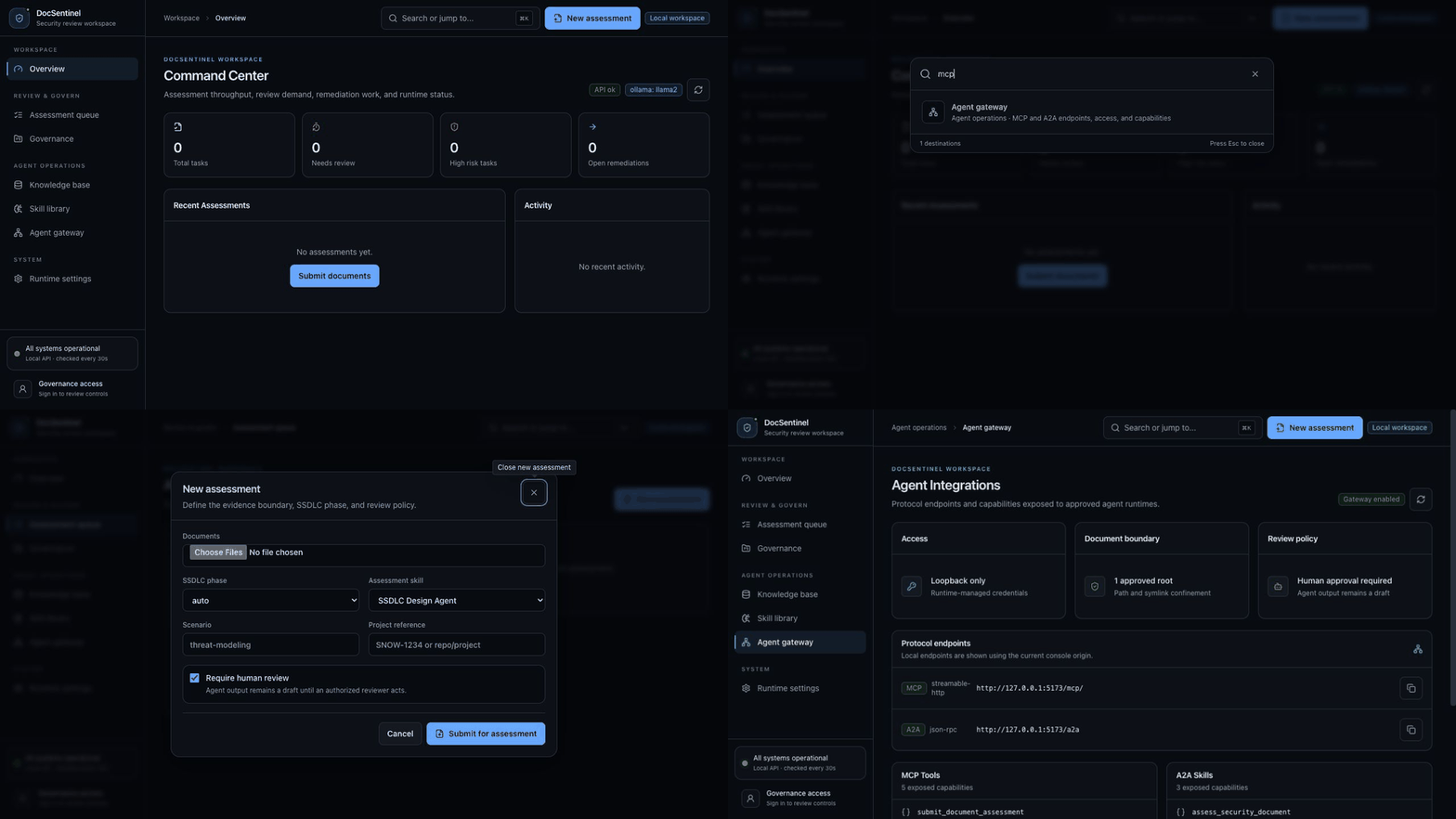
The local React console brings the main workflow into one operational surface:
- Command Center: live API and LLM status, assessment throughput, review demand, remediation queues, and recent activity.
- Assessment Workbench: upload project documents, choose SSDLC phase/skill, inspect AI-generated risks, and complete human review.
- Governance Portal: create projects, apply public framework overlays, generate controls, submit evidence, and track Pallas Lens readiness.
- Knowledge Base: ingest policies and standards for RAG-backed review.
- Agent Integrations: expose governed MCP and A2A tools to coding agents and multi-agent platforms without granting approval authority.
- Settings: switch providers such as DeepSeek, OpenAI, Anthropic, Qwen, or Ollama; API keys are accepted locally and only shown as masked previews.
Why DocSentinel?
| Pain Point | DocSentinel Solution |
|---|---|
| Fragmented SSDLC coverage Most tools only address testing/deployment. | Full lifecycle agents cover all 6 SSDLC phases with dedicated AI personas. |
| Fragmented criteria Policies, standards, and precedents are scattered. | Single knowledge base ensures consistent findings and traceability. |
| No automated threat modeling Threat models are created ad-hoc. | Design Agent generates STRIDE/DREAD threat models from architecture docs. |
| Heavy questionnaire workflow Endless review cycles. | Automated first-pass and gap analysis reduces manual back-and-forth rounds. |
| SAST/DAST report overload Too many findings, too little context. | Testing Agent triages, prioritizes, and maps findings to threat models. |
| Pre-release review pressure Everything lands on security at the end. | Shift-left approach catches issues early in requirements and design. Structured reports help reviewers focus on decision-making. |
| Scale vs. consistency Manual reviews vary by reviewer. | LangGraph workflows and unified pipeline ensure consistent, auditable assessment across projects. |
| SSDLC coverage gaps Security involvement is uneven across lifecycle stages; early stages get less scrutiny. | Stage-aware assessment covers all 6 SSDLC stages with dedicated skills and checklists. |
See the full problem statement and SSDLC phase details in SPEC.md.
Architecture
DocSentinel is a React Console + FastAPI application with three governed
entry paths: REST APIs for the console and CI, MCP tools for coding agents, and
A2A JSON-RPC for remote agent delegation. These entry paths converge on the
same AssessmentService, LangGraph assessment pipeline, knowledge base, and
human-review lifecycle. Governance workflows from PallasGuard are now a
first-class domain beside assessment, backed by SQLModel records, policy packs,
control evidence, audit trails, and Pallas Lens readiness scoring.
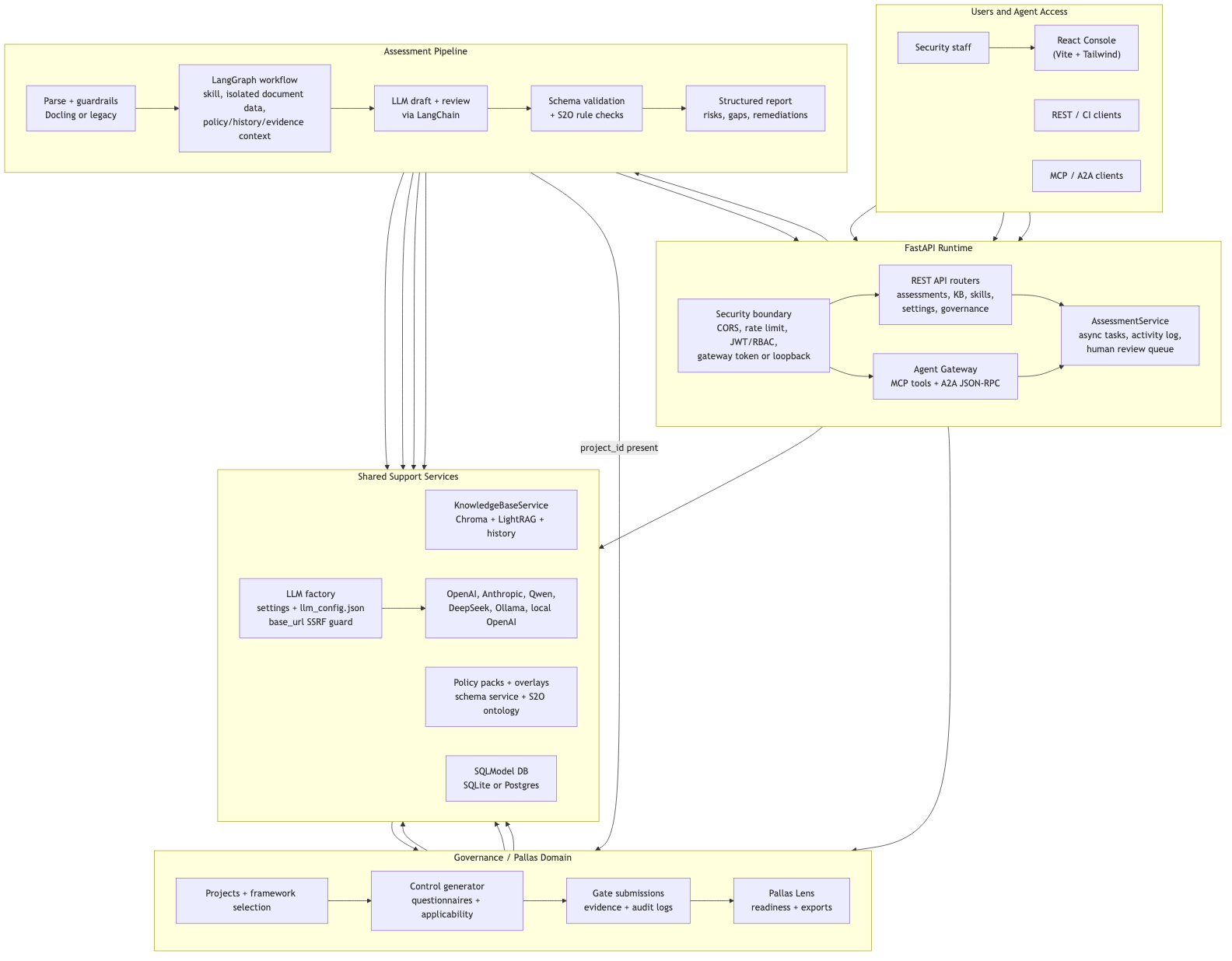
Data flow (simplified):
- Security staff work in the React console; REST clients call
/api/v1/*; coding agents call MCP or A2A through the agent gateway. - REST write paths use JWT/RBAC dependencies. Agent protocols use a bearer gateway token or loopback-only development access. LLM-costly POST paths are rate limited by IP or bearer token.
- Assessment submissions enter
AssessmentService, which creates an async task, parses uploaded or approved local documents, applies guardrails, and invokes the LangGraph assessment pipeline. - The LangGraph pipeline loads the selected skill, wraps untrusted document content as data, retrieves policy/history/evidence context from the KB, asks the LLM for draft/review text, and converts the result into the structured assessment schema.
- Deterministic services remain authoritative for governance decisions: policy-pack schemas, the S2O rule engine, control applicability, and schema validation cross-check LLM output before it enters the review queue.
- When an assessment is linked to a project, findings are persisted as Gate 3 control evidence. Governance workflows then use the same SQLModel store for projects, controls, submissions, audit logs, Pallas Lens scoring, and exports.
- The KB persists chunks in Chroma, optional graph artifacts in LightRAG, and
prior assessment history for reuse. Runtime LLM settings are loaded from
.envplusllm_config.json, and every provider base URL is checked by the network guard before client construction.
Detailed architecture: ARCHITECTURE.md and docs/01-architecture-and-tech-stack.md.
Core Capabilities
SSDLC Full Lifecycle Coverage
Six dedicated AI agents, each with phase-specific skills, prompts, and knowledge base collections. Run individual phases or a full end-to-end SSDLC assessment:
- Requirements: Security requirements, compliance mapping, initial risk analysis.
- Design: Architecture review, STRIDE/DREAD threat modeling, SDR.
- Development: Secure coding standards, code review findings.
- Testing: SAST/DAST report triage, pen-test evaluation.
- Deployment: Release readiness, config security, hardening.
- Operations: Incident response, vulnerability monitoring, log audit.
Automated Security Assessment
Submit security questionnaires, design documents, or audit reports. DocSentinel analyzes them using configured LLMs and identifies:
- Security Risks: Classified by severity (Critical, High, Medium, Low).
- Compliance Gaps: Missing controls against frameworks like ISO 27001, PCI DSS.
- Remediation Steps: Actionable advice to fix identified issues.
Governance & Compliance Workflows
PallasGuard governance capabilities are merged into DocSentinel as first-class project workflows:
- Policy packs:
generic-ssdlcplus eight public overlays for NIST SSDF, MAS TRM, ISO 27001:2022, EU AI Act, ISO 42001, China MLPS 2.0, OWASP SAMM, and EU CRA. - Gate workflows: Gate 1/3 questionnaire, submission, approval, audit, and evidence tracking flows backed by SQLModel and Alembic migrations.
- Control generation: Framework overlays generate applicable SCD controls and expected evidence without replacing DocSentinel's existing assessment engine.
- Pallas Lens: Project readiness scoring summarizes control coverage, evidence depth, and next actions in the React governance portal.
Intelligent Agent Orchestration (LangGraph)
- Structured workflows: LangGraph nodes separate context collection, drafting, evidence review, schema conversion, and governance persistence
- Cross-phase traceability: Threats from Design link to test cases in Testing and monitoring rules in Operations
- Conditional routing: Agents activate based on project risk level, compliance requirements, or user selection
- Human-in-the-loop: Agent-created assessments enter a review queue and cannot approve themselves
- Planned hardening: Explicit plan gates, durable LangGraph checkpoints, and resumable execution are tracked in the development roadmap below
Threat Evidence Critic
Design-phase STRIDE threats are independently checked against the currently uploaded architecture documents in one inference-time pass:
- Every threat receives a
supported,contradicted, orinsufficient_evidenceverdict with a support score and reviewer-facing rationale. - Evidence references use content hashes plus stable line locators and include the exact source excerpt shown in the Assessment Workbench.
- Only current-project document passages are accepted. Invented, missing, policy, or historical references cannot make a threat appear supported.
- Verification failures safely abstain as
insufficient_evidence; all verdicts still require human review. - No training or fine-tuning pipeline is required. The critic uses the configured OpenAI, Anthropic, Qwen, DeepSeek, compatible, or local runtime model.
For a public-demo input and walkthrough, see
examples/evidence-critic-architecture.md
and examples/README.md.
RAG-Powered Knowledge Base
Upload your organization's security policies, standards, and past audits. Phase-specific collections ensure each agent retrieves the most relevant context:
- Requirements: compliance frameworks, security policies
- Design: threat catalogs, security patterns
- Development: secure coding standards (OWASP)
- Testing: vulnerability databases, remediation guides
- Deployment: CIS benchmarks, hardening guides
- Operations: CVE databases, incident playbooks
LangGraph Agent Orchestration
Powered by LangChain + LangGraph — stateful, graph-based agent workflows with conditional routing per SSDLC stage. Parallel execution of Policy and Evidence agents, followed by Drafter and Reviewer agents.
API-First, MCP & A2A Ready
Use the local React console for human review, integrate CI/CD pipelines through the REST API, or expose the same assessment capabilities to AI agents (Claude Desktop, Cursor, OpenClaw) through MCP. A2A-compatible platforms can delegate assessment tasks to DocSentinel as a specialist security agent.
Reproducible Evaluation Harness
DocSentinel includes an evals/ harness for measuring assessment quality against
public and future golden datasets without going through HTTP or the UI. The first
implemented path covers OWASP Benchmark v1.2 SAST triage:
- Dataset hygiene: raw benchmark data is fetched locally into ignored paths; only the fetch script, checksum, manifest, and tiny test fixture are committed.
- Direct pipeline execution: the runner calls
AssessmentService.submit()withphase="testing"andskill_id="ssdlc-testing", matching production task semantics while staying self-contained. - Hard-key scoring: M1 scores CWE-based binary triage with accuracy, precision, recall, F1, and false-positive rate, with no LLM judge.
- Threat grounding scoring: the Evidence Critic scorer measures verdict accuracy, supported precision/recall/F1, contradiction recall, abstention rate, citation validity, and the full verdict confusion matrix.
- Scorecards: every run writes machine-readable
scorecard.jsonand a human-readablescorecard.mdunderevals/reports/<run_id>/.
See docs/07-evaluation-plan.md for the full methodology and milestone roadmap.
Agent Architecture Development Roadmap
This roadmap turns the project's agent-safety principles into implementation work that can be delivered and reviewed incrementally. It is informed by Microsoft Learn's Designing Agent Architecture and SDLC Integration module and follows one governing rule: agents propose; deterministic policy and authorized humans accept.
The target control flow is:
Status legend: [x] implemented baseline, [ ] planned work. Priorities indicate
delivery order rather than release dates.
Current Baseline
- Phase-specific SSDLC skills and a shared assessment pipeline for REST, MCP, and A2A entry points.
- Human review is mandatory for agent-gateway submissions; external agents cannot approve their own work.
- MCP document-root confinement, token/loopback boundaries, bounded KB results, input guardrails, and LLM base-URL network checks.
- Structured reports with citations, document hashes, confidence, threat evidence verification, and remediation tracking.
- Reproducible evaluation harness with OWASP triage and threat-grounding scorecards.
M0 — Repository Governance (P0)
Goal: make the pull request the enforceable control point for human and agent-generated changes.
- Add
CODEOWNERSfor security-sensitive paths, including.github/workflows/,app/core/,app/agent_gateway/, migrations, deployment files, and policy packs. - Expand the pull request template with required Goal, Scope, Plan, Success Criteria, Risk/Mitigations, Evidence, and Rollback/Escalation sections.
- Add a required Plan Gate workflow that validates meaningful PR fields and classifies changes as low, medium, high, or critical risk.
- Configure the
mainruleset to require pull requests, passing CI and Plan Gate checks, resolved conversations, and CODEOWNERS approval for sensitive changes. - Upload test, coverage, contract, and evaluation outputs as durable GitHub Actions artifacts named with the workflow run ID and commit SHA.
Exit criteria: a planless change or an unreviewed sensitive-path change cannot
be merged into main.
M1 — Task Contract and Plan–Act–Evaluate Graph (P1)
Goal: make agent intent, authority, outputs, and success conditions inspectable before effects occur.
- Define a versioned
AgentTaskContractschema containing goal, inputs, allowed paths/tools, expected outputs, success criteria, risk tier, approval mode, retry limit, and escalation owner. - Persist the task contract and expose it through the assessment API and review console.
- Add an explicit read-only planning node and immutable
PlanArtifactto the assessment graph. - Implement a risk policy: low-risk tasks may use plan + execution in one review; workflow, authentication, infrastructure, and production-impacting tasks require plan-first approval.
- Separate evaluation from generation so schema validation, evidence grounding, deterministic rules, and evaluation thresholds remain independent of the drafting agent.
- Add transition and authorization tests proving that agents cannot skip the plan/evaluation stages or approve their own output.
Exit criteria: every assessment can answer what was requested, what the agent was allowed to do, what plan it followed, and which signals determined success.
M2 — Durable Execution and Reliability (P1)
Goal: make long-running assessments restart-safe, bounded, and recoverable.
- Replace in-memory assessment task state with database-backed task, revision, activity, and review records.
- Compile LangGraph workflows with a database-backed checkpointer using
task_idas the stable execution/thread identifier. - Make nodes idempotent and store node input/output hashes to prevent duplicate side effects during resume.
- Add bounded retries for transient failures only; after two repeated failures, stop and escalate with attempted actions, evidence, and a suggested human next step.
- Add cancellation, timeout, resume, and disaster-recovery tests.
Exit criteria: a process restart can resume an assessment without losing review history, duplicating effects, or entering an infinite retry loop.
M3 — Observability, Tools, MCP, and Secrets (P2)
Goal: make every meaningful agent action attributable and enforce least privilege independently of model instructions.
- Create an evidence manifest for each run containing task and graph-run IDs, node, source channel, document/output hashes, skill and policy-pack versions, model/prompt identifiers, citations, timestamps, and reviewer decision.
- Define capability profiles: planning and review agents are read-only; execution agents receive narrow allowlisted tools for the current task.
- Treat additions or expansions to MCP tools as high-risk governed changes with explicit security tests and owner review.
- Add pre-action policy hooks, post-action audit hooks, and error hooks for escalation; hooks must be able to block actions without relying on the LLM.
- Scope secrets to the smallest runtime component and environment, prevent secret values from entering prompts/artifacts, and document network-egress policy for hosted deployments.
Exit criteria: operators can determine who or what performed an action, against which inputs and code state, under which capability policy, and with what result.
M4 — Evaluation and Release Gates (P2)
Goal: turn assessment quality and production safety into objective release signals.
- Expand the evaluation harness across all SSDLC phases and add held-out expert-labelled cases with inter-annotator agreement.
- Version approved scorecard baselines and fail CI on agreed grounding, recall, false-positive, calibration, or latency regressions.
- Report variance across repeated runs and preserve judge rationales and human-audit results as reviewable artifacts.
- Require protected GitHub Environments and authorized reviewers for production-impacting exports or deployments; agents may prepare but not approve or execute the final release action.
- Deploy sensitive configuration from an explicit commit or tag rather than an unpinned branch head, with a tested rollback procedure.
Exit criteria: releases have reproducible quality evidence, an approved code reference, a human decision for critical effects, and a verified rollback path.
Definition of Done for Roadmap Work
Every roadmap PR must include:
- a bounded plan and changed-path scope;
- verifiable functional and security success criteria;
- automated tests for allowed and denied behavior;
- durable evidence or artifacts linked to the commit under test;
- documentation and migration notes where contracts or persistence change; and
- rollback and escalation guidance for high-risk changes.
Implementation should proceed in milestone order because M0 establishes the repository controls used to review M1–M4 safely. Each unchecked item is intended to be small enough to become a dedicated GitHub issue and pull request.
Agent Integration (MCP + A2A)
Use MCP to expose bounded tools to Claude Desktop, Cursor, coding agents, and workflow platforms. Use A2A to expose DocSentinel as a remote specialist agent. REST, MCP, and A2A submissions share the same task lifecycle and activity log. Agent-created assessments always remain drafts until a human reviewer approves them in the console.
| Interface | Endpoint | Purpose |
|---|---|---|
| MCP stdio | python app/mcp_server.py | Local desktop and coding-agent integration |
| MCP Streamable HTTP | POST /mcp/ | Remote tool discovery and invocation |
| A2A Agent Card | GET /.well-known/agent-card.json | Standards-based agent discovery |
| A2A JSON-RPC | POST /a2a | Remote task delegation |
| Integration status | GET /api/v1/integrations/agents/status | Non-secret protocol and capability status |
| Console | /console/integrations | Human-readable integration state |
MCP exposes five governed tools:
submit_document_assessmentget_assessment_statusassess_document(compatibility tool)query_knowledge_baseget_agent_gateway_status
The A2A Agent Card advertises assessment submission, assessment retrieval, and security knowledge query skills.
What can it do?
Once connected, you can ask your AI agent:
"Analyze the attached
requirements.pdffor missing security requirements using DocSentinel.""Run a STRIDE threat model on
system-design.pdfusing the Design Agent.""Triage these SonarQube SAST findings and prioritize by risk."
Configuration Guide
1. Claude Desktop
Add to your claude_desktop_config.json:
assess_document only reads files inside MCP_DOCUMENT_ROOTS. Use : to
separate multiple roots on macOS/Linux, or ; on Windows. If unset, the
server only allows ./examples.
FastAPI also serves Streamable HTTP MCP at /mcp/ and publishes the A2A Agent
Card at /.well-known/agent-card.json. Tokenless protocol access is
loopback-only. External agents cannot approve, reject, or bypass human review.
For network, Docker, or reverse-proxy access, configure:
Clients send Authorization: Bearer <AGENT_GATEWAY_TOKEN>. Keep
MCP_DOCUMENT_ROOTS, allowed hosts, and allowed origins as narrow as possible.
Docker bridge traffic is not treated as loopback, so published MCP/A2A ports
require a token.
2. Cursor
- Go to Settings > Features > MCP.
- Click + Add New MCP Server.
- Name:
docsentinel - Type:
stdio - Command:
/path/to/DocSentinel/.venv/bin/python - Args:
/path/to/DocSentinel/app/mcp_server.py
- Name:
See full guide in docs/06-agent-integration.md.
Quick Start
Option A: One-Click Deployment (Recommended)
- React Console: http://localhost:8000/console
- Agent Integrations: http://localhost:8000/console/integrations
- API Docs: http://localhost:8000/api-docs
- A2A Agent Card: http://localhost:8000/.well-known/agent-card.json
To connect an external agent through the published Docker port, set
AGENT_GATEWAY_TOKEN in .env before running ./deploy.sh.
Option B: Manual Setup
Prerequisites: Python 3.11+ and Node.js 20+. Optional:
Ollama (ollama pull llama2).
DeepSeek example
Set these values in .env, or use the Settings page after the server is
running. Never commit real API keys.
- API docs: http://localhost:8000/api-docs · Health: http://localhost:8000/health
- React Console: http://localhost:8000/console
- Agent Integrations: http://localhost:8000/console/integrations
- MCP Streamable HTTP:
http://localhost:8000/mcp/ - A2A Agent Card: http://localhost:8000/.well-known/agent-card.json
- Legacy Review Console (HITL): http://localhost:8000/docs/review-console.html
React Console
DocSentinel includes a React + TypeScript + Vite + Tailwind CSS console for assessments, knowledge base operations, skills, and system status.
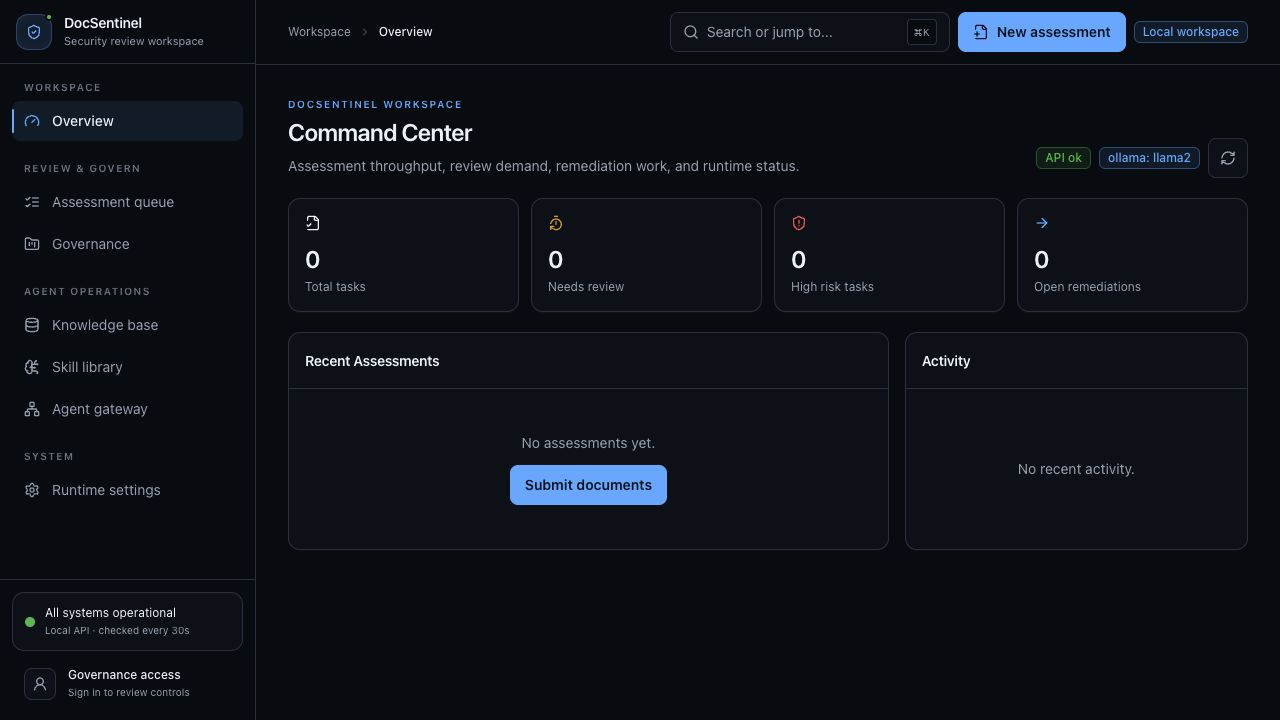
Open http://localhost:8000/console. For frontend-only development, run:
The Vite dev server proxies /api, /health, and /config to http://localhost:8000.
The Settings page can update the running server's LLM provider, model, base URL, and API key. API keys are only returned to the UI as masked previews. For persistent startup defaults, set the matching values in .env.
Example: Submit an SSDLC assessment
Example: Upload to KB and query
Hosted deployment
A hosted deployment is available on Fronteir AI.
Project Layout
Configuration
| Variable | Description | Default |
|---|---|---|
LLM_PROVIDER | ollama or openai | ollama |
OLLAMA_BASE_URL / OLLAMA_MODEL | Local LLM | http://localhost:11434 / llama2 |
OPENAI_API_KEY / OPENAI_MODEL | OpenAI | -- |
ANTHROPIC_API_KEY / ANTHROPIC_MODEL | Anthropic Claude | -- / claude-3-5-sonnet-latest |
QWEN_API_KEY / QWEN_MODEL | Qwen DashScope OpenAI-compatible API | -- / qwen-plus |
DEEPSEEK_API_KEY / DEEPSEEK_MODEL | DeepSeek OpenAI-compatible API | -- / deepseek-chat |
COMPAT_API_KEY / COMPAT_BASE_URL / COMPAT_MODEL | Any OpenAI-compatible hosted API | -- |
LOCAL_API_KEY / LOCAL_BASE_URL / LOCAL_MODEL | Local OpenAI-compatible API | -- / http://localhost:1234/v1 / local-model |
EVIDENCE_CRITIC_ENABLED | Verify Design-phase threats against current document evidence | true |
EVIDENCE_CRITIC_MAX_CANDIDATES | Candidate passages supplied per threat | 5 |
EVIDENCE_CRITIC_MAX_THREATS | Maximum threats verified in one inference pass | 20 |
CHROMA_PERSIST_DIR | Vector DB path | ./data/chroma |
PARSER_ENGINE | Parser: auto, docling, or legacy | auto |
ENABLE_GRAPH_RAG | Enable LightRAG graph retrieval | true |
LANGGRAPH_CHECKPOINT_DIR | LangGraph checkpoint persistence | ./data/checkpoints |
SSDLC_DEFAULT_PHASES | Default phases for full assessment | requirements,design,development,testing,deployment,operations |
SSDLC_DEFAULT_STAGE | Default SSDLC stage if not specified | auto |
UPLOAD_MAX_FILE_SIZE_MB / UPLOAD_MAX_FILES | Upload limits | 50 / 10 |
MCP_DOCUMENT_ROOTS | Filesystem roots available to document assessment tools | ./examples |
AGENT_GATEWAY_ENABLED | Enable MCP HTTP and A2A endpoints | true |
AGENT_GATEWAY_TOKEN | Bearer token for remote agent access; empty is loopback-only | -- |
AGENT_GATEWAY_TENANT_ID | Tenant assigned to the shared MCP/A2A gateway credential | default |
AGENT_GATEWAY_PUBLIC_URL | Public URL advertised by the A2A Agent Card | http://localhost:8000 |
AGENT_GATEWAY_ALLOWED_HOSTS | MCP DNS-rebinding Host allow-list | local hosts |
AGENT_GATEWAY_ALLOWED_ORIGINS | MCP browser Origin allow-list | local origins |
See .env.example and docs/05-deployment-runbook.md for full options.
Tech Stack
| Layer | Technology | Purpose |
|---|---|---|
| Frontend | React, TypeScript, Vite, Tailwind CSS | Local-first assessment and review console |
| Agent Orchestration | LangGraph | Stateful graph-based SSDLC workflow engine |
| LLM Framework | LangChain | Unified LLM abstraction, prompts, tools, RAG |
| Web/API | FastAPI | Async REST API with auto OpenAPI |
| Agent Protocols | MCP + A2A 1.0 | Governed tools and cross-agent task delegation |
| Vector Store | ChromaDB + LightRAG | Hybrid vector + graph RAG |
| Parsing | Docling + legacy fallback | Multi-format document parsing |
| LLM Providers | OpenAI, Anthropic, Qwen, DeepSeek, Ollama, OpenAI-compatible APIs | Cloud and local LLM support |
| Language | Python 3.11+ | Primary development language |
Documentation and PRD
- ARCHITECTURE.md — System architecture: LangGraph design, SSDLC agents, data flow, deployment.
- SPEC.md — Product requirements: SSDLC phases, features, security controls.
- CHANGELOG.md — Version history; Releases.
- Design docs docs/: Architecture, API spec (OpenAPI), contracts, integration guides, deployment runbook.
- docs/07-evaluation-plan.md — Evaluation methodology and milestone plan for
evals/.
Development & Testing
Option A: One-Click Test (Recommended)
Option B: Manual
Contributing
Issues and Pull Requests are welcome. Please read CONTRIBUTING.md for setup, tests, and commit guidelines. By participating you agree to the CODE_OF_CONDUCT.md.
AI-Assisted Contribution: We encourage using AI tools to contribute! Check out CONTRIBUTING_WITH_AI.md for best practices.
Submit a Skill Template: Have a great security persona for an SSDLC phase? Submit a Skill Template or add it to examples/templates/.
Security
- Vulnerability reporting: See SECURITY.md for responsible disclosure.
- Security requirements: Follows security controls in SPEC §7.2.
- Document confinement: MCP/A2A document paths must resolve inside
MCP_DOCUMENT_ROOTS; symlink escapes are rejected before file reads. - Agent authority: External agents may submit and inspect drafts, but cannot approve their own assessments.
- Remote access: Tokenless MCP/A2A access is loopback-only. Network deployments require a bearer token, TLS, and narrow Host/Origin allow-lists.
License
This project is licensed under the MIT License — see the LICENSE file for details.
Star History
Author and Links
- Author: PAN CHAO (Arthur Pan)
- Repository: github.com/arthurpanhku/DocSentinel
- SPEC and design docs: See links above.
If you use DocSentinel in your organization or contribute back, we'd love to hear from you (e.g. via GitHub Discussions or Issues).