Nobulex README
The full upstream README, mirrored here for reference. Install config, tool schemas, adoption signals, and an original overview live on the Nobulex listing page.
This repository is a prior direction, kept rather than deleted.
Nobulex is now the independent reliability registry for agent tools. The current work is at arian-gogani/nobulex-registry and nobulex.com.
Same name, different thing. This one was a protocol for agents to earn a trust score through verified behavior, which answers "can this agent be trusted with more access." The question that turned out to matter was one layer down: when an agent calls a tool, did the tool tell it the truth? A receipt proving that an agent faithfully acted on a wrong answer is a receipt for a wrong answer.
Nothing below is retracted. The code runs, the spec draft says what it says, and the published packages do what they claim. It is simply not what is being built now, and a repository that goes on quietly describing a live product nobody is building is doing the exact thing the current project exists to grade.
Current project: read the method · run the self-test · see the register · follow the work






Every person has a credit score. Every business has one. AI agents have nothing.
Nobulex is the credit and trust protocol for autonomous AI agents.
Agents earn trust score through verified behavior. Higher trust, more access.
Autonomy earned, not granted.
Website · Try it live · Quickstart · Spec · PyPI · npm
Reference implementation of the OWASP Agentic Skills Top 10 (AST09) execution-receipt pattern · listed in the OWASP solutions catalog · in the Microsoft Agent Governance Toolkit adopters · merged to the Dify marketplace
Break the AI. Win $7,400.
Five AI agents, each with rules they must not break. Make them violate their own rules. Beat Level 5 to claim the bounty. 2,847 attempts, 0 winners so far.
Install
How it works
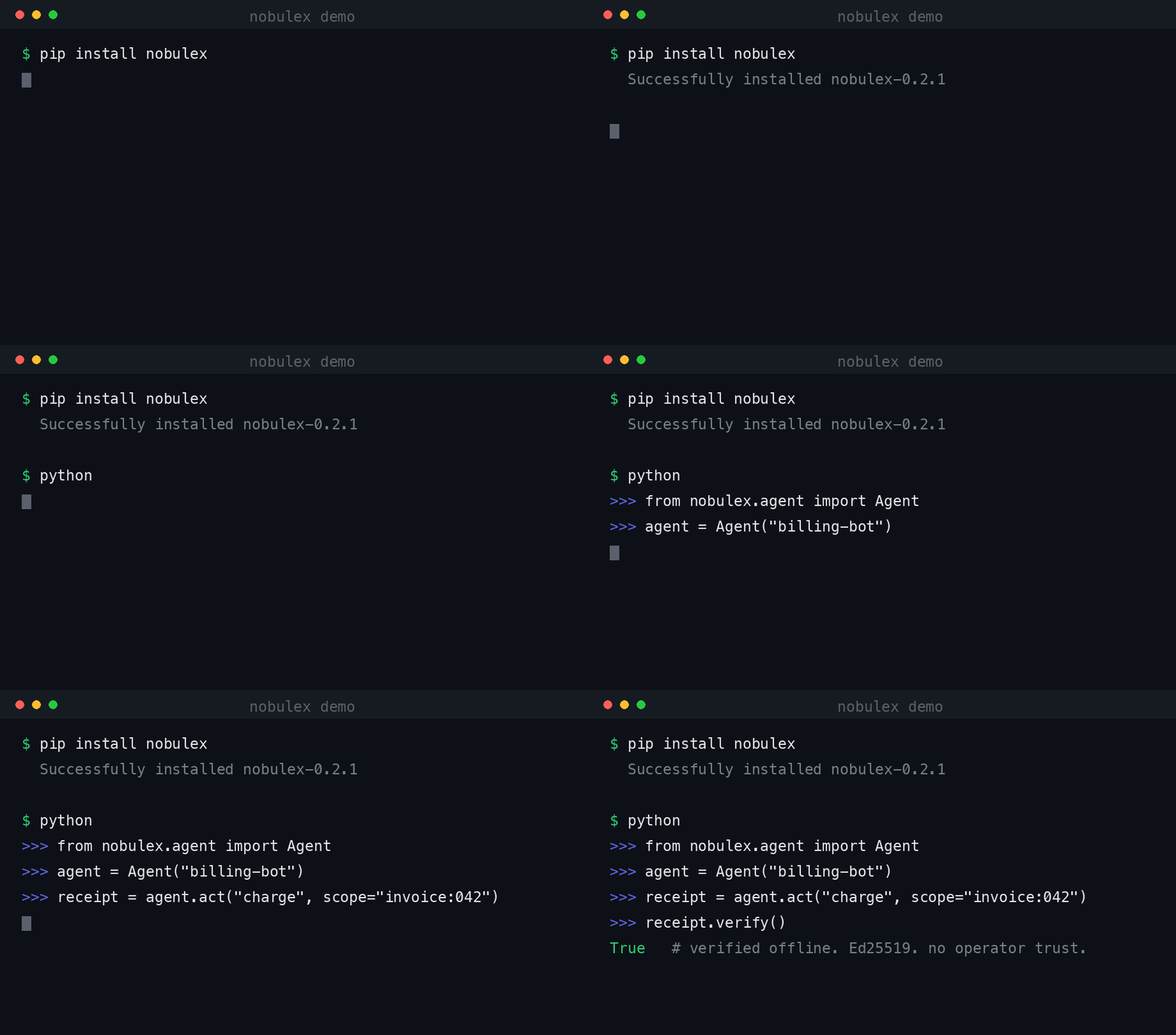
Every agent action produces a cryptographic receipt -- Ed25519 signed before and after execution, hash-chained for tamper evidence. A third party can verify the full history without trusting the agent or the operator.
Here is the whole idea in one run (python -m nobulex demo):
Change one byte of a receipt and verification fails. That is the whole guarantee.
Performance: ~13,683 signed receipts/sec at p50 (Python SDK, single core). Full signed-and-chained receipt takes ~73 μs end-to-end. See BENCHMARKS.md for the full breakdown; reproduce with python3 scripts/benchmark.py.
Receipts accumulate into trust score -- a credit score for the agent.
| Tier | trust score | Access Level |
|---|---|---|
| Restricted | 0 -- 30 | Read-only, sandboxed execution |
| Standard | 30 -- 60 | Financial ops up to $500, API access |
| Trusted | 60 -- 85 | Cross-org operations, regulated markets |
| Sovereign | 85+ | Full autonomy, self-directed |
Agents that create more value earn more access. Agents that deviate get cut off automatically. Not as punishment -- as math.
Quick start
Python (recommended for AI agents)
One line to add receipts to any function:
Or use the Agent API directly:
LangChain integration
CrewAI integration
Google ADK integration
PydanticAI integration
Haystack integration
LlamaIndex integration
Verify any exported trail (no operator trust)
JavaScript / TypeScript
Who is accountable?
An agent key is free to generate. So if the score lives on the key, the score is theater: an agent with a bad record deletes the key, makes a new one, and starts clean in thirty seconds. A human can't do that with a credit score, because the SSN is scarce. That scarcity is what makes a score mean anything.
So the file doesn't live on the key. It lives on the operator: the legal entity accountable for the agent. Agents inherit trust from their operator the way a corporate card inherits its limit from the company rather than from the plastic.
Burning a key doesn't escape the record:
| before the burn | after | |
|---|---|---|
| agent's own score | 8.0 | 0.0 (fresh key) |
| operator score | 8.0 | 3.4 (history survived) |
| churn ratio | 0.0 | 0.5 (the burn is visible) |
| new agent starts at | 2.72, not 0 |
And the attack doesn't work one level up either: an unverified operator
can claim a score of 99 and passes exactly 0.0 to a new agent, so
registering fake operators to farm trust fails by construction.
Meanwhile the honest operator gets paid for it. Acme at 90 with zero churn means their next agent starts at 60 instead of 0. That's the reason to bind keys rather than stay anonymous.
The protocol
The flywheel: more trust score leads to more valuable work, which produces more receipts, which builds higher trust score. Accountability becomes the most profitable strategy.
Code
Traction
Independent, verifiable signals (each links to evidence):
| What | Evidence | |
|---|---|---|
| OWASP Agentic Skills Top 10 (AST09) | Bilateral receipt pattern merged as normative guidance (PR #35). Vendor listing in the solutions catalog (PR #38). Fixture-corpus proposal (PR #46, merged as a discussion doc, not a normative spec). All merged by project lead Ken Huang, Jun-Jul 2026. The action_ref hash construction itself is in the solutions catalog, not the normative page | |
| IETF Conformance | draft-farley-acta-signed-receipts: 4/4 vectors pass. Implementation PR #12 filed | |
| OWASP CheatSheetSeries | Sections 8-11 (JCS canonicalization, cross-agent accountability, sanctions-list freshness, regulatory mapping) merged into master by Jim Manico, Jun 2026 (PR #2210) | |
| Dify Plugin Marketplace | Plugin merged into official dify-plugins repository (PR #2500). Nobulex receipts available to the 155K+ star Dify ecosystem | |
| Microsoft AI Agents for Beginners | Merged. nobulex is the Python production receipt library in Lesson 18, Securing AI Agents with Cryptographic Receipts (PR #571) | |
| AgentAudit AI | Design-partner conversation. A signed specimen receipt verifies end-to-end in 10 lines of Python (fixture) | |
| Microsoft AGT | Listed in ADOPTERS (PR merged by Microsoft maintainers) | |
| builderz-labs / mission-control | Cross-session trust score RFC accepted as open issue; TypeScript reference implementation delivered |
EU AI Act Article 12 enforcement: December 2, 2027.
Verify API
Receipts verify offline with the SDK today. No server, no network, no callback:
The hosted verification layer is the paid product: rate-limited tiers,
agent trust scores, and regulator-ready compliance reports. It is implemented in
packages/verify-api/ (Flask + Dockerfile) and is
not yet deployed to nobulex.com.
| Endpoint | What it does | Tier |
|---|---|---|
POST /verify | Verify signature + recompute action_ref | Free |
POST /verify/chain | Verify chain integrity | Pro |
POST /verify/bundle | Compliance report for regulators | Pro |
GET /agent/:id/score | Trust score (A-F grade) | Free |
GET /demo/tamper-test | Live tamper detection demo | Free |
Planned pricing: Free 100/day · Pro ($99/mo) 10K/day · Scale ($499/mo) unlimited.
Why now
AI agents are being deployed into production with no accountability infrastructure.
- 82% of enterprises have unknown AI agents running in their infrastructure (CSA, April 2026)
- UUMit launched the first A2A marketplace with zero identity verification
- $138B+ committed to physical AI with zero accountability layer
- Top models prove 41% of research-level lemmas (LemmaBench, April 2026), with no traceability on failure
The agents are deployed. The money is flowing. The accountability infrastructure doesn't exist yet. We're building it.
Standards
| Standard | Status |
|---|---|
| Proof-of-Behavior spec | draft-gogani-nobulex-proof-of-behavior-00 |
| Microsoft AGT | Listed in ADOPTERS (PR merged) |
| CTEF v0.3.2 | 14/14 byte-match conformance |
| A2A Protocol | Receipt row proposed; URN scheme urn:nobulex:receipt:<id> |
| NIST RFI | Formal comments submitted |
Development
Website · Try it · npm · Spec · X @nobulexlabs
Curated resource: Awesome AI Agent Accountability: standards, regulations, and tools for verifiable agent behavior.
Star this repo to follow the project
MIT License