Appstore Reviews README
The full upstream README, mirrored here for reference. Install config, tool schemas, adoption signals, and an original overview live on the Appstore Reviews listing page.
Apple App Store Reviews API: iOS and macOS app reviews as structured JSON
The most efficient, reliable, and developer-friendly way to use the Apple App Store Reviews API.
Actor page: apify.com/johnvc/apple-app-store-reviews-api Input schema: apify.com/johnvc/apple-app-store-reviews-api/input-schema
The Apple App Store Reviews API returns user reviews for any iOS or macOS app as clean, structured JSON: star rating, review title, body text, author, app version, review dates, and helpfulness counts, across 50+ country stores. Target an app by its numeric App Store ID or just by name, sort by most recent, most helpful, most favorable, or most critical, and page through as many or as few reviews as you want. It is built for App Store Optimization (ASO), sentiment analysis, competitor monitoring, churn-signal tracking, and AI agent workflows.
Video Walkthrough

Quick Start
Prerequisites
- Python 3.11 or higher
- An Apify account and API key (get a free key here)
-
Clone the repository
-
Install dependencies with UV
-
Configure your API key
-
Run the example
Alternative: set the API key directly
Why Use This Apple App Store Reviews API?
One row per review, ready to analyze. Every result is a flat JSON object with the rating, title, text, author, version, and dates already separated out. No HTML, no parsing, no cleanup.
Target by ID or by name. Pass numeric App Store IDs when you have them, or pass a plain app name and the API resolves it for you. Handy when an agent only knows the app by name.
iOS and macOS. The same call works for iPhone, iPad, and Mac apps. Each row is tagged with its platform so mixed runs stay clear.
Sort the way you need. Most recent for monitoring, most critical for triage, most helpful for the signal that users themselves upvoted, most favorable for testimonials.
Localized. Pull reviews from 50+ country stores to compare sentiment by region or to do localization QA.
Predictable pay-per-event pricing. You pay a small setup fee plus a per-review fee, so a quick spot-check costs cents and you only pay for what you receive.
Features
Core Capabilities
- Reviews for any iOS or macOS app by numeric ID or by app name
- Four sort orders: most recent, most helpful, most favorable, most critical
- 50+ country stores
- Pagination with a per-app review cap, or unlimited
- Optional ISO date normalization and parsed helpfulness counts
Data Quality
- Flat, one-review-per-row JSON with consistent field names
- Each row carries its source app ID, country, platform, and sort order
- Helpfulness prose parsed into integer helpful and total counts
- Locale-formatted dates plus an optional ISO 8601 field
Usage Examples
Basic Example
Advanced Example
Input Parameters
| Parameter | Type | Required | Default | Description |
|---|---|---|---|---|
product_ids | array[str] | one of | [] | Numeric Apple App Store IDs (e.g. ["534220544"]). Find each ID after id in an apps.apple.com/.../id<NNNNNNNN> URL. |
app_name | str | one of | - | Plain app name (e.g. netflix). If product_ids is empty, the API resolves the ID and uses the top match. |
country | str | no | us | Two-letter Apple country store code. Drives the storefront and review locale. 50+ supported. |
sort | str | no | mostrecent | mostrecent, mosthelpful, mostfavorable, or mostcritical. iOS only; macOS always returns most recent. |
max_reviews | int | no | 100 | Maximum reviews per app. Set 0 for unlimited (internally capped for safety). Each review returned is billed. |
start_page | int | no | 1 | Page to start paginating from. Useful for resuming. |
include_macos | bool | no | true | Set false to skip macOS apps entirely. |
normalize_dates | bool | no | true | Emit a review_date_iso field alongside the locale-formatted date. |
parse_helpfulness | bool | no | true | Parse helpful_count and total_helpful_count integers from the helpfulness text. |
At least one of product_ids or app_name is required.
Output Format
Each dataset item is one review:
Use as an MCP tool
You can load the Apple App Store Reviews API as an MCP tool so assistants call it for you. The MCP server URL preloads just this one Actor:
Authenticate with OAuth in the browser when offered, or with your Apify API token (the same APIFY_API_TOKEN used by the Python example). Get a token at https://console.apify.com/settings/integrations and a free Apify account at https://apify.com?fpr=9n7kx3 .
Install in Claude Cowork Desktop
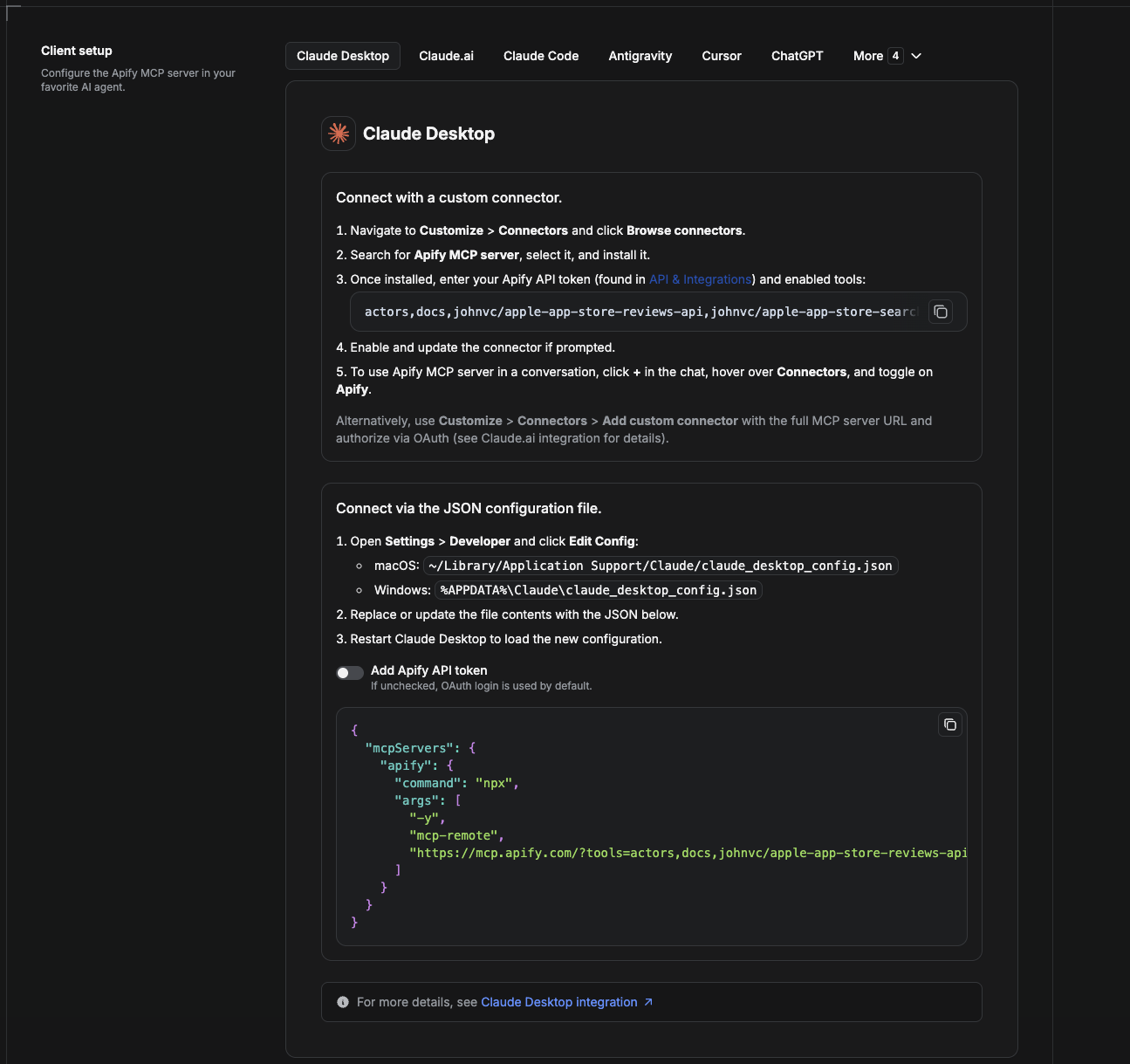
Cowork is the desktop app's automation mode. To give it the Apple App Store Reviews API as a tool, add the Apify MCP server as a connector.
- Open the Claude desktop app and go to Settings → Connectors (or Settings → Developer → Edit Config to edit
claude_desktop_config.jsondirectly).- macOS:
~/Library/Application Support/Claude/claude_desktop_config.json - Windows:
%APPDATA%\Claude\claude_desktop_config.json
- macOS:
- Add the Apify MCP server, preloaded with only this Actor:
- Restart the app. When Cowork first calls the tool, complete the OAuth prompt in your browser, or add your Apify API token in the connector settings to skip OAuth.
- In a Cowork chat, confirm the tool is available and ask it to run the Apple App Store Reviews API.
Download the desktop app and start a free trial: https://claude.ai/referral/uIlpa7nPLg More help: https://docs.apify.com/platform/integrations/claude-desktop
Install in Claude Code
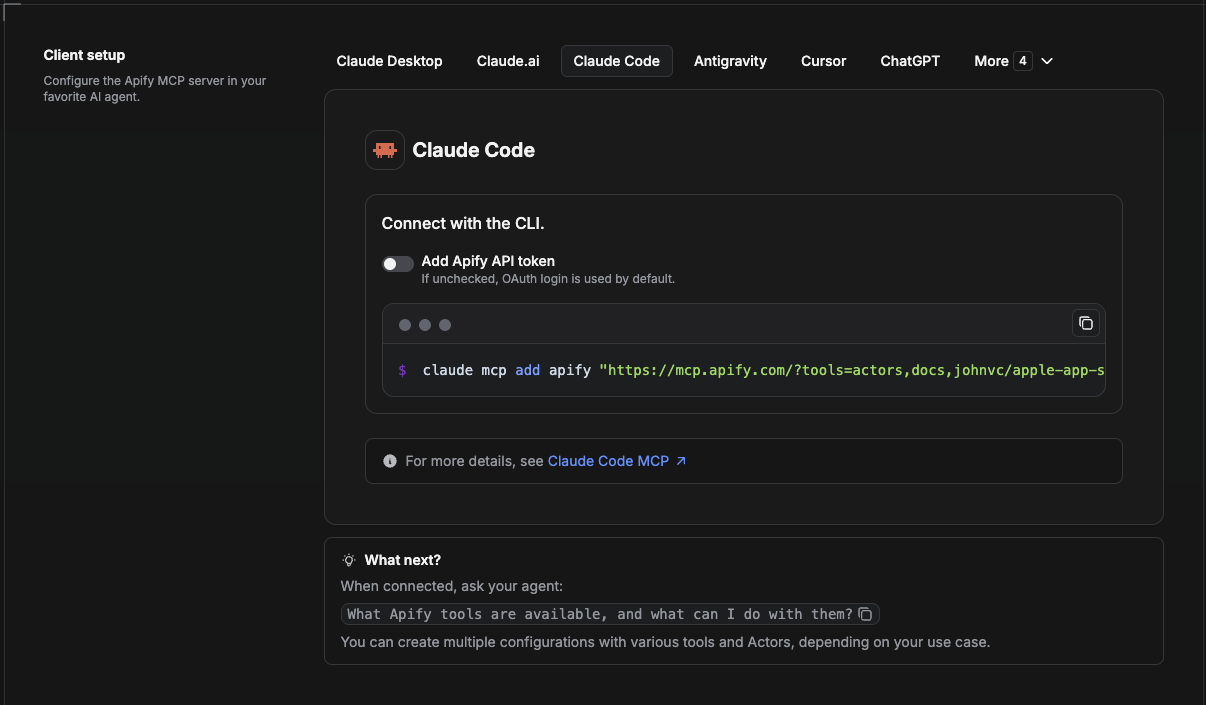
Claude Code is the command-line tool. Add the Actor's MCP server with one command:
To use a token instead of browser OAuth:
Then verify with claude mcp list, or run /mcp inside a session. Ask Claude Code to call the Apple App Store Reviews API.
Try Claude Code free: https://claude.ai/referral/uIlpa7nPLg Claude Code MCP docs: https://code.claude.com/docs/en/mcp
Install in Claude (website)
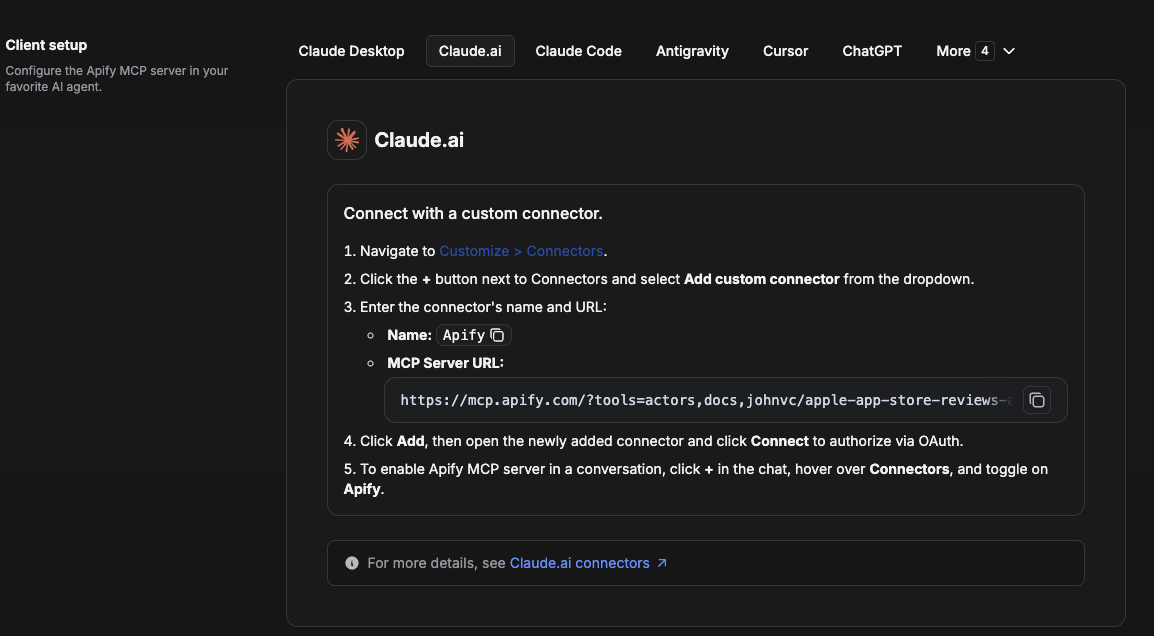
On claude.ai you add Apify as a connector, then enable just this Actor's tool.
- Go to Settings → Connectors → Browse connectors and search for Apify MCP server. Install it (enable or update if prompted).
- When connecting, authenticate with your Apify API token, and enable the tool
johnvc/apple-app-store-reviews-api. - In any chat, open + → Connectors and turn on Apify.
- Alternatively, choose Add custom connector and paste the full MCP URL
https://mcp.apify.com/?tools=actors,docs,johnvc/apple-app-store-reviews-api, using OAuth when prompted. - Ask Claude to run the Apple App Store Reviews API.
Open Claude on the web: https://claude.ai/referral/uIlpa7nPLg
Install in Cursor
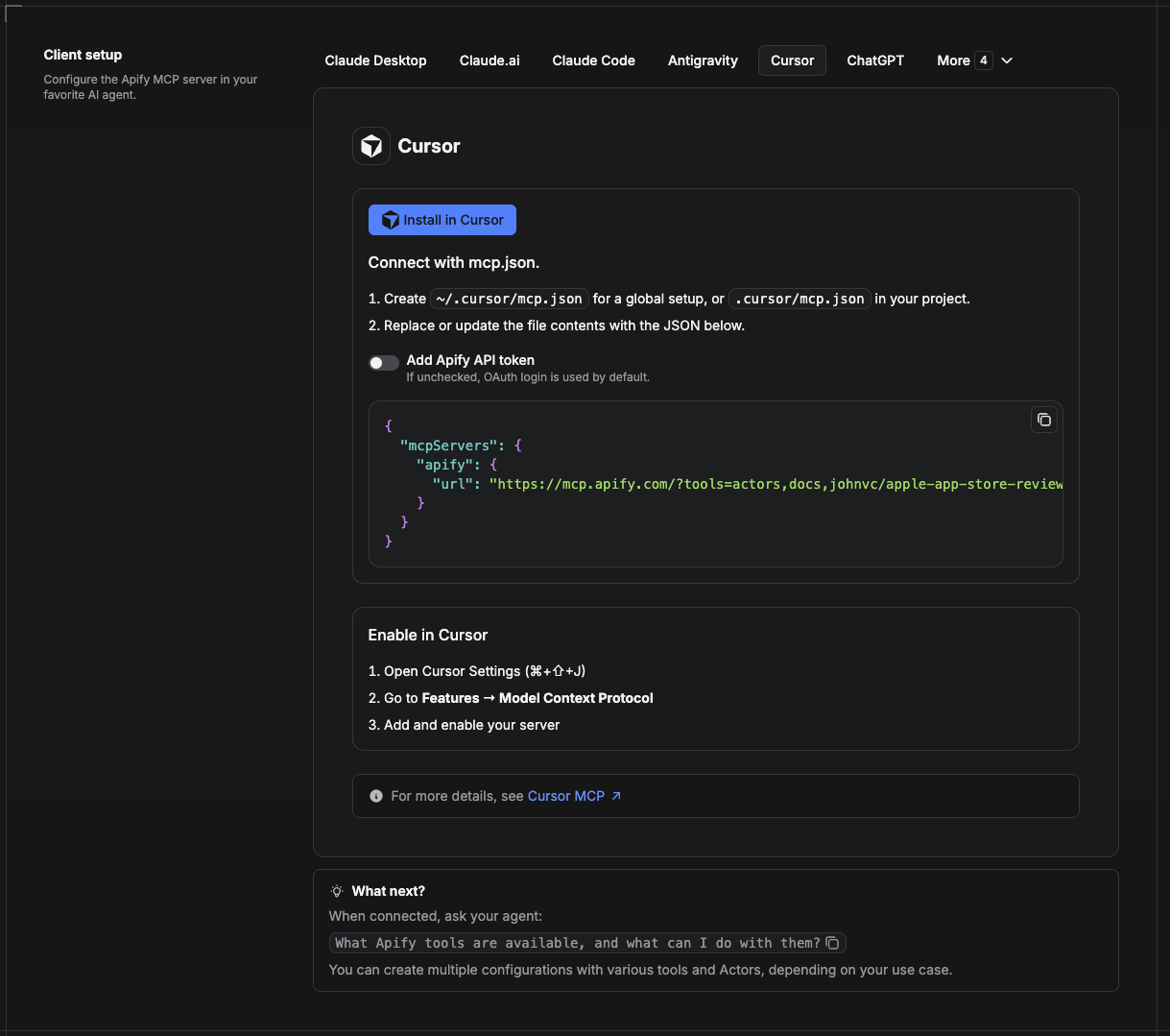
Cursor reads MCP servers from a project file at .cursor/mcp.json.
- In your project, create
.cursor/mcp.json:
- If you prefer token auth over browser OAuth, add a header:
- Open Cursor → Settings → MCP and confirm the apify server is connected (green dot).
- In Composer or Chat, ask Cursor to call the Apple App Store Reviews API.
New to Cursor? Get it here: https://cursor.com/referral?code=XQP4VBLI3NNX
Install in ChatGPT
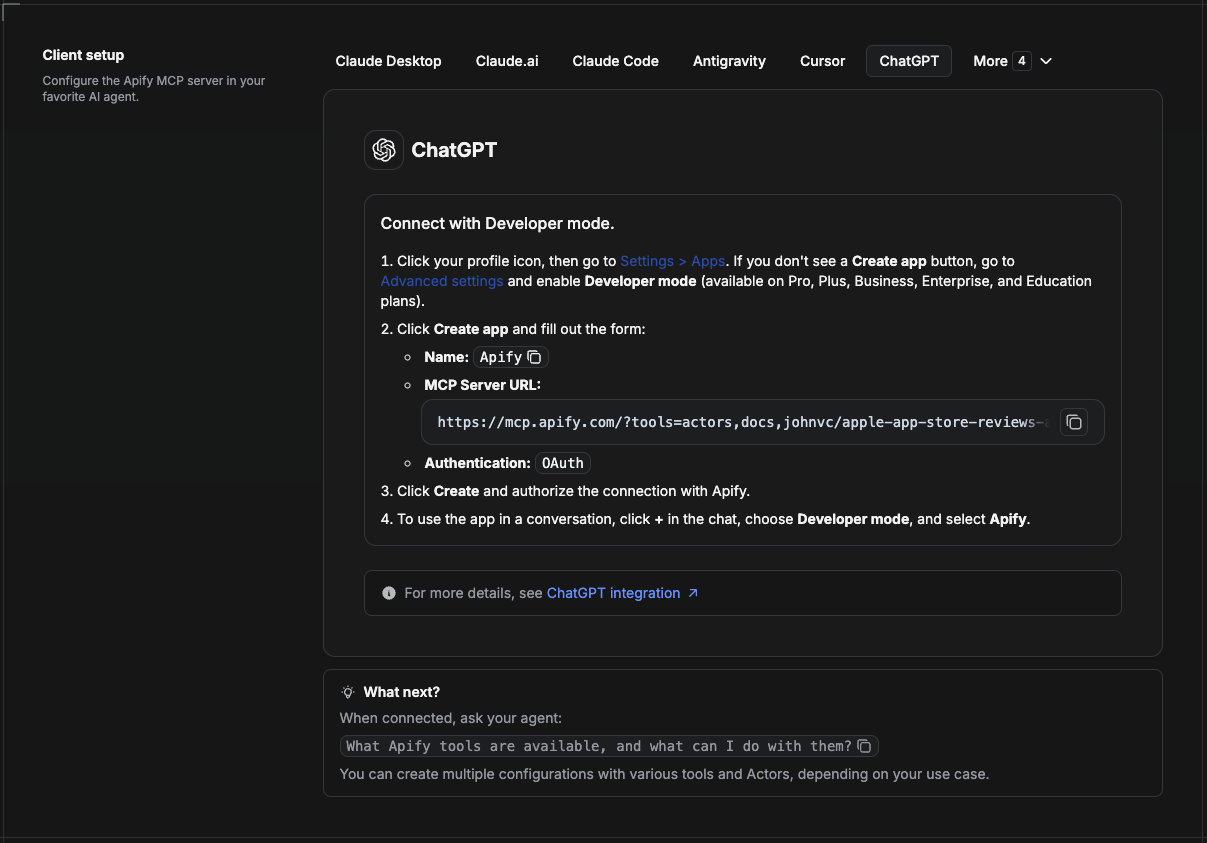
ChatGPT connects to the Apify MCP server through Developer mode (available on ChatGPT Pro, Plus, Business, Enterprise, and Education plans).
- Click your profile icon, then go to Settings > Apps. If you do not see a Create app button, open Advanced settings and enable Developer mode.
- Click Create app and fill out the form:
- Name: Apify
- MCP Server URL:
https://mcp.apify.com/?tools=actors,docs,johnvc/apple-app-store-reviews-api - Authentication: OAuth
- Click Create and authorize the connection with Apify.
- To use the app in a conversation, click + in the chat, choose Developer mode, and select Apify.
More help: https://docs.apify.com/platform/integrations/mcp
Use the Apple App Store Reviews API to power ASO, sentiment analysis, and competitor monitoring with reliable, structured results.
Last Updated: 2026.06.15
n8n integration
Available as an n8n community node, n8n-nodes-apple-app-store-api. In n8n: Settings, Community Nodes, install n8n-nodes-apple-app-store-api, then use it in any workflow (it also works as an AI Agent tool). The node bundles this Actor with the Apple App Store Search and Product APIs as three operations behind one Apify credential.
Featured Tasks
Ready-to-run examples on the Apify Store.
Last Updated: 2026.09.08