Multi-model LLM Council and parallel AI window for Claude Code. Fork any model, fold results back.
Quick Install
Automated & IDE SetupCopy the AI prompt to install this server into Claude Code, Cursor, or another agent — or use 1-click editor setup below.
Not yet automatically verified
We haven't yet run this listing's install command through our automated sandbox check. This isn't a red flag — we're steadily working through the catalog.
Manual Client & Custom JSON ConfigExpand JSON ▾
Client Config & Setup
Choose your client or environment
Target File:
💡 Paste the JSON block into your client's configuration file under mcpServers, then restart the application.
Documentation Overview
Amicus
A multi-model LLM Council for Claude — with a parallel AI window underneath.
Hand Claude a plan, a design, a diff, an architecture decision, a manuscript — anything — and say council review this: Amicus routes it through several models from different families, has them anonymously cross-review each other, and a non-Claude chair synthesizes a verdict you turn into accept/deny edits. Or skip the ceremony and fork a single conversation to Gemini, GPT, DeepSeek, or any other model — it works in parallel with full context, and you fold the result back when you're ready. Claude orchestrates throughout; you stay in your editor.
The same council — more ways to run it: take it headless in CI with no Claude runtime, sharpen it with a debate round, or run it on free local models (Ollama, LM Studio, vLLM) at $0 — private and offline.


Quick start ↓ · Commands · Documentation · Troubleshooting
Supported clients: Claude Code CLI, Claude Desktop, and Claude Cowork are fully tested and supported. Claude Code web is experimental.
Table of Contents
- What is Amicus
- The Council
- Ways to run the council
- Quick start
- Requirements & Dependencies
- The parallel window
- Commands
- Models
- MCP integration
- Configuration
- JSON output
- Windows
- Troubleshooting
- Documentation
- Contributing
- Built on OpenCode
- Attribution & License
What is Amicus
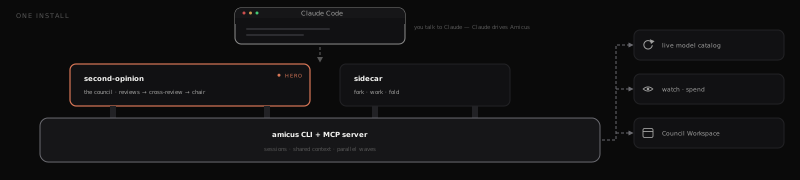
One install delivers six things that work together:
- The
second-opinionLLM Council skill. Structured multi-model review: independent reviews → anonymized peer cross-review → a non-Claude chair verdict → tiered accept/deny decisions. This is the hero. - The
sidecarchat skill. Ad-hoc fork/work/fold — spin up one other model in a real window (or headless), work alongside it, fold the summary back. - The
amicusCLI (with anamalias) and an MCP server. The engine underneath both skills: launches sessions, shares context, runs parallel waves, and exposes the same surface to Claude as MCP tools. - A self-updating model catalog. Aliases and validation resolve against a live catalog fetched from provider APIs (cached locally), so model names stay current without a hard-coded table.
- Observability.
amicus watch <id>renders any live or finished run (fan-out or council) from any terminal;--followstreams milestones as they happen;--on-completefires a hook when a run lands;--retry-failedplus opt-in cheaper-model fallbacks recover dead legs without relaunching the whole wave;amicus spendanswers "what did this cost, and where" with per-run attribution. - Council Workspace.
amicus watch <runId> --ui: a window that shows a council thinking — live seats, the anonymized judge packet, the adjudication matrix, dissent drill-in, chair verdict, and cost-by-seat — for both live and historical runs. It also auto-opens on an MCP-invoked council run from Claude Code (local), so you no longer have to remember the flag (see docs/council.md).
Claude is the orchestrator. The council and chat skills run on top of the engine; you talk to Claude, and Claude drives Amicus.
The Council
Trigger it by saying "council review this" to Claude, or, on the plugin channel, run
/amicus:councildirectly.
Why multi-model. Any single model — including the one running your session — has consistent blind spots. Route the same material through models from different families and the disagreements surface: missed issues, overstated confidence, claims one model alone would have waved through. The council is the structured version of that idea.
The flow, in five beats:
- Independent reviews. Each council model reviews the artifact on its own (one parallel wave), producing a structured findings list — claim, severity (
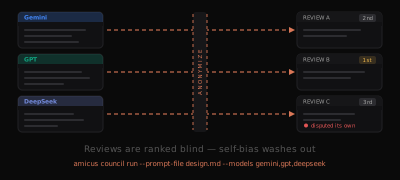
blocker | major | minor | nit), location, rationale. - Anonymized cross-review. Claude relabels every review (Review A, B, C…) and sends the identical bundle to every model. Each model ranks the reviews and adjudicates every finding (
agree | dispute | neutral) — unknowingly judging its own, so self-bias washes out. This yields a street-cred ranking and sorts findings into Disputed / Confirmed / Contested / Singleton tiers. Self-bias is washed out per seat: if you deliberately seat one model twice, each seat's vote on the other seat's finding is counted as the real peer vote it is, and the finding is flagged when its only corroboration came from its own twin. - Chair verdict. A designated non-Claude chair receives the de-anonymized picture — all reviews, rankings, and adjudications — and synthesizes an independent verdict. Claude presents it verbatim; Claude does not synthesize.
- Tiered decisions. Confirmed findings get one bulk accept/deny; Contested and Singleton findings are decided one at a time (accept / deny / modify).
- Outputs applied. Accepted findings are written into a reviewed copy of the source; the full run is captured in the run folder.
What a run produces (in output/<stem>-council/):
review-<model>.md× N — each model's independent review.crossreview-matrix.md— the adjudication grid plus the de-anonymized street-cred table.verdict.md— the chair's synthesis.report.md— synthesis + the full decision log + a per-call run-stats table.report.html— the deterministic renderer output (adjudication matrix, street-cred table, findings-by-tier, cost — no chair prose). This is the default artifact handed to the user.- For an editable source, the accepted edits land in
<stem>-reviewed.<ext>next to the original.
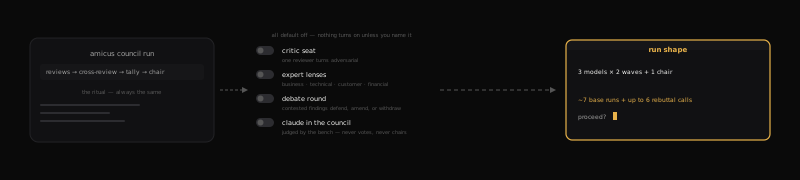
Optional council elements (v2.2.0, all default off): four opt-in behaviors, offered once as a menu at launch — nothing turns on unless you name it, and the confirmation lists exactly what's on. Chair verdict scale (standard since v2.2.0's follow-ups — no longer opt-in): the chair always closes with 3–5 hard questions and one parseable VERDICT: Ship it | Fix these first | Fundamental rethink line.
- Critic seat — one reviewer swaps to a four-pass adversarial brief (adversarial pass, edge-case hunt, consistency check, executability test). Its findings enter the same anonymized bundle as everyone else's, so the bench disciplines the critic: manufactured negativity lands Disputed and dies in the tally.
- Expert lenses — each reviewer takes a distinct expert perspective; you pick the panel domain (business, technical, customer, financial, or custom). Lens runs never feed the reliability ledger, and the report discloses the weakened cross-review anonymity.
- Debate mode — after cross-review, every Contested or Disputed finding goes back to its raiser to defend, amend, or withdraw, and the disputing judges re-vote. Exactly one rebuttal round, then the final tally.
- Claude in the council — Claude adds its own fresh review to the bundle so the bench ranks and adjudicates it. Claude is judged but never votes or chairs, so the verdict stays independent.
The critic and lens methodologies are adapted from the /critic and /debate agents in John Renaldi's product-kit (MIT); the briefing boilerplate lives in skills/second-opinion/SEAT-BRIEFS.md.
Cost is disclosed up front. Before any model launches, you see the run shape — including any enabled optional elements — for example:
Related MCP Servers
Adoption & maintenance
Factual signals from GitHub, npm, and our automated checks — not a rating.
GitHub stars
2
Stargazers on the source repository.
Last commit
5d ago
Most recent push to the default branch.
Reviews
No reviews yet — be the first to share how this listing worked for you.
Frequently Asked Questions about Amicus
AllMCPs Directory Badge
Showcase your server listing on GitHub or your project documentation. Embed this dynamic SVG badge to highlight official listing status and live engagement.
Badge Style:
Live Dynamic SVG Preview
Markdown (GitHub README)
[](https://allmcps.com/mcp/amicus)HTML Embed
<a href="https://allmcps.com/mcp/amicus"><img src="https://allmcps.com/api/badge/amicus?style=directory" alt="Amicus on AllMCPs" /></a>Technical Specs & Signals
CategoryDeveloper Tools
11/15 checks healthy over the last 46d
41Quality signal: Fair · 41/100How this signal is calculated ▾
Server availabilityNot measured
Not scored for repo-hosted servers — we can't reach the running server, only its GitHub page. Hosted MCP endpoints are health-checked live.
Verified ownership10/20
Documentation & tools16/30
Adoption & activity5/15
Community engagement0/10
A guidance signal from public completeness & health data — not a user rating. New listings start lower and rise as they add docs, get verified, and grow adoption. Signals we can't observe for a listing are skipped, not counted against it.
Supply-chain signal
No high-severity advisories surfaced by our automated scan.
Critical 0High 0Medium 0Low 0
Scanned 2d ago via OSV.dev · amicus@latest (npm)
Own this project?
This directory is pre-filled from public sources. Claim via GitHub README, site badge, or DNS TXT to unlock edit access and the Official badge — proof is checked automatically, then reviewed by our team.
Free dofollow backlink: add your website and place the AllMCPs badge on it — no claim needed. We detect it automatically and keep it verified as long as the badge stays live.
Claim & get free dofollowShare & Embed
Add our SVG badge (dark/light directory styles) or embeddable widget to your site.