mikrotiknetwork-automationrouterosmcpfirewall
Typed MCP server for AI-driven management and automation of MikroTik RouterOS devices with safety and audit features.
Quick Install
Automated & IDE SetupCopy the AI prompt to install this server into Claude Code, Cursor, or another agent — or use 1-click editor setup below.
One-click editor setup isn’t available for this listing yet — we don’t have a confirmed install command, and we’d rather show nothing than point your editor at the wrong package or host. Follow the project’s own setup instructions, linked above.
Manual Client & Custom JSON ConfigExpand JSON ▾
No confirmed setup config for this listing yet. We only publish a config block when the install details come from the project itself — its README, its docs, or a verified owner. We haven’t found those for AliKarami/MikroMCP, and we’d rather show nothing than a guess you’d paste into your client. Follow the project’s own setup instructions for the current steps.
Overview
Use cases
Inspect system status, interfaces, routes, and logs on MikroTik routers
Manage firewall filter and NAT rules with safety checks and audits
Perform dry-run previews and apply safe static route changes
Automate WireGuard VPN peer management and configuration
Run diagnostics like ping, traceroute, and log filtering remotely
Key features
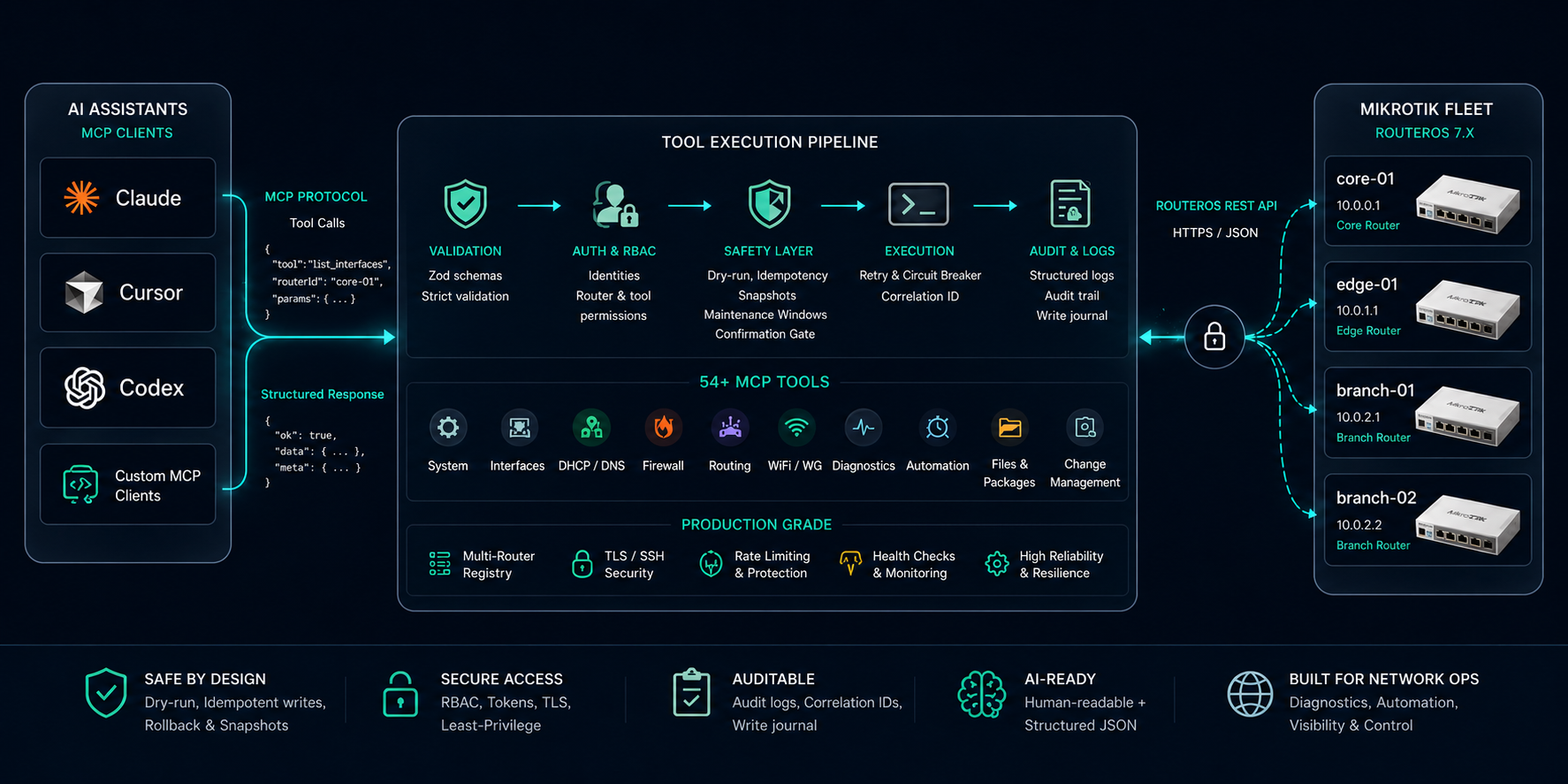
Typed, auditable MCP interface for RouterOS 7.x
118 typed tools covering interfaces, firewall, DHCP, DNS, routing, BGP, OSPF, VLANs, and more
Dry-run previews, idempotent writes, snapshots, and rollback-aware change workflows
Per-router circuit breakers, retry policies, RBAC, and audit logs
Supports stdio, HTTP/SSE, and legacy SSE MCP client protocols
Human-readable and structured JSON responses for AI reasoning and chaining
Capabilities & Tool Schemas
Inspect callable tools, capabilities, and parameters exposed to AI agents by MikroMCP.
Extracted Tool Capabilities
Typed, auditable MCP interface for RouterOS 7.x
118 typed tools covering interfaces, firewall, DHCP, DNS, routing, BGP, OSPF, VLANs, and more
Dry-run previews, idempotent writes, snapshots, and rollback-aware change workflows
Per-router circuit breakers, retry policies, RBAC, and audit logs
Supports stdio, HTTP/SSE, and legacy SSE MCP client protocols
Human-readable and structured JSON responses for AI reasoning and chaining
Documentation Overview
MikroMCP

AI-native network automation for MikroTik RouterOS. MikroMCP exposes RouterOS as a typed, auditable Model Context Protocol server so Claude, Cursor, Codex, and other MCP clients can inspect, diagnose, and safely operate MikroTik routers in natural language.





MikroMCP exists because raw router CLI access is the wrong abstraction for AI agents. RouterOS is powerful, but asking an LLM to improvise shell commands against production network gear is risky. MikroMCP gives agents a controlled tool surface: strict schemas, idempotent writes, dry-run previews, per-router circuit breakers, retry policies, RBAC, audit logs, snapshots, and rollback-aware change workflows.
In one sentence: MikroMCP turns MikroTik RouterOS into a production-minded MCP control plane for AI infrastructure, DevOps automation, and modern router management.
Quick Start
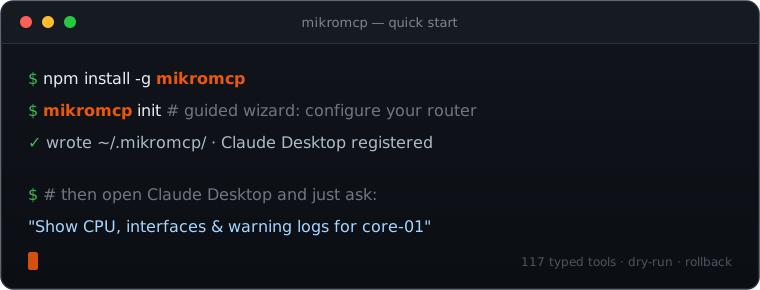
That's the whole setup for a single-router stdio deployment. For standalone binaries, Docker, HTTP/SSE mode, the RouterOS API prerequisites, and the full 15-minute walkthrough, see the Getting Started guide.
Feature Showcase
| Category | What MikroMCP covers |
|---|---|
| 🧭 Router management | System status, clock, reboot, packages, files, scripts, scheduler jobs, containers |
| 🌐 Network operations | Interfaces, VLANs, IP addresses, DHCP leases, DNS static records, bridge ports, WiFi clients |
| 🔥 Firewall and policy | Filter/NAT rules, mangle rules, address lists, route tables, routing rules |
| 🛰️ Routing visibility | Static routes, routing tables, BGP peers, OSPF neighbors |
| 🔀 SwOS switches | Experimental. MikroTik SwOS and SwOS Lite switches (deviceType: "swos") over the reverse-engineered .b HTTP API: port links, PoE, SFP diagnostics, and guarded whole-blob writes with a firmware-compatibility check |
| 🔐 Secure access | HTTP bearer auth, bcrypt token hashes, RBAC, router/tool restrictions, confirmation tokens |
| 🧪 Diagnostics | Router-originated ping, traceroute, torch, log filtering, guarded SSH command execution |
| 🛡️ Change safety | Dry-run, idempotent writes, snapshots, write journal, plan_changes, apply_plan, rollback_change |
| ⚙️ Production behavior | Retries for read tools, per-router circuit breakers, correlation IDs, structured logs, audit logs |
| 🤖 AI-agent fit | Human-readable responses plus structured JSON content for reasoning, chaining, and automation; server advertises an instructions string on MCP initialize so clients self-configure; optional routerId resolved via MIKROMCP_DEFAULT_ROUTER for single-router setups; usage skill for safe, guided tool use in Claude Code |
| 🧩 MCP compatibility | stdio for desktop clients, Streamable HTTP and legacy SSE for remote or service-style clients |
122 typed tools in total — browse the full catalog with parameters, defaults, and copy-paste example prompts in Available Tools.
Demo
Usage
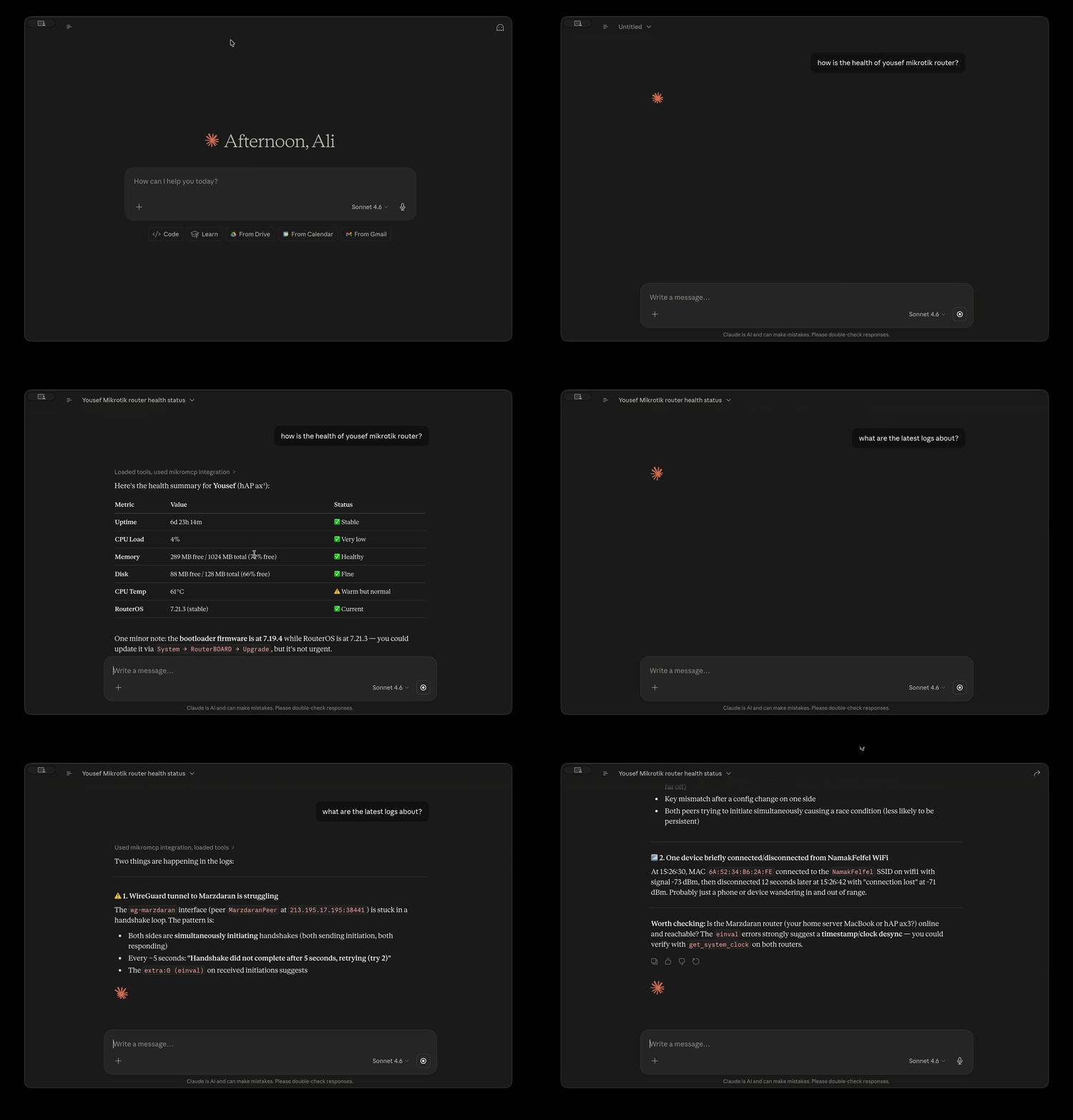
Review by Claude
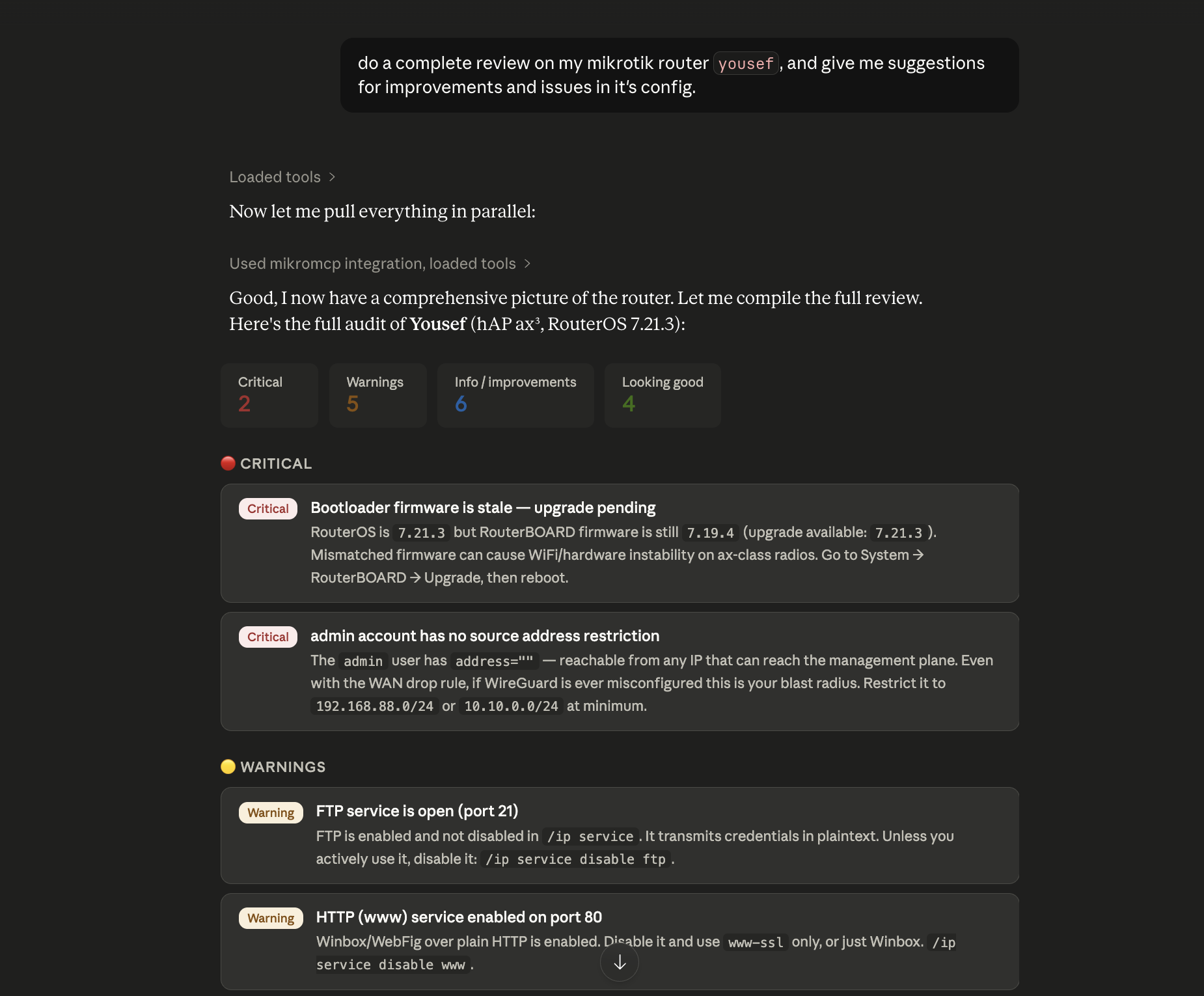
Real-World Usage Examples
Router Inspection
Firewall Management
Safe Static Route Change
WireGuard Operations
Interface Diagnostics
Plan / Apply / Rollback Workflow
Why MikroMCP Is Useful For AI Agents
MCP gives LLMs a standard way to call tools. MikroMCP makes RouterOS a high-quality MCP target by turning network operations into well-described, machine-readable, permission-aware actions.
AI assistants can use MikroMCP to:
- Investigate router state without memorizing RouterOS command syntax.
- Chain tool calls across interfaces, routes, firewall rules, logs, and diagnostics.
- Return both operator-friendly summaries and structured JSON for follow-up reasoning.
- Preview changes before mutation and explain exactly what would happen.
- Respect tool-level authorization, router scoping, maintenance windows, and confirmation gates.
FAQ
What is MikroMCP?
MikroMCP is an open-source Model Context Protocol (MCP) server that exposes MikroTik RouterOS as 122 typed, auditable tools — letting AI assistants inspect, diagnose, and safely operate routers in natural language instead of improvising CLI commands.
MikroMCP vs RouterOS API
The RouterOS REST/API exposes raw endpoints. MikroMCP wraps them in schema-validated, idempotent, dry-run-able tools with RBAC, audit logging, snapshots, and rollback — the safety layer an LLM needs before it touches production gear.
MikroMCP vs SSH automation
Instead of brittle SSH scripts that screen-scrape CLI output, MikroMCP returns structured, typed results with confirmation gates and per-router circuit breakers. SSH is used only where REST can't reach — ping, traceroute, torch, and guarded run_command.
MikroMCP for Claude Code
MikroMCP speaks MCP over stdio and HTTP/SSE, so Claude Code and Claude Desktop drive RouterOS directly. Pair it with the bundled usage skill for safe, guided workflows.
MikroMCP for Codex
Codex connects to MikroMCP over the standard MCP protocol — see Connecting to AI Assistants.
MikroMCP for Cursor
Cursor connects to MikroMCP as an MCP server (stdio or HTTP) to inspect and manage MikroTik routers without leaving the editor.
MikroMCP for OpenClaw
Any MCP-compatible client — OpenClaw included — can use MikroMCP; configure it as a stdio or HTTP MCP server.
RouterOS AI Automation Guide
Start with Getting Started to install and connect, then use the usage skill and Available Tools to automate RouterOS safely with an AI assistant.
Best MCP Servers for Network Engineers
MikroMCP is purpose-built for MikroTik/RouterOS operations with production-grade safety — dry-run, rollback, audit, and RBAC — making it a strong MCP choice for network engineers adopting AI tooling.
Documentation
The README stays intentionally short. Everything below is documented in depth in the wiki:
Related MCP Servers
Adoption & maintenance
Factual signals from GitHub, npm, and our automated checks — not a rating.
GitHub stars
65
Stargazers on the source repository.
Last commit
4d ago
Most recent push to the default branch.
Directory activity
2 views
Config copies, upvotes, and views on AllMCPs.
Reviews
No reviews yet — be the first to share how this listing worked for you.
Frequently Asked Questions about MikroMCP
AllMCPs Directory Badge
Showcase your server listing on GitHub or your project documentation. Embed this dynamic SVG badge to highlight official listing status and live engagement.
Badge Style:
Live Dynamic SVG Preview
Markdown (GitHub README)
[](https://allmcps.com/mcp/alikarami-mikromcp)HTML Embed
<a href="https://allmcps.com/mcp/alikarami-mikromcp"><img src="https://allmcps.com/api/badge/alikarami-mikromcp?style=directory" alt="MikroMCP on AllMCPs" /></a>Technical Specs & Signals
CategoryCloud Platforms
PricingFree
10/10 checks healthy over the last 31d
49Quality signal: Fair · 49/100How this signal is calculated ▾
Server availabilityNot measured
Not scored for repo-hosted servers — we can't reach the running server, only its GitHub page. Hosted MCP endpoints are health-checked live.
Verified ownership10/20
Documentation & tools20/30
Adoption & activity7/15
Community engagement0/10
A guidance signal from public completeness & health data — not a user rating. New listings start lower and rise as they add docs, get verified, and grow adoption. Signals we can't observe for a listing are skipped, not counted against it.
Own this project?
This directory is pre-filled from public sources. Claim via GitHub README, site badge, or DNS TXT to unlock edit access and the Official badge — proof is checked automatically, then reviewed by our team.
Free dofollow backlink: add your website and place the AllMCPs badge on it — no claim needed. We detect it automatically and keep it verified as long as the badge stays live.
Claim & get free dofollowShare & Embed
Add our SVG badge (dark/light directory styles) or embeddable widget to your site.