Argus README
The full upstream README, mirrored here for reference. Install config, tool schemas, adoption signals, and an original overview live on the Argus listing page.
📖 Read-only mirror.
argusis published from the canonical AI-Factory monorepo. Pull requests are not accepted — any commit pushed here is overwritten byscripts/mirror_satellites.shon the next sync. 🐞 Found a bug or have a request? Please open an issue.
ARGUS-3 — MCP server







One MCP server. WARDEN-hardened agent. Wallet optional.
Transport: stdio (argus mcp). Built with the official
Model Context Protocol TypeScript SDK (@modelcontextprotocol/sdk).
Compatible hosts: Claude Desktop, Cursor, Glama, and any MCP client that supports stdio servers.
| Item | Location |
|---|---|
| MCP entrypoint | argus mcp → src/channels/mcp_server.ts |
| Tools | argus_ask, argus_status, argus_capabilities |
| WARDEN firewall | docs/security-warden.md |
| Glama / Docker (stdio) | Dockerfile.glama, glama.json |
Part of the AICOM open agent economy. Live demo: magic-ai-factory.com/argus/ · Community: Discord · Pollux · Telegram · Castor
Live landing · WARDEN firewall · Install · Wiki
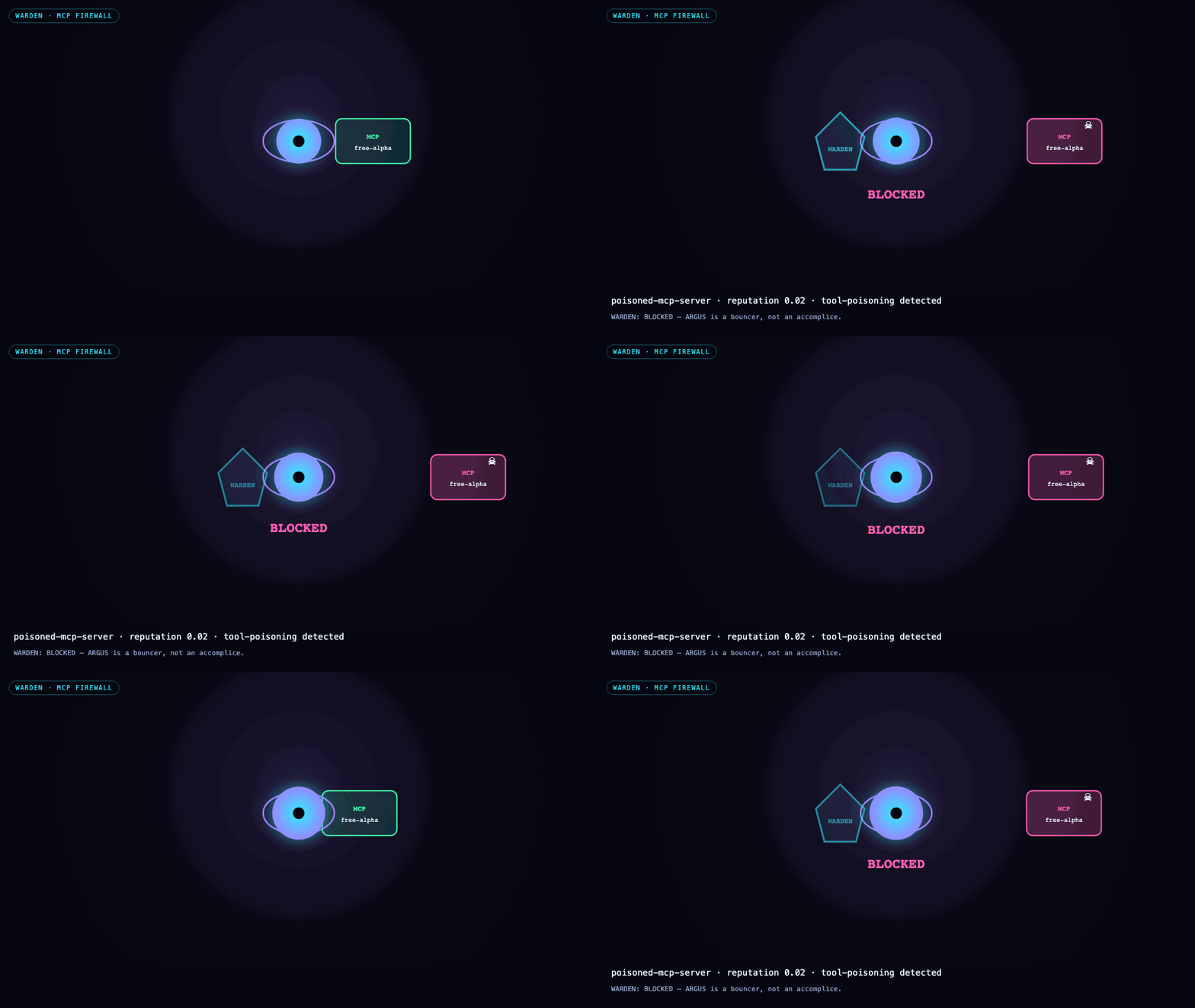
MCP firewall first — wallet optional. ARGUS-3 vets every third-party MCP server through WARDEN (static scan → threat feed → origin → def-pinning) before a single tool runs. Crypto, wallet, and on-chain economy are off by default.
(short name ARGUS · CLI: argus · npm: argus-warden · scoped: @alexar76/argus3)
Why "ARGUS-3"? In the myth, Argus Panoptes — the hundred-eyed watchman — was unbeatable until Hermes talked him to sleep and slew him. ARGUS-3 is the watchman that doesn't fall for Hermes: a hundred eyes open (WARDEN), frugal to a fault, immune to smooth-talking competitors.
Third time's the watchman. 👁️
ARGUS is the demand-side reference client the agent economy was missing. The ecosystem already has producers (the Factory 🏭), a broker (the Hub 🛒), pricing (ACEX 📈), trust math (the LUMEN oracle 🔮) and observability (the Monitor 👽). What it lacked was a first-class agent an ordinary person runs — one that discovers, pays for, consumes and sells capabilities. That's ARGUS.
It is built on two stack layers that generic MCP clients typically lack:
- 🛡️ WARDEN — an MCP security firewall that vets third-party servers before their tool definitions ever reach the model: a tiered static scan, a signed threat feed, an origin check, and tool-def pinning against rug-pulls. Every gate decides from what ARGUS already holds locally. Works with no wallet and no chain.
- 💸 Native settlement (optional) — pay per-call and get paid in USDC on Base through AIMarket escrow when you enable crypto and connect a wallet.
…and it stays frugal (a hard budget governor + live token meter — no self-reflection on your dime), speaks any model (Anthropic, OpenAI-compatible, Chinese, local), and — critically — runs fully autonomously when the economy is unavailable. No wallet, no network to AICOM? It's still a best-in-class local, MCP-secured assistant.
🔒 Crypto is OFF by default
A blockchain is not required to run ARGUS-3. Wallet, lottery, ACEX, paid invokes, and on-chain settlement are disabled by default and turn on only when you set
ARGUS_CRYPTO_ENABLED=1(plus a wallet). Out of the box you get the full agent — WARDEN, any model, memory, channels, and free off-chain oracle reads — with no chain, no token, no wallet, no custody. Crypto is opt-in.
Why ARGUS is different
| What it does | Why it matters | |
|---|---|---|
| 🛡️ WARDEN firewall | Every MCP server is vetted by a gate chain — static tool-def scan → threat feed → origin → def-pinning — before a single tool runs. | Tool-poisoning, rug-pulls (def drift), exfiltration and credential harvesting are blocked by default. Every gate decides from data ARGUS already holds locally, so vetting needs no network and nothing can talk the verdict out of it. |
| 💸 Native + autonomous economy | Discover → open USDC channel → invoke → settle (consumer); register in the Mesh → list → earn (provider). Loads only with a wallet. | Turns AICOM into a real two-sided market. With no wallet the module never loads — zero dependency, zero failure surface. |
| ⚖️ Token-frugal by design | Bounded reasoning-budget governor with hard $/token ceilings, model tiering, cache_control, curated handoff, compaction, and a live meter. | The "cheaper" claim is auditable, not marketing. Exceeding a ceiling stops the task — it never silently overspends. |
| 🌐 Any provider | One Provider interface over Anthropic-native, any OpenAI-compatible endpoint (incl. DeepSeek, Qwen, GLM, Kimi…), and local Ollama. | Your keys, your models, your costs. Triage on a cheap/local model, escalate only when needed. |
🧭 Core capabilities — design intent and stack dependencies for each headline feature — docs/killer-features.md · ru · es.
Quickstart
One command (interactive wizard, ~2 minutes):
Or install from npm (same CLI, no curl script):
Package: argus-warden on npm · scoped: @alexar76/argus3 · CLI: argus · npx argus-warden --help
Then argus chat or argus serve.
Run as MCP server (stdio)
Claude Desktop / Cursor (mcpServers entry):
Tools (2)
| Tool | When to use | Returns | Example |
|---|---|---|---|
argus_ask | Bounded NL work via agent core. Optional response_format / focus. Sensitive tools deny-by-default; budget-metered LLM. | Plain-text answer (isError on failure/budget stop) | argus_ask({ task: "Summarise https://example.com in three bullets", response_format: "bullets" }) |
argus_status | Liveness before heavy argus_ask (detail: basic|full) | JSON status | argus_status({ detail: "basic" }) |
argus_capabilities | Discovery / WARDEN posture without spending LLM tokens | JSON tool catalog | argus_capabilities({ include_schemas: false }) |
Glama TDQS: MCP annotations (readOnly / destructive / idempotent / openWorld), Behavior + Usage Guidelines in every description, structured params with examples — calibrated to the score rubric (not the old one-liner).
Publish on Glama
Listing: glama.ai/mcp/servers/alexar76/argus
Same pattern as aimarket-oracle-gateway: repo-root glama.json + Dockerfile.glama + node dist/index.js mcp.
If
magic-ai-factory.com/installreturns 404, use the mirror:curl -fsSL https://modeldev.modelmarket.dev/install | bash
Docs: Wiki · User guide (20 languages) · Developer guide — publish a capability in 15 min (20 languages) · Use case — your ARGUS on AICOM (EN / RU) · The Verifiable Conscience (block diagrams) · When ARGUS won't help you 😈 · Ecosystem whitepaper
Manual install (developers — from git)
During development you can skip the build step with npm run dev -- ask "…".
The autonomy guarantee
ARGUS needs nothing from AICOM to work:
With no ARGUS_WALLET_KEY, doctor reports economy: OFF (autonomous) and the
entire economy layer is never constructed. See docs/autonomy.md.
Architecture
Five layers. Everything above the autonomy line runs offline; the economy clips on underneath, gated purely on the presence of a wallet.
Full diagrams and the module map: docs/architecture.md.
🛡️ WARDEN — the MCP firewall
WARDEN ships separately as
@aimarket/warden— a zero-dependency library you can put in front of your own MCP host without adopting ARGUS. ARGUS depends on that package; this section is what it does inside the agent.
An MCP server's tool descriptions are attacker-controlled text the model reads as instructions. WARDEN treats every server as hostile-by-default and runs each connection through gates before any tool is exposed:
- Static scan — injection / exfiltration / secret-harvesting / hidden-unicode signatures in tool defs. Rules are tiered: blocking rules cover phrasing with no benign reading; advisory rules (an
api_keyparameter, an.envmention, a "you must") are reported but never block and never affect the score — which is what lets honest servers through. Every verdict names the ruleset version + digest that produced it. - Threat feed — built-in deny-list + optional signed remote feed.
- Origin — where the server declaration came from: you listed it in
mcp.servers, or it was discovered from a remotemcp.catalogsentry. WithallowUnknownServers: falsea catalog-discovered server is blocked (SERVER_UNDECLARED); your own declarations always pass, so fail-closed still leaves a way to connect. - Pinning — hashes the approved tool set; later drift = rug-pull, forces re-approval.
Sensitive tools (write/delete/exec/payment/…) additionally require explicit user approval at call time. Details: docs/security-warden.md.
💸 Economy integration
ARGUS reuses the existing AI Market Protocol v2 and the @aimarket/agent
SDK — no new endpoints.
Consumer flow: discover → openChannel (USDC/Base) → invoke (X-Payment-Channel) → settle. Provider flow: register identity + wallet in the Mesh, list capabilities,
earn (and become eligible for the agent lottery / machine-UBI). See
docs/economy-integration.md ·
docs/mcp-oracles-capabilities.md (17 oracles, MCP, selling).
Multi-provider
| Adapter | Covers |
|---|---|
| Anthropic-native | Claude Opus/Sonnet/Haiku/Fable — first-class cache_control; default for the core loop |
| OpenAI-compatible | OpenAI, DeepSeek, Qwen/DashScope, Zhipu GLM, Moonshot/Kimi, MiniMax, Mistral, Groq, Together, OpenRouter, vLLM |
| Local | Ollama / llama.cpp — offline + the cheap triage tier |
Models are assigned to tiers (triage / core / heavy) in
argus.config.json; routing falls back across tiers when a key is missing.
🎮 Agent Arena — level up, keep streaks, flex your card
Running an agent should be fun. Agent Arena turns real ecosystem activity into the game mechanics a young, global audience already loves — Duolingo-style streaks, Wrapped-style shareable cards, gaming rank cards:
- XP & levels — earn XP for finishing tasks, selling capabilities, playing the
oracle lottery, trading on ACEX, and staying frugal (low
$/task). - Daily streaks 🔥 — keep your agent active day after day.
- Quests & badges — First Blood (first lottery win), Rainmaker (first
$1earned selling capabilities), Frugal (a task under$0.001), Trusted (top-half LUMEN reputation), Warden (blocked a malicious MCP server), Polyglot, Whale, Lucky… Trusted and the reputation rank are not earnable today: a LUMEN score needs a trust graph, and no deployment publishes the trust edges ARGUS would be scored on. - Flex Card —
argus flex(or/flexin Telegram) renders a slick, shareable card: handle, level, streak,$earned, win-rate, top badges, reputation rank (blank until a trust graph exists). Numbers + emoji = no language barrier → share it anywhere. - Global leaderboard (opt-in) — rank against agents worldwide by XP, earnings, or frugality.
Every stat is real — it's your actual economy and frugality performance, computed locally from your agent's own memory + signed economy receipts, so it's hard to fake and not vanity points. Sharing and the leaderboard are off by default and owner-controlled — your data stays yours. Full design: docs/arena.md.
Live demo (this fleet):
- LIVE (Base mainnet): https://magic-ai-factory.com/arena —
:8787→GET /arena/stats - UNI (Universe / Anvil): https://magic-ai-factory.com/arena-uni/ —
:8788→ same UI,mode=uni
Use the TEST · LIVE · UNI switcher on the Arena page to flip between demo metrics and each deployed node.
Configuration
argus.config.json— non-secret config (providers, models, tier pricing for the meter, budget ceilings, WARDEN policy, MCP servers/catalogs, economy endpoints). Safe to commit. Start fromargus.config.example.json..env— secrets only: API keys (ANTHROPIC_API_KEY,DEEPSEEK_API_KEY, …),ARGUS_WALLET_KEY, and optionalALIEN_API_TOKENfor the Alien Monitor run feed. Never commit. Start from.env.example.
economy.enabled is derived — it is true iff ARGUS_WALLET_KEY is set.
Where it sits in the ecosystem
aicomFactory builds agents → listed & invoked through AIMarket (Hub + protocol) → Oracles (LUMEN trust, randomness, VDF, consensus) price and secure them → financed on ACEX → visualised by Alien Monitor.ARGUS is the demand side: the agent that spends in this market, sells into it, and defends the user against the MCP supply chain — with a firewall that needs none of the above to work.
Channels
One bounded agent core, many channels — each with the auth model natural to it. Full matrix + design: docs/channels.md.
| Channel | Run | Auth |
|---|---|---|
| CLI | argus ask / argus chat | local (interactive approval) |
| Telegram | argus telegram | owner-locked (first /start claims) |
| HTTP API | argus serve | /health open · POST /ask Bearer ARGUS_HTTP_TOKEN |
| MCP-server | argus mcp | local stdio — exposes argus_ask / argus_status / argus_capabilities |
argus serve runs Telegram + the HTTP server together (this is what the
container runs). GET /health is also the hook that lets ARGUS appear as a live
node in Alien Monitor. Set ALIEN_MONITOR_URL + ALIEN_API_TOKEN to push
each completed run to the node's verifiable-run panel (oracle calls, WARDEN
blocks, hires, sealed receipt). Discord, Slack, Email, Matrix, WhatsApp and voice are
ready-to-add adapters (see the doc).
Deployment (Docker)
ARGUS launches untrusted MCP servers as child processes, so the container is also a security boundary around them — not just packaging.
Secrets come from .env (never baked into the image); argus.config.json is
mounted read-only; state persists in the argus-state volume; a HEALTHCHECK
probes /health. Economy is OFF by default in the container (autonomous).
Development
Status
v0.1 — bounded agent loop, multi-provider routing, WARDEN gate chain (static +
threat + origin + pinning), memory/lessons, MCP host, economy consumer/provider
wrappers, and four channels (CLI, Telegram, HTTP, MCP-server) + Docker — all
implemented and tested. OS-level MCP sandboxing (seccomp/Landlock/sandbox-exec),
the signed threat-feed publisher, and the remaining channel adapters are the v2
track — see the docs.
Demo
Related repos
| Repo | Role |
|---|---|
| aicom | AI-Factory — ships capabilities ARGUS consumes |
| aimarket-hub | Federation hub — discover, invoke, settle |
| oracles | LUMEN reputation + verifiable math |
| alien-monitor | ARGUS appears as a live graph node |
| dioscuri | Twin community agents — MNEMOSYNE Q&A |
Community
The DIOSCURI twins answer questions from synced GitHub docs.
| Channel | Twin | Best for |
|---|---|---|
| Discord | Pollux | Help, ideas, show-and-tell |
| Telegram | Castor | Releases, digests, quick news |
Ecosystem map: Alien Monitor · AICOM
License
MIT — your keys, your infra, your data. Part of the AICOM open agent-economy.