Aispace README
The full upstream README, mirrored here for reference. Install config, tool schemas, adoption signals, and an original overview live on the Aispace listing page.

aispace
Secure temporary file sharing for AI agents and humans.
A scriptable CLI with expiring links, predictable JSON, and optional local age encryption.


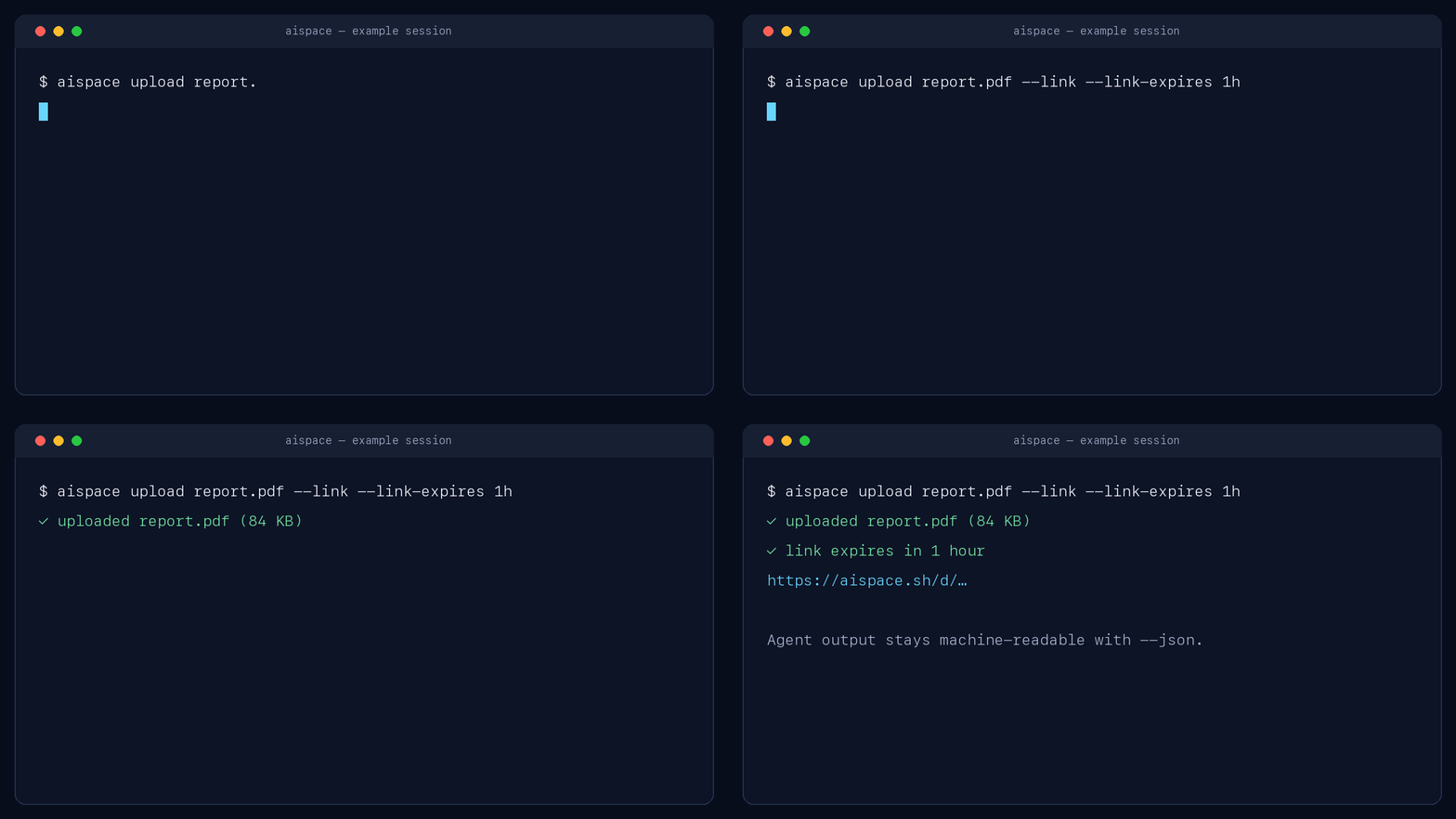
aispace.sh is a bot-friendly file drop for outputs that are too large, structured, or temporary for chat. The open-source client is deliberately easy to automate: one binary, stable exit codes, streaming uploads, and share URLs printed on a predictable final line.
- Built for agents: stable JSON on supported commands, documented errors, stdin support, and explicit noninteractive flags for automation. Secret-bearing handoff commands remain interactive.
- Short-lived by design: file expiration, separately expiring links, revocation, and optional per-link download caps.
- Private when needed: sealed asynchronous transfers encrypt filenames, file metadata, and content locally; their master key never reaches aispace. The existing age X25519 flow remains available for recipient-key workflows.
Sealed transfers, agent identities, device pairing, and adaptive durable-first intent are experimental surfaces. Ordinary uploads and durable R2 storage continue to work alongside them.
The hosted service is operated separately. This repository contains the client, agent skill, and integration examples—not the server, billing system, deployment configuration, or customer data.
Try it in 60 seconds
Install the latest release:
Authenticate with a key created in the aispace dashboard, then store a file:
On a Pro account, add a separately expiring public handoff:
The URL is printed last on its own line, making it easy for an agent or shell script to capture.
Add --json for a stable machine-readable response. An abridged response looks like:
Other installation channels:
Pin the shell installer with AISPACE_VERSION=v1.2.3. Release binaries support macOS, Linux, and
Windows on amd64 and arm64. The shell installer supports macOS and Linux; use npm on Windows.

Using Grok Bot?
Give Grok Bot a fast, bot-friendly way to share files with aispace.
Give aispace to an agent
The repository includes a reusable Codex-compatible skill. Clone the repository and link the skill into your personal Codex skills directory:
Restart Codex, then ask it to use aispace when it needs to hand you a report, archive, image, or
other generated artifact. The skill defaults to account-private storage unless you request a public
link, prefers short expirations, and treats encryption identities as credentials.
Model Context Protocol (MCP)
The native CLI also exposes ten typed MCP tools over local stdio. Create a separately scoped bot key in the dashboard, export it in the environment that launches Codex, and add:
Run codex mcp list to verify the connection. The ChatGPT desktop app, Codex CLI, and Codex IDE
extension on the same host share this configuration. Keep the key in a secret store or injected
environment; never put its expanded value in a committed project file or command argument. See
docs/CLI.md for Claude Code and generic-host examples.
For custom agent runtimes, docs/LLM_USAGE.md includes a system-prompt snippet,
OpenAI/Anthropic-compatible tool schemas, and a reference Python handler. See examples
for runnable shell, CI, and encrypted-handoff recipes.
Common workflows
Follow docs/SECURE_HANDOFFS.md for sealed bundles, trusted agent
inboxes, device pairing, adaptive R2 fallback, and recovery. The complete command reference is in
docs/CLI.md; the HTTP contract is in docs/API.md.
upload accepts --name, --expires, --content-type, --sha256, --link, --link-expires,
--max-downloads, --private, --shared, --encrypt, --recipient, and --identity-out.
Uploads stream from disk. Encrypted uploads use age X25519 locally and store ciphertext as
<name>.age; the secret identity is never sent to the API.
transfer create uses aispace-sealed-v1: AES-256-GCM authenticated chunks and an encrypted
manifest support multiple files, ranged retry, and a verified receipt. transfer receive accepts
the secret from its prompt, --token-file, or AISPACE_TRANSFER_TOKEN; avoid putting a full
fragment link or token in a process argument on shared systems.
transfer create --json omits bearer links and tokens unless --include-secret is explicit, and
secret-inclusive JSON must be redirected rather than written to a terminal. handoff encode
likewise accepts the protected prompt, --token-file, or AISPACE_TRANSFER_TOKEN.
With --json, errors also remain structured and are written to stderr. upload --link --json
returns {"file": File, "link": ShareLink}; encrypted uploads add an "encryption" object.
Configuration
Precedence: flag > environment > config file > default.
| Setting | Flag | Env | File key | Default |
|---|---|---|---|---|
| API key | --key | AISPACE_KEY | key | — |
| Server | --url | AISPACE_URL | url | https://aispace.sh |
AISPACE_AGE_IDENTITY supplies a decryption identity when decrypt --identity-file is omitted.
It is deliberately not accepted as a command-line value.
Config file: $XDG_CONFIG_HOME/aispace/config.json (default ~/.config/aispace/config.json), written with
mode 0600. A warning is printed if the file is readable by others. AISPACE_CONFIG overrides the path.
Durations (--expires, --link-expires) accept Go syntax plus a d suffix: 30m, 24h, 7d, 1d12h,
or a bare number of seconds. Omitting them uses the server defaults (7 days for files, 1 hour for
Pro public links).
File permissions and links
File visibility controls authenticated key access. A public link is a separate capability: creating one requires a Pro account and makes that one file available to anyone holding the URL.
| File mode | Who can access it? | File lifetime | Public-link lifetime | Download cap | Exposure if access leaks |
|---|---|---|---|---|---|
private | Uploading key only | 7 days by default; maximum 7 days on Free or 30 days on Pro | None | Account monthly limit | Private files belonging to that key, until deletion or expiry |
account | Every active key on the account | 7 days by default; maximum 7 days on Free or 30 days on Pro | None | Account monthly limit | Account-shared files, until deletion or expiry |
private + public link | Uploading key and anyone with the URL | Maximum 30 days because links require Pro | 1 hour by default; maximum 30 days and never beyond file expiry | Optional per-link cap | Only the linked file, until link expiry, revocation, exhaustion, file deletion, or file expiry |
account + public link | Account keys and anyone with the URL | Maximum 30 days because links require Pro | 1 hour by default; maximum 30 days and never beyond file expiry | Optional per-link cap | URL access ends with the link; account keys retain access until file deletion or expiry |
| Client-encrypted file | Visibility controls ciphertext access; only age identity holders can decrypt it | Same limits as the selected file mode | Same Pro-only limits when a link is created | Optional per-link cap | Plaintext exposure requires both the ciphertext and the age identity |
Available duration syntax includes 30s, 15m, 1h, 36h, and 7d.
A file becomes unavailable when its file lifetime ends. A link can end sooner because it expired, was revoked, or reached its download cap. Deleting the file immediately ends authenticated key access and every associated public link.
Exit codes
| Code | Meaning |
|---|---|
| 0 | success |
| 1 | generic error (network, 4xx/5xx not listed below) |
| 2 | usage error |
| 3 | authentication (401, or no key configured) |
| 4 | quota / size (402, 413) |
| 5 | rate limited (429) — idempotent GETs sleep Retry-After (max 30s) and retry once |
Errors go to stderr as error: <message> (<code>); with --json they are a JSON object
{"error":{"code","message","status","details","exit_code"}} on stderr instead.
Development
The test suite uses local HTTP fixtures and does not require an aispace key. Contributions are
welcome—start with CONTRIBUTING.md, check the ROADMAP.md, and
review the CHANGELOG.md. Focused bug reports and feature proposals can use the
repository's structured issue forms.
Releases are cut through the manual GitHub Actions workflow. GoReleaser builds checksummed macOS,
Linux, and Windows binaries, updates the Homebrew tap, publishes @aispace-sh/cli to npm, verifies
the installed MCP server on all three platforms, and finally publishes sh.aispace/mcp to the
official Registry. See RELEASE.md for publisher configuration, resumable MCP-only
publication, and the release checklist.
Security
Please report vulnerabilities privately through GitHub Security Advisories. Do not open a public
issue containing a credential, private link, or customer data. See docs/SECURITY.md.