Audit web pages for AI search readiness (ChatGPT, Claude, Perplexity, Gemini).
Quick Install
Automated & IDE SetupCopy the AI prompt to install this server into Claude Code, Cursor, or another agent — or use 1-click editor setup below.
Not yet automatically verified
We haven't yet run this listing's install command through our automated sandbox check. This isn't a red flag — we're steadily working through the catalog.
Manual Client & Custom JSON ConfigExpand JSON ▾
Client Config & Setup
Choose your client or environment
Target File:
💡 Paste the JSON block into your client's configuration file under mcpServers, then restart the application.
Documentation Overview
aiseo-audit


A deterministic, Lighthouse-style audit for AI search readiness. Test how easily generative engines can fetch, extract, understand, and reuse a web page.
AI SEO measures content readiness, not traditional search rank. The score is a research-informed heuristic audit, not a citation probability or a promise that an engine will cite the page.
Website & guides · Quick start · CI/CD · AI assistants · Library API · Scoring methodology
Quick Start
Requires Node.js 20.19 or later.
No install or API key is required. Analysis runs locally with no AI API calls or telemetry. Network access is limited to the page, the sitemap, and domain-signal files such as robots.txt and llms.txt.
Typical output begins with the overall score, pipeline stages, and highest-impact fixes:
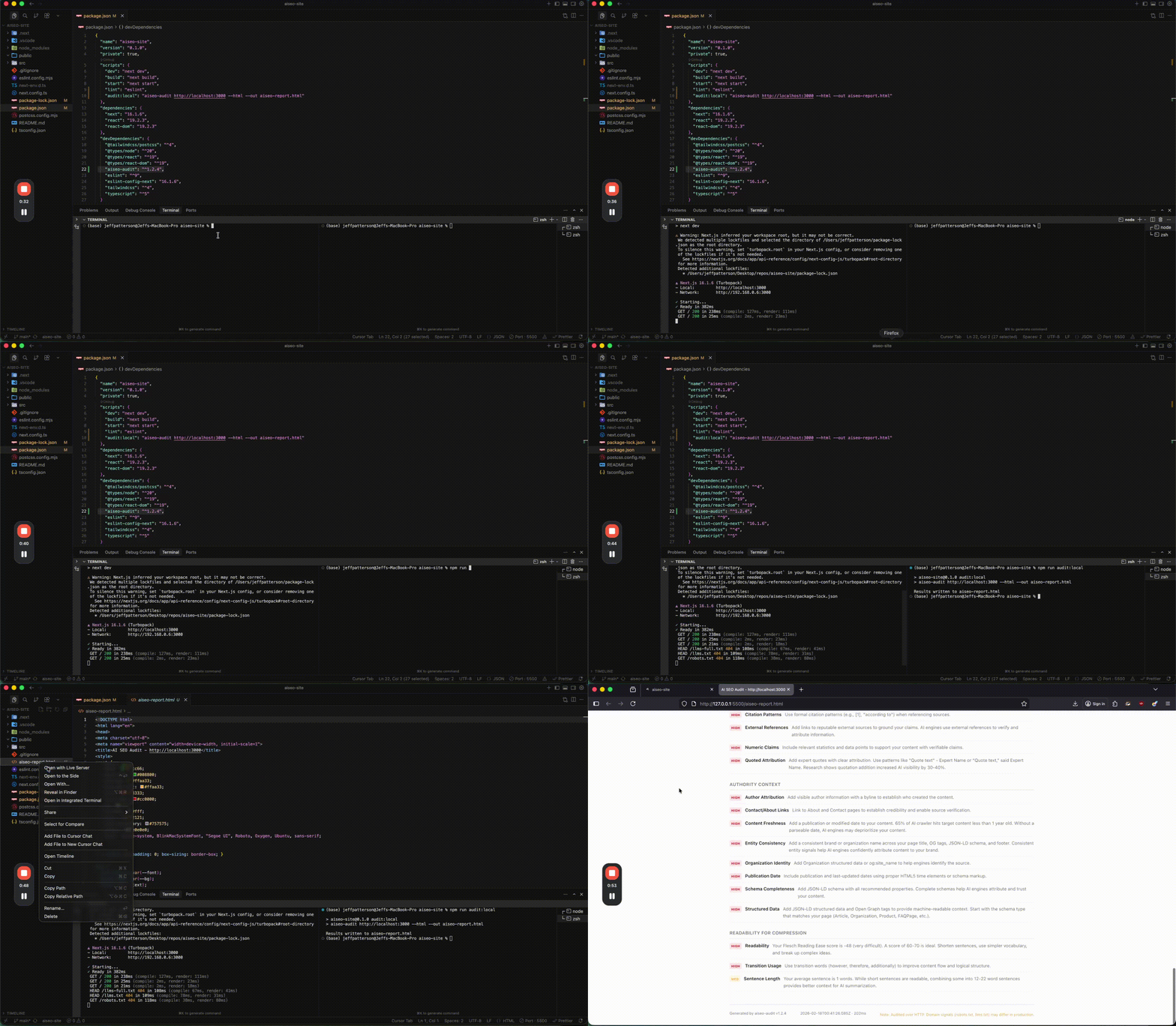
For a project-local CLI installation:
Install it as a regular dependency when using the programmatic API, or globally with npm install -g aiseo-audit.
Why aiseo-audit?
- Content analysis, not tag detection. Reads the page the way an engine would: does it name its subject consistently, answer questions directly, back claims with sources, and keep boilerplate out of the way? 50+ factors.
- Evidence-tiered scoring. Every factor is labeled supported, conditional, heuristic, diagnostic, or experimental and mapped to the reviewed literature in docs/EVIDENCE.md.
- Pipeline-stage reporting. See whether the main constraint is technical eligibility, retrieval alignment, citation fitness, or provenance.
- Deterministic and inspectable. The same tool version, configuration, and fetched HTML produce the same score. Weights and thresholds are documented rather than hidden behind an external service.
- Multiple ways to run. Use the CLI, GitHub Action, MCP server, or typed TypeScript API; render terminal, JSON, Markdown, or standalone HTML reports.
Common Workflows
Audit against target queries
Query-aware audits measure three things: query terms in structural fields such as the title and headings, query terms in the body text, and a section of the page addressing each aspect of the query. Supply about five queries for a stable measurement; the maximum is ten.
Use --domain product for product-specific price, specification, and comparison checks. --engine gemini|gpt|perplexity applies experimental presets that reweight existing categories toward each engine; they add no new checks.
Create a shareable report
The format is inferred from the output extension:
Use --tldr for only the score and top three fixes.
Track changes over time
--diff records JSON results in ./audits by default and updates the discovered config file. See the CLI guide before enabling it in a repository.
Audit a sitemap
The report includes the average score, site-wide category averages, a host-level provenance profile, and per-URL results. Sitemap indexes are supported. URLs run sequentially, so scope large sitemaps intentionally.
More recipes and every flag are documented in the CLI guide. For tutorials and practical implementation guidance, visit aiseo-audit.com.
What the Audit Reports
Every report rolls results up into four pipeline stages:
| Stage | Meaning |
|---|---|
| Technical Eligibility | Can the page be fetched, yield usable text, and remain accessible to at least one known AI crawler? |
| Retrieval Alignment | Do structural fields, entities, topic coverage, and structured data support retrieval? |
| Citation Fitness | Does the in-context content provide direct, grounded, appropriately fresh material that can be reused? |
| Provenance | Does the page communicate authorship, organization identity, and attribution clearly? |
Technical Eligibility is a gate. A fetch failure, unusable text, or blocking every known crawler caps the overall score at 25 and suppresses downstream percentages. Citation Fitness also has evidence-based negative gates for visibly stale time-sensitive content, target-query mismatch, and missing product prices.
Factors are organized into ten categories, with Query Alignment appearing only when target queries are supplied and Product Fit appearing only for product pages. The complete factor, weight, threshold, and stage mapping lives in the Audit Breakdown.
Unscored diagnostics never affect the score. They keep observations visible when the research cannot yet justify scoring them.
Interpreting scores
Letter grades use familiar academic score bands. They are not population percentiles, calibrated estimates of citation likelihood, or evidence that one site is “above average.” Use the score to compare the same page or page set under a stable tool version and configuration, then prioritize the highest-weight findings and re-measure.
If you use --fail-under, establish the threshold from your own v2 baselines rather than treating any universal score as a guaranteed passing grade.
CI/CD
The official GitHub Action can gate a workflow and maintain a sticky PR comment:
Calibrate fail-under against your own pages before making the check blocking. A one-line CI invocation also works:
Use with AI Assistants (MCP)
The included MCP server exposes an audit_url tool to Cursor, Claude Desktop, Windsurf, and other MCP clients:
The tool accepts optional queries and domain arguments. No separate server installation is required.
Configuration
The CLI searches upward from the current directory for aiseo.config.json, .aiseo.config.json, or aiseo-audit.config.json.
Missing weight keys default to 1; set a category to 0 to exclude it. See CLI configuration for all fields, defaults, and examples.
Programmatic API
The package supports ESM and CommonJS and exports the analyzer, sitemap, report, diff, configuration, and scoring types. See the API guide.
Limitations
Related MCP Servers
Adoption & maintenance
Factual signals from GitHub, npm, and our automated checks — not a rating.
GitHub stars
8
Stargazers on the source repository.
npm downloads
1.7k
Package downloads in the last 30 days.
Last commit
24d ago
Most recent push to the default branch.
Directory activity
1 views
Config copies, upvotes, and views on AllMCPs.
Reviews
No reviews yet — be the first to share how this listing worked for you.
Frequently Asked Questions about Aiseo Audit
AllMCPs Directory Badge
Showcase your server listing on GitHub or your project documentation. Embed this dynamic SVG badge to highlight official listing status and live engagement.
Badge Style:
Live Dynamic SVG Preview
Markdown (GitHub README)
[](https://allmcps.com/mcp/aiseo-audit)HTML Embed
<a href="https://allmcps.com/mcp/aiseo-audit"><img src="https://allmcps.com/api/badge/aiseo-audit?style=directory" alt="Aiseo Audit on AllMCPs" /></a>Technical Specs & Signals
CategorySecurity
11/15 checks healthy over the last 45d
45Quality signal: Fair · 45/100How this signal is calculated ▾
Server availabilityNot measured
Not scored for repo-hosted servers — we can't reach the running server, only its GitHub page. Hosted MCP endpoints are health-checked live.
Verified ownership10/20
Documentation & tools15/30
Adoption & activity9/15
Community engagement0/10
A guidance signal from public completeness & health data — not a user rating. New listings start lower and rise as they add docs, get verified, and grow adoption. Signals we can't observe for a listing are skipped, not counted against it.
Supply-chain signal
No high-severity advisories surfaced by our automated scan.
Critical 0High 0Medium 0Low 0
Scanned 5d ago via OSV.dev · aiseo-audit (npm)
Own this project?
This directory is pre-filled from public sources. Claim via GitHub README, site badge, or DNS TXT to unlock edit access and the Official badge — proof is checked automatically, then reviewed by our team.
Free dofollow backlink: add your website and place the AllMCPs badge on it — no claim needed. We detect it automatically and keep it verified as long as the badge stays live.
Claim & get free dofollowShare & Embed
Add our SVG badge (dark/light directory styles) or embeddable widget to your site.