AI Open Source Intelligence
One Skill. Nine live read-only Radar tools. Evidence-backed open-source AI research without a second server-side model call.
简体中文 · Product page · AI Open Source Radar · Quickstart
AI Open Source Intelligence is the Skills/MCP product layer for AI Open Source Radar.
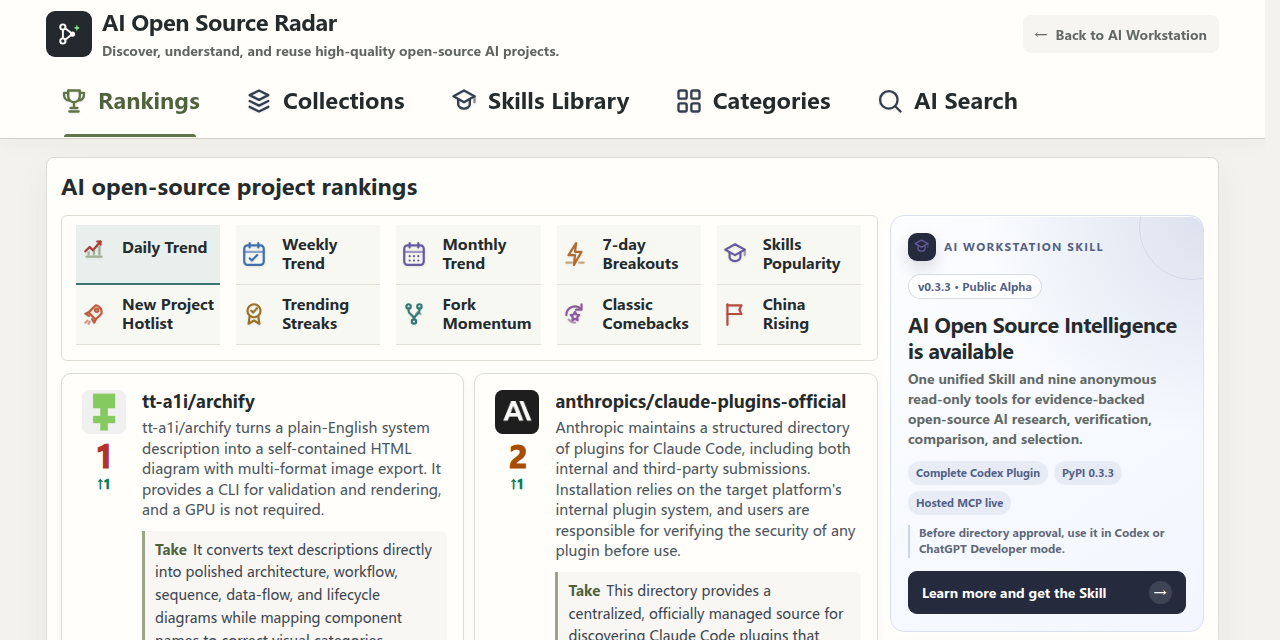
Production screenshot captured 2026-08-29. Rankings and project data update with Radar snapshots.
Product shape
The user does not choose separate research/comparison/stack Skills. The single Skill routes the task internally.
The host model performs natural-language reasoning and synthesis. The AI Workstation server provides data/evidence only on this product path.
One active Skill
It handles:
- browsing rankings, collections, categories, scenarios and the Radar Skills library;
- finding projects from deployment, privacy, integration, budget and license requirements;
- verifying named-project facts and license evidence;
- comparing two to five projects for a concrete use case;
- finding alternatives while preserving hard requirements;
- planning candidate open-source AI stacks and exposing unverified compatibility.
The only product Skill is packaged from:
agents/openai.yaml makes the Skill's dependency on the canonical
ai_open_source_intelligence Hosted MCP explicit while keeping automatic
invocation enabled. This is the Skill-level dependency contract; .mcp.json
is the matching Plugin-level connection contract.
The previous split research/comparison/stack Skill files are removed from the current product and distribution bundle.
Nine standard MCP tools
All nine are read-only. They do not execute or install third-party repository code.
No AI Workstation server-model execution
This is a hard product boundary for the current release.
The Hosted MCP exposes no Premium model tool, no checkout tool and no runtime OAuth/Premium switch. Requirement-based selection calls the public Radar selector with:
Therefore an ordinary Skill/MCP workflow is:
It is not:
If member-linked server-model capabilities are added later, they must ship as a new reviewed product version rather than being enabled through a hidden environment variable.
Evidence model
Every tool result separates:
- verified facts — source-backed observations that crossed the evidence boundary;
- recommendations — host-model/rules analysis;
- unknowns — unavailable or unverified information;
- risks — license, maintenance, deployment, security and integration limits.
A value in data is not automatically a verified fact. License evidence is deliberately stricter and is technical evidence, not legal advice.
Requirement tools publish the actual typed constraint contract through MCP:
Formal matches are revalidated against project-detail evidence. README excerpts
may directly verify narrow Docker, self-hosting, browser UI and low/no-code
claims; unresolved hard requirements become near-match blockers. A License label
is exposed only as observed_license_label until a direct LICENSE-family source
supports a verified license fact. Response observation time and evidence-source
freshness are reported separately.
Official resources in results
MCP tool results include canonical, non-tracking publisher links under:
with:
- AI Workstation — https://aiworkstation.cn/
- AI Open Source Radar — https://aiworkstation.cn/githubai/
- this open-source project — https://github.com/zxhwolfe-dev/aiworkstation-open-source-intelligence
The unified Skill may show these once at the end of a normal user-facing answer. They are kept separate from verified facts so publisher attribution never changes a research conclusion.
Hosted MCP
Canonical endpoint:
Current Hosted mode is intentionally:
The container stays on host loopback 127.0.0.1:8001 behind Nginx/TLS.
Anonymous abuse controls
The gateway uses two per-IP request windows plus a connection cap:
- short-window:
60 requests/minute, burst30; - sustained:
10 requests/minute, burst300; - concurrent connections:
10per IP; - MCP request body:
256 KBmaximum; - unrelated paths on the dedicated MCP hostname return
404.
This is intentionally request-based rather than token-based because the nine data tools do not consume AI Workstation model tokens.
Use it now
The published v0.3.3 Plugin packages the unified Skill and the production
Hosted MCP configuration together. Codex and the ChatGPT desktop Codex host can
install both from one version-pinned marketplace entry. The public ChatGPT
directory listing is still pending review. Today:
- Codex / ChatGPT desktop users can install the complete repository Plugin;
- ChatGPT web users can register
https://mcp.aiworkstation.cn/mcpas a No Authentication developer-mode app while the public listing is pending; - Python users can install the matching CLI/MCP package from PyPI with:
See the Quickstart for exact ChatGPT, Codex and Python
steps and the v0.3.3 Release
for signed-off assets and checksums. The immutable v0.3.0 archive remains the
earlier Skills-only artifact; the complete Plugin uses the current v0.3.3 patch
identity rather than replacing it.
Local development
Offline fixture data:
Live public Radar data:
Hosted configuration check requires an exact candidate identity:
Setting OSI_HOSTED_ACCESS_MODE=oauth fails closed in the current release.
Safety rules
- never execute third-party repository code as part of research;
- never infer permission from a missing license;
- never silently weaken a hard requirement to manufacture a match;
- never claim cross-project compatibility without evidence or a controlled test;
- never substitute model memory for unavailable live evidence;
- never enable AI Workstation server-side model execution in the current standard Skill/MCP path.
Development checks
CI covers Python 3.10 and 3.12, deterministic Skill packaging, MCP round trips, data-only Hosted configuration and container packaging.
License
The public repository is licensed under Apache-2.0. That does not grant rights to private AI Workstation databases, unpublished datasets, credentials, infrastructure or trademarks.