AI Context Flow MCP – Persistent AI context and memory for tools, agents, and platforms.
Quick Install
Automated & IDE SetupCopy the AI prompt to install this server into Claude Code, Cursor, or another agent — or use 1-click editor setup below.
Manual Client & Custom JSON ConfigExpand JSON ▾
Client Config & Setup
Choose your client or environment
Target File:
💡 Paste the JSON block into your client's configuration file under mcpServers, then restart the application.
Documentation Overview
Plurality MCP Server
Universal memory for AI agents and tools. Save, organize and search context anywhere.




An Model Context Protocol server that gives any MCP-compatible AI client persistent memory — documents, notes, conversations, and files stored across organized memory buckets with semantic search. Supports OAuth and Personal Access Tokens (PAT) based authentication.
Why use this?
- Memory Studio — a personal knowledge base and second brain where you organize context into memory buckets, review saved content, and manage what your AI agents know.
- Save important chats — directly from within Claude, ChatGPT, Cursor, and other AI tools into the relevant memory bucket
- Shared persistent memory across all your agents — Claude Code, Lovable, Cursor, OpenClaw and more all access the same context
- Semantic search — find relevant memories using natural language, not just keywords
- Share buckets with other people — collaborate by giving others access to your context
- Works everywhere — any MCP-compatible client can connect
We also have a Chrome extension called AI Context Flow that lets you capture and use context on any website. It comes with a built-in chat agent (30+ models) that opens as a sidebar on any page — talk to your memories, answer questions from your stored context, and surface connections across everything you've saved. You can use the MCP Server alongside the extension to get full feature set of the product.
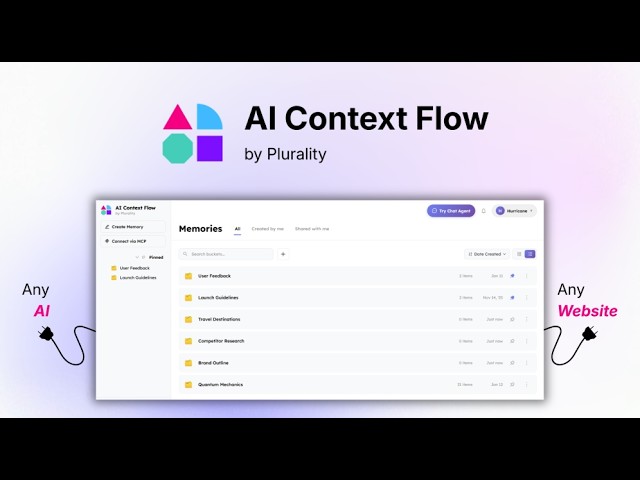
▶️ Watch the demo
📖 Full documentation · 🌐 Website · 🧩 Chrome Extension · 🧠 Memory Studio
Quick connect (production)
Production URL: https://app.plurality.network/mcp
The server supports OAuth 2.1 with PKCE (for interactive clients) and Personal Access Tokens (for headless agents and CI). Most clients handle the OAuth flow automatically.
Works with Claude Desktop, Claude Code, ChatGPT, Cursor, and any MCP-compatible client.
→ Step-by-step setup guides for all supported clients
Tools
| Tool | Description |
|---|---|
get_user_memory_buckets | List all memory buckets (organized folders) for the user |
list_items_in_memory_bucket | List stored items in a specific bucket (metadata only) |
search_memory | Semantic search across buckets with relevance scoring |
read_context | Read the full content of a stored item with pagination |
save_memory | Save text content to a specific memory bucket |
save_conversation | Save a conversation (chat history) to a memory bucket |
create_memory_bucket | Create a new memory bucket for organizing saved content |
Authentication
The MCP server accepts two auth methods:
| Method | When to use | Browser required? |
|---|---|---|
| OAuth 2.1 + PKCE | Interactive clients: Claude Desktop, Web, Code, ChatGPT | Yes (one-time) |
| Personal Access Token (PAT) | Headless agents, CI runners, custom integrations, n8n, LangChain | No |
Using a Personal Access Token
- Sign in to the dashboard, open Connect via MCP → Manage tokens
- Click Create token, give it a name and optional expiry, copy the
plur_pat_…value - Configure your client to send it as a Bearer token:
PATs require a paid plan. They auto-revoke at expiry, can be rotated with a configurable grace period (default 7 days), and can be immediately revoked from the dashboard. They are stored hashed and never appear in logs.
OAuth details
The server uses Ory Hydra as the OAuth2/OIDC provider:
| Property | Value |
|---|---|
| Algorithm | RS256 |
| Issuer | https://app.plurality.network (prod) |
| Scope | openid offline_access mcp:tools |
| Access token TTL | 15 minutes |
| Refresh token TTL | 720 hours |
| Discovery | https://app.plurality.network/.well-known/oauth-authorization-server |
| Dynamic Client Registration | https://app.plurality.network/register |
OAuth2 flow (step by step)
- Client discovers auth server — fetches
/.well-known/oauth-protected-resourcefrom Traefik - Client registers — calls
/register(Dynamic Client Registration) to getclient_id/client_secret. The API Gateway proxies this to Hydra, injecting themcp:toolsscope - User authenticates — browser opens Hydra's login flow, which redirects to the frontend's login/consent pages
- Token issued — Hydra returns a JWT access token (RS256, 15min TTL) with the user's ID as the
subclaim andmcp:toolsscope - Authenticated requests — client includes
Authorization: Bearer <token>on all MCP requests - MCP server validates — JWT signature verified locally against Hydra's JWKS public keys (cached 1 hour),
mcp:toolsscope is checked - API Gateway access — MCP server forwards the Bearer token when calling API Gateway endpoints for data retrieval and storage
Architecture
Traefik is the single entrypoint. It routes OAuth traffic to Hydra and MCP protocol traffic to the MCP server. The MCP server validates JWTs locally via Hydra's JWKS keys, then forwards the Bearer token to the API Gateway for data access. The API Gateway handles authentication, DCR proxying, and routes vector/search operations to the Vector Service.
Local development setup
Prerequisites
- Python 3.11+
- uv (Python package manager)
- Docker and Docker Compose
- Running API Gateway (plurality-backend-api): Handles authentication, OAuth metadata, DCR proxying, and database access
- Running Vector Service (plurality-ai-service): Handles semantic search and vector database operations
1. Install dependencies
2. Configure environment
Default values work for local development — no changes needed if the API Gateway runs on :5000:
3. Start Docker services (Hydra + Traefik)
This starts:
| Service | Port | Purpose |
|---|---|---|
| PostgreSQL | 5433 | Hydra's database |
| Hydra | 4444, 4445 | OAuth2/OIDC provider (public + admin) |
| Traefik | 5050 | Reverse proxy / routing |
Wait for services to be healthy: docker compose ps
4. Start the MCP server
Port 5051, not 5050. Traefik listens on 5050 and proxies
/mcpto the MCP server on 5051.
5. Verify
Local client configuration
Claude Code
Then authenticate via /mcp inside Claude Code.
Claude Code — VS Code Extension
Authenticate first in the terminal using the steps above. Then add .mcp.json to your project root:
The VS Code extension may not trigger the OAuth browser flow automatically. Complete authentication via the terminal first.
Claude Desktop
Edit your config file:
- macOS:
~/Library/Application Support/Claude/claude_desktop_config.json - Windows:
%APPDATA%\Claude\claude_desktop_config.json
Related MCP Servers
Reviews
No reviews yet — be the first to share how this listing worked for you.
Frequently Asked Questions about AI Context Flow
AllMCPs Directory Badge
Showcase your server listing on GitHub or your project documentation. Embed this dynamic SVG badge to highlight official listing status and live engagement.
Badge Style:
Live Dynamic SVG Preview
Markdown (GitHub README)
[](https://allmcps.com/mcp/ai-context-flow)HTML Embed
<a href="https://allmcps.com/mcp/ai-context-flow"><img src="https://allmcps.com/api/badge/ai-context-flow?style=directory" alt="AI Context Flow on AllMCPs" /></a>Technical Specs & Signals
CategoryKnowledge & Memory
27Quality signal: Emerging · 27/100How this signal is calculated ▾
Server availabilityNot measured
Not scored for repo-hosted servers — we can't reach the running server, only its GitHub page. Hosted MCP endpoints are health-checked live.
Verified ownership8/20
Documentation & tools11/30
Adoption & activity1/15
Community engagement0/10
A guidance signal from public completeness & health data — not a user rating. New listings start lower and rise as they add docs, get verified, and grow adoption. Signals we can't observe for a listing are skipped, not counted against it.
Own this project?
This directory is pre-filled from public sources. Claim via GitHub README, site badge, or DNS TXT to unlock edit access and the Official badge and attach your website — proof is checked automatically, then reviewed by our team.
Free dofollow backlink: add your website and place the AllMCPs badge on it — no claim needed. We detect it automatically and keep it verified as long as the badge stays live.
Claim & get free dofollowShare & Embed
Add our SVG badge (dark/light directory styles) or embeddable widget to your site.