Stealth web browser for agents: search, fetch, click and type through persistent sessions over MCP.
Quick Install
Automated & IDE SetupCopy the AI prompt to install this server into Claude Code, Cursor, or another agent — or use 1-click editor setup below.
Manual Client & Custom JSON ConfigExpand JSON ▾
Client Config & Setup
Choose your client or environment
Target File:
💡 Paste the JSON block into your client's configuration file under mcpServers, then restart the application.
Documentation Overview
AginxBrowser
The Browser for AI Agents. See the live web. Read it. Act on it. Remember it.



A browser built for agents from the first line of code — not a human browser bolted onto automation. See the world, read it, search it, act on it, and keep what you read: one Rust binary with built-in V8, no Chromium required.
Humans have Chrome. Agents have AginxBrowser.
One binary, zero dependencies, instant service. HTTP API + native MCP + CDP — agents plug in and go, and existing Playwright / Puppeteer / browser-use code attaches directly.
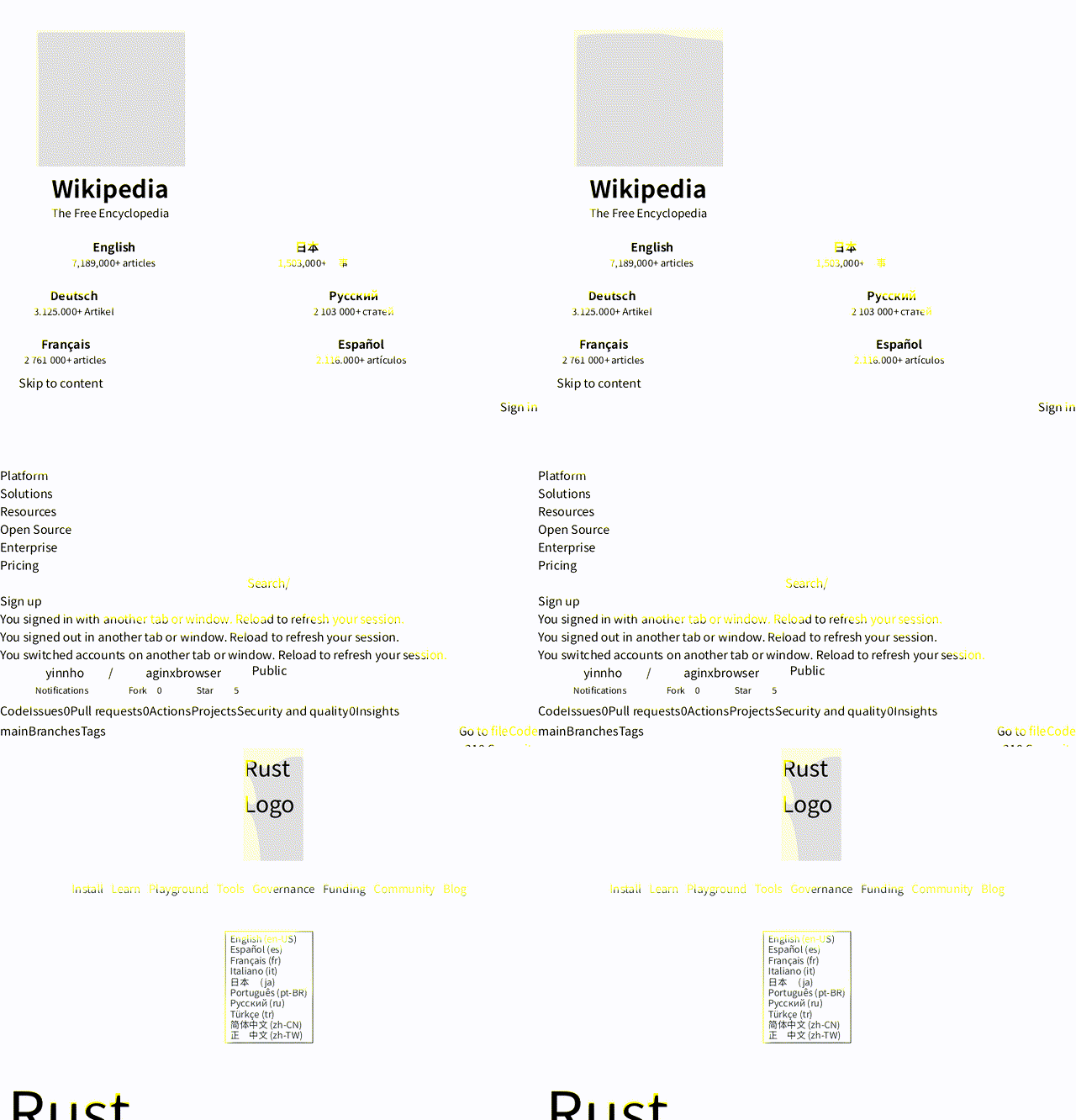
Real pages rendered by AginxBrowser's diting engine (no Chromium) — Wikipedia, this repo, Rust. Screenshot it yourself →
Why Agents Need Their Own Browser
Measured against headless Chrome on the same 20 pages, same network (bench, 2026-08-28): 7.6× faster to agent-usable text (p50 532 ms vs 4 053 ms), ~10× less memory (227 MB for the whole process vs ~2.1 GB per Chrome page), and 0 hard failures where Chrome's --dump-dom produced no DOM on 5 of 40 loads. An agent's total cost is browser efficiency × model efficiency — this is the browser half.
Existing "browser automation" was built for humans or for one-shot scraping — not for agents:
| AginxBrowser | Puppeteer/Playwright | Firecrawl | Browser-use | |
|---|---|---|---|---|
| Designed for | Agents first | Human debugging | Scraping service | LLM wrapper |
| Dependencies | Single binary, no Chromium | Chromium ~500MB | Docker ~1GB | Chromium |
| Sees (screenshots) | ✅ built-in diting rendering engine | Needs Chromium | ❌ | Needs Chromium |
| Reads | markdown + js_extract + fetch receipts | DIY | markdown | DIY |
| Finds (search) | ✅ 15 engines, 7 categories, merged | ❌ | ❌ | ❌ |
| Acts | indexed session interaction | DevTools API | ❌ | LLM-driven |
| Remembers | ✅ local fetch/search cache (SQLite FTS5) | ❌ | crawl cache | ❌ |
| Protocol | HTTP + native MCP + CDP | Node API | HTTP | Python |
| TLS fingerprints | ✅ Chrome/Firefox/Safari/Edge | Plugin required | ❌ | ❌ |
| CAPTCHA | ✅ detect + auto-wait + optional 2captcha | DIY | ❌ | ❌ |
| Interactive sessions | ✅ persistent | ✅ | ❌ | ✅ |
An agent needs five things from a browser: see, read, find, act, remember. One binary covers them all — systemd-friendly, MCP-native for Claude/Cursor, zero dependencies.
Core advantage: no Chromium. AginxBrowser inlines a full browser engine (V8 + Rust HTTP stack + the diting CSS/layout/paint rendering engine, with the Blitz/Stylo/Taffy lineage as its reference implementation). No Puppeteer, no Chrome, no Docker. One Rust binary under systemd is your agent browsing infrastructure.
Three Things Stateless Renderers Can't Do
Most new "agent browsers" are stateless, fingerprint-less one-shot renderers — fine for public pages, dead on arrival against Cloudflare or login flows. AginxBrowser goes the opposite way:
- 🔐 Real TLS fingerprints — stealth mode replicates the complete Chrome145 / Firefox133 / Safari / Edge TLS handshakes via BoringSSL (not just a UA string), switchable per request; Cloudflare Turnstile challenges wait automatically for
cf_clearance. Fingerprint-less engines eat 403s — we get through. - 🤝 Stateful interactive sessions — login state injectable and exportable (
session_create(cookies=...)↔session_cookies), surviving pagination and multi-step flows;persistent: trueeven survives idle eviction and server restarts — the same session id comes back logged in. One-shot engines throw state away. - 🔌 MCP native — 27 tools as first-class citizens (not a CDP shim). Claude Code / Cursor / Claude Desktop connect in one line. HTTP + MCP dual protocol — plus a CDP bridge, so the DevTools ecosystem works too.
Reference point: Cloudflare's Kitesurf explicitly ships neither real TLS-fingerprint negotiation nor persistent auth sessions — anti-bot and login territory is exactly where AginxBrowser plays.
Apache-2.0 open source, single binary — self-host today, no cloud lock-in.
Every Fetch Is a Receipt
Agents act on what a browser tells them, so the response reports what actually happened — not just "got a 200":
tier— which path served the page: plain HTTP (~100 ms) or the V8-rendered browser tier. An agent can see why a fetch was fast or slow.redirected_from— the full redirect trail.redirected_from[0]is the URL you asked for,urlis where the content actually came from — requested paired with effective, every hop visible.content_hash+changed_since_prev— every fetch is hashed; consecutive samples of the same URL can be diffed. A rate-limited origin serving the same frozen 200 body for days reads aschanged_since_prev: false— the cheapest drift detector there is.captcha_event— when a challenge page was detected (and solved, if a solver is configured), the response says so instead of handing over a challenge page as if it were content.
The local cache builds on the same idea: search hits come back with [§ heading] section prefixes so an agent knows where on the page a hit landed, and ranking fuses keyword relevance with freshness.
Capabilities
- Tiered rendering: static pages over plain HTTP (~100ms); V8 spins up only when JS rendering is needed (~1-2s) — 90% of the bench page set served without spinning up V8 at all; every response reports which tier served it (
tierfield) - Multi-engine meta-search: general web (Baidu / Bing / Sogou / WeChat / Google / DuckDuckGo), news (Bing News), code (Stack Overflow, GitHub), packages (npm, PyPI), academic (arXiv), AI models (Hugging Face) — 15 engines across 7 categories, queried concurrently, merged and deduplicated. Operators can plug a private Meilisearch index into the same
/search. Search → read in one step - Image search:
categories=imageshits Baidu/Bing image indexes and returns direct binaryimage_urllinks (downloadable straight to jpg/png) plussource_urlprovenance - Interactive sessions: persistent browser sessions with indexed interaction (
state/click/input/scroll/eval) — agents browse like humans do, andsession_exportturns what an agent figured out into a runnable curl replay script (zero model tokens on re-run). Session tools also cover the acting part:session_viewportsimulates device viewports (media queries respond),session_waitblocks on a selector or predicate with a timeout,session_screenshotrenders the live state,session_consolereplays the page's console ring, andsession_storageexports/restores cookies plus localStorage for login hand-off - Playback-link sniffer:
session_network(filter=media)extracts the m3u8/mp4/dash URLs a page's player actually requested at runtime — links found only in page HTML are often decoys, so the request log is the source of truth.GET /session/{id}/harexports the same traffic as HAR 1.2 (retained bodies included) - CDP bridge:
/json/version+/devtools/{kind}/{id}WebSocket —chromium.connectOverCDP()from Playwright, Puppeteer, or browser-use attaches with one line (integration guide). DevTools ecosystem compatibility without becoming a CDP shim - File download: streaming to disk (no memory buffering), SHA-256 integrity, resume of interrupted transfers — for binaries, archives, datasets
- Local cache that remembers: every fetch/search lands in SQLite (FTS5) at
~/.aginxbrowser/cache.db. Thecachetool re-answers from what the agent already read instead of re-paying network time: full-text search with CJK substring matching, keyword × freshness fusion ranking,[§ heading]section-aware snippets, per-URL content hashes for drift detection, TTL-bounded, per-session scoping for shared deployments - CAPTCHA handling: type detection with automatic Cloudflare challenge wait and optional 2captcha integration — search never stalls on verification pages
- JS data extraction:
js_extractpullswindow.__INITIAL_STATE__and other structured data out of SPAs - Screenshot rendering:
/screenshotendpoint (opt-in--features screenshot) paints the JS-rendered DOM with the diting rendering engine — pure CPU, no Chromium — to PNG. Vision input for agents - TLS fingerprint spoofing: stealth mode impersonates Chrome145/Firefox133/Safari/Edge, switchable per request
- MCP server:
--mcpmode exposes 28 tools (fetch/eval/search/download/cache + session + screenshot tools) — Claude Code / Claude Desktop / Cursor call them directly - Firecrawl compatible:
/v1/scrapeendpoint — existing Firecrawl clients migrate by changing the base URL - DNS rebinding protection: built-in SSRF guard + post-resolution IP validation
A Browser, Not a Crawler
AginxBrowser exists for real-time retrieval: an agent arrives with a question, reads a handful of pages, leaves with the answer. It is not a crawling tool — and the product is shaped so it can't quietly become one:
Related MCP Servers
Reviews
No reviews yet — be the first to share how this listing worked for you.
Frequently Asked Questions about Aginx Browser
AllMCPs Directory Badge
Showcase your server listing on GitHub or your project documentation. Embed this dynamic SVG badge to highlight official listing status and live engagement.
Badge Style:
Live Dynamic SVG Preview
Markdown (GitHub README)
[](https://allmcps.com/mcp/aginx-browser)HTML Embed
<a href="https://allmcps.com/mcp/aginx-browser"><img src="https://allmcps.com/api/badge/aginx-browser?style=directory" alt="Aginx Browser on AllMCPs" /></a>Technical Specs & Signals
CategoryDeveloper Tools
28Quality signal: Emerging · 28/100How this signal is calculated ▾
Server availabilityNot measured
Not scored for repo-hosted servers — we can't reach the running server, only its GitHub page. Hosted MCP endpoints are health-checked live.
Verified ownership8/20
Documentation & tools12/30
Adoption & activity1/15
Community engagement0/10
A guidance signal from public completeness & health data — not a user rating. New listings start lower and rise as they add docs, get verified, and grow adoption. Signals we can't observe for a listing are skipped, not counted against it.
Own this project?
This directory is pre-filled from public sources. Claim via GitHub README, site badge, or DNS TXT to unlock edit access and the Official badge — proof is checked automatically, then reviewed by our team.
Free dofollow backlink: add your website and place the AllMCPs badge on it — no claim needed. We detect it automatically and keep it verified as long as the badge stays live.
Claim & get free dofollowShare & Embed
Add our SVG badge (dark/light directory styles) or embeddable widget to your site.