Read-only, provenance-aware selection of Wolof speech corpora by measured quality.
Quick Install
Automated & IDE SetupCopy the AI prompt to install this server into Claude Code, Cursor, or another agent — or use 1-click editor setup below.
One-click editor setup isn’t available for this listing yet — we don’t have a confirmed install command, and we’d rather show nothing than point your editor at the wrong package or host. Follow the project’s own setup instructions, linked above.
Manual Client & Custom JSON ConfigExpand JSON ▾
No confirmed setup config for this listing yet. We only publish a config block when the install details come from the project itself — its README, its docs, or a verified owner. We haven’t found those for African Speech Corpora Quality Audit, and we’d rather show nothing than a guess you’d paste into your client. Follow the project’s own setup instructions for the current steps.
Capabilities & Tool Schemas (8)
Inspect callable tools, capabilities, and parameters exposed to AI agents by African Speech Corpora Quality Audit.
list_corporaList variants, audit state, recommended use, and validation state.
audit_corpusReturn counts, durations, verification basis, warnings, and separate published figures.
plan_training_setBuild a plan without double-counting derivatives or including benchmarks by default.
filter_segmentsFilter only when a row-level manifest exists; otherwise refuse to promise exclusions.
compare_corporaCompare quality, domain, language purity, license, and metric freshness.
search_segmentsSearch rows in a variant whose remote schema has been validated.
Documentation Overview
African Speech Corpora MCP
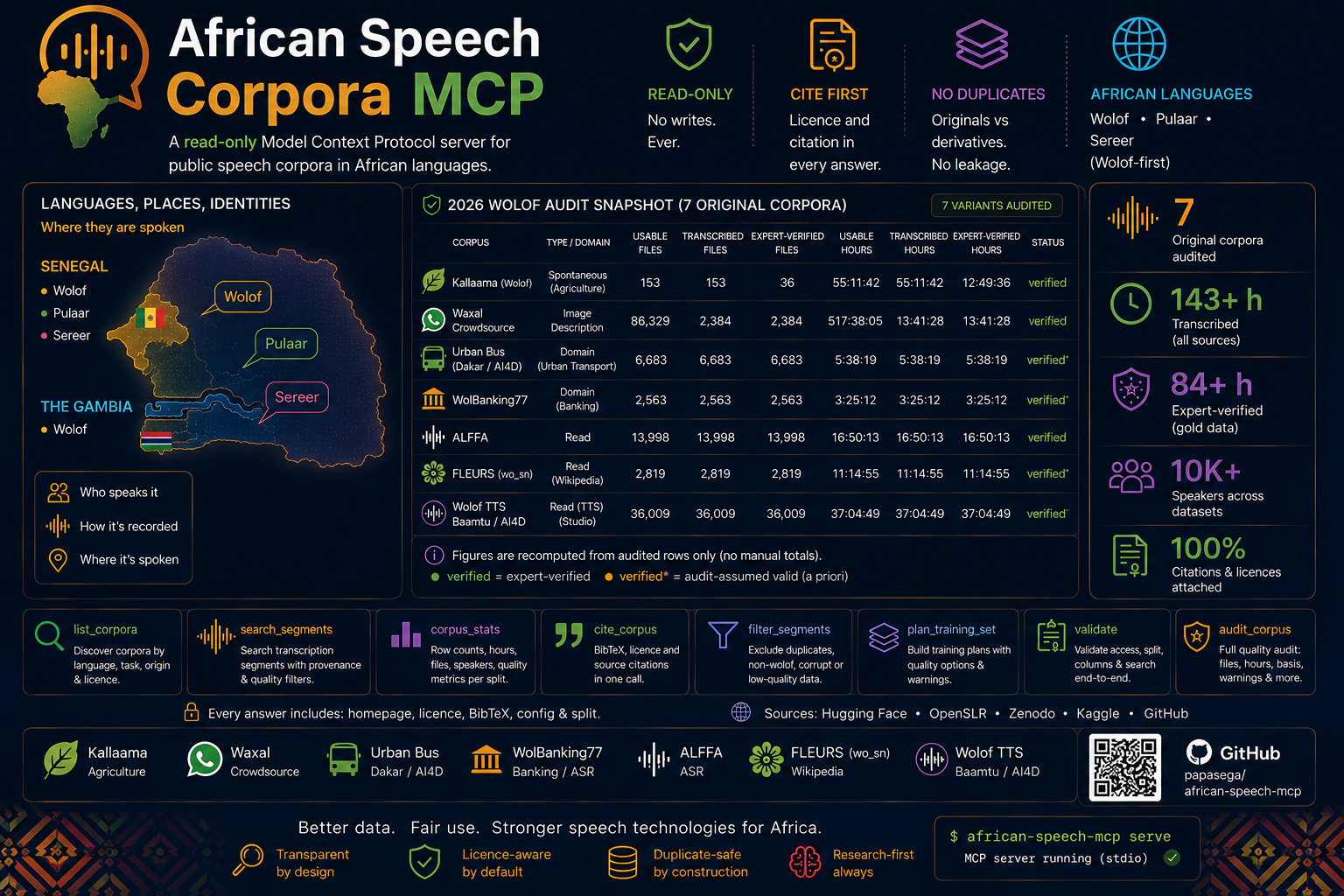
A read-only server implementing the Model Context Protocol, an open standard created by Anthropic, over public speech corpora for African languages: Wolof first, plus Pulaar and Sereer.
The project is Wolof-first. The 2.0 catalog contains 14 variants: 11 variants of original sources and 3 derivatives. Pulaar (ful) and Sereer (srr) are represented only by Kallaama variants without local metrics; the project does not claim Swahili or Amharic coverage. The bundled validation lock, generated on August 26, 2026, makes 6 Hugging Face variants queryable. A later validation run may naturally produce a different state.
Version 2.0.0 is distributed on PyPI and published as io.github.papasega/african-speech-corpora in the official MCP Registry.
The server does not train models, download complete corpora, or write to Hugging Face, OpenSLR, Kaggle, GitHub, or any other remote source.
What the server measures
The quality pipeline keeps the following stages separate:
- Raw: a file present in the observed snapshot.
- Usable: a file remaining after the audit's quantifiable exclusions.
- Transcribed: audio associated with a transcription.
- Audit accepted: an explicitly named union of expert-verified material and material only assumed valid by the audit.
- Expert verified: only
expert_auditedorsource_reported_expert. An “a priori” assessment never enters this level.
Seconds are the canonical duration representation. Decimal hours and HH:MM:SS strings are derived at serialization time. Every audited metric states its scope, source, method, observation date, and confidence. A missing value remains null; it is never converted to zero. Figures published by a project remain under published_metrics, separate from local observations.
2026 Wolof snapshot
The machine-readable source is assets/wolof-audit-2026.csv. The protocol, limitations, and discrepancies with the source table's TOTAL cells are documented in assets/wolof-audit-2026.md.
Seven Wolof variants have a local observation: ALFFA, FLEURS wo_sn, Kallaama Wolof, Urban Bus, Waxal crowdsource, Wolof TTS Baamtu, and WolBanking77. Totals are recomputed from these seven rows and are never stored as a redundant manual total: 148,102 usable files, 64,609 transcribed files, 50,494 audit-accepted files, 2,329,382.06 seconds of audio, 515,185.06 transcribed seconds, and 302,048.06 audit-accepted seconds.
Important limitations:
- the FLEURS, Urban Bus, Waxal, Wolof TTS, and WolBanking77 observations described as “a priori” are
audit_assumed_valid, not expert verified; - ALFFA explicitly has zero expert-verified files in this snapshot;
- the 153 Kallaama files are long radio or interview recordings, not 153 speech turns; 36 files and 12:49:36 are attributed to the local protocol's
source_reported_expertbasis; - Urban Bus contains substantial French content without a quantified rate and therefore has
language_purity=mixed_fr; - Waxal separates 517:38:05 of raw audio, usable notably for SSL, from only 13:41:28 transcribed for supervised ASR;
- the local Wolof TTS Baamtu snapshot—36,009 files and 37:04:49—is distinct from the rounded public metric, and this TTS corpus is excluded from ASR by default;
- WolBanking77 distinguishes 2,563 observed audio files from the 9,791 text phrases reported elsewhere;
- Afrivoice publishes 530.74 hours of Wolof audio, including 102.96 transcribed hours. These are source-published figures, not measurements from the 2026 local audit and not evidence of expert verification. The dataset is auto-gated on Hugging Face, so its files, schema, splits, and durations cannot be independently checked without accepting its access conditions and supplying a token; it therefore remains
audit_status=pending; - because the exact source observation date is unavailable,
observed_at=2026intentionally has year-only precision.
Installation
The package requires Python 3.11 or newer. Python 3.12 is recommended and is selected explicitly below so that the virtual environment does not accidentally inherit an older system interpreter such as Python 3.9:
Install the published release from PyPI:
For development, install an editable checkout with the development dependencies:
Both version commands should report Python 3.12.x. Creating the environment with python -m venv .venv is safe only when that python executable is already Python 3.11 or newer. If installation fails with an error such as:
then the virtual environment was created with Python 3.9.6. Deactivate it, remove or rename that local .venv, install Python 3.12 if necessary, and recreate the environment with python3.12 -m venv .venv. A virtual environment keeps the interpreter with which it was created; activating it does not upgrade Python.
The stdio server starts with no arguments:
It can also be started explicitly:
Example Claude Desktop configuration after installing the package, preferably using an absolute path:
Version 2.0.0 is published on PyPI and can be installed with pip. The repository installation remains the appropriate choice for development or unreleased changes.
MCP tools
All eight tools declare read_only_hint=true, destructive_hint=false, and idempotent_hint=true.
| Tool | Purpose |
|---|---|
list_corpora | List variants, audit state, recommended use, and validation state. |
audit_corpus | Return counts, durations, verification basis, warnings, and separate published figures. |
plan_training_set | Build a plan without double-counting derivatives or including benchmarks by default. |
filter_segments | Filter only when a row-level manifest exists; otherwise refuse to promise exclusions. |
compare_corpora | Compare quality, domain, language purity, license, and metric freshness. |
search_segments | Search rows in a variant whose remote schema has been validated. |
corpus_stats | Return sizes for the variant's config only and report schema discrepancies. |
cite_corpus | Return the license, citation, and parent citations for a derivative. |
Conceptual examples:
The last call currently returns filter_available=false. Aggregate totals establish that Waxal contains 430 duplicates and 22 corrupt or non-Wolof files, but they provide no row identifiers. The server therefore refuses to pretend that it removed those rows.
plan_training_set semantics
quality accepts:
any: select by task and license without requiring transcription;transcribed: use actually transcribed duration;audit_accepted: include expert and assumed-valid material, with a visible breakdown and warning;expert_verified: use only genuinely expert verification bases;wolof_only: excludemixed_fr,mixed,unknown, and variants without sufficient language-purity evidence.
metric_source is either latest_audit (the default) or published. Variants without a known duration remain listed in hours_unknown_for. FLEURS is a benchmark and stays out of training unless include_benchmarks=true. Urban Bus requires include_mixed_language=true. TTS variants stay out of ASR unless explicitly enabled, and derivatives are never added to their parents. Unknown, non-commercial, share-alike, or unconfirmed licenses produce appropriate warnings; commercial_use=null is never presented as commercially compatible.
Persistent Hugging Face validation
Validation checks the dataset identifier, config, splits, transcription column, and any declared language column. The lock is written through atomic replacement and records checked_at, observed schema information, and a stable fingerprint. It is also bound to the catalog hash, so the server rejects a stale lock.
By default, --write creates validation-lock.json in the current directory without modifying the installed package. To use it afterward:
Related MCP Servers
Adoption & maintenance
Factual signals from GitHub, npm, and our automated checks — not a rating.
GitHub stars
1
Stargazers on the source repository.
Last commit
14d ago
Most recent push to the default branch.
Tools exposed
8
Callable tools this server registers over MCP.
Reviews
No reviews yet — be the first to share how this listing worked for you.
Frequently Asked Questions about African Speech Corpora Quality Audit
AllMCPs Directory Badge
Showcase your server listing on GitHub or your project documentation. Embed this dynamic SVG badge to highlight official listing status and live engagement.
Badge Style:
Live Dynamic SVG Preview
Markdown (GitHub README)
[](https://allmcps.com/mcp/african-speech-corpora-quality-audit)HTML Embed
<a href="https://allmcps.com/mcp/african-speech-corpora-quality-audit"><img src="https://allmcps.com/api/badge/african-speech-corpora-quality-audit?style=directory" alt="African Speech Corpora Quality Audit on AllMCPs" /></a>Technical Specs & Signals
CategoryDeveloper Tools
45Quality signal: Fair · 45/100How this signal is calculated ▾
Server availabilityNot measured
Not scored for repo-hosted servers — we can't reach the running server, only its GitHub page. Hosted MCP endpoints are health-checked live.
Verified ownership10/20
Documentation & tools20/30
Adoption & activity4/15
Community engagement0/10
A guidance signal from public completeness & health data — not a user rating. New listings start lower and rise as they add docs, get verified, and grow adoption. Signals we can't observe for a listing are skipped, not counted against it.
Own this project?
This directory is pre-filled from public sources. Claim via GitHub README, site badge, or DNS TXT to unlock edit access and the Official badge and attach your website — proof is checked automatically, then reviewed by our team.
Free dofollow backlink: add your website and place the AllMCPs badge on it — no claim needed. We detect it automatically and keep it verified as long as the badge stays live.
Claim & get free dofollowShare & Embed
Add our SVG badge (dark/light directory styles) or embeddable widget to your site.