Full-CRUD Adobe Experience Platform server: 46 tools for schemas, ingestion, profiles, audiences.
Quick Install
Automated & IDE SetupCopy the AI prompt to install this server into Claude Code, Cursor, or another agent — or use 1-click editor setup below.
Not yet automatically verified
We haven't yet run this listing's install command through our automated sandbox check. This isn't a red flag — we're steadily working through the catalog.
Manual Client & Custom JSON ConfigExpand JSON ▾
Client Config & Setup
Choose your client or environment
Target File:
💡 Paste the JSON block into your client's configuration file under mcpServers, then restart the application.
Documentation Overview
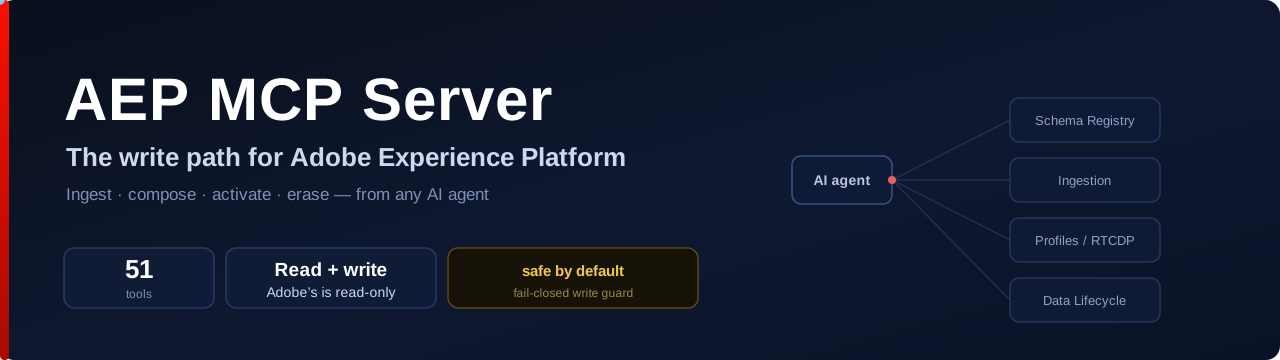





Adobe's MCP lets your agent read Experience Platform. This one lets it work.
61 tools across 14 categories. Full read AND write. Self-hosted, Apache-2.0, no invitation required. Experience Platform, Journey Optimizer and Customer Journey Analytics — from one OAuth credential.
Ingest a batch → compose a schema → activate an audience → honour an erasure. Every mutation gated by a fail-closed write guard that asks Adobe what kind of sandbox it's in.
⚡ Do it in three lines
Then just ask your agent:
"Create a schema with the Demographic Details field group, then a dataset on it." "Ingest this NDJSON file and tell me when the batch lands." "Build an audience of customers who bought twice this quarter and activate it." "Delete every record for this email address — dry run first."
Writes are off until you ask for them, and safe mode only unlocks sandboxes Adobe classifies as development.
The loop that makes it different
Adobe's first-party gateway can tell you what's in your Experience Platform tenant. It cannot create a dataset, land a batch, activate an audience, or submit an erasure. This does — and does it behind a guard that fails closed.
🧠 How it works
The agent calls tools; the server talks to live Adobe APIs over OAuth Server-to-Server. The write guard sits in the HTTP client, not in each tool, so all 61 inherit it and none can forget it. Blocked calls never reach Adobe.
🛡️ Safe by default
Three postures. Reads are never restricted in any mode.
AEP_MODE | Writes permitted | Use it when |
|---|---|---|
read-only | Never, in any sandbox | Handing the server to someone to explore an environment you don't want touched |
safe (default) | Only where Adobe classifies the sandbox development | Evaluating, or letting an agent work without risking production |
production | Anywhere, including production | You run your own change control and don't want the server second-guessing you |
How
safedecides — and why it's not the sandbox name. A production sandbox can be called anything, and a sandbox calledprodmight not be production. Only Adobe'stypefield from the Sandbox Management API decides.It fails closed. If the type can't be determined — the credential can't read sandbox metadata, the API errors, startup hasn't finished — writes are blocked. A credential must not earn write access by being less capable. An unrecognised
AEP_MODEfalls back tosafe, so a typo can never grant production writes.A sandbox literally named
prodis refused unconditionally, before mode resolution — soAEP_MODE=productiondoes not lift it. Override withAEP_I_UNDERSTAND_THIS_WRITES_TO_PROD=trueonly if that really is your sandbox's name. The inference is deliberately asymmetric: trusting a name to allow a write is unsafe, trusting one to deny a write is safe, because the worst case is a refusal you can override on purpose.Mutations are off entirely unless
AEP_ALLOW_MUTATIONS=true. That is separate fromAEP_MODEon purpose: choosing a write mode should not also mean "yes, you may change my data".
Startup always states the active posture:
Per-tool confirmation gates
Writes are not uniformly gated — uniform gating makes an agent useless. Gates sit where an action is irreversible and wide-reaching, and every one is checked before any network call:
| Tool | Gate |
|---|---|
aep_create_record_delete | dryRun defaults true. Real submission needs confirm: "DELETE RECORDS <datasetId> <identityDigest>" — bound to the dataset and a SHA-256 digest of the exact identity set, so a confirmation can't be reused for a different deletion. ALL and multi-dataset targets are refused. |
aep_delete_segment | confirm: "DELETE SEGMENT <segmentId>" — segments were create-only until 0.9.1, so every one an agent made was permanent |
aep_delete_dataset | confirm: "DELETE DATASET <id>", escalating to "DELETE PROFILE-ENABLED DATASET <id>" when the dataset feeds Profile |
aep_complete_batch | confirm: "COMPLETE BATCH <batchId>" — the point of no return for ingestion |
aep_revert_batch | confirm: "REVERT BATCH <batchId>" |
aep_create_dataset_expiration | confirm: "CREATE DATASET EXPIRATION <datasetId>" — unless dryRun: true |
aep_update_dataset_expiration | confirm: "UPDATE DATASET EXPIRATION <ttlId>" |
aep_cancel_dataset_expiration | confirm: "CANCEL DATASET EXPIRATION <ttlId>" |
aep_delete_profile | confirm: "I understand this is irreversible" (deprecated — prefer Data Hygiene) |
Confirmations name their target. A phrase carrying the dataset id — and for record delete, a hash of the identities too — cannot be copied from one call to another. A generic "I understand this is irreversible" approves any deletion once you've typed it once.
Identity values never leave the process.
aep_create_record_deletereturns a count, the namespace names, and a digest — never the email addresses or device IDs you passed it. A record-delete request is by nature a list of real people; a tool that echoes them copies them into every transcript and log sink it touches.Batch creation and file upload are ungated on purpose: those writes are additive and recoverable. An unwanted batch can be left uncompleted, and data that did land can be removed with the Data Hygiene tools.
Tool annotations
Every tool ships MCP annotations — readOnlyHint, destructiveHint, idempotentHint, openWorldHint — derived from the same metadata that builds its description, so the two cannot drift.
| Count | |
|---|---|
readOnlyHint: true | 39 |
destructiveHint: true | 8 |
| Un-annotated | 0 |
These are hints for the client, not enforcement — the guards above enforce. Their value is that a client like Claude Desktop uses destructiveHint to decide when to interrupt and ask a human. Without them aep_delete_profile looks identical to aep_list_schemas. A test asserts the destructive list exactly, so a ninth is a deliberate act rather than an oversight.
🛠️ The 61 tools
All prefixed aep_, verb_noun naming. 🔒 changes state · 🔥 destructive.
Data modelling & ingestion
|
Schemas (4)
Datasets (4)
|
Ingestion (7)
|
Sources (2)
Query Service (3)
|
Profiles, audiences & activation
|
Identities (2)
|
Profiles (4)
|
Segments (5)
Destinations (3)
|
Governance — privacy, lifecycle & event routing
Related MCP Servers
Adoption & maintenance
Factual signals from GitHub, npm, and our automated checks — not a rating.
npm downloads
906
Package downloads in the last 30 days.
Last commit
25d ago
Most recent push to the default branch.
Reviews
No reviews yet — be the first to share how this listing worked for you.
Frequently Asked Questions about Aep
AllMCPs Directory Badge
Showcase your server listing on GitHub or your project documentation. Embed this dynamic SVG badge to highlight official listing status and live engagement.
Badge Style:
Live Dynamic SVG Preview
Markdown (GitHub README)
[](https://allmcps.com/mcp/aep)HTML Embed
<a href="https://allmcps.com/mcp/aep"><img src="https://allmcps.com/api/badge/aep?style=directory" alt="Aep on AllMCPs" /></a>Technical Specs & Signals
CategoryDeveloper Tools
12/13 checks healthy over the last 45d
44Quality signal: Fair · 44/100How this signal is calculated ▾
Server availabilityNot measured
Not scored for repo-hosted servers — we can't reach the running server, only its GitHub page. Hosted MCP endpoints are health-checked live.
Verified ownership10/20
Documentation & tools16/30
Adoption & activity7/15
Community engagement0/10
A guidance signal from public completeness & health data — not a user rating. New listings start lower and rise as they add docs, get verified, and grow adoption. Signals we can't observe for a listing are skipped, not counted against it.
Supply-chain signal
No high-severity advisories surfaced by our automated scan.
Critical 0High 0Medium 0Low 0
Scanned 3d ago via OSV.dev · @focusgts/aep-mcp-server (npm)
Own this project?
This directory is pre-filled from public sources. Claim via GitHub README, site badge, or DNS TXT to unlock edit access and the Official badge — proof is checked automatically, then reviewed by our team.
Free dofollow backlink: add your website and place the AllMCPs badge on it — no claim needed. We detect it automatically and keep it verified as long as the badge stays live.
Claim & get free dofollowShare & Embed
Add our SVG badge (dark/light directory styles) or embeddable widget to your site.