MCP server for the Google AdMob API — apps, ad units, mediation, and revenue reports
Quick Install
Automated & IDE SetupCopy the AI prompt to install this server into Claude Code, Cursor, or another agent — or use 1-click editor setup below.
Not yet automatically verified
We haven't yet run this listing's install command through our automated sandbox check. This isn't a red flag — we're steadily working through the catalog.
Manual Client & Custom JSON ConfigExpand JSON ▾
Client Config & Setup
Choose your client or environment
Target File:
💡 Paste the JSON block into your client's configuration file under mcpServers, then restart the application.
Capabilities & Tool Schemas (9)
Inspect callable tools, capabilities, and parameters exposed to AI agents by Admob MCP Server.
list_accountsList accessible publisher accounts — use to find your `pub-...` ID
get_accountGet account details: publisher ID, reporting currency, reporting time zone
list_appsList registered apps with app ID, platform, store link, and approval state
list_ad_unitsList ad units with their IDs, formats, and owning apps
generate_network_reportAdMob Network performance: earnings, impressions, clicks, match rate, RPM, ...
generate_mediation_reportMediation performance across ad sources: earnings, observed eCPM per `AD_SOURCE` / `MEDIATION_GROUP
Documentation Overview
AdMob MCP Server


English | 한국어
Ask your AI assistant about your AdMob apps and earnings — in plain language:
- "How much did my apps earn in the last 7 days, broken down by country?"
- "Which mediation ad source had the best eCPM this month?"
- "Compare the RPM of my banner vs. rewarded ad units."
- "List my apps and their ad units."
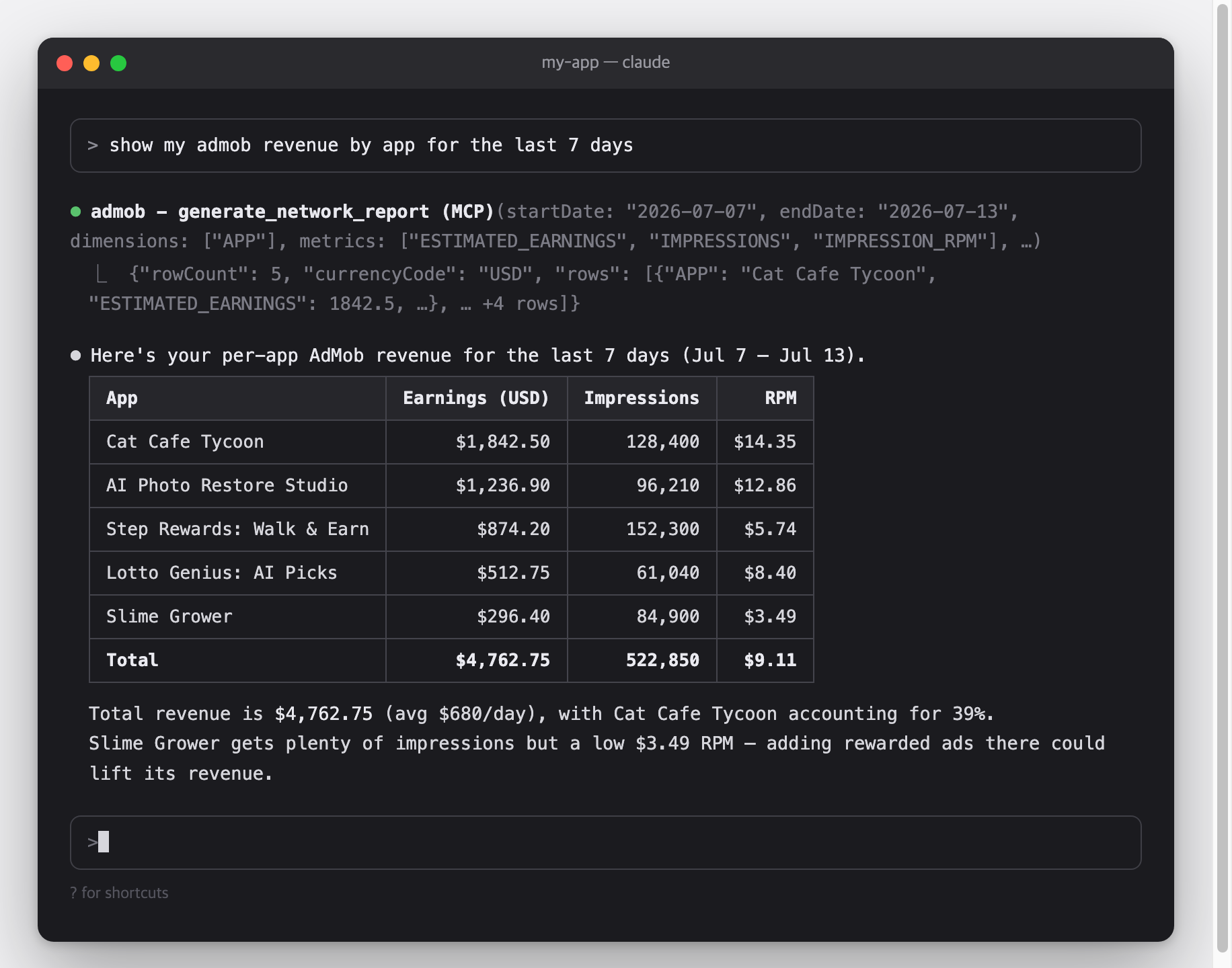
This is a Model Context Protocol (MCP) server for the Google AdMob API.
It works with Claude Code, Claude Desktop, Cursor, Gemini CLI, and any other MCP-capable AI client.
Architecture
Credentials and revenue data travel only between your machine and Google — there is no third-party server in between.
Features
- Everything the AdMob API opens to normal accounts — 9 tools across accounts, apps, ad units, reports, and mediation (why there are no write tools)
- Reports made readable — streaming report responses are flattened into simple row tables, and monetary values (micros) are converted to real currency units
- Read-only by design — the sign-in requests read scopes only, so the server cannot change anything in your AdMob account
- Toolsets — enable only the tool groups you need, e.g.
--toolsets reports,accounts - Three authentication options — one-command browser sign-in (
npx admob-mcp-server auth), environment-variable refresh token, or gcloud Application Default Credentials - Built-in analysis prompts and report-spec reference resources
Setup at a glance
One-time setup, roughly 10 minutes:
| Step | What you do | Where |
|---|---|---|
| 1. Google Cloud setup | Register a personal "app" so Google lets you access your own data | browser |
| 2. Sign in | Run one command and log in with Google | terminal |
| 3. Connect your AI client | Add one config entry and restart the client | terminal |
Requirements
- Node.js 18 or newer — check with
node --version; if missing, install from nodejs.org - An AdMob account and the Google account that owns it
Setup
Part 1 — Google Cloud setup
Why is this needed?
The AdMob API has no simple API keys — Google requires every program that accesses your data to be registered as an "OAuth app".
Here you register a personal one that only you will use.
It's free and needs no billing setup.
- Create (or select) a Google Cloud project: console.cloud.google.com/projectcreate — any name works; reusing an existing project is fine too.
- Enable the AdMob API: console.cloud.google.com/apis/library/admob.googleapis.com → check that your project is selected in the top bar → Enable.
- Configure the OAuth consent screen: console.cloud.google.com/auth/overview — the first visit opens a short wizard:
- App name: anything (e.g.
admob-mcp), and your email as the support/contact email - Audience: External
- Finish the wizard — you do not need to submit the app for Google's verification
- Then go to Audience → Test users → Add users and add the Google account that owns your AdMob account
- App name: anything (e.g.
- Create an OAuth client: console.cloud.google.com/apis/credentials → Create credentials → OAuth client ID
- Application type: Desktop app
- After creating it, click Download JSON — you'll use this file in Part 2
[!WARNING] While the consent screen is in Testing mode, Google expires sign-ins after 7 days, so you'll need to re-run the sign-in weekly.
To stop that, publish the app (Audience → Publish app).
Publishing for your own use doesn't require Google's verification — you'll just see an "unverified app" warning during sign-in, which is expected.
Part 2 — Sign in
Move the JSON file you downloaded to where the server looks for it, then run the sign-in command:
(On Windows, move the file to C:\Users\<you>\.admob-mcp\oauth_client.json in Explorer, then run the npx command.)
Your browser opens.
Pick the Google account that owns your AdMob account and allow access.
If you see a "Google hasn't verified this app" warning, that's your own app from Part 1 — click "Continue".
When the terminal prints Setup complete, your sign-in is saved to ~/.admob-mcp/token.json and reused from then on.
The sign-in requests the admob.readonly and admob.report scopes — read access only.
What the auth command does:
Advanced: environment variables (headless / CI)
If you already have a refresh token, no files are needed:
Advanced: gcloud Application Default Credentials
The same pattern Google's official Analytics/Ads MCP servers use:
Credential resolution order: environment variables → token.json (from auth) → ADC.
Part 3 — Connect your AI client
Pick your client below.
MCP servers are loaded when the client starts, so restart the client after adding the config.
Claude Code
Verify with claude mcp list — you should see admob: ... - ✔ Connected.
Claude Desktop — open Settings → Developer → Edit Config, which opens claude_desktop_config.json (macOS: ~/Library/Application Support/Claude/, Windows: %APPDATA%\Claude\), and add:
Restart the app; the admob tools appear in the tools menu of the chat input.
Cursor — add the same mcpServers block to ~/.cursor/mcp.json, then check Settings → MCP shows admob as enabled.
Gemini CLI — add the same mcpServers block to ~/.gemini/settings.json, then check with /mcp inside the CLI.
[!TIP] If you used the environment-variable sign-in, pass the variables through your client's
envblock (Claude Code: repeat--env KEY=valuebefore--; JSON configs: add an"env": { ... }object next to"args").
Try it
You don't call tools yourself — just ask in plain language and the assistant picks the right tools.
Some starters:
- "What did my apps earn last week?"
- "Break down this month's revenue by country and app."
- "Which ad format had the highest RPM in the last 30 days?"
- "How is my mediation doing? Compare ad sources by observed eCPM."
- "List my apps and their ad units."
Most clients ask for your permission before each tool call, so nothing runs without your approval.
Configuration
All configuration is optional — the defaults work for a single AdMob account.
Environment variables
Related MCP Servers
Adoption & maintenance
Factual signals from GitHub, npm, and our automated checks — not a rating.
GitHub stars
4
Stargazers on the source repository.
npm downloads
332
Package downloads in the last 30 days.
Last commit
1mo ago
Most recent push to the default branch.
Tools exposed
9
Callable tools this server registers over MCP.
Directory activity
2 views
Config copies, upvotes, and views on AllMCPs.
Reviews
No reviews yet — be the first to share how this listing worked for you.
Frequently Asked Questions about Admob MCP Server
AllMCPs Directory Badge
Showcase your server listing on GitHub or your project documentation. Embed this dynamic SVG badge to highlight official listing status and live engagement.
Badge Style:
Live Dynamic SVG Preview
Markdown (GitHub README)
[](https://allmcps.com/mcp/admob-mcp-server)HTML Embed
<a href="https://allmcps.com/mcp/admob-mcp-server"><img src="https://allmcps.com/api/badge/admob-mcp-server?style=directory" alt="Admob MCP Server on AllMCPs" /></a>