# xmpuspus/cloudwright [Health: Active]
**Category:** ☁️ Cloud Platforms
**Repository:** https://github.com/xmpuspus/cloudwright
**GitHub Stars:** 32
**Views:** 2
**Installs:** 0
**Upvotes:** 0
**Directory Page:** https://allmcps.com/mcp/xmpuspus-cloudwright
## Description
Natural-language cloud architecture intelligence for AWS, GCP, Azure, and Databricks. 19 tools for architecture design, cost estimation, compliance validation (HIPAA, SOC 2, FedRAMP, GDPR, PCI-DSS, Well-Architected), security scanning, Terraform/CloudFormation export, and blast-radius analysis.
## Claude Desktop Quick Installation
Heuristic fallback — verify the package name and runner against the repository README before running it. Uses `npx` (confidence: low):
```json
"mcpServers": {
"cloudwright": {
"command": "npx",
"args": ["-y","xmpuspus-cloudwright"],
"env": {
"ANTHROPIC_API_KEY": "",
"OPENAI_API_KEY": ""
}
}
}
```
**Requires environment variables:** `ANTHROPIC_API_KEY`, `OPENAI_API_KEY` — the values above are empty placeholders; fill in real credentials before running (see the repository for what each one is for).
## Documentation & README
# Cloudwright
*Design a cloud architecture or plan a migration. Get costs, controls, code, and checked evidence.*
[](https://pypi.org/project/cloudwright-ai/) [](https://github.com/xmpuspus/cloudwright/actions/workflows/ci.yml) [](LICENSE) [](https://pypi.org/project/cloudwright-ai/) [](https://glama.ai/mcp/servers/xmpuspus/cloudwright)

```bash
pip install 'cloudwright-ai[cli]'
export ANTHROPIC_API_KEY=sk-ant-...
cloudwright design "HIPAA healthcare API on AWS with Postgres and Redis"
```
Cloudwright turns one line of English into a typed spec, a cost breakdown, a control-mapped compliance report,
and infrastructure code. A source estate and target become ordered migration waves, explicit costs,
and evidence gates. It covers AWS, GCP, Azure and Databricks across 114 service keys. Only `design`, `modify`,
`chat` and `adr` call a model. Every other command runs offline and needs no API key.
[Quickstart](#quickstart) · [Migrations](#migration-plans-stop-when-evidence-is-missing) · [Compliance](#every-finding-carries-the-control-id-it-violates) · [Agents](#one-mcp-server-reaches-11-coding-agents) · [Docs](https://github.com/xmpuspus/cloudwright/blob/HEAD/docs/) · [Changelog](https://github.com/xmpuspus/cloudwright/blob/HEAD/CHANGELOG.md)
## A prompt produces a spec, a cost, a control-mapped report, and Terraform
- **Spec.** Typed YAML you commit, diff and review. Everything below reads from it.
- **Cost.** Per component and region-aware, with a confidence flag on every line.
- **Compliance.** HIPAA, SOC 2, PCI-DSS, FedRAMP, GDPR, ISO 27001 and NIST 800-53 control IDs.
- **Infrastructure code.** Terraform, OpenTofu, Pulumi (TypeScript or Python) and CloudFormation.
- **Diagrams.** ASCII, Mermaid, D2, and a web canvas you can edit by hand.
- **An MCP server**, so any coding agent runs the same checks inside its own loop.
Exports carry safe defaults. S3 gets a public-access block, SSE and versioning. RDS gets encryption, multi-AZ
and deletion protection. EC2 gets IMDSv2. A compliance framework overrides the workload profile, and always
forces encryption and high availability.
## Quickstart
```bash
cloudwright design "HIPAA healthcare API on AWS with Postgres and Redis"
cloudwright cost spec.yaml --workload-profile medium
cloudwright compliance spec.yaml --frameworks hipaa,soc2
cloudwright export spec.yaml --format terraform -o ./infra
cloudwright plan spec.yaml --target terraform # proves it deploys, never applies
cloudwright migrate demo # packaged migration proof, fully offline
cloudwright chat --web # canvas at http://localhost:8765
```
Add `--json` before any subcommand for machine-readable output, or `--stream` to watch tokens arrive. Set `ANTHROPIC_API_KEY` or `OPENAI_API_KEY` for the four commands that need a model.
## Migration plans stop when evidence is missing
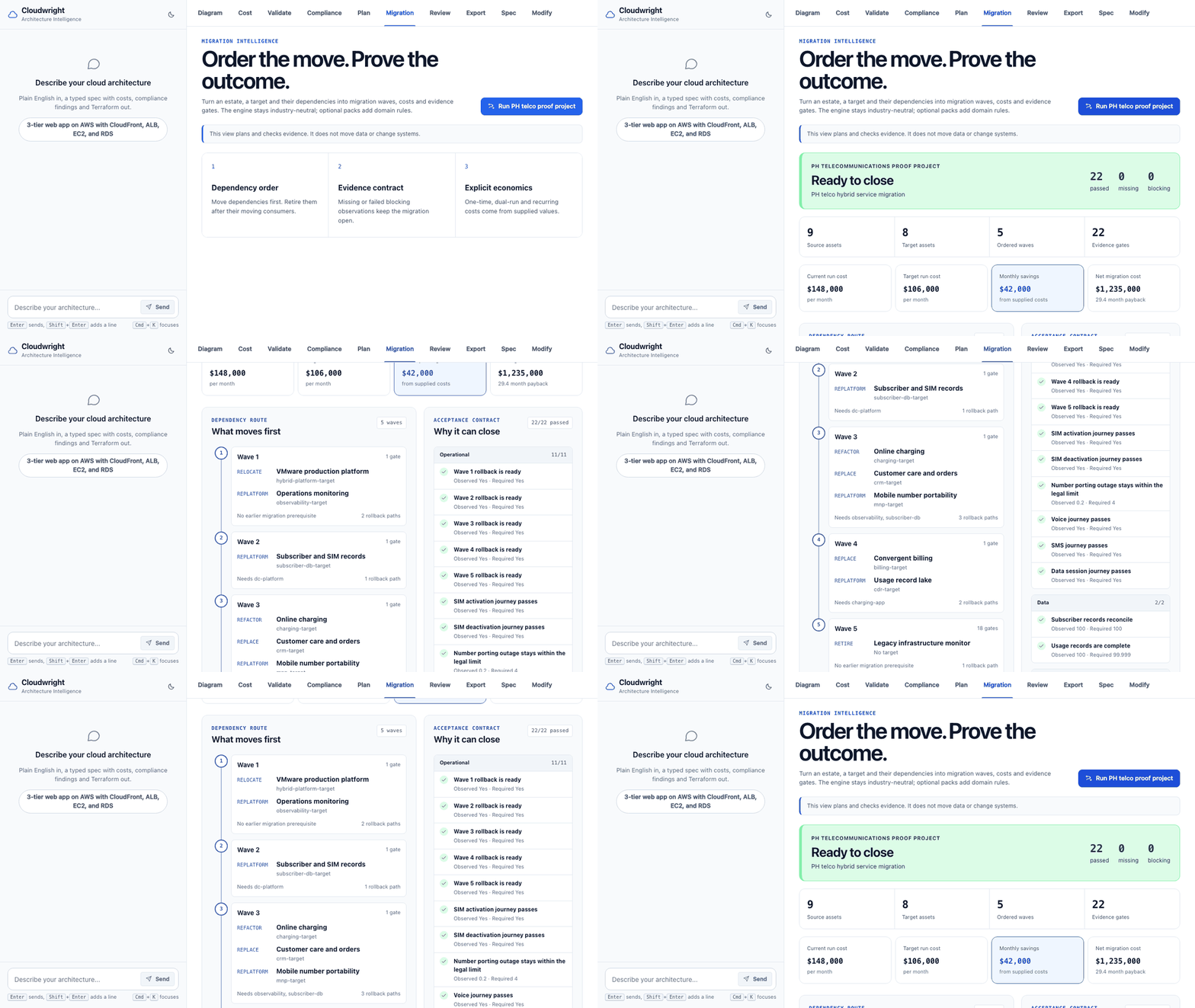
The migration model covers infrastructure, applications, data, platforms, networks, facilities, and business
services in one dependency graph. It works for on-premises, cloud, cross-cloud, hybrid, data-center, and
application moves. It plans and checks work. It never copies data, applies infrastructure, switches traffic,
or runs a cutover.
```bash
cloudwright migrate plan examples/migrations/ph-telco-project.yaml -o assessment.yaml
cloudwright migrate verify examples/migrations/ph-telco-project.yaml examples/migrations/ph-telco-evidence.yaml
```
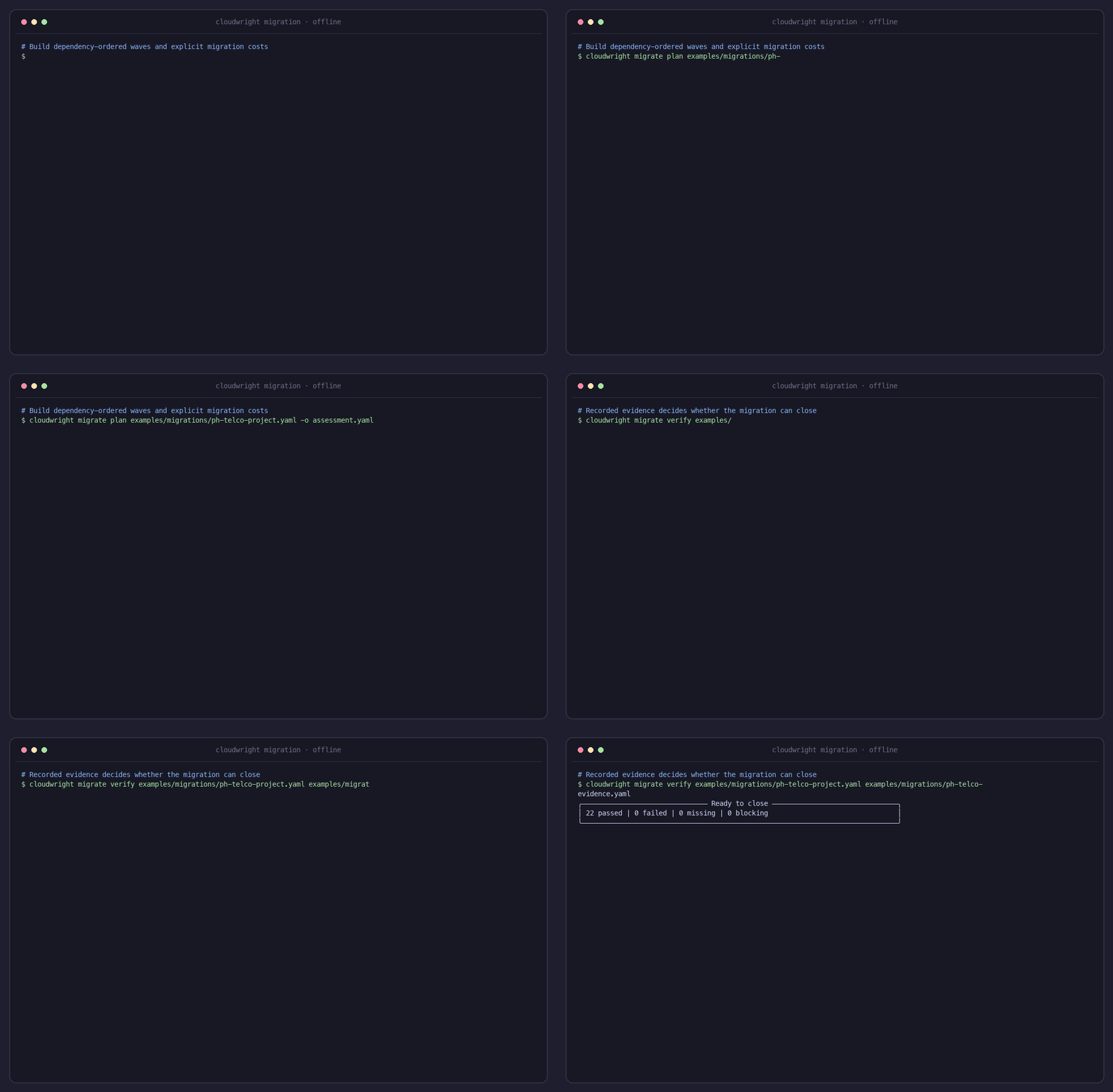
The core has no telco fields. The first proof project selects an external `ph_telco` pack for subscriber,
billing, usage-record, number-porting, privacy, recovery, and source-shutdown gates. A manufacturing ERP
fixture proves the same planner works without that pack. Missing blocking evidence changes the result to
`closed: false` and makes `migrate verify` exit with code 2. Each evidence file carries the deterministic
assessment ID, so observations from an older target or cutover plan cannot close a revised assessment.
MCP clients use the same engine through `plan_migration` and `verify_migration` in the `migration` tool group.
See [Migration planning and evidence](https://github.com/xmpuspus/cloudwright/blob/HEAD/docs/migrations.md) for the file contract, Python API, HTTP routes,
domain-pack format, limits, and recording commands.
## Every finding carries the control ID it violates
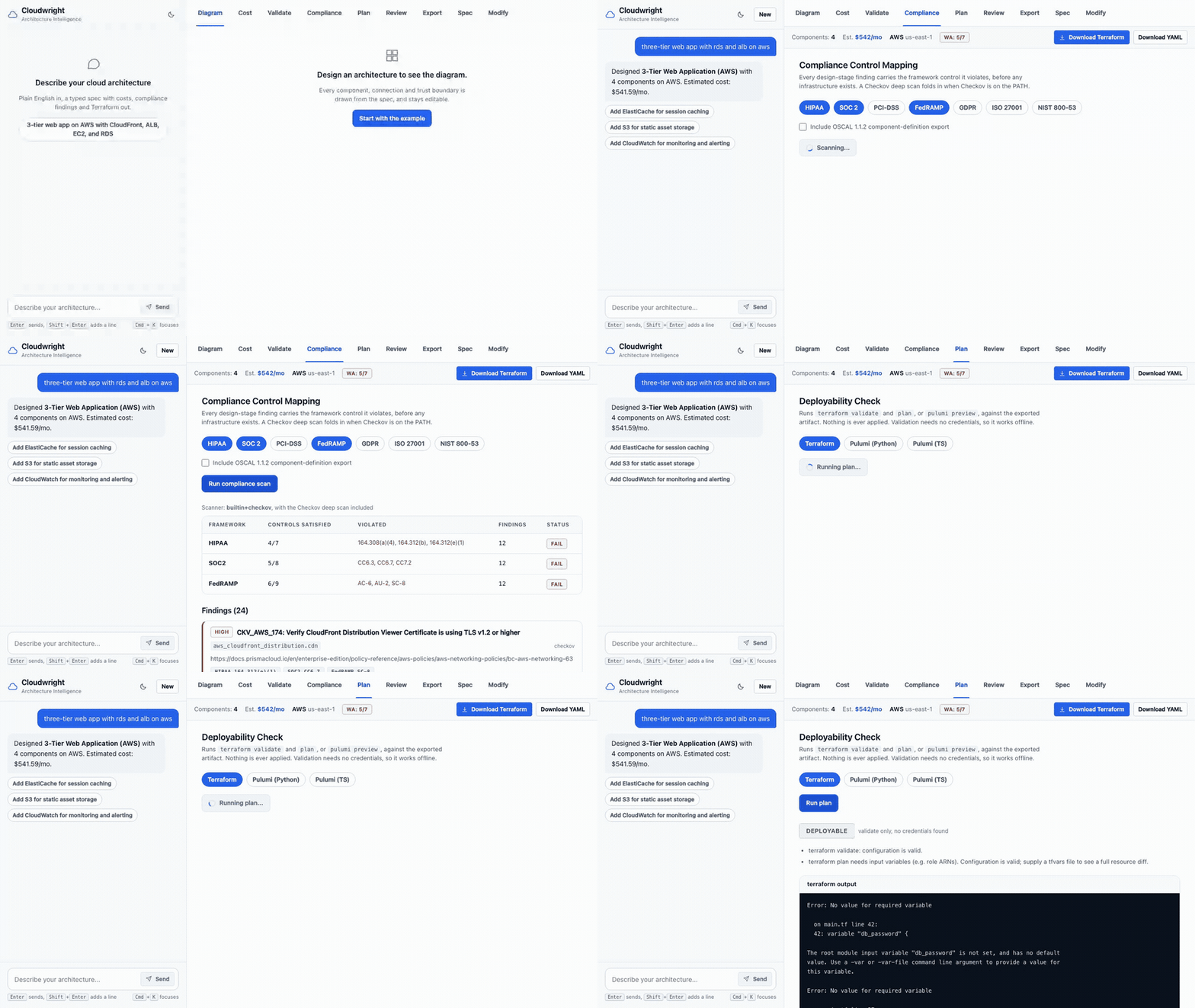
Other tools scan infrastructure after you deploy it. Cloudwright maps each finding to its control before any
resource exists. The fix then costs a spec edit instead of a change ticket. HIPAA `164.312(a)(2)(iv)`, SOC 2 `CC6.1`
and FedRAMP `SC-28` come from the built-in scanner, with no extra tooling. Checkov folds into the same report
when it sits on your PATH.
- `--oscal` writes an OSCAL 1.1.2 component-definition with deterministic UUIDs.
- `--traceability` prints the chain from component to resource to control to status.
- `cloudwright plan` runs `terraform validate` against the export, and never applies.
## The review needs no API key and no network

`cloudwright review` runs the scorer, the linter and the validator over a spec, and returns one severity-ranked
report. The same three critics run inside `cloudwright design`. When blocking findings survive generation, the
architect repairs the spec once and records the change in `spec.metadata.critique`. Pass
`Architect(repair=False)` to turn that off.
## Canvas edits never call the model, so they are instant and free
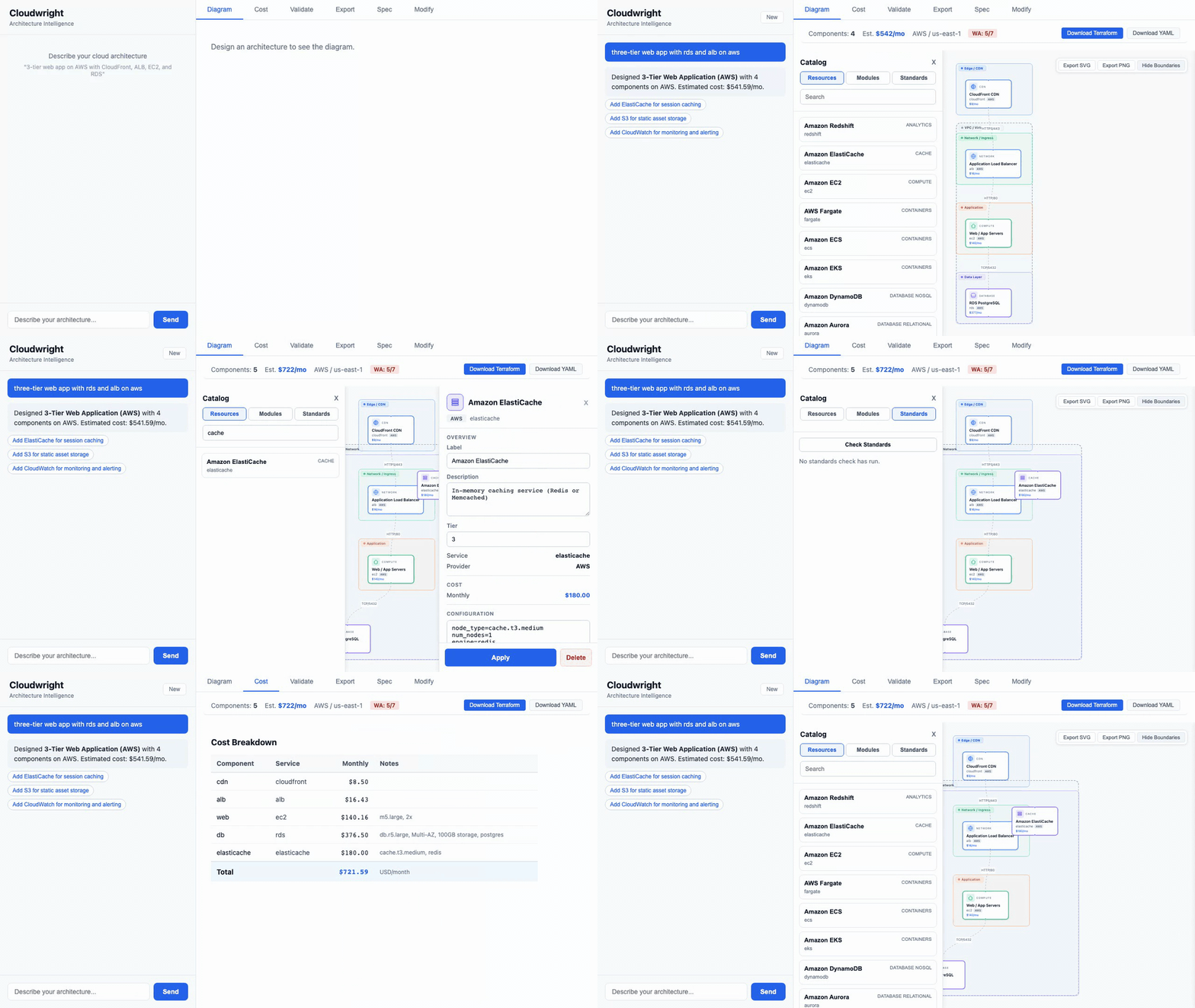
Add, drag, connect, edit and delete are deterministic frontend mutations. The Catalog drawer serves the resource
list per provider and five approved multi-resource modules. Its standards check flags orphan connections,
partial modules and missing tags. An intact module exports as a single Terraform `module` block, with the
catalog's pinned source and version.
## One MCP server reaches 11 coding agents
```bash
cloudwright integrate --harness claude-code # exact wiring, in that client's format
cloudwright integrate --harness cursor --write # merge it into the right file
cloudwright integrate --rules --agent-file claude # a gate block for CLAUDE.md
```
Do not hand-write the config. `cloudwright integrate` emits it for Claude Code, Cursor, Cline, Windsurf, GitHub
Copilot, Zed, Codex CLI, Junie, Kiro and Antigravity. Aider gets a CLI-pipe recipe instead, because it speaks
no MCP. Every client wants a different shape: Zed wants `context_servers`, Copilot wants `servers`, and Codex
wants a TOML table.
The server exposes 24 tools in 10 groups: design, cost, validate, analyze, export, session, review, compliance,
plan and migration. Full matrix in [docs/integrations.md](https://github.com/xmpuspus/cloudwright/blob/HEAD/docs/integrations.md).
## Offline commands grade, scan, compare, and plan
`lint` runs 10 anti-pattern checks. `score` grades 5 dimensions. `analyze` reports blast radius and single
points of failure. `policy` enforces policy-as-code with 9 built-in rules. `security` scans the spec and the
exported HCL. `drift` compares a design against a `tfstate`, and `--remediate` turns the gap into a cost,
compliance and plan preview.
`review`, `compliance` and `plan` are above. See [docs/cli-reference.md](https://github.com/xmpuspus/cloudwright/blob/HEAD/docs/cli-reference.md).
## Python API
```python
from cloudwright import ArchSpec
from cloudwright.cost import CostEngine
from cloudwright.validator import Validator
from cloudwright.exporter import export_spec
spec = ArchSpec.from_file("spec.yaml")
priced = CostEngine().estimate(spec, workload_profile="medium")
findings = Validator().validate(spec, compliance=["hipaa", "pci-dss"])
hcl = export_spec(spec, "terraform", output_dir="./infra")
```
## v1.10.0 adds migration planning with evidence-based closure
- **One model covers the full estate.** Infrastructure, data, applications, platforms, networks,
facilities, and business services share one dependency graph.
- **Dependencies determine the waves.** The planner schedules prerequisites first, rejects cycles,
checks rollback paths, and reports unresolved mappings.
- **Closure needs evidence.** Missing or failed blocking observations prevent closure and make
`migrate verify` return exit code 2.
- **Industry rules stay outside the engine.** Optional YAML packs add acceptance gates without adding
industry fields to the core.
- **PH telco is the first proof.** The product remains industry-neutral. A manufacturing ERP fixture
runs through the same planner with no domain pack.
Earlier releases added control-ID mapping and `plan` (v1.5.0), the self-correcting architect and OSCAL
(v1.6.0), `cloudwright integrate` (v1.7.0), the responsive dark-theme canvas (v1.8.0), and measured
canvas interaction fixes (v1.9.0). Full history in [CHANGELOG.md](https://github.com/xmpuspus/cloudwright/blob/HEAD/CHANGELOG.md).
## Compatibility
- Python 3.12+
- Models: Anthropic (Claude Sonnet, Haiku) and OpenAI (GPT-5+ family), auto-detected from env.
- Clouds: AWS, GCP, Azure, Databricks. 114 service keys total.
- Install variants: `cloudwright-ai[cli]`, `cloudwright-ai[web]`, `cloudwright-ai-mcp`.
## Contributing, license, changelog
- Contributing guide: [CONTRIBUTING.md](https://github.com/xmpuspus/cloudwright/blob/HEAD/CONTRIBUTING.md)
- License: MIT, see [LICENSE](https://github.com/xmpuspus/cloudwright/blob/HEAD/LICENSE)
- Full release history: [CHANGELOG.md](https://github.com/xmpuspus/cloudwright/blob/HEAD/CHANGELOG.md)