# wg-easy-mcp
**Category:** 💻 Developer Tools
**Repository:** https://github.com/ni-c/wg-easy-mcp
**Views:** 0
**Installs:** 0
**Upvotes:** 0
**Directory Page:** https://allmcps.com/mcp/wg-easy-mcp
## Description
Administer wg-easy (WireGuard Easy) v15: manage VPN clients, configs, QR codes and server status
## Claude Desktop Quick Installation
Heuristic fallback — verify the package name and runner against the repository README before running it. Uses `npx` (confidence: low):
```json
"mcpServers": {
"wg-easy-mcp": {
"command": "npx",
"args": ["-y","wg-easy-mcp"]
}
}
```
## Documentation & README
# wg-easy-mcp
[](https://github.com/ni-c/wg-easy-mcp/actions/workflows/ci.yml)
[](https://scorecard.dev/viewer/?uri=github.com/ni-c/wg-easy-mcp)
 [](https://glama.ai/mcp/servers/ni-c/wg-easy-mcp)
[](https://glama.ai/mcp/servers/ni-c/wg-easy-mcp)
[](https://www.npmjs.com/package/wg-easy-mcp)
[](https://github.com/ni-c/wg-easy-mcp/pkgs/container/wg-easy-mcp)
[](https://mcp-hub.ni-c.de)
[](https://wg-easy-mcp.ni-c.de)
[](https://github.com/sponsors/ni-c)
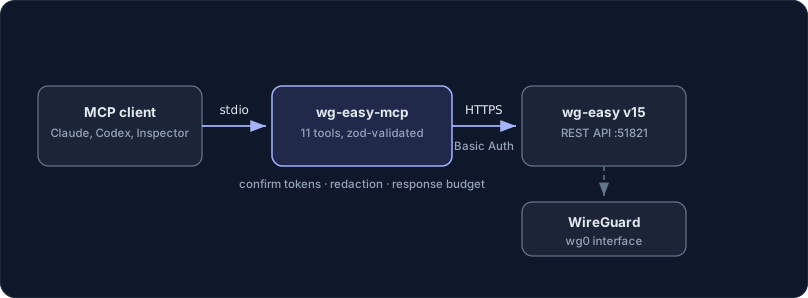
A [Model Context Protocol](https://modelcontextprotocol.io) (MCP) server for administering [wg-easy](https://github.com/wg-easy/wg-easy) (WireGuard Easy) instances.
Lets MCP clients like Claude Code, Claude Desktop or Codex manage your WireGuard VPN: list, create, update, enable/disable and delete clients, fetch configuration files and QR codes, and inspect the server status — all through the wg-easy v15 REST API.
Eleven tools is the ceiling, not the floor: `WG_EASY_ALLOW_TOOLS=essential`
registers a curated six instead, and a model picks the right tool far more
reliably from six than from eleven — see
[choosing which tools load](#choosing-which-tools-load).
## What makes it different
**The full client lifecycle over the wg-easy v15 REST API**, including `.conf`
files, QR codes and one-time download links.
**Partial updates merge.** An update reads the current client state and changes
only the fields you named, instead of overwriting the rest with defaults.
**`disable_client` stays ungated on purpose.** Every other write asks a person
first through MCP elicitation; that one only ever withdraws access, and making it
harder would be making the safe move the slow one.
## Requirements
- Node.js ≥ 22
- A running **wg-easy v15+** instance
- **2FA (TOTP) must be disabled** for the account used by this server — the wg-easy API only supports Basic Authentication and does not work with 2FA enabled
> **Note:** The wg-easy REST API is [not yet declared stable](https://wg-easy.github.io/wg-easy/latest/advanced/api/) and may change between releases. This server targets wg-easy v15.
## Configuration
Configuration is provided via environment variables:
| Variable | Required | Description |
| ---------------------- | -------- | --------------------------------------------------------------------------------------- |
| `WG_EASY_URL` | yes | Base URL of the wg-easy web UI, e.g. `https://vpn.example.com:51821` |
| `WG_EASY_USERNAME` | yes | Username of a wg-easy admin account |
| `WG_EASY_PASSWORD` | yes | Password of that account |
| `WG_EASY_INSECURE_TLS` | no | Set to `true` to accept self-signed TLS certificates (scoped to the wg-easy connection) |
| `WG_EASY_ALLOW_TOOLS` | no | Comma-separated tool names, `list_*` prefixes, or `essential` for a curated preset |
| `WG_EASY_DENY_TOOLS` | no | Same syntax; removed from whatever `WG_EASY_ALLOW_TOOLS` left |
| `ELICITATION` | no | `false` replaces the approval dialog with the two-call token. **Not prefixed** |
> **Use `https://`.** With a plain-`http` URL the Basic Auth credentials and all
> WireGuard private keys travel unencrypted; the server prints a warning unless
> the host is local. For self-signed certificates prefer a proper internal CA
> over `WG_EASY_INSECURE_TLS`.
Without credentials the server still starts and lists its tools (so registries
and inspectors can introspect it), but every tool call fails with setup
instructions instead of reaching the wg-easy API.
### Choosing which tools load
`WG_EASY_ALLOW_TOOLS` and `WG_EASY_DENY_TOOLS` take comma-separated tool names;
a trailing `*` matches a whole family. `essential` is a curated preset of
six: `get_server_info`, `list_clients`, `get_client`, `create_client`, `enable_client`, `disable_client`.
`get_client_config`, `get_client_qrcode` and `generate_one_time_link` are not in
it, and neither is `delete_client`: all four either destroy something
irreversibly or hand out a peer's private key. Name them where you want them.
```sh
WG_EASY_ALLOW_TOOLS=essential
WG_EASY_ALLOW_TOOLS=essential,get_client_config
WG_EASY_ALLOW_TOOLS=list_clients,get_client_config
WG_EASY_DENY_TOOLS=delete_client,create_client
```
An entry that matches no tool aborts startup and names it, so a typo cannot
silently hide a tool — an absent tool is not something anyone traces back to an
environment variable. A filtered tool is never registered, so it is absent from
`tools/list` and unknown to `tools/call` alike, exactly like a write tool under
`WG_EASY_READ_ONLY`.
If you run several of these servers at once, [mcp-hub](https://mcp-hub.ni-c.de)
is the other answer — its `/hub` endpoint replaces every server's tools with six
meta-tools.
## Installation
### Claude Code
```bash
claude mcp add wg-easy -s user \
-e WG_EASY_URL=https://vpn.example.com:51821 \
-e WG_EASY_USERNAME=admin \
-e WG_EASY_PASSWORD=your-password \
-- npx -y wg-easy-mcp
```
### Claude Desktop
Add to your `claude_desktop_config.json`:
```json
{
"mcpServers": {
"wg-easy": {
"command": "npx",
"args": ["-y", "wg-easy-mcp"],
"env": {
"WG_EASY_URL": "https://vpn.example.com:51821",
"WG_EASY_USERNAME": "admin",
"WG_EASY_PASSWORD": "your-password"
}
}
}
}
```
### Codex
Add to your `~/.codex/config.toml`:
```toml
[mcp_servers.wg-easy]
command = "npx"
args = ["-y", "wg-easy-mcp"]
env = { WG_EASY_URL = "https://vpn.example.com:51821", WG_EASY_USERNAME = "admin", WG_EASY_PASSWORD = "your-password" }
```
### From source
```bash
git clone https://github.com/ni-c/wg-easy-mcp.git
cd wg-easy-mcp
npm install
npm run build
# then use `node /path/to/wg-easy-mcp/dist/index.js` as the command
```
### Docker
A multi-arch image (`linux/amd64`, `linux/arm64`) with an SBOM and build provenance is published to GitHub Container Registry:
```bash
docker run -i --rm \
-e WG_EASY_URL=https://vpn.example.com:51821 \
-e WG_EASY_USERNAME=admin \
-e WG_EASY_PASSWORD=your-password \
ghcr.io/ni-c/wg-easy-mcp:latest
```
The image talks MCP over stdio, so clients need `docker run -i` (no port is
exposed):
```json
{
"mcpServers": {
"wg-easy": {
"command": "docker",
"args": [
"run",
"-i",
"--rm",
"-e",
"WG_EASY_URL",
"-e",
"WG_EASY_USERNAME",
"-e",
"WG_EASY_PASSWORD",
"ghcr.io/ni-c/wg-easy-mcp:latest"
],
"env": {
"WG_EASY_URL": "https://vpn.example.com:51821",
"WG_EASY_USERNAME": "admin",
"WG_EASY_PASSWORD": "your-password"
}
}
}
}
```
### Through mcp-hub
A client that cannot spawn a local process — ChatGPT connectors, Claude on the web,
Cursor, LibreChat — reaches wg-easy-mcp through [mcp-hub](https://mcp-hub.ni-c.de): one
container serves many stdio MCP servers over Streamable HTTP, with an OAuth 2.1 login
behind a single password and long-lived tokens for the clients that cannot do OAuth. Its
`/hub` endpoint puts every server behind six meta-tools, so one connector reaches all of
them without N×tool schemas in the model's context, and it speaks both protocol revisions
— a question this server asks travels through it to the person at the far end.
Its `/config/mcp.json` uses Claude Code's format, so the entry is the one you already
have:
```json
{
"mcpServers": {
"wg-easy": {
"command": "npx",
"args": ["-y", "wg-easy-mcp"],
"env": { "WG_EASY_ALLOW_TOOLS": "essential" },
"denyTools": ["delete_client"]
}
}
}
```
`allowTools` and `denyTools` there are the hub's **own** per-server filter, which is not
the same thing as `*_ALLOW_TOOLS` in `env` — the difference, and the mistake it invites,
are in the [client guide](https://wg-easy-mcp.ni-c.de/guide/clients#through-mcp-hub).
## Tools
| Tool | Description |
| --------------------------- | -------------------------------------------------------------------------------------- |
| `list_clients` | List all WireGuard clients with status and traffic statistics |
| `get_client` | Get the full details of a single client |
| `create_client` 👤 | Create a new client (`name`, optional `expiresAt`) |
| `update_client` 👤 | Update a client; only the provided fields are changed |
| `enable_client` 👤 | Let a client connect again — re-arms a key pair already installed on the peer |
| `disable_client` | Block a client; it keeps its configuration and keys |
| `delete_client` 👤 | Permanently delete a client |
| `get_client_config` | Get the client's WireGuard `.conf` file |
| `get_client_qrcode` | Get the client configuration as a QR code (SVG) |
| `generate_one_time_link` 👤 | Generate a one-time config download link, valid five minutes |
| `get_server_info` | Release/update status, general settings and interface configuration (secrets redacted) |
👤 asks a person through MCP elicitation · falls back to a two-call
`confirm_token` where the client cannot show a dialog.
### Structured output
Every tool declares an `outputSchema` and answers with `structuredContent`
alongside the text block, so a client can use the result without parsing prose:
```jsonc
{
"untrusted": true,
"source": "wg-easy",
"count": 2,
"clients": [{ "id": 1, "name": "laptop", "enabled": true }],
}
```
The `untrusted` marker is a field and not only a sentence in the text, because a
client that reads the structured half and ignores the text would otherwise get
free-form client names, DNS entries and endpoints with no framing at all. Every
tool carries it except `delete_client`, which reports an id this server was
given and nothing that came back from the instance.
Three answers changed shape to fit, and all three for the same reason: a schema
whose root is not an object is served to a 2025-era client rewritten as
`{result: …}`, so the tool would answer differently depending on who asked.
| Tool | Was | Is |
| ------------------- | ---------------- | ------------------ |
| `list_clients` | a bare array | `{count, clients}` |
| `get_client_config` | the `.conf` text | `{configuration}` |
| `get_client_qrcode` | the SVG markup | `{svg}` |
An oversized answer is now shortened as an **object** rather than cut as a
string: the longest text field is shortened first, then list entries are
dropped, and a `truncated` field says what was cut and how much there was. A
document sliced at a byte offset is not a smaller answer, it is an unparseable
one — and the two channels have to carry the same value.
What wg-easy sends is described with every field optional and unknown fields
allowed; only what this server builds is exact. The SDK validates each result
against its schema before it goes out, so a stricter shape would turn a wg-easy
release that adds a field into a tool that fails outright.
### Safety
- **Five tools ask a person, not just the model.** `create_client`,
`update_client`, `enable_client`, `delete_client` and `generate_one_time_link`
raise a real dialog through MCP elicitation where the client supports it. Only
one of the five destroys anything — the others issue a VPN credential, re-arm
one, can widen a route, and mint an unauthenticated URL that hands out a
private key. `disable_client` is the one write tool that never asks: it can
only withdraw access. Where the
client cannot show a dialog they fall back to a random token valid for 5
minutes and bound to the exact target (for `update_client`, to the exact
edit), which proves the call was made twice with the same arguments and
nothing more. `ELICITATION=false` takes that fallback deliberately; it never
removes the guard. See
[Asking a person](https://wg-easy-mcp.ni-c.de/guide/approval).
- **Key material is redacted everywhere it is not the point.** `privateKey`, `preSharedKey`, `password` and session/TOTP secrets are replaced with `[redacted]` at every nesting level — in `get_server_info`'s admin responses, which carry the WireGuard _server_ key, and in `list_clients` and `get_client`, which carry each client's _own_ key. Live one-time-link tokens are redacted from the same two, because `GET /cnf/` serves the whole configuration with no login at all; `expiresAt` survives, so a listing still shows that a link is live. `get_client_config`, `get_client_qrcode` and `generate_one_time_link` are the deliberate exceptions: handing a peer its configuration is what they are for, and somebody asked.
- Everything the wg-easy API returns carries an explicit **untrusted-data marker** and a 60 000-character budget. Client names, DNS entries and endpoints are free-form strings, so they are marked as data to report rather than instructions to follow, and a single oversized field cannot flood the model's context.
- A `WG_EASY_URL` containing embedded credentials (`user:password@host`) is rejected at startup — they would otherwise be echoed in the startup log and prefixed onto every request.
- Upstream error bodies are truncated and HTML error pages (reverse proxies) are dropped before being returned to the MCP client.
- `WG_EASY_INSECURE_TLS` only relaxes certificate validation for the wg-easy connection — it does not disable TLS verification process-wide.
- **`WG_EASY_READ_ONLY=true` registers `list_clients`, `get_client` and `get_server_info`, and nothing else.** `get_client_config` and `get_client_qrcode` are reads and still not in that set: what they read is a client's private key in the clear, and a read-only mode that leaves key disclosure standing is not the mode its name promises.
- Tools carry MCP annotations (`readOnlyHint`, `destructiveHint`, `idempotentHint`) so hosts can apply appropriate permission policies.
- Keep in mind that `get_client_config` and `get_client_qrcode` return the client's **private key**, and a `generate_one_time_link` URL allows an unauthenticated config download — treat tool output as sensitive.
The full trust model is in [SECURITY.md](https://github.com/ni-c/wg-easy-mcp/blob/HEAD/SECURITY.md) and, in prose, at [wg-easy-mcp.ni-c.de/guide/security](https://wg-easy-mcp.ni-c.de/guide/security).
## Not exposed, on purpose
**wg-easy v15 or newer only.** Older versions expose a different, session-based
API that this server does not implement.
**No server administration.** The tools cover the client lifecycle; the instance's
own configuration, its admin accounts and its host stay outside the tool list.
## Safety
- Five tools ask a person first, through MCP elicitation: `create_client`,
`update_client`, `enable_client`, `delete_client` and
`generate_one_time_link`. Only one of them destroys anything — the others are
on the list because `destructiveHint` is the wrong axis for what they do. A
new client is a credential that reaches every network behind the VPN,
`update_client` can widen `serverAllowedIps`, and `enable_client` re-arms a key
pair that is already installed on a peer.
- The approval is bound to the exact edit, so approving a rename does not license
a later call that widens the routes.
- `disable_client` deliberately stays ungated: it only ever withdraws access, and
making the safe move the slow one would be the wrong trade.
- Client names, addresses and the instance's own strings are marked as untrusted
data, and oversized output is truncated with the omission stated.
- `WG_EASY_READ_ONLY=true` registers the read tools and nothing else.
## Documentation
The full guide, tool reference and security notes live at
**[wg-easy-mcp.ni-c.de](https://wg-easy-mcp.ni-c.de)** (source in [`docs/`](https://github.com/ni-c/wg-easy-mcp/blob/HEAD/docs/)).
## Development
```bash
npm install
npm run build # compile TypeScript to dist/
npm test # run the vitest test suite
npm run lint # oxlint + prettier check
npm run test:coverage
```
CI runs the suite on Node 22 and 24 and adds `npm audit`, CodeQL and a Trivy scan of the container image on both architectures. See [CONTRIBUTING.md](https://github.com/ni-c/wg-easy-mcp/blob/HEAD/CONTRIBUTING.md).
The documentation site lives in `docs/` with its own manifest:
```bash
cd docs && npm install && npm run dev
```
### Releasing
1. Bump the version in `package.json` and add a `CHANGELOG.md` entry.
2. Commit, then tag and push: `git tag -a vX.Y.Z -m "vX.Y.Z" && git push origin main vX.Y.Z`
The release workflow runs the test suite, publishes to npm (via [trusted publishing](https://docs.npmjs.com/trusted-publishers), no token, with provenance), creates a GitHub release from the changelog entry and updates the entry in the official [MCP Registry](https://registry.modelcontextprotocol.io) (`io.github.ni-c/wg-easy-mcp`, via GitHub OIDC). The container image is published to GHCR by the CI workflow on the same tag.
`server.json` lists both an npm and an OCI package; the registry job syncs the version into both before publishing. If it ever fails, fix `main` and re-run `mcp-registry.yml` via `workflow_dispatch` — re-running the tag job checks out the old tree.
## Releasing
Releases are tag-driven. Bump `package.json`, move the `[Unreleased]` notes in
`CHANGELOG.md` under the new version, commit, then:
```sh
git tag -s vX.Y.Z -m "vX.Y.Z"
git push origin main vX.Y.Z
```
The release workflow publishes to npm via Trusted Publishing (OIDC, with
provenance), pushes the multi-arch container image to GHCR, creates the GitHub
release from the CHANGELOG section, and updates the entry in the official MCP
registry.
## Contributing
Issues, discussions and pull requests are welcome — see
[CONTRIBUTING.md](https://github.com/ni-c/wg-easy-mcp/blob/HEAD/CONTRIBUTING.md). For vulnerabilities please use
[private reporting](https://github.com/ni-c/wg-easy-mcp/security/advisories/new)
rather than a public issue; the policy is in [SECURITY.md](https://github.com/ni-c/wg-easy-mcp/blob/HEAD/SECURITY.md).
## License
[MIT](https://github.com/ni-c/wg-easy-mcp/blob/HEAD/LICENSE) © Willi Thiel

## What makes it different
**The full client lifecycle over the wg-easy v15 REST API**, including `.conf`
files, QR codes and one-time download links.
**Partial updates merge.** An update reads the current client state and changes
only the fields you named, instead of overwriting the rest with defaults.
**`disable_client` stays ungated on purpose.** Every other write asks a person
first through MCP elicitation; that one only ever withdraws access, and making it
harder would be making the safe move the slow one.
## Requirements
- Node.js ≥ 22
- A running **wg-easy v15+** instance
- **2FA (TOTP) must be disabled** for the account used by this server — the wg-easy API only supports Basic Authentication and does not work with 2FA enabled
> **Note:** The wg-easy REST API is [not yet declared stable](https://wg-easy.github.io/wg-easy/latest/advanced/api/) and may change between releases. This server targets wg-easy v15.
## Configuration
Configuration is provided via environment variables:
| Variable | Required | Description |
| ---------------------- | -------- | --------------------------------------------------------------------------------------- |
| `WG_EASY_URL` | yes | Base URL of the wg-easy web UI, e.g. `https://vpn.example.com:51821` |
| `WG_EASY_USERNAME` | yes | Username of a wg-easy admin account |
| `WG_EASY_PASSWORD` | yes | Password of that account |
| `WG_EASY_INSECURE_TLS` | no | Set to `true` to accept self-signed TLS certificates (scoped to the wg-easy connection) |
| `WG_EASY_ALLOW_TOOLS` | no | Comma-separated tool names, `list_*` prefixes, or `essential` for a curated preset |
| `WG_EASY_DENY_TOOLS` | no | Same syntax; removed from whatever `WG_EASY_ALLOW_TOOLS` left |
| `ELICITATION` | no | `false` replaces the approval dialog with the two-call token. **Not prefixed** |
> **Use `https://`.** With a plain-`http` URL the Basic Auth credentials and all
> WireGuard private keys travel unencrypted; the server prints a warning unless
> the host is local. For self-signed certificates prefer a proper internal CA
> over `WG_EASY_INSECURE_TLS`.
Without credentials the server still starts and lists its tools (so registries
and inspectors can introspect it), but every tool call fails with setup
instructions instead of reaching the wg-easy API.
### Choosing which tools load
`WG_EASY_ALLOW_TOOLS` and `WG_EASY_DENY_TOOLS` take comma-separated tool names;
a trailing `*` matches a whole family. `essential` is a curated preset of
six: `get_server_info`, `list_clients`, `get_client`, `create_client`, `enable_client`, `disable_client`.
`get_client_config`, `get_client_qrcode` and `generate_one_time_link` are not in
it, and neither is `delete_client`: all four either destroy something
irreversibly or hand out a peer's private key. Name them where you want them.
```sh
WG_EASY_ALLOW_TOOLS=essential
WG_EASY_ALLOW_TOOLS=essential,get_client_config
WG_EASY_ALLOW_TOOLS=list_clients,get_client_config
WG_EASY_DENY_TOOLS=delete_client,create_client
```
An entry that matches no tool aborts startup and names it, so a typo cannot
silently hide a tool — an absent tool is not something anyone traces back to an
environment variable. A filtered tool is never registered, so it is absent from
`tools/list` and unknown to `tools/call` alike, exactly like a write tool under
`WG_EASY_READ_ONLY`.
If you run several of these servers at once, [mcp-hub](https://mcp-hub.ni-c.de)
is the other answer — its `/hub` endpoint replaces every server's tools with six
meta-tools.
## Installation
### Claude Code
```bash
claude mcp add wg-easy -s user \
-e WG_EASY_URL=https://vpn.example.com:51821 \
-e WG_EASY_USERNAME=admin \
-e WG_EASY_PASSWORD=your-password \
-- npx -y wg-easy-mcp
```
### Claude Desktop
Add to your `claude_desktop_config.json`:
```json
{
"mcpServers": {
"wg-easy": {
"command": "npx",
"args": ["-y", "wg-easy-mcp"],
"env": {
"WG_EASY_URL": "https://vpn.example.com:51821",
"WG_EASY_USERNAME": "admin",
"WG_EASY_PASSWORD": "your-password"
}
}
}
}
```
### Codex
Add to your `~/.codex/config.toml`:
```toml
[mcp_servers.wg-easy]
command = "npx"
args = ["-y", "wg-easy-mcp"]
env = { WG_EASY_URL = "https://vpn.example.com:51821", WG_EASY_USERNAME = "admin", WG_EASY_PASSWORD = "your-password" }
```
### From source
```bash
git clone https://github.com/ni-c/wg-easy-mcp.git
cd wg-easy-mcp
npm install
npm run build
# then use `node /path/to/wg-easy-mcp/dist/index.js` as the command
```
### Docker
A multi-arch image (`linux/amd64`, `linux/arm64`) with an SBOM and build provenance is published to GitHub Container Registry:
```bash
docker run -i --rm \
-e WG_EASY_URL=https://vpn.example.com:51821 \
-e WG_EASY_USERNAME=admin \
-e WG_EASY_PASSWORD=your-password \
ghcr.io/ni-c/wg-easy-mcp:latest
```
The image talks MCP over stdio, so clients need `docker run -i` (no port is
exposed):
```json
{
"mcpServers": {
"wg-easy": {
"command": "docker",
"args": [
"run",
"-i",
"--rm",
"-e",
"WG_EASY_URL",
"-e",
"WG_EASY_USERNAME",
"-e",
"WG_EASY_PASSWORD",
"ghcr.io/ni-c/wg-easy-mcp:latest"
],
"env": {
"WG_EASY_URL": "https://vpn.example.com:51821",
"WG_EASY_USERNAME": "admin",
"WG_EASY_PASSWORD": "your-password"
}
}
}
}
```
### Through mcp-hub
A client that cannot spawn a local process — ChatGPT connectors, Claude on the web,
Cursor, LibreChat — reaches wg-easy-mcp through [mcp-hub](https://mcp-hub.ni-c.de): one
container serves many stdio MCP servers over Streamable HTTP, with an OAuth 2.1 login
behind a single password and long-lived tokens for the clients that cannot do OAuth. Its
`/hub` endpoint puts every server behind six meta-tools, so one connector reaches all of
them without N×tool schemas in the model's context, and it speaks both protocol revisions
— a question this server asks travels through it to the person at the far end.
Its `/config/mcp.json` uses Claude Code's format, so the entry is the one you already
have:
```json
{
"mcpServers": {
"wg-easy": {
"command": "npx",
"args": ["-y", "wg-easy-mcp"],
"env": { "WG_EASY_ALLOW_TOOLS": "essential" },
"denyTools": ["delete_client"]
}
}
}
```
`allowTools` and `denyTools` there are the hub's **own** per-server filter, which is not
the same thing as `*_ALLOW_TOOLS` in `env` — the difference, and the mistake it invites,
are in the [client guide](https://wg-easy-mcp.ni-c.de/guide/clients#through-mcp-hub).
## Tools
| Tool | Description |
| --------------------------- | -------------------------------------------------------------------------------------- |
| `list_clients` | List all WireGuard clients with status and traffic statistics |
| `get_client` | Get the full details of a single client |
| `create_client` 👤 | Create a new client (`name`, optional `expiresAt`) |
| `update_client` 👤 | Update a client; only the provided fields are changed |
| `enable_client` 👤 | Let a client connect again — re-arms a key pair already installed on the peer |
| `disable_client` | Block a client; it keeps its configuration and keys |
| `delete_client` 👤 | Permanently delete a client |
| `get_client_config` | Get the client's WireGuard `.conf` file |
| `get_client_qrcode` | Get the client configuration as a QR code (SVG) |
| `generate_one_time_link` 👤 | Generate a one-time config download link, valid five minutes |
| `get_server_info` | Release/update status, general settings and interface configuration (secrets redacted) |
👤 asks a person through MCP elicitation · falls back to a two-call
`confirm_token` where the client cannot show a dialog.
### Structured output
Every tool declares an `outputSchema` and answers with `structuredContent`
alongside the text block, so a client can use the result without parsing prose:
```jsonc
{
"untrusted": true,
"source": "wg-easy",
"count": 2,
"clients": [{ "id": 1, "name": "laptop", "enabled": true }],
}
```
The `untrusted` marker is a field and not only a sentence in the text, because a
client that reads the structured half and ignores the text would otherwise get
free-form client names, DNS entries and endpoints with no framing at all. Every
tool carries it except `delete_client`, which reports an id this server was
given and nothing that came back from the instance.
Three answers changed shape to fit, and all three for the same reason: a schema
whose root is not an object is served to a 2025-era client rewritten as
`{result: …}`, so the tool would answer differently depending on who asked.
| Tool | Was | Is |
| ------------------- | ---------------- | ------------------ |
| `list_clients` | a bare array | `{count, clients}` |
| `get_client_config` | the `.conf` text | `{configuration}` |
| `get_client_qrcode` | the SVG markup | `{svg}` |
An oversized answer is now shortened as an **object** rather than cut as a
string: the longest text field is shortened first, then list entries are
dropped, and a `truncated` field says what was cut and how much there was. A
document sliced at a byte offset is not a smaller answer, it is an unparseable
one — and the two channels have to carry the same value.
What wg-easy sends is described with every field optional and unknown fields
allowed; only what this server builds is exact. The SDK validates each result
against its schema before it goes out, so a stricter shape would turn a wg-easy
release that adds a field into a tool that fails outright.
### Safety
- **Five tools ask a person, not just the model.** `create_client`,
`update_client`, `enable_client`, `delete_client` and `generate_one_time_link`
raise a real dialog through MCP elicitation where the client supports it. Only
one of the five destroys anything — the others issue a VPN credential, re-arm
one, can widen a route, and mint an unauthenticated URL that hands out a
private key. `disable_client` is the one write tool that never asks: it can
only withdraw access. Where the
client cannot show a dialog they fall back to a random token valid for 5
minutes and bound to the exact target (for `update_client`, to the exact
edit), which proves the call was made twice with the same arguments and
nothing more. `ELICITATION=false` takes that fallback deliberately; it never
removes the guard. See
[Asking a person](https://wg-easy-mcp.ni-c.de/guide/approval).
- **Key material is redacted everywhere it is not the point.** `privateKey`, `preSharedKey`, `password` and session/TOTP secrets are replaced with `[redacted]` at every nesting level — in `get_server_info`'s admin responses, which carry the WireGuard _server_ key, and in `list_clients` and `get_client`, which carry each client's _own_ key. Live one-time-link tokens are redacted from the same two, because `GET /cnf/` serves the whole configuration with no login at all; `expiresAt` survives, so a listing still shows that a link is live. `get_client_config`, `get_client_qrcode` and `generate_one_time_link` are the deliberate exceptions: handing a peer its configuration is what they are for, and somebody asked.
- Everything the wg-easy API returns carries an explicit **untrusted-data marker** and a 60 000-character budget. Client names, DNS entries and endpoints are free-form strings, so they are marked as data to report rather than instructions to follow, and a single oversized field cannot flood the model's context.
- A `WG_EASY_URL` containing embedded credentials (`user:password@host`) is rejected at startup — they would otherwise be echoed in the startup log and prefixed onto every request.
- Upstream error bodies are truncated and HTML error pages (reverse proxies) are dropped before being returned to the MCP client.
- `WG_EASY_INSECURE_TLS` only relaxes certificate validation for the wg-easy connection — it does not disable TLS verification process-wide.
- **`WG_EASY_READ_ONLY=true` registers `list_clients`, `get_client` and `get_server_info`, and nothing else.** `get_client_config` and `get_client_qrcode` are reads and still not in that set: what they read is a client's private key in the clear, and a read-only mode that leaves key disclosure standing is not the mode its name promises.
- Tools carry MCP annotations (`readOnlyHint`, `destructiveHint`, `idempotentHint`) so hosts can apply appropriate permission policies.
- Keep in mind that `get_client_config` and `get_client_qrcode` return the client's **private key**, and a `generate_one_time_link` URL allows an unauthenticated config download — treat tool output as sensitive.
The full trust model is in [SECURITY.md](https://github.com/ni-c/wg-easy-mcp/blob/HEAD/SECURITY.md) and, in prose, at [wg-easy-mcp.ni-c.de/guide/security](https://wg-easy-mcp.ni-c.de/guide/security).
## Not exposed, on purpose
**wg-easy v15 or newer only.** Older versions expose a different, session-based
API that this server does not implement.
**No server administration.** The tools cover the client lifecycle; the instance's
own configuration, its admin accounts and its host stay outside the tool list.
## Safety
- Five tools ask a person first, through MCP elicitation: `create_client`,
`update_client`, `enable_client`, `delete_client` and
`generate_one_time_link`. Only one of them destroys anything — the others are
on the list because `destructiveHint` is the wrong axis for what they do. A
new client is a credential that reaches every network behind the VPN,
`update_client` can widen `serverAllowedIps`, and `enable_client` re-arms a key
pair that is already installed on a peer.
- The approval is bound to the exact edit, so approving a rename does not license
a later call that widens the routes.
- `disable_client` deliberately stays ungated: it only ever withdraws access, and
making the safe move the slow one would be the wrong trade.
- Client names, addresses and the instance's own strings are marked as untrusted
data, and oversized output is truncated with the omission stated.
- `WG_EASY_READ_ONLY=true` registers the read tools and nothing else.
## Documentation
The full guide, tool reference and security notes live at
**[wg-easy-mcp.ni-c.de](https://wg-easy-mcp.ni-c.de)** (source in [`docs/`](https://github.com/ni-c/wg-easy-mcp/blob/HEAD/docs/)).
## Development
```bash
npm install
npm run build # compile TypeScript to dist/
npm test # run the vitest test suite
npm run lint # oxlint + prettier check
npm run test:coverage
```
CI runs the suite on Node 22 and 24 and adds `npm audit`, CodeQL and a Trivy scan of the container image on both architectures. See [CONTRIBUTING.md](https://github.com/ni-c/wg-easy-mcp/blob/HEAD/CONTRIBUTING.md).
The documentation site lives in `docs/` with its own manifest:
```bash
cd docs && npm install && npm run dev
```
### Releasing
1. Bump the version in `package.json` and add a `CHANGELOG.md` entry.
2. Commit, then tag and push: `git tag -a vX.Y.Z -m "vX.Y.Z" && git push origin main vX.Y.Z`
The release workflow runs the test suite, publishes to npm (via [trusted publishing](https://docs.npmjs.com/trusted-publishers), no token, with provenance), creates a GitHub release from the changelog entry and updates the entry in the official [MCP Registry](https://registry.modelcontextprotocol.io) (`io.github.ni-c/wg-easy-mcp`, via GitHub OIDC). The container image is published to GHCR by the CI workflow on the same tag.
`server.json` lists both an npm and an OCI package; the registry job syncs the version into both before publishing. If it ever fails, fix `main` and re-run `mcp-registry.yml` via `workflow_dispatch` — re-running the tag job checks out the old tree.
## Releasing
Releases are tag-driven. Bump `package.json`, move the `[Unreleased]` notes in
`CHANGELOG.md` under the new version, commit, then:
```sh
git tag -s vX.Y.Z -m "vX.Y.Z"
git push origin main vX.Y.Z
```
The release workflow publishes to npm via Trusted Publishing (OIDC, with
provenance), pushes the multi-arch container image to GHCR, creates the GitHub
release from the CHANGELOG section, and updates the entry in the official MCP
registry.
## Contributing
Issues, discussions and pull requests are welcome — see
[CONTRIBUTING.md](https://github.com/ni-c/wg-easy-mcp/blob/HEAD/CONTRIBUTING.md). For vulnerabilities please use
[private reporting](https://github.com/ni-c/wg-easy-mcp/security/advisories/new)
rather than a public issue; the policy is in [SECURITY.md](https://github.com/ni-c/wg-easy-mcp/blob/HEAD/SECURITY.md).
## License
[MIT](https://github.com/ni-c/wg-easy-mcp/blob/HEAD/LICENSE) © Willi Thiel