# webear [Health: Active]
**Category:** 🎥 Multimedia Process
**Repository:** https://github.com/asume21/webear
**GitHub Stars:** 1
**npm Downloads (last month):** 197
**Views:** 2
**Installs:** 0
**Upvotes:** 0
**Directory Page:** https://allmcps.com/mcp/webear
## Description
Give your AI coding assistant ears — capture, analyze, and describe live audio.
## Claude Desktop Quick Installation
Install path detected from listing signals. Uses `npx` (confidence: high):
```json
"mcpServers": {
"webear": {
"command": "npx",
"args": ["webear"]
}
}
```
## Documentation & README
# webear
[](https://www.npmjs.com/package/webear)
[](https://www.npmjs.com/package/webear)
[](./LICENSE)
[](https://modelcontextprotocol.io)
**Give your AI real senses — hear, see, and feel any web app.**
An [MCP](https://modelcontextprotocol.io) server + browser SDK that gives AI coding assistants **direct sensory access** to a live web application. Audio, visuals, performance, network, security, and console — captured from the browser, analyzed in real time, delivered via MCP.
> *"The beat sounds muddy"* → your AI captures 3 seconds, measures the spectral centroid at 580 Hz with 45% energy below 250 Hz, and tells you exactly why.
---
---
## What It Does
| Tool | Description |
|------|-------------|
| `capture_audio` | Record a short clip (500ms–30s) of what your web app is outputting right now |
| `analyze_audio` | Signal analysis: RMS, peak dB, clipping, spectral centroid, frequency bands, BPM, timing jitter |
| `describe_audio` | Plain-English AI description — *"the kick is boomy with heavy sub buildup around 80 Hz"* |
| `diff_audio` | Compare two captures and flag what changed — loudness, tone, timing, clipping |
## How It Works
```
Browser (Web Audio API)
↓ MediaRecorder taps the AudioContext output node
↓ Uploads WebM blob via HTTP POST
Express Middleware (your dev server)
↓ Stores captures in memory, dispatches commands via SSE
MCP Server (stdio — runs inside your IDE)
↓ Retrieves captures, sends to CodedSwitch analysis API
AI Coding Assistant
→ "Your bass band is 42% of the mix (high), spectral centroid
is 580 Hz (muddy), and timing jitter is 23ms — the scheduler
is drifting under load."
```
The key difference from every other audio MCP: **this taps the Web Audio graph directly**, bypassing room acoustics, microphone hardware, and the need to export files.
---
## Quick Start
### 1. Install
```bash
npm install webear
```
### 2. Add the Express middleware to your dev server
```js
import express from 'express'
import { webearMiddleware } from 'webear/middleware'
const app = express()
app.use(express.json())
// Mount the audio debug bridge (automatically disabled in production)
app.use('/api/webear', webearMiddleware())
app.listen(5000)
```
### 3. Add the client snippet to your web app
**Option A — auto-detect everything (Tone.js or raw Web Audio)**
```js
import WebEar from 'webear/client'
WebEar.init()
```
**Option B — explicit AudioContext**
```js
const ctx = new AudioContext()
const masterGain = ctx.createGain()
masterGain.connect(ctx.destination)
WebEar.init({ audioContext: ctx, outputNode: masterGain })
```
**Option C — Tone.js project**
```js
import * as Tone from 'tone'
WebEar.init({ toneJs: true })
```
**Option D — Three.js WebGL Game**
```js
import * as THREE from 'three'
const listener = new THREE.AudioListener()
camera.add(listener)
WebEar.init({ tapNode: listener.getInput() })
```
**Option E — plain script tag**
```html
```
### 4. Configure your IDE
**Claude Code** (`.mcp.json` in project root):
```json
{
"mcpServers": {
"webear": {
"command": "npx",
"args": ["webear"],
"env": {
"WEBEAR_BASE_URL": "http://localhost:5000",
"CODEDSWITCH_API_KEY": "your-key-here"
}
}
}
}
```
**Cursor** (`.cursor/mcp.json`):
```json
{
"mcpServers": {
"webear": {
"command": "npx",
"args": ["webear"],
"env": {
"WEBEAR_BASE_URL": "http://localhost:5000",
"CODEDSWITCH_API_KEY": "your-key-here"
}
}
}
}
```
**Windsurf** (`mcp_config.json`):
```json
{
"webear": {
"command": "npx",
"args": ["webear"],
"disabled": false,
"env": {
"WEBEAR_BASE_URL": "http://localhost:5000",
"CODEDSWITCH_API_KEY": "your-key-here"
}
}
}
```
### 5. Get an API key — optional, and not to start
**`analyze_audio` works with no key and no account.** If `ffmpeg` is on your PATH,
it decodes and analyzes the capture **on your machine** and returns a basic report:
duration, loudness, peak level and whether the audio is clipping. Nothing is
uploaded. Try the tool before you sign up for anything.
A key unlocks the parts that need more than arithmetic:
| | No key | With key |
|---|---|---|
| `capture_audio` | ✓ | ✓ |
| `analyze_audio` | Basic — duration, loudness, peak, clipping (local) | Full — spectral centroid, band energy, crest factor, BPM, timing jitter |
| `describe_audio` — what it SOUNDS like | — | ✓ |
| `mix_coach` — measured + heard | — | ✓ |
| `diff_audio` — before/after | — | ✓ |
To get one:
1. Create a free account at **[codedswitch.com](https://www.codedswitch.com)**.
2. Go to **[codedswitch.com/developer](https://www.codedswitch.com/developer)** (also in the account menu as **Developer API**).
3. Click **Generate API Key** — that value is your `CODEDSWITCH_API_KEY`. Keys start with `wbr_`.
Free tier: 50 analyses/day. No credit card required.
### 6. Start your dev server, open your app, play audio, then ask your AI:
> "Capture 3 seconds and tell me why the bass sounds muddy."
> "Compare the audio before and after my last commit."
> "Is there any clipping in the high-frequency range?"
---
## Example Output
### `analyze_audio`
```
── Audio Analysis Report ──────────────────────────────
Duration: 3.02s
── Loudness ─────────────────────────────────────────
RMS: -12.4 dBFS
Peak: -1.2 dBFS
Dynamic range: 11.2 dB
Crest factor: 3.63
Clipping: none
── Tone ──────────────────────────────────────────────
Spectral centroid: 2847 Hz
DC offset: 0.00012 (ok)
── Frequency Bands ───────────────────────────────────
Sub (20-80 Hz): 8.2%
Bass (80-250 Hz): 22.1%
Mid (250-2k Hz): 38.4%
Hi-mid (2-6k Hz): 21.8%
High (6k+ Hz): 9.5%
── Rhythm ────────────────────────────────────────────
Estimated BPM: 92
Onset count: 12
Timing jitter: 4.2 ms std dev
── Summary ───────────────────────────────────────────
Loudness: -12.4 dBFS RMS, peak -1.2 dBFS. Tone: balanced (centroid 2847 Hz).
Band mix — sub: 8% | bass: 22% | mid: 38% | hi-mid: 22% | high: 10%.
Rhythm: estimated 92 BPM, 12 onsets detected. Timing: very tight (< 5 ms jitter).
```
### `diff_audio`
```
── Audio Diff: a1b2c3d4… → e5f6g7h8… ──
── Loudness ──────────────────────────────────────────
RMS: -14.2 dBFS → -12.4 dBFS (+1.8 dBFS)
⚠ Peak: -3.1 dBFS → -0.2 dBFS (+2.9 dBFS)
⚠ CLIPPING INTRODUCED — gain staging regression
── Tone ──────────────────────────────────────────────
⚠ Spectral centroid: 2847.0 Hz → 1920.0 Hz (-927.0 Hz)
── Interpretation ────────────────────────────────────
A gain bug was introduced that causes clipping.
Tonal character changed noticeably — EQ or filter behaviour may have shifted.
```
---
## Configuration
### Environment Variables
| Variable | Default | Description |
|----------|---------|-------------|
| `WEBEAR_BASE_URL` | `http://localhost:4000` | URL of your dev server (where middleware is mounted) |
| `CODEDSWITCH_API_KEY` | — | API key from [codedswitch.com](https://www.codedswitch.com) — required for `analyze_audio` and `describe_audio` |
| `MCP_API_URL` | `https://www.codedswitch.com` | Override the analysis API base (advanced / self-hosted) |
### Middleware Options
```js
webearMiddleware({
maxCaptures: 50, // Max captures in memory (default: 50)
maxAgeMins: 10, // Auto-evict after N minutes (default: 10)
maxUploadBytes: 50e6, // Max upload size (default: 50MB)
devOnly: true, // Disable in production (default: true)
})
```
### Client Options
```js
WebEar.init({
audioContext: myCtx, // Your AudioContext instance
outputNode: myGainNode, // The node to tap (defaults to destination)
toneJs: true, // Auto-detect Tone.js context
bridgeBase: '/api/webear', // Override API path
devOnly: true, // Only init outside of production (default: true)
})
```
---
## Requirements
- **Node.js** >= 18
- A browser that supports `MediaRecorder` (Chrome, Firefox, Edge, Safari 14+)
- A `CODEDSWITCH_API_KEY` for analysis (free at [codedswitch.com](https://www.codedswitch.com))
---
## Who Is This For?
- **Web Audio / Tone.js developers** — debug beats, synths, effects, and mixing without leaving your IDE
- **Game audio developers** — verify sound effects, spatial audio, and mixing in real-time
- **Music app builders** — catch regressions between code changes with `diff_audio`
- **Podcast / streaming apps** — validate audio quality, levels, and encoding
- **Anyone whose app makes sound** — if it has a Web Audio graph, your AI can now hear it
---
## Why Not Just Use the Microphone?
Microphone MCPs capture room sound — your fan noise, chair creaks, and room reverb are all in the recording. `webear` taps the Web Audio API **before it hits the DAC**, giving you a clean digital signal with no room artifacts.
---
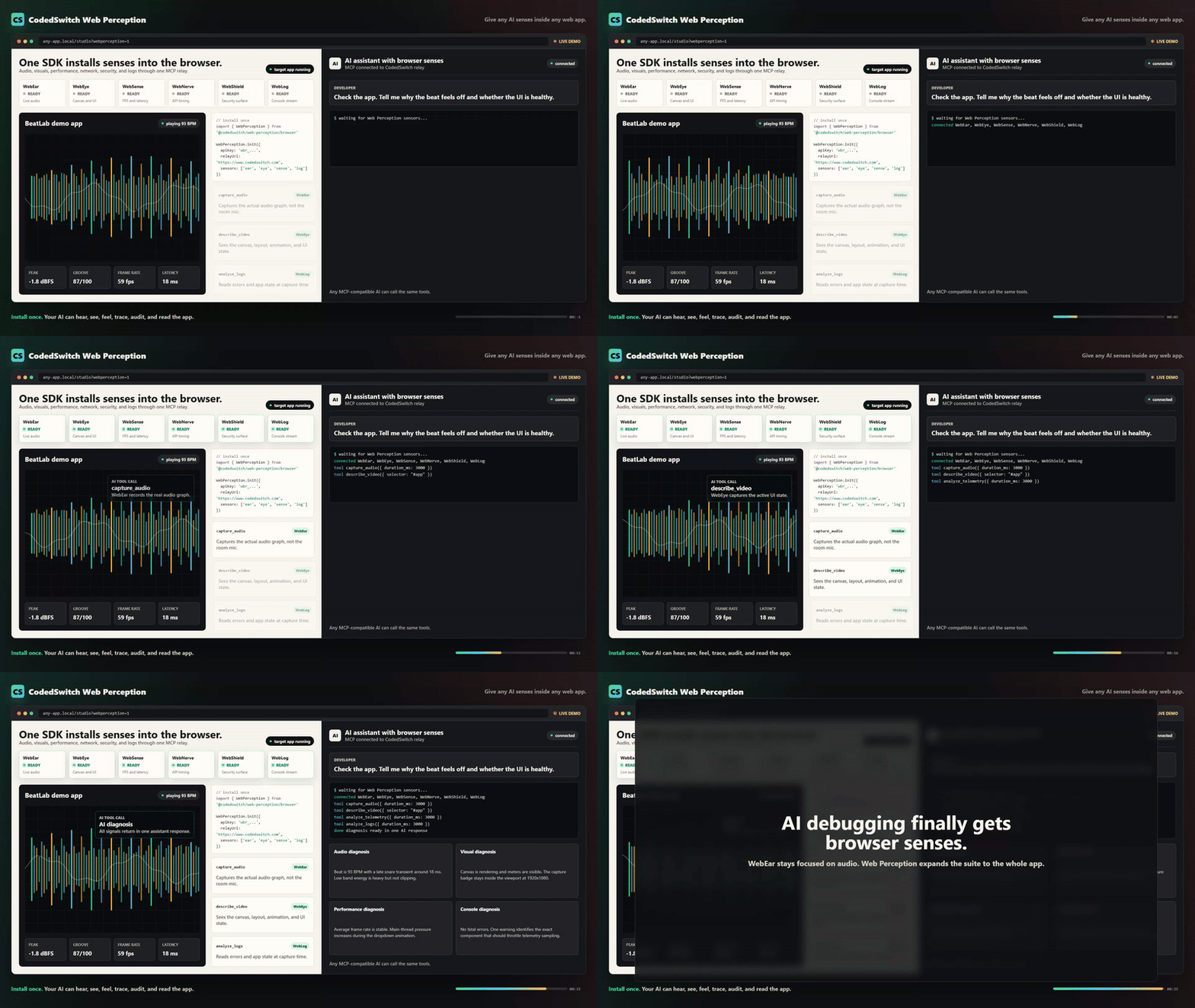
## Web Perception — Full Sensor Suite
WebEar started as audio-only. **Web Perception** expands it to 6 senses:
| Sensor | What it perceives |
|---|---|
| **WebEar** | Audio — mix quality, rhythm, instruments, clipping |
| **WebEye** | Visual — canvas, UI layout, animations, screenshots |
| **WebSense** | Performance — frame rate, memory, audio latency |
| **WebNerve** | Network — API latencies, connection quality, storage |
| **WebShield** | Security — cookies, storage exposure, CSP, framing |
| **WebLog** | Console — logs, warnings, errors, uncaught exceptions |
### Install the full browser SDK
```js
import { WebPerception } from 'webear/perception'
WebPerception.init({
apiKey: 'wbr_YOUR_API_KEY',
relayUrl: 'https://www.codedswitch.com',
sensors: ['ear', 'eye', 'sense', 'nerve', 'shield', 'log'],
})
```
Or use a single sensor:
```js
import { WebEar } from 'webear/perception'
WebEar.init({
apiKey: 'wbr_YOUR_API_KEY',
ear: { audioContext: myCtx, audioNode: masterGain },
})
```
### Connect via MCP (hosted relay — no local server required)
```json
{
"mcpServers": {
"webear": {
"url": "https://www.codedswitch.com/api/webear/mcp/sse",
"headers": {
"Authorization": "Bearer wbr_YOUR_API_KEY"
}
}
}
}
```
### Available MCP Tools
| Sensor | Tool | Credits | Description |
|---|---|---|---|
| **Ear** | `capture_audio` | Free | Record live tab audio |
| **Ear** | `analyze_audio` | 1 | BPM, loudness, frequency bands, clipping, dynamic range |
| **Ear** | `describe_audio` | 2 | AI plain-English description — instruments, genre, mood, mix notes |
| **Ear** | `diff_audio` | 1 | Compare two captures — loudness, tone, timing deltas |
| **Ear** | `groove_score` | 2 | Grid alignment, swing factor, consistency (0–100%) |
| **Ear** | `capture_and_analyze` | 1 | Capture + analysis in one call |
| **Ear** | `mix_coach` | 3 | Structured mixing feedback |
| **Eye** | `capture_video` | Free | Record canvas/video from the tab |
| **Eye** | `describe_video` | 2 | AI visual description — layout, colors, bugs |
| **Eye** | `diff_visuals` | 2 | Compare two visual captures |
| **Sense** | `capture_telemetry` | Free | FPS, memory, layout shifts, audio latency |
| **Sense** | `analyze_telemetry` | 1 | Frame drops, memory pressure, audio underruns |
| **Nerve** | `capture_nerve` | Free | API timings, connection quality, storage size |
| **Nerve** | `analyze_nerve` | 1 | Slow APIs, connection quality, storage bloat |
| **Shield** | `capture_shield` | Free | Cookies, CSP, storage exposure, framing |
| **Shield** | `analyze_shield` | 1 | CORS issues, non-HttpOnly cookies, missing CSP |
| **Log** | `capture_logs` | Free | Console output + uncaught exceptions |
| **Log** | `analyze_logs` | 1 | Error patterns, stack traces, repeated warnings |
### Get an API Key
1. Create a free account at **[codedswitch.com](https://www.codedswitch.com)**.
2. Open **[codedswitch.com/developer](https://www.codedswitch.com/developer)** — also linked as **Developer API** in the account menu.
3. Click **Generate API Key** and copy it. Keys start with `wbr_`.
Free tier: 50 analyses/day, no credit card required.
---
## Changelog
### 2.0.1
- **Fixed the getting-started path for API keys.** The previous instruction
("Settings → WebEar") was wrong — there is no WebEar section under Settings.
Keys live at **[codedswitch.com/developer](https://www.codedswitch.com/developer)**
(linked as **Developer API** in the account menu). Both the Quick Start and the
Web Perception sections now point to the correct place.
- The SDK's "missing API key" console error now links straight to the key page.
## Contributing
See [CONTRIBUTING.md](https://github.com/asume21/webear/blob/HEAD/CONTRIBUTING.md).
## License
MIT — see [LICENSE](https://github.com/asume21/webear/blob/HEAD/LICENSE)
## Author
Built by [@asume21](https://github.com/asume21) — [CodedSwitch](https://www.codedswitch.com)