# TwittrAPI
**Category:** 🌐 Social Media
**Repository:** https://github.com/twittrapi/twittrapi-mcp
**Views:** 0
**Installs:** 0
**Upvotes:** 0
**Directory Page:** https://allmcps.com/mcp/twittrapi
## Description
Read public Twitter/X data: tweets, profiles, followers, search. No X developer account.
## Claude Desktop Quick Installation
Install path detected from listing signals. Uses `npx` (confidence: high):
```json
"mcpServers": {
"twittrapi": {
"command": "npx",
"args": ["-y","twittrapi-mcp"]
}
}
```
## Documentation & README
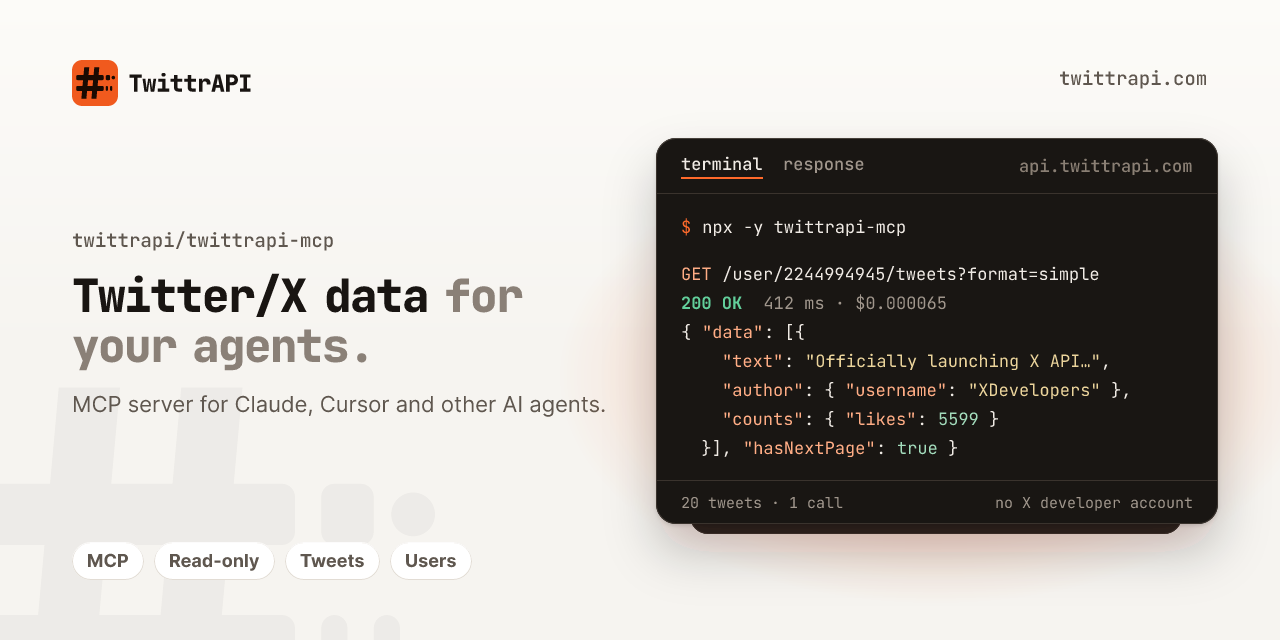
# twittrapi-mcp – Twitter/X MCP server for Claude, Cursor and other AI agents
[](https://www.npmjs.com/package/twittrapi-mcp)
[](LICENSE)
An [MCP](https://modelcontextprotocol.io) server for [TwittrAPI](https://twittrapi.com), a REST API for
public Twitter/X data: tweets, profiles, followers, search, lists and communities. It lets Claude, Cursor
and other MCP clients read that data, from $0.065 per 1,000 calls and with no X developer account.
> **Get an API key:** [twittrapi.com/start](https://twittrapi.com/start?utm_source=github&utm_medium=readme&utm_campaign=twittrapi-mcp) · [Pricing](https://twittrapi.com/pricing?utm_source=github&utm_medium=readme&utm_campaign=twittrapi-mcp) · [Docs](https://twittrapi.com/docs?utm_source=github&utm_medium=readme&utm_campaign=twittrapi-mcp) · [Status](https://twittrapi.com/status) · also available on [RapidAPI](https://rapidapi.com/viperscores-viperscores-default/api/twitter-aio)
**SDKs and integrations:** [Python](https://github.com/twittrapi/twittrapi-python) · [Node.js](https://github.com/twittrapi/twittrapi-node) · [Go](https://github.com/twittrapi/twittrapi-go) · [n8n](https://github.com/twittrapi/n8n-nodes-twittrapi) · [Make](https://github.com/twittrapi/twittrapi-make) · [Apify](https://github.com/twittrapi/twittrapi-apify) · [LangChain](https://github.com/twittrapi/langchain-twittrapi) · [LlamaIndex](https://github.com/twittrapi/llama-index-tools-twittrapi) · [Agent skill](https://github.com/twittrapi/twittrapi-skills) · [Examples](https://github.com/twittrapi/twittrapi-examples)
Not affiliated with X Corp.
## Hosted server (no install)
Apps that support remote MCP servers can connect by URL instead (available with the hosted
release; see [twittrapi.com/docs/hosted-mcp](https://twittrapi.com/docs/hosted-mcp)):
```text
https://mcp.twittrapi.com/mcp
```
| Client | Setup |
| --- | --- |
| Claude.ai / Claude Desktop | Settings > Connectors > Add custom connector, paste the URL, Connect, log in to TwittrAPI and allow access (OAuth) |
| ChatGPT | Settings > Apps & Connectors > Advanced settings > Developer mode, then Create with the URL and OAuth |
| Claude Code | `claude mcp add --transport http twittrapi https://mcp.twittrapi.com/mcp` (OAuth), or add `--header "Authorization: Bearer $TWITTRAPI_API_KEY"` |
| Cursor | `{"mcpServers": {"twittrapi": {"url": "https://mcp.twittrapi.com/mcp", "headers": {"X-API-KEY": "${env:TWITTRAPI_API_KEY}"}}}}` in `mcp.json` |
| VS Code | `{"servers": {"twittrapi": {"type": "http", "url": "https://mcp.twittrapi.com/mcp"}}}` in `.vscode/mcp.json` (OAuth) |
With OAuth the app never sees your API key; calls are billed to your balance like any other call.
Connected apps are listed (and can be disconnected) in the dashboard under **Connected apps**.
## What you need
- Node.js 20 or newer
- A TwittrAPI key, or a RapidAPI key subscribed to the Twitter AIO API
Every tool call is one billed API call on your account.
## Install
### Claude Code
```sh
claude mcp add twittrapi --env TWITTRAPI_API_KEY=your-key -- npx -y twittrapi-mcp
```
### Claude Desktop
Open Settings > Developer > Edit Config and add this to `claude_desktop_config.json`:
```json
{
"mcpServers": {
"twittrapi": {
"command": "npx",
"args": ["-y", "twittrapi-mcp"],
"env": {
"TWITTRAPI_API_KEY": "your-key"
}
}
}
}
```
Restart Claude Desktop afterwards.
### Cursor
Add this to `~/.cursor/mcp.json` (all projects) or `.cursor/mcp.json` (one project):
```json
{
"mcpServers": {
"twittrapi": {
"command": "npx",
"args": ["-y", "twittrapi-mcp"],
"env": {
"TWITTRAPI_API_KEY": "your-key"
}
}
}
}
```
### Other clients
Any client that can start a stdio server works. The command is `npx -y twittrapi-mcp`.
## Environment variables
| Variable | Required | Description |
| --- | --- | --- |
| `TWITTRAPI_API_KEY` | one of the two keys | Your TwittrAPI key. Sent as the `X-API-KEY` header. |
| `RAPIDAPI_KEY` | one of the two keys | RapidAPI key. Used only when `TWITTRAPI_API_KEY` is not set. |
| `RAPIDAPI_HOST` | no | Host of your RapidAPI listing. Default `twitter-aio.p.rapidapi.com`. |
| `TWITTRAPI_BASE_URL` | no | API base URL for the direct API. Default `https://api.twittrapi.com`. |
| `TWITTRAPI_RESPONSE_FORMAT` | no | `simple` (default) or `raw`. See [Response format](#response-format). |
| `TWITTRAPI_X_COOKIE` | no | Cookie of your own logged-in x.com session. Turns on the [account tools](#account-tools) together with `TWITTRAPI_X_PROXY`. |
| `TWITTRAPI_X_PROXY` | no | Your proxy for the account tools, `http://user:pass@host:port`. |
| `TWITTRAPI_X_CHAT_PASSCODE` | no | Your X Chat passcode. Adds `send_dm` and message text in `list_dm_conversations`. |
If neither key is set, the server still starts and lists its tools, but every call returns an
error explaining how to set a key.
## Using RapidAPI instead
If you bought access through RapidAPI, set `RAPIDAPI_KEY` instead of `TWITTRAPI_API_KEY`:
```json
"env": { "RAPIDAPI_KEY": "your-rapidapi-key" }
```
Requests then go to `https://twitter-aio.p.rapidapi.com` with the `x-rapidapi-key` and
`x-rapidapi-host` headers. The tools and their output are the same.
Subscribed to another TwittrAPI listing on RapidAPI? Set its host:
`"RAPIDAPI_HOST": "twttr.p.rapidapi.com"`.
## Tools
These tools read public data and are always available. The [account tools](#account-tools) are
added when you configure your X session.
| Tool | What it does |
| --- | --- |
| `get_user_by_username` | Profile by handle, including the numeric user ID |
| `get_user_by_id` | Profile by numeric user ID |
| `username_to_id` | Resolve a handle to its user ID |
| `users_by_ids` | Profiles for up to 500 user IDs at once |
| `get_user_tweets` | A user's tweets |
| `get_user_tweets_and_replies` | A user's tweets and replies |
| `get_user_media` | A user's tweets with photos or videos |
| `get_followers` | A user's followers |
| `get_following` | Accounts a user follows |
| `get_verified_followers` | A user's verified followers |
| `search_tweets` | Search with X operators; Top, Latest, People, Photos or Videos |
| `get_tweet` | A tweet and its reply thread |
| `get_tweet_retweets` | Users who retweeted a tweet |
| `get_tweet_quotes` | Tweets quoting a tweet |
| `get_list_details` | List name, owner and counts |
| `get_list_tweets` | Tweets from a list's members |
| `get_list_members` | Members of a list |
| `get_community` | Community details |
| `get_community_tweets` | Tweets in a community |
| `search_communities` | Find communities by keyword |
| `get_trends` | Trending topics for a location (WOEID) |
| `get_trend_locations` | Locations that have trends, with their WOEIDs |
The user timeline tools (`get_user_tweets`, `get_followers` and so on) accept either `userId` or
`username`.
### Account tools
With `TWITTRAPI_X_COOKIE` and `TWITTRAPI_X_PROXY` set, the server also lists tools that act on
your own X account:
| Tool | What it does |
| --- | --- |
| `create_tweet` | Post a tweet; optional quote (`quoteUrl`), poll (`pollChoices`) and reply limit |
| `reply_to_tweet` | Reply to a tweet |
| `delete_tweet` | Delete one of your tweets |
| `like_tweet`, `unlike_tweet` | Like or unlike a tweet |
| `retweet`, `unretweet` | Retweet or undo a retweet |
| `bookmark_tweet`, `unbookmark_tweet` | Add or remove a bookmark |
| `follow_user`, `unfollow_user` | Follow or unfollow (by `userId` or `username`) |
| `list_dm_conversations` | Your DM inbox |
| `send_dm` | Send a direct message (needs `TWITTRAPI_X_CHAT_PASSCODE`) |
| `create_list` | Create a list |
| `add_list_member`, `remove_list_member` | Add or remove a list member |
| `create_draft`, `list_drafts` | Save a draft, list your drafts |
How to get the cookie and set up a proxy: [twittrapi.com/docs/x-session](https://twittrapi.com/docs/x-session).
The cookie needs `auth_token` and `ct0`; direct messages also need `twid`.
```json
"env": {
"TWITTRAPI_API_KEY": "your-key",
"TWITTRAPI_X_COOKIE": "auth_token=...; ct0=...; twid=u%3D...",
"TWITTRAPI_X_PROXY": "http://user:pass@host:port"
}
```
- The cookie and proxy stay in the server's configuration. They are not tool arguments, so the
model never sees them, and they are never logged or returned in a result.
- Write tools are marked `readOnlyHint: false` (deletions and undo actions also
`destructiveHint: true`), so clients ask before running them.
- Each call is one billed API call, like the read tools.
- Account tools are only available over stdio. HTTP mode and the hosted server do not offer them.
### Response format
Tool results use the API's [simple format](https://twittrapi.com/docs/simple-format) by default:
flat camelCase JSON with a fixed schema (`{"data": [...], "nextCursor": ..., "hasNextPage": ...}`
for lists, `{"data": {...}}` for single objects). Tweets carry `id`, `url`, `text`, `createdAt`,
`author`, `counts`, `media`, `quoted`, `retweetOf` and a few more fields; users carry `username`,
`name`, `description`, `counts` and so on. That is about 60 % fewer tokens than X's raw GraphQL JSON.
To get the raw JSON instead (for cards, polls, edit history, community notes and other fields the
simple format leaves out):
- per call: every tool takes an optional `format` argument, `"simple"` or `"raw"`;
- for the whole server: set `TWITTRAPI_RESPONSE_FORMAT=raw` (the `format` argument still wins).
### Output size and pagination
Raw responses can be several hundred KB. Every tool takes an optional `max_chars` argument
(default 50,000, range 1,000 to 1,000,000). Longer output is cut and ends with a
`[TRUNCATED ...]` marker.
Paginated tools print the cursor above the JSON, so truncation never removes it:
```
next_cursor: DAABCgABGZ...
Pass next_cursor as `cursor` to get the next page.
{"data":{...}}
```
On the last page the header reads `next_cursor: none (last page, no more results)`. In the simple
format that is when `hasNextPage` is false. In the raw format it happens when the response has no
next cursor (empty likes timelines included), when X returns the cursor you just sent, or
when a page holds only cursors and no results.
### Errors
API errors come back as tool errors with a short explanation, for example:
- 402: the account has no balance left
- 429: rate limit hit, wait before retrying
- 404: the user or tweet does not exist, is private or is suspended
- 5xx: temporary upstream problem
## HTTP mode (remote hosting)
```sh
npx -y twittrapi-mcp --http --port 3333 --host 0.0.0.0
```
This serves a stateless [Streamable HTTP](https://modelcontextprotocol.io/specification/2025-11-25/basic/transports#streamable-http)
endpoint at `/mcp` and a health check at `/health`. The default host is `127.0.0.1`. Every POST
gets its own server instance bound to the caller's credentials, so any number of instances can
run behind a load balancer without sticky sessions. `GET /mcp` answers 405 (no server-initiated
stream); the legacy SSE transport is not offered.
In HTTP mode the server does not use a key from its own environment. Each request carries the
caller's credentials:
- `X-API-KEY: ` or `Authorization: Bearer ` for the direct API
- `x-rapidapi-key: ` for RapidAPI, plus `x-rapidapi-host: ` for a listing other than
`twitter-aio.p.rapidapi.com` (must end in `.p.rapidapi.com`)
- `Authorization: Bearer twa_at_...`: a TwittrAPI OAuth access token (hosted mode, below)
The [account tools](#account-tools) are not offered in HTTP mode; `TWITTRAPI_X_COOKIE` and
`TWITTRAPI_X_PROXY` are ignored there. `TWITTRAPI_BASE_URL` and `TWITTRAPI_RESPONSE_FORMAT` are still read from the environment; callers
can pick the format per call with the `format` argument. Put the server behind HTTPS if it is
reachable from the internet.
Example client config for your own instance (Claude Code):
```sh
claude mcp add --transport http twittrapi https://your-host.example.com/mcp --header "X-API-KEY: your-key"
```
### Hosted mode with OAuth
For clients that require OAuth (Claude.ai connectors, ChatGPT), the server acts as an OAuth 2.1
resource server and the TwittrAPI dashboard as the authorization server (dynamic client
registration, PKCE S256, consent screen, rotating refresh tokens). The server:
- answers requests without credentials with `401` and
`WWW-Authenticate: Bearer resource_metadata="/.well-known/oauth-protected-resource/mcp", scope="mcp"`;
- serves [RFC 9728](https://datatracker.ietf.org/doc/html/rfc9728) metadata at
`/.well-known/oauth-protected-resource/mcp` and `/.well-known/oauth-protected-resource`, and
relays the dashboard's RFC 8414 metadata at `/.well-known/oauth-authorization-server`;
- checks each access token with the dashboard's internal introspection endpoint (shared secret),
caches valid results for up to `OAUTH_CACHE_SECONDS` (30) and invalid ones for 5 s, and accepts
only tokens whose audience is `MCP_PUBLIC_URL`;
- calls the API with the key of the account behind the token. The key never reaches the client.
Invalid or revoked tokens get `401` with `error="invalid_token"`; if the dashboard cannot be
reached the answer is `503` with `Retry-After`, so clients keep their tokens.
### Environment (HTTP mode)
| Variable | Default | Description |
| --- | --- | --- |
| `PORT`, `HOST` | `3333`, `127.0.0.1` | Listen address (the Docker image uses `3000`, `0.0.0.0`) |
| `TWITTRAPI_BASE_URL` | `https://api.twittrapi.com` | Gateway the tools call |
| `TWITTRAPI_RESPONSE_FORMAT` | `simple` | Default format of tool results |
| `MCP_PUBLIC_URL` | – | Public URL of `/mcp`, e.g. `https://mcp.twittrapi.com/mcp`. Token audience. |
| `OAUTH_ISSUER` | – | Authorization server, e.g. `https://app.twittrapi.com` |
| `OAUTH_INTROSPECTION_SECRET` | – | Shared secret with the dashboard (32+ characters). OAuth is on when these three are set. |
| `OAUTH_INTROSPECTION_URL` | `$OAUTH_ISSUER/api/oauth/introspect` | Internal URL of the introspection endpoint |
| `OAUTH_METADATA_URL` | `$OAUTH_ISSUER/.well-known/oauth-authorization-server` | Where the relayed metadata is fetched |
| `OAUTH_CACHE_SECONDS` | `30` | Cache for valid tokens (max 300). Revocations take effect within this time. |
| `MAX_CONCURRENCY_PER_KEY` | `8` | Requests in flight per key and instance; more get `429` with `Retry-After: 1`. `0` turns it off. |
| `MAX_BODY_BYTES` | `262144` | Larger request bodies get `413` |
| `REQUEST_TIMEOUT_MS` | `90000` | Requests running longer get `504` |
| `ALLOWED_ORIGINS` | – | Comma-separated `Origin` allowlist for browser clients (DNS rebinding protection) |
| `TRUST_PROXY` | – | `1` to log the client IP from `X-Forwarded-For` |
| `LOG_LEVEL` | `info` | `debug`, `info`, `warn`, `error` |
Logs are JSON lines on stdout, one per request: request id, client IP, auth kind
(`api_key`, `rapidapi`, `oauth`, `none`), a hashed key id (`k_` + 12 hex characters), OAuth client
and account id, JSON-RPC method, tool name, status and duration. Keys and tokens are never logged.
### Docker / Coolify
```sh
docker build -t twittrapi-mcp .
docker run -p 3000:3000 -e MCP_PUBLIC_URL=... -e OAUTH_ISSUER=... -e OAUTH_INTROSPECTION_SECRET=... twittrapi-mcp
```
In Coolify: build pack Dockerfile, port 3000, health check path `/health`, domain
`mcp.twittrapi.com`, and the variables above. Set `OAUTH_INTROSPECTION_URL` to the dashboard's
internal address when both run on the same server.
## Development
```sh
npm install
npm run build
npm test
```
`npm test` builds first, then runs unit tests, a protocol test that starts the server over stdio
and HTTP against a local mock API, and tests of hosted mode (OAuth challenge and metadata, token
introspection and caching, audience check, limits, log redaction) against a fake dashboard.
To add or change a tool, edit `src/endpoints.ts`. Each entry has a name, description, API path and
zod parameter schemas. Every tool also gets `max_chars` and `format`. An entry can set a `simplify`
function to reshape the parsed JSON further; none do. Account tools live in `src/actions.ts`.
Try the server interactively with the MCP Inspector:
```sh
npx @modelcontextprotocol/inspector -e TWITTRAPI_API_KEY=your-key node dist/index.js
```
## Support
Questions, bugs or a higher rate limit: email support@twittrapi.com or open an issue in this repository. Service status: [twittrapi.com/status](https://twittrapi.com/status). News and changes: the TwittrAPI Telegram channel (link on the website).
## License
MIT