# ToolTrust Scanner [Health: Active]
**Category:** 💻 Developer Tools
**Repository:** https://github.com/AgentSafe-AI/tooltrust-scanner
**GitHub Stars:** 19
**npm Downloads (last month):** 2885375
**Views:** 0
**Installs:** 0
**Upvotes:** 0
**Directory Page:** https://allmcps.com/mcp/tooltrust-scanner
## Description
Scans MCP servers for prompt injection, data exfiltration, and privilege escalation.
## Tools
Capabilities this server exposes over MCP:
- **tooltrust_scan_config** — Scan all MCP servers in your `.mcp.json` or `~/.claude.json
- **tooltrust_scan_server** — Launch and scan a specific MCP server by command
- **tooltrust_scanner_scan** — Scan a raw JSON blob of tool definitions
- **tooltrust_lookup** — Look up a server's trust grade from the ToolTrust Directory
- **tooltrust_list_rules** — List all built-in security rules
## Claude Desktop Quick Installation
Install path detected from listing signals. Uses `npx` (confidence: high):
```json
"mcpServers": {
"tooltrust-scanner": {
"command": "npx",
"args": ["-y","@modelcontextprotocol/server-filesystem"]
}
}
```
## Documentation & README

ToolTrust Scanner
Static security scanner for MCP tool definitions
Trust grades (A–F) before your agent calls a tool — run as an MCP server, CLI, or CI check.





---
Every MCP tool your agent calls is an attack surface — prompt injection, data exfiltration, privilege escalation, supply-chain backdoors. ToolTrust scans tool definitions *before* your agent trusts them and assigns a trust grade (A–F) so you know the risk. ToolTrust is an **MCP Server** and a **CLI/CI tool** — not a host, gateway, or runtime proxy. Coverage is expanding beyond today’s MCP-focused workflows; **skills** and additional agent tool formats are on the roadmap.
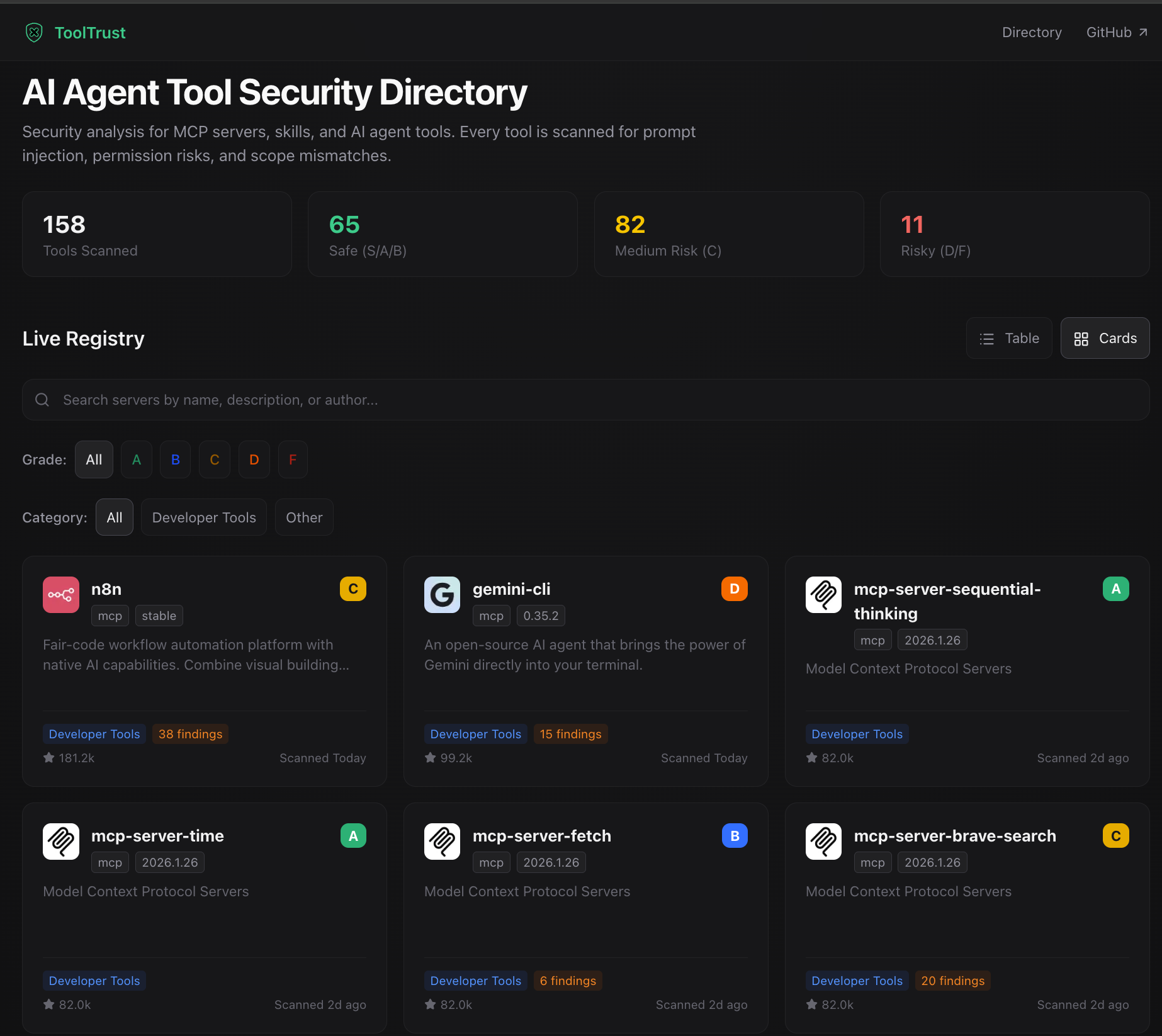
Browse the live ToolTrust Directory — trust grades and scan-backed reports before you install.
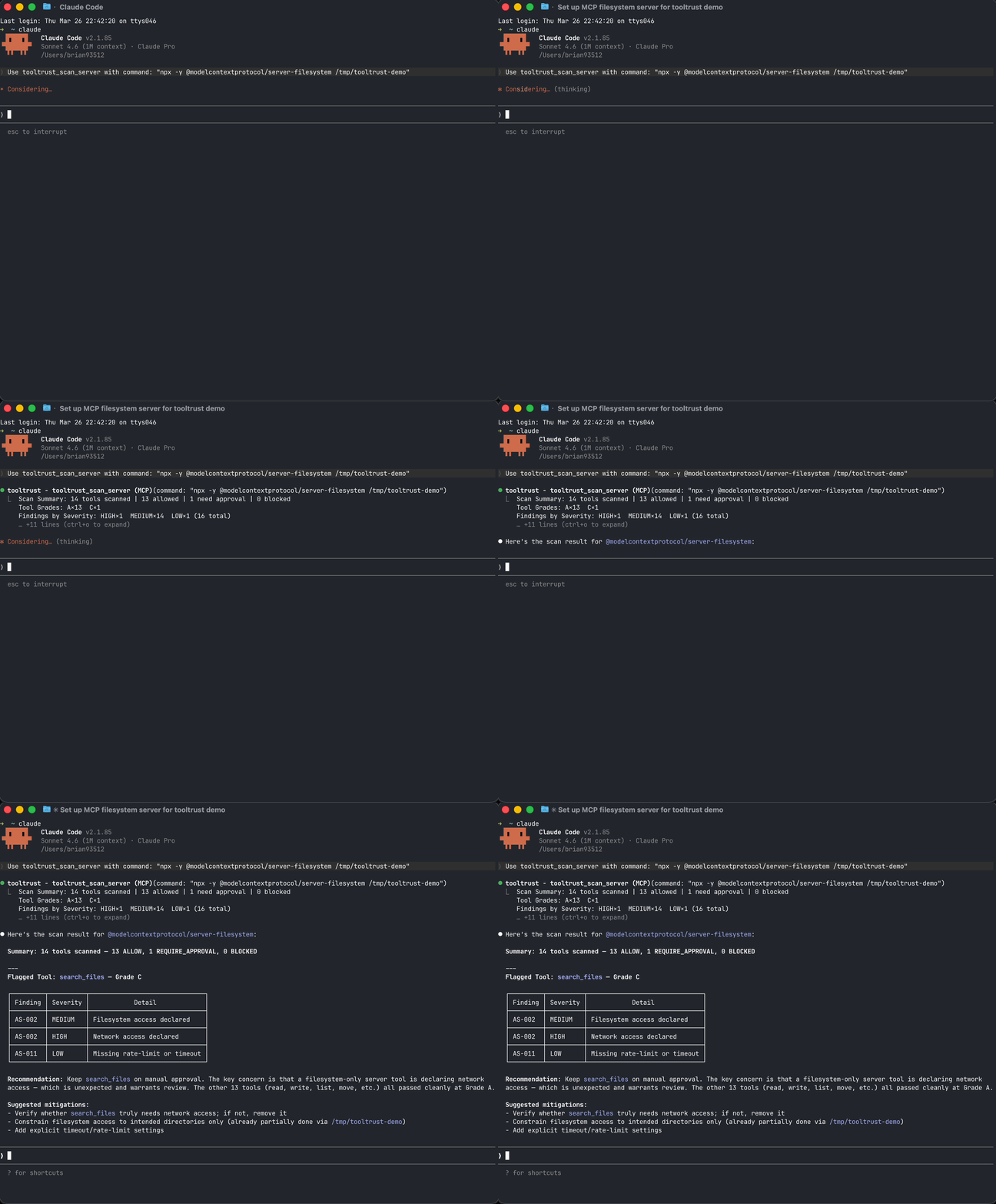
MCP demo: run a full config scan from your agent.
## Scan your setup in 30 seconds
Add ToolTrust as an MCP server and let your agent audit its own tools (stdio transport — no network listener; your host launches it as a subprocess):
```json
{
"mcpServers": {
"tooltrust": {
"command": "npx",
"args": ["-y", "tooltrust-mcp"]
}
}
}
```
Then ask your agent: *"Run tooltrust_scan_config"*
It reads your MCP config, connects to each server in parallel, scans every tool, and returns a risk report with grades and enforcement decisions — all in seconds.
Or use the CLI:
```bash
curl -sfL https://raw.githubusercontent.com/AgentSafe-AI/tooltrust-scanner/main/install.sh | bash
tooltrust-scanner scan --server "npx -y @modelcontextprotocol/server-filesystem /tmp"
```
## Example snapshot (research cohort)
The public **[ToolTrust Directory](https://www.tooltrust.dev/)** holds **current** grades and aggregates as scanning scales. One published research pass illustrates the shape of the problem — **207 MCP servers**, **3,235** tools — not an exhaustive count of everything we scan today:
| Metric | Count |
|--------|-------|
| MCP servers in cohort | 207 |
| Individual tools analyzed | 3,235 |
| Total security findings | 3,613 |
| Servers with at least one finding | 145 (70%) |
| Servers with a clean Grade A | 22 (10%) |
| Servers with arbitrary code execution | 16 |
**Only 10% of servers in that cohort had a clean Grade A.** See **[tooltrust.dev](https://www.tooltrust.dev/)** for up-to-date directory-wide results (and use this table only as a labeled snapshot).
## 🔍 What it catches
ToolTrust runs **16** static tool-definition rules in this repo (**AS-001–AS-011**, **AS-013–AS-017**) plus **2** source-scan rules for embedded MCP implementations (**AS-018**, **AS-019**). **AS-012** (tool drift) is evaluated in the **[ToolTrust Directory](https://github.com/AgentSafe-AI/tooltrust-directory)** when new scan results are compared to previous runs.
| ID | Severity | Detects |
|----|:--------:|---------|
| 🛡️ **AS‑001** | `Critical` | **Tool Poisoning** — Adversarial prompts hidden in tool descriptions (`ignore previous instructions`, ``) |
| 🔑 **AS‑002** | `High`/`Low` | **Permission Surface** — `exec`, `network`, `db`, `fs` beyond stated purpose; over-broad input schema |
| 📐 **AS‑003** | `High` | **Scope Mismatch** — Tool name contradicts its permissions (e.g. `read_config` with `exec`) |
| 📦 **AS‑004** | `High`/`Critical` | **Supply Chain CVEs** — Known CVEs in bundled dependencies via [OSV](https://osv.dev) |
| 🔓 **AS‑005** | `High` | **Privilege Escalation** — `admin`/`:write` OAuth scopes; `sudo`/`impersonate` in descriptions |
| ⚡ **AS‑006** | `Critical` | **Arbitrary Code Execution** — `evaluate_script`, `_evaluate` suffix, `execute javascript`, `page.evaluate()` patterns |
| ℹ️ **AS‑007** | `Info` | **Insufficient Tool Data** — Tool lacks a valid description or schema |
| 🚨 **AS‑008** | `Critical` | **Known Compromised Package** — Offline embedded blacklist of confirmed supply-chain attacks (LiteLLM 1.82.7/1.82.8, Trivy v0.69.4-v0.69.6, Langflow <1.9.0, Axios 1.14.1/0.30.4). Zero-latency, no network required. |
| 🔤 **AS‑009** | `Medium` | **Typosquatting** — Tool name within edit-distance 2 of a well-known MCP tool, suggesting impersonation |
| 🗝️ **AS‑010** | `Medium` | **Secret Handling** — Input params accepting API keys/passwords; credentials logged insecurely |
| ⚡ **AS‑011** | `Low` | **DoS Resilience** — No rate-limit, timeout, or retry config on network/exec tools |
| 🔄 **AS‑012** | `High` | **Rug-Pull** — Tool set changed between scans of the same version without a version bump *(directory pipeline only)* |
| 👥 **AS‑013** | `High`/`Medium` | **Tool Shadowing** — Duplicate or near-duplicate tool name hijacks calls intended for a trusted tool |
| ℹ️ **AS‑014** | `Info` | **Dependency Inventory Unavailable** — MCP server exposed neither `metadata.dependencies` nor a `repo_url`, so supply-chain coverage is limited and must be treated as incomplete |
| ⚠️ **AS‑015** | `Medium`/`High` | **Suspicious NPM Lifecycle Script** — npm dependency publishes `preinstall` / `postinstall` / similar install-time scripts; severity rises for remote-fetch or inline-execution patterns |
| 🚨 **AS‑016** | `Critical` | **Suspicious NPM IOC Dependency** — published npm metadata or install-time scripts reference a known malicious IOC package, domain, URL, or reviewed script pattern such as `plain-crypto-js`, even if the top-level package name is new |
| ⚠️ **AS‑017** | `Medium` | **Suspicious Data Exfiltration Description** — tool description explicitly suggests sending user data, content, or conversation history to external / remote endpoints, without classifying it as prompt injection |
| ℹ️ **AS‑018** | `Info` | **Embedded MCP Server Detected** — source-level MCP SDK usage was found, but tools could not be enumerated from a manifest or live handshake, so manual review is still required |
| 🔓 **AS‑019** | `High` | **Unauthenticated MCP Route Exposure** — embedded MCP HTTP routes expose the same handler without equivalent authentication middleware |
Full rule details: [docs/RULES.md](https://github.com/AgentSafe-AI/tooltrust-scanner/blob/HEAD/docs/RULES.md)
## How it works
1. **Parse** — Connects to a live MCP server (or reads a JSON file) and extracts every tool definition
2. **Analyze** — Runs tool-definition rules against each tool's name, description, schema, and permissions; source scans add embedded MCP implementation checks
3. **Grade** — Assigns a numeric risk score and letter grade (A–F) per tool
4. **Enforce** — Maps each grade to a gateway policy: `ALLOW`, `REQUIRE_APPROVAL`, or `BLOCK`
Pure static analysis. No LLM calls. No data leaves your machine (except optional CVE lookups). Runs in milliseconds. Deterministic and reproducible.
## Install
```bash
# One-line install (macOS / Linux)
curl -sfL https://raw.githubusercontent.com/AgentSafe-AI/tooltrust-scanner/main/install.sh | bash
# Go
go install github.com/AgentSafe-AI/tooltrust-scanner/cmd/tooltrust-scanner@latest
# npx (no install needed)
npx -y tooltrust-mcp
```
## MCP tools
When running as an MCP server, ToolTrust exposes these tools to your agent:
| Tool | What it does | Data access |
|------|-------------|-------------|
| `tooltrust_scan_config` | Scan all MCP servers in your `.mcp.json` or `~/.claude.json` | Reads local config; spawns each server as subprocess |
| `tooltrust_scan_server` | Launch and scan a specific MCP server by command | Runs user-supplied command as subprocess (stdio) |
| `tooltrust_scanner_scan` | Scan a raw JSON blob of tool definitions | In-memory only; no subprocess or network |
| `tooltrust_lookup` | Look up a server's trust grade from the ToolTrust Directory | Network request to ToolTrust Directory API |
| `tooltrust_list_rules` | List all built-in security rules | Local catalog only |
## CI / GitHub Actions
Block risky MCP servers in your pipeline:
```yaml
- name: Audit MCP Server
uses: AgentSafe-AI/tooltrust-scanner@main
with:
server: "npx -y @modelcontextprotocol/server-filesystem /tmp"
fail-on: "approval"
```
## Deployment and security
For deployment, use the install paths in [Install](#install) or the workflow example in [CI / GitHub Actions](#ci--github-actions). For vulnerability reporting and disclosure policy, see [docs/SECURITY.md](https://github.com/AgentSafe-AI/tooltrust-scanner/blob/HEAD/docs/SECURITY.md).
## Scan-before-install gate
Never add an untrusted MCP server to your config again:
```bash
# Scans the server, then auto-installs if Grade A/B, prompts on C/D, blocks on F
tooltrust-scanner gate @modelcontextprotocol/server-memory -- /tmp
# Replace `claude mcp add` with a scanned install
alias mcp-add='tooltrust-scanner gate'
```
Full gate options and pre-commit hook setup: [docs/USAGE.md](https://github.com/AgentSafe-AI/tooltrust-scanner/blob/HEAD/docs/USAGE.md)
## Add a trust badge to your project
If your MCP server passes ToolTrust, let people know:
```markdown
[](https://www.tooltrust.dev/)
```
> [](https://www.tooltrust.dev/)
---
> **Supply-chain alert:** ToolTrust detects and blocks confirmed compromised packages including LiteLLM v1.82.7/8 (TeamPCP backdoor), Trivy v0.69.4–v0.69.6, and Langflow < 1.9.0. If you encounter a Grade F with rule AS-008, remove the package immediately and rotate all credentials.
---
[Usage guide](https://github.com/AgentSafe-AI/tooltrust-scanner/blob/HEAD/docs/USAGE.md) · [Developer guide](https://github.com/AgentSafe-AI/tooltrust-scanner/blob/HEAD/docs/DEVELOPER.md) · [Contributing](https://github.com/AgentSafe-AI/tooltrust-scanner/blob/HEAD/docs/CONTRIBUTING.md) · [Deployment & security](#deployment-and-security) · [Changelog](https://github.com/AgentSafe-AI/tooltrust-scanner/blob/HEAD/CHANGELOG.md) · [Security](https://github.com/AgentSafe-AI/tooltrust-scanner/blob/HEAD/docs/SECURITY.md) · [License: MIT](https://github.com/AgentSafe-AI/tooltrust-scanner/blob/HEAD/LICENSE)