# TokCalc MCP Server
**Category:** 💻 Developer Tools
**Repository:** https://github.com/stevecrates489-commits/tokcalc.git
**Views:** 0
**Installs:** 0
**Upvotes:** 0
**Directory Page:** https://allmcps.com/mcp/tokcalc-mcp-server
## Description
LLM capacity planning tools to estimate VRAM, compute, latency, and GPU topology for agents.
## Claude Desktop Quick Installation
Heuristic fallback — verify the package name and runner against the repository README before running it. Uses `npx` (confidence: low):
```json
"mcpServers": {
"tokcalc-mcp-server": {
"command": "npx",
"args": ["-y","tokcalc-mcp-server"]
}
}
```
## Documentation & README
# tokcalc
### The open-source LLM serving capacity planner
**Plan your LLM deployment before you rent the GPUs.**
[](https://tokcalc.vercel.app)
[](LICENSE)
[](CONTRIBUTING.md)
[](https://nextjs.org)
[](https://www.npmjs.com/package/@tokcalc/mcp-server)
---
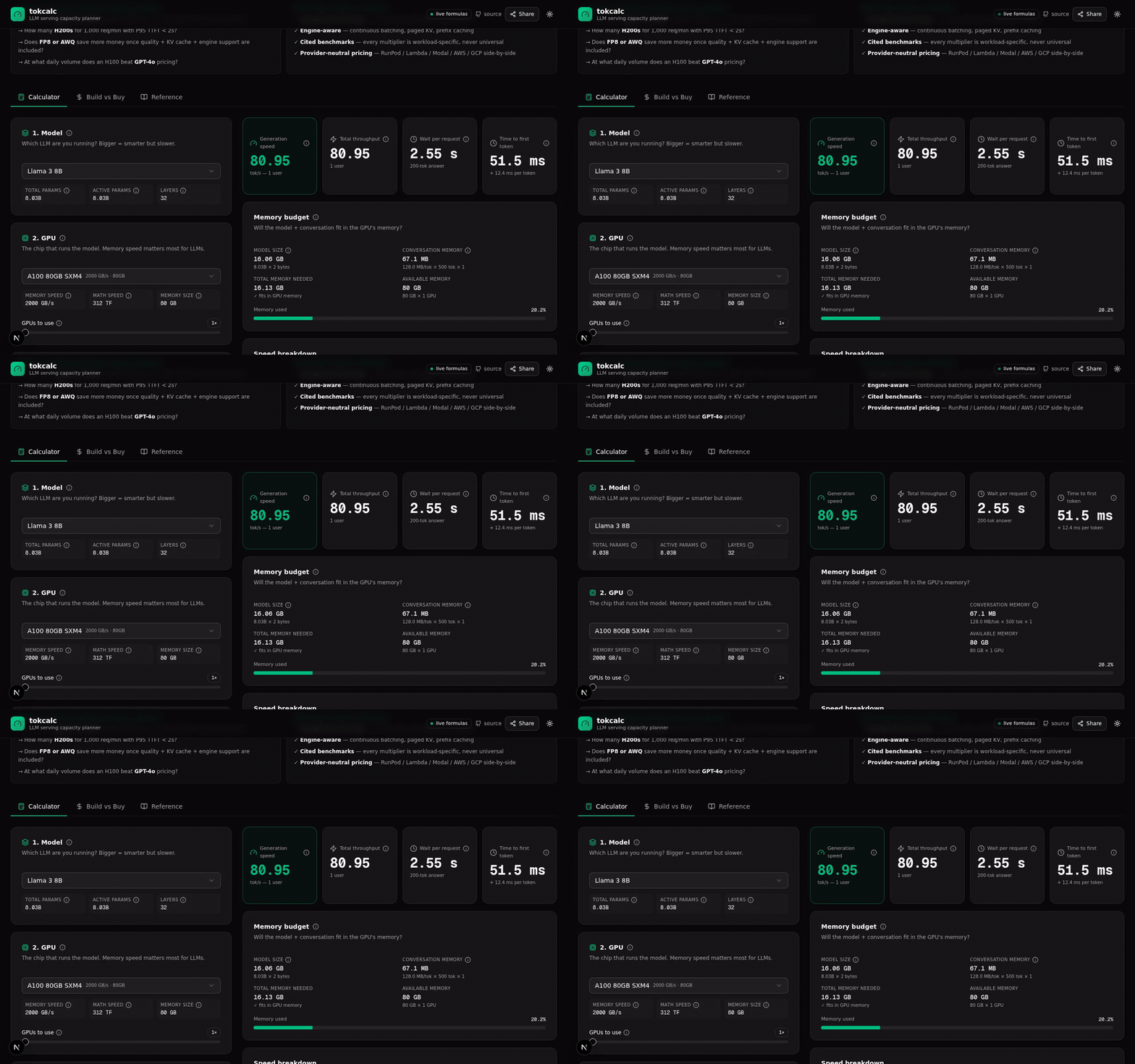
*Switch model → multi-GPU → long-context capacity planner → Build vs Buy → Reference catalog → Live GPU pricing*
---
tokcalc turns your LLM traffic, context length, latency SLOs, cache behavior,
and model choice into a **defensible serving topology and cost plan** —
with transparent formulas and cited benchmarks.
It's the engineering-grade pre-deployment decision layer for LLM inference.
Not another static "tokens per second" calculator.
## Try it now
**[tokcalc.vercel.app](https://tokcalc.vercel.app)** — no signup, no tracking, no paywall.
Pick a model, a GPU, and a workload. Get an instant capacity plan:
- Generation speed (tok/s)
- Time-to-first-token (TTFT) + inter-token latency (ITL)
- VRAM budget with KV-cache sizing
- Multi-GPU topology recommendation (Single GPU → TP×2/4/8 → Context Parallel)
- Monthly cost + break-even vs API pricing
- **Live GPU pricing** across Azure + AWS + GCP + Vast.ai marketplace (fetched in parallel)
- **Shareable URL** — your config encoded in the URL hash, send to colleagues
- **Copy as Markdown** — paste the full result into GitHub issues / Slack / docs
## Why tokcalc?
The market has dozens of "tokens per second" calculators and self-host-vs-API
break-even tools (induwara.lk, gigagpu, kickllm, cloudparity, curlscape,
profitable.ai). None of them are unified capacity planners — and none show
their math.
### What tokcalc answers that competitors can't
> *"Can I serve Qwen 2.5 72B at 128K context on 2× H100 with 20 concurrent users?"*
> *"How many H200s do I need for 1,000 req/min with P95 TTFT < 2s?"*
> *"Does FP8 or AWQ save more money once quality, KV cache, and engine support are included?"*
> *"At what daily volume does an H100 beat GPT-4o pricing?"*
> *"What's the cheapest H100 right now across Azure / AWS / GCP / Vast.ai?"*
> *"What happens to cost and latency if an agent makes 8 model calls, has 3 tool calls, and its context grows by 5K tokens each turn?"*
> *"Would prefix caching, continuous batching, or PD disaggregation save more for this workload?"*
## Features
### Calculator tab
| Feature | What it computes |
|---|---|
| **Model fit / VRAM** | Will the model + KV cache fit in the GPU's memory? |
| **Throughput** | Decode tok/s (per-stream) + aggregate (batched) + prefill tok/s |
| **Latency split** | Time-to-first-token (= prefill) + inter-token latency (= decode) |
| **Continuous batching** | User-tunable 1.0–4× multiplier (cited 1.5–4× SOSP range) |
| **Reasoning tokens** | Hidden reasoning budget added to billed output (o1 / R1 / Claude thinking) |
| **Prompt caching** | Self-hosted vLLM APC + Anthropic 5m/1h TTL + OpenAI 50%-off cached tokens |
| **Speculative decoding** | User-tunable 1.2–4× boost factor |
| **Multi-GPU TP** | 1× → 8× tensor parallel with NVLink efficiency factor |
| **Long-context capacity** | KV memory + max concurrency + prefill time at 4K → 1M context |
| **Topology recommendation** | Single GPU → TP×2 → TP×4 → TP×8 → TP×8 + Context Parallel (RingAttention) |
| **Cost economics** | GPU $/hr → $/M output tokens → $/request → monthly cost |
| **Observed benchmark calibration** | Paste vLLM/SGLang/TRT-LLM JSON → see formula accuracy verdict (validated / underestimated / overestimated) |
### Build vs Buy tab
Independent calculator (separate state) that compares:
- **Self-host**: model + GPU + quant + utilization + batch → $/M tokens + monthly cost
- **API**: 13 providers (OpenAI / Anthropic / Gemini / Groq / DeepSeek / Mistral / Together)
- **Verdict**: Self-host cheaper / API cheaper / Not enough volume — with break-even reqs/day
### Reference tab
6 sub-tables — fully transparent, every record source-linked where available:
- **Models** (35 entries: Llama 4 Scout/Maverick, Qwen 3 family, DeepSeek V3/R1, Pixtral, BGE-M3, ...)
- **GPUs** (30 entries: H100/H200/B200/B300, AMD MI300X/MI325X, Intel Gaudi 3, TPU v5p/Trillium, Groq LPU, Cerebras WSE-3, Apple M2/M3/M4 Ultra, ...)
- **Quantization** (16 formats: FP16/BF16, GGUF Q2_K→Q8_0, GPTQ, AWQ, EXL2, FP8, NVFP4)
- **API pricing** (13 models with input/cached/output + retired/current status)
- **Cloud GPU pricing** (all GPUs with $/hr > 0 + typical providers — static curated)
- **🔴 Live pricing** (real-time fetch from Azure + AWS + GCP + Vast.ai in parallel — LIVE badges + timestamps)
### The long-context capacity planner (the differentiator)
This is the formula the Perplexity research brief called "the most important
tokcalc should visibly expose":
$$
\text{KV bytes/request} = 2 \cdot L \cdot T \cdot H_{\text{kv}} \cdot D_h \cdot B
$$
For dense attention, prefill cost grows **superlinearly** with context length:
$$
\text{prefill FLOPs} = \underbrace{2 \cdot N \cdot T}_{\text{linear}} + \underbrace{T^2 \cdot H_{\text{kv}} \cdot D_h \cdot L}_{\text{attention}}
$$
tokcalc shows you:
- Max concurrent users at 4K / 8K / 16K / 32K / 64K / 128K / 256K / 512K / 1M context
- KV memory per request at each context length
- Prefill time (with superlinear attention correction beyond 32K)
- Required topology (Single GPU → TP×2/4/8 → TP×8 + Context Parallel)
- RingAttention citation when CP is needed
### Live GPU pricing (NEW)
The 🔴 Live pricing sub-tab in Reference fetches real-time GPU prices from 4 providers in parallel via `Promise.allSettled`:
| Provider | API | Auth | Cache TTL |
|---|---|---|---|
| **Azure** | Retail Prices API | None (public) | 24h |
| **AWS** | EC2 bulk pricing file | None (public) | 24h |
| **GCP** | Cloud Billing Catalog API | `GCP_API_KEY` env var | 24h |
| **Vast.ai** | Marketplace bundles API | None (public) | 5m (spot prices change rapidly) |
Each provider shows a LIVE badge with timestamp + cache state. The comparison table shows the cheapest price per GPU across all 4 providers (highlighted in emerald) + per-provider breakdown.
If any provider fails (e.g., GCP_API_KEY not set), the others still work — graceful degradation per provider.
## The math, transparently
Every number above comes from a formula you can inspect. No black boxes.
Decode tokens/sec (memory-bandwidth bound)
$$
\text{decode tok/sec} \approx \frac{\text{HBM BW} \cdot \eta_{\text{mem}} \cdot \text{quant\_eff}}{\text{model size}}
$$
Where:
- `HBM BW` = GPU memory bandwidth (e.g., 3350 GB/s for H100 SXM)
- `η_mem = 0.65` = typical real-world memory utilization (35% overhead)
- `quant_eff` = dequantization efficiency multiplier (1.0 for FP16, 1.5 for FP8 on H100, 0.85 for INT4)
- `model size = active_params × bytes_per_param` (uses ACTIVE params for MoE, not total)
Refs: PagedAttention paper ([arxiv.org/abs/2309.06180](https://arxiv.org/abs/2309.06180))
Prefill tokens/sec (compute bound)
$$
\text{prefill tok/sec} \approx \frac{\text{GPU FLOPS} \cdot \eta_{\text{compute}}}{2 \cdot \text{active params}}
$$
Where:
- `GPU FLOPS` = dense FP16/BF16 TFLOPS (sparse values not used)
- `η_compute = 0.50` = typical compute utilization
- Factor of 2 = one multiply + one add per parameter per token
For long context (>32K), the superlinear attention correction above applies.
Continuous batching multiplier (workload-specific)
$$
\text{aggregate tok/sec} = \text{decode tok/sec} \cdot \text{batch size} \cdot \text{continuous batching multiplier}
$$
**Critical caveat**: There is no universal continuous batching multiplier. vLLM
reported 14–24× vs HF Transformers (extreme), 2.2–2.5× vs TGI. SOSP paper
finds 2–4× typical vs FasterTransformer/Orca. tokcalc defaults to a
conservative **1.5×** and lets you tune.
Refs:
- [vLLM blog (2023-06-20)](https://vllm.ai/blog/2023-06-20-vllm)
- [PagedAttention paper](https://arxiv.org/abs/2309.06180)
- [Anyscale continuous batching study](https://www.anyscale.com/blog/continuous-batching-llm-inference)
Prompt caching economics (Anthropic / OpenAI)
For shared prefix of length $T_p$, suffix of length $T_u$, output $O$,
cache hit rate $h$:
$$
\text{API input cost} = N \cdot \left[ (1-h) \cdot T_p \cdot P_{\text{write}} + h \cdot T_p \cdot P_{\text{read}} + T_u \cdot P_{\text{input}} \right]
$$
Anthropic multipliers (verified 2025-2026):
- 5-minute cache write: 1.25× base input
- 1-hour cache write: 2.0× base input
- Cache read: 0.1× base input (90% savings)
OpenAI: cached input discounted 50%, no separate write fee.
Refs:
- [Anthropic prompt caching docs](https://docs.anthropic.com/en/docs/build-with-claude/prompt-caching)
- [OpenAI prompt caching guide](https://platform.openai.com/docs/guides/prompt-caching)
Multi-GPU topology recommendation
$$
\text{total needed} = \text{model weights} + (\text{KV per request} \cdot \text{batch size})
$$
Walk the smallest topology that fits:
- **Single GPU**: total ≤ VRAM × 1
- **Tensor Parallel ×2/4/8**: total ≤ VRAM × N (weights + KV split evenly)
- **TP×8 + Context Parallel**: total > VRAM × 8 — use RingAttention to shard KV across nodes
Refs: [RingAttention paper](https://arxiv.org/abs/2310.01889)
Self-host vs API break-even
$$
\text{self-host $/M tokens} = \frac{\text{GPU $/hr}}{3600 \cdot \text{effective tok/s} \cdot \text{utilization}} \cdot 10^6
$$
$$
\text{break-even req/day} = \frac{\text{monthly self-host cost}}{30 \cdot \text{API cost per request}}
$$
The decisive term is **effective utilization** — not peak throughput. A GPU
running at 10% utilization pays 10× more per token than the theoretical minimum.
## Comparison with adjacent tools
| Capability | induwara / techfuelhq / pcmasterstudio | gigagpu / kickllm / cloudparity | HF Open LLM Leaderboard / MLPerf | **tokcalc** |
|---|:---:|:---:|:---:|:---:|
| Model × GPU × quant tok/s | ✓ | some | some | **✓** |
| Model-fit / VRAM | basic | rare | rare | **✓** |
| KV-cache by context + concurrency | — | — | implicit | **✓** |
| Prefill vs decode split (TTFT/ITL) | — | — | engine-specific | **✓** |
| Continuous batching / paged attention | — | — | docs only | **✓** |
| Long-context (128K–1M) planning | — | — | — | **✓** |
| Topology recommendation (TP/CP) | — | — | partial | **✓** |
| Prompt-cache economics | — | partial API only | — | **✓** |
| Reasoning tokens (o1/R1/Claude thinking) | — | — | — | **✓** |
| API vs self-host break-even | some | ✓ | — | **✓** |
| **Live cloud GPU pricing (4 providers)** | — | — | — | **✓** |
| **Observed benchmark calibration** | — | — | — | **✓** |
| **MCP server for AI agents** | — | — | — | **✓** |
| **Public hosted MCP endpoint + self-serve keys** | — | — | — | **✓** |
| Transparent formulas / open source | mixed | usually no | mixed | **✓** |
| Cited benchmark evidence per config | rare | rare | ✓ (not planning) | **✓ (in progress)** |
| Shareable URL per config | — | — | — | **✓** |
| Copy result as Markdown | — | — | — | **✓** |
## Roadmap
### Shipped
- ✅ 35 models, 30 GPUs, 16 quantization formats
- ✅ Continuous batching, reasoning tokens, prompt caching
- ✅ TTFT/ITL split, long-context superlinear attention
- ✅ Long-context capacity planner + topology recommendation
- ✅ Build-vs-Buy calculator (13 API providers with retired/current status)
- ✅ Reference catalog (6 sub-tables including live pricing)
- ✅ **Live GPU pricing** (Azure + AWS + GCP + Vast.ai parallel fetch with LIVE badges)
- ✅ **Observed benchmark calibration** (paste vLLM/SGLang/TRT-LLM JSON → verdict)
- ✅ **MCP server v0.2.0** — 7 read-only tools, stdio + Streamable HTTP transports
- ✅ **Public hosted MCP endpoint** at `tokcalc.vercel.app/api/mcp` with bearer auth + Upstash Redis rate limiting
- ✅ **Self-serve API key generation** at `tokcalc.vercel.app/mcp` (email → instant key)
- ✅ **4 SEO landing pages**: `/compare/h100-vs-h200`, `/compare/gguf-q4-k-m-vs-q5-k-m`, `/self-host-vs-openai-api`, `/mcp` (install docs)
- ✅ Share URL + localStorage persistence
- ✅ Copy result as Markdown (for GitHub issues / Slack / docs)
- ✅ Dark mode toggle
- ✅ Plain-English glossary (28 terms with hover tooltips)
- ✅ OG image + Twitter card + social metadata
- ✅ Plausible Analytics (privacy-friendly) + Sentry error monitoring
### Next 30 days
- ⏳ GitHub Action (`tokcalc/plan` PR comment)
- ⏳ i18n: Chinese, Japanese, Korean
- ⏳ MCP server v0.2.1: Fix empty `inputSchema` in `tools/list` response (zod-to-json-schema serialization issue)
- ⏳ MCP server v0.3.0: OAuth 2.1 with PKCE for multi-user auth
### Next 90 days
- ⏳ Workload-trace / SLO capacity planner (prompt/output/arrival distributions, p50/p95 TTFT/ITL)
- ⏳ P/D disaggregation planner (separate prefill + decode pools)
- ⏳ Cache-aware economics (prefix-sharing distribution, multi-turn/agent traces)
- ⏳ Engine-aware presets (vLLM / SGLang / TensorRT-LLM / llama.cpp) — UI integration
- ⏳ Versioned price + benchmark provenance system
### Long-term
- 🔮 Agentic workflow calculator (multi-turn + tool calls + growing context)
- 🔮 Multi-LoRA capacity planner (Punica / S-LoRA economics)
- 🔮 VLM image-token accounting (per-model patch/tile tokenization)
- 🔮 Embedding model mode (vectors/sec, separate workload)
- 🔮 Training/fine-tuning estimator (LoRA / QLoRA / full-SFT FLOPs)
- 🔮 Energy / carbon per million tokens (region-specific grid intensity)
## Open core model
tokcalc is **open core** — the calculator and catalog are open source; the
cloud/data/team features are paid.
| Asset | License | Notes |
|---|---|---|
| Source code | Apache 2.0 | This repo. Free to use, modify, distribute |
| Model/GPU/quant catalog | CC0 1.0 | Public domain data. Anyone can use, no attribution required |
| Benchmark provenance data | CC-BY-SA 4.0 | Anyone can use, but must attribute + share-alike |
| Documentation | CC-BY 4.0 | Attribution required if copied |
| "tokcalc" name + logo | Trademark | Even without formal registration, common-law rights apply |
| Cloud SaaS layer | Proprietary | Real-time pricing API, benchmark DB, team workspaces (coming soon) |
### Why this structure
- **Trust**: Open-source formulas build credibility vs opaque competitors
- **Community**: Contributors can submit models, GPUs, quants, benchmarks
- **Defensibility**: Trademark + cloud features + URL-share viral loop protect against forks
- **Revenue**: Cloud tier funds ongoing development + pricing/benchmark data maintenance
## Contributing
We welcome contributions! See [CONTRIBUTING.md](https://github.com/stevecrates489-commits/tokcalc/blob/HEAD/CONTRIBUTING.md) for:
- How to add a model (with HuggingFace config.json as source)
- How to add a GPU (with critical guardrails for B200/B300 null FP16 fields)
- How to add a quantization format (with measured file sizes as source)
- How to submit a benchmark (3-tier confidence model)
- How to improve a formula (cite the source, no magic numbers)
### Most-needed contributions
- 🟢 New models (Qwen 3, Mistral Large 4, Llama 4 variants as they release)
- 🟢 New GPUs (B300, AMD MI400, Apple M5 Ultra when shipping)
- 🟢 New quantization formats (mxFP8, MXFP4, BitNet 2)
- 🟢 Real benchmark data (run vLLM benchmarks and submit with provenance)
- 🟢 Translations (especially Chinese, Japanese, Korean)
## MCP server — use tokcalc from AI agents
tokcalc ships an [MCP (Model Context Protocol)](https://modelcontextprotocol.io) server that lets AI agents (Cursor, Claude Desktop, Cline) call tokcalc during design reviews.
**npm package**: [`@tokcalc/mcp-server`](https://www.npmjs.com/package/@tokcalc/mcp-server) (latest: v0.2.0)
**Public endpoint**: `https://tokcalc.vercel.app/api/mcp` (Streamable HTTP, bearer auth, rate-limited)
**Install docs**: `https://tokcalc.vercel.app/mcp`
### 7 read-only tools
| Tool | What it does |
|---|---|
| `estimate_capacity` | VRAM/KV/throughput/latency/cost for one config |
| `compare_gpus` | Ranked GPU comparison for one workload |
| `recommend_topology` | TP/CP topology recommendation |
| `estimate_api_vs_self_host` | Break-even analysis |
| `list_models` | Discover supported model IDs |
| `list_gpus` | Discover supported GPU IDs |
| `get_mlperf_benchmarks` | Curated MLPerf Inference v4.1 audited reference configs |
All tools are **read-only** — no side effects, no cloud credentials, no deployments.
### Option A: Public hosted endpoint (recommended — no install)
Point Cursor or Claude Desktop at the public endpoint. Get an instant API key at [`/mcp`](https://tokcalc.vercel.app/mcp):
```json
{
"mcpServers": {
"tokcalc": {
"url": "https://tokcalc.vercel.app/api/mcp",
"headers": { "Authorization": "Bearer " }
}
}
}
```
Features:
- ✅ **Bearer API key auth** (constant-time comparison via `crypto.timingSafeEqual`)
- ✅ **KV-backed rate limiting** via Upstash Redis (30 req/min per IP, 120 req/min per key)
- ✅ **Self-serve key generation** — enter email at `/mcp`, get instant key (5 per IP per day limit)
- ✅ Keys expire after 90 days of inactivity
- ✅ SHA-256 key hashing (never stored raw)
### Option B: Self-hosted stdio (for local Cursor / Claude Desktop)
```json
{
"mcpServers": {
"tokcalc": {
"command": "npx",
"args": ["-y", "@tokcalc/mcp-server"]
}
}
}
```
No API key needed for stdio (local install). Cursor spawns the process via `npx`.
### Option C: Self-hosted HTTP (for air-gapped / custom infra)
```bash
npm install -g @tokcalc/mcp-server
tokcalc-mcp-http # defaults to port 3000
```
Set `MCP_API_KEY`, `UPSTASH_REDIS_REST_URL`, `UPSTASH_REDIS_REST_TOKEN` env vars for auth + rate limiting.
### Example agent prompt
> "I need to serve Llama 3.3 70B at 32K context for 50 concurrent users. What GPU topology do you recommend, and how much will it cost per month?"
The agent calls `list_models` → `list_gpus` → `recommend_topology` → `estimate_capacity` → returns a structured plan with VRAM, throughput, latency, cost, and confidence.
## Tech stack
- **Framework**: Next.js 16 with App Router (Turbopack)
- **Language**: TypeScript 5
- **Styling**: Tailwind CSS 4 + shadcn/ui (New York)
- **Charts**: Recharts
- **State**: React hooks (useState + useEffect + useMemo)
- **Theme**: next-themes (dark mode default)
- **MCP SDK**: `@modelcontextprotocol/sdk` v1.30.1 (Streamable HTTP transport, stateless mode)
- **Auth**: `crypto.timingSafeEqual` (constant-time bearer key validation)
- **Rate limiting**: `@upstash/ratelimit` + `@upstash/redis` (sliding window, 30/min per IP, 120/min per key)
- **Analytics**: Plausible (privacy-friendly, no cookies)
- **Error monitoring**: Sentry
- **Database**: None for core; Upstash Redis for API key storage + rate limiting
## Project structure
```
tokcalc/
├── src/
│ ├── app/
│ │ ├── api/
│ │ │ ├── mcp/route.ts # Public MCP endpoint (Streamable HTTP)
│ │ │ ├── keys/route.ts # Self-serve API key generation
│ │ │ └── pricing/ # Live GPU pricing proxies
│ │ │ ├── aws/route.ts
│ │ │ ├── azure/route.ts
│ │ │ ├── gcp/route.ts
│ │ │ └── vast-ai/route.ts
│ │ ├── compare/ # SEO landing pages
│ │ │ ├── h100-vs-h200/page.tsx
│ │ │ └── gguf-q4-k-m-vs-q5-k-m/page.tsx
│ │ ├── self-host-vs-openai-api/page.tsx
│ │ ├── mcp/page.tsx # MCP install docs + self-serve key form
│ │ ├── page.tsx # Main calculator
│ │ └── layout.tsx
│ ├── lib/
│ │ ├── mcp/
│ │ │ ├── core.ts # UNIFIED tool core — all 11 tools, both surfaces
│ │ │ ├── server.ts # thin shim → core (createMcpServer factory)
│ │ │ ├── mcp-version.ts # MCP_SERVER_VERSION — single source of truth
│ │ │ ├── mcp-store.ts # per-install store (spec cache + calibration)
│ │ │ └── auth.ts # validateApiKey (Redis + env var)
│ │ ├── token-calc.ts # Core calculation engine
│ │ ├── mlperf-curated.ts # 9 MLPerf v4.1 reference configs
│ │ ├── price-schema.ts # PriceRecord type + helpers
│ │ ├── benchmark-schema.ts # BenchmarkRecord + CalibrationResult
│ │ ├── engine-presets.ts # 5 engine presets (vLLM/SGLang/TRT-LLM/llama.cpp/generic)
│ │ └── url-state.ts # URL hash + localStorage persistence
│ └── components/
│ ├── benchmark-import.tsx # Paste JSON → calibrate against estimate
│ └── confidence-badge.tsx # 🟢🟡⚪ confidence dots
├── mini-services/
│ └── mcp-server/ # Standalone npm package (for stdio + self-hosted HTTP)
│ ├── server.ts # thin shim → src/lib/mcp/core.ts (no duplicated handlers)
│ ├── auth.ts # Bearer auth middleware (Node http)
│ ├── rate-limit.ts # Upstash rate limiter (Node http)
│ ├── http.ts # Standalone HTTP entry (tokcalc-mcp-http)
│ ├── index.ts # Stdio entry (tokcalc-mcp-server)
│ └── package.json # @tokcalc/mcp-server npm package
├── public/
│ ├── sitemap.xml # 5 URLs (/, /mcp, 3 compare pages)
│ ├── og.png # OG image
│ └── manifest.json # PWA manifest
├── server.json # MCP registry entry (packages + remotes)
├── package.json # Web app deps
└── next.config.ts
```
## Acknowledgments
tokcalc builds on the work of:
- **vLLM team** — PagedAttention, continuous batching ([arxiv.org/abs/2309.06180](https://arxiv.org/abs/2309.06180))
- **llama.cpp / ggml-org** — GGUF format and quantization variants
- **MLPerf / MLCommons** — standardized inference benchmark methodology
- **Stanford HELM** — efficiency-aware model evaluation framework
- **Anthropic / OpenAI / Google** — published prompt-caching pricing rules
- **Model Context Protocol team** — MCP Streamable HTTP transport spec (2025-03-26)
- **NVIDIA / AMD / Intel / Google / Groq / Cerebras** — published hardware specs
- **Upstash** — Redis + rate limiting infrastructure
Every formula has a citation. Every model/GPU/quant entry has a source URL
where available. If you spot an unsourced claim, please open an issue.
## Star history
[](https://star-history.com/#stevecrates489-commits/tokcalc&Date)
---
**[Live demo](https://tokcalc.vercel.app)** ·
**[MCP install docs](https://tokcalc.vercel.app/mcp)** ·
**[Public MCP endpoint](https://tokcalc.vercel.app/api/mcp)** ·
**[npm package](https://www.npmjs.com/package/@tokcalc/mcp-server)** ·
**[Contributing](https://github.com/stevecrates489-commits/tokcalc/blob/HEAD/CONTRIBUTING.md)** ·
**[License](https://github.com/stevecrates489-commits/tokcalc/blob/HEAD/LICENSE)** ·
**[Code of Conduct](https://github.com/stevecrates489-commits/tokcalc/blob/HEAD/CODE_OF_CONDUCT.md)**
Made with care by the tokcalc community. Apache 2.0 licensed.