# tlennon-ie/neurodock [Health: Active]
**Category:** 💬 Communication
**Repository:** https://github.com/tlennon-ie/neurodock
**GitHub Stars:** 12
**Views:** 1
**Installs:** 0
**Upvotes:** 0
**Directory Page:** https://allmcps.com/mcp/tlennon-ie-neurodock
## Description
Local-first cognitive substrate for neurodivergent professionals: a translator for corporate ambiguity, a planner, and a guardrail that declines to amplify rumination, hyperfocus, or sycophancy. Hosted stateless tools over OAuth.
## Claude Desktop Quick Installation
Install path detected from listing signals. Uses `npx` (confidence: high):
```json
"mcpServers": {
"neurodock": {
"command": "npx",
"args": ["-y","@neurodock/cli@latest"]
}
}
```
## Documentation & README

NeuroDock
A cognitive substrate that remembers, paces, and refuses. Built with neurodivergent professionals, not for them.







## 5-second TL;DR
- **What it does:** gives Claude a memory of your work, a sense of time, a refuse-rumination guardrail, and a translator for corporate ambiguity.
- **Who it's for:** neurodivergent people — self-ID only, no diagnosis required, no gatekeeping.
- **How to install:** one command, below.
NeuroDock plugs into Claude Desktop / Claude Code / Cursor (any MCP-aware
client). Local-first by default. No telemetry. AGPL-3.0-or-later.
## How it fits together
You chat with Claude exactly like normal. Under the hood, Claude calls
NeuroDock's local MCP servers; they read and write your local store; the
result flows back into Claude's reply.
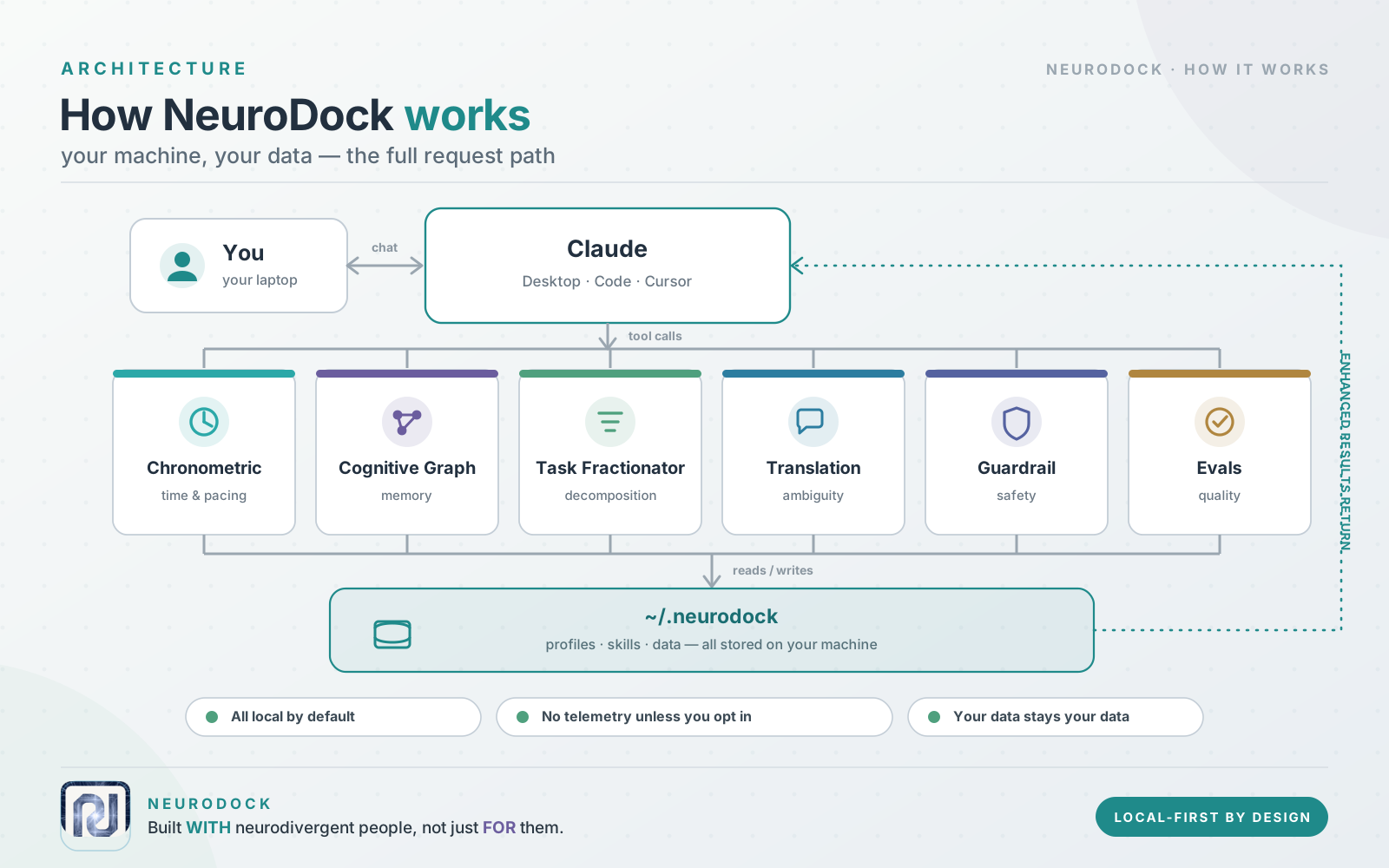
Everything runs on your laptop. Nothing leaves your machine unless you
explicitly turn on a cloud option.
## Install
```sh
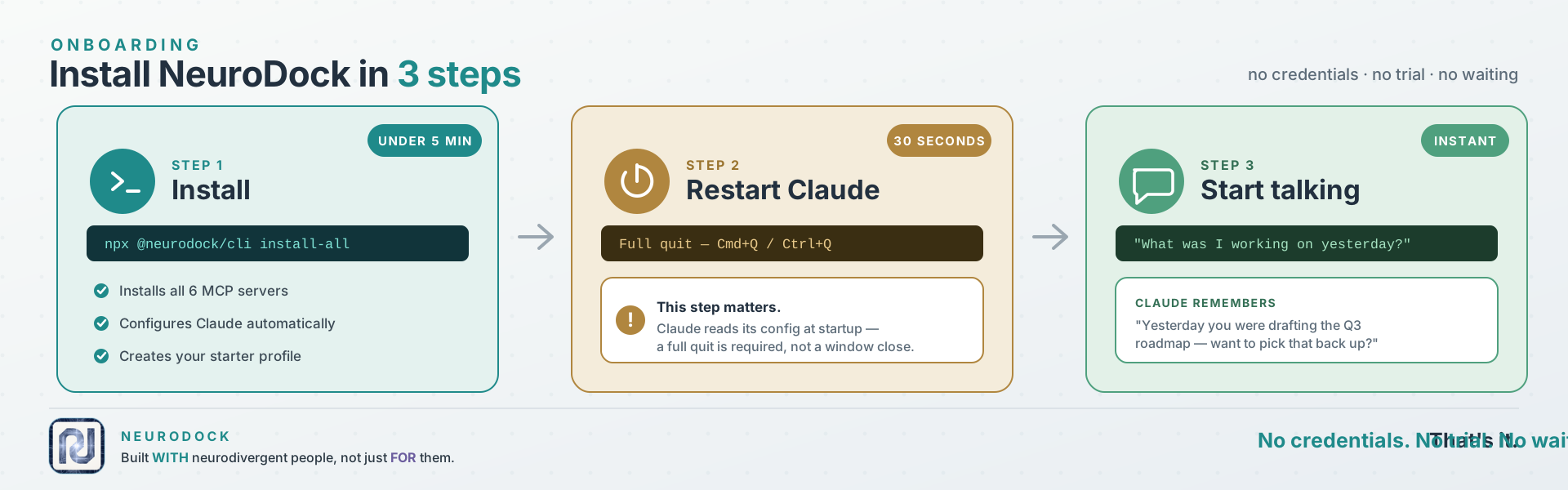
npx --yes @neurodock/cli@latest install-all
```
One command. It pip-installs the five MCP servers (plus the `neurodock-evals`
harness), wires Claude Desktop / Claude Code / Cursor, and drops a starter
profile at `~/.neurodock/profile.yaml`.
Then, **in any conversation**, try one of:
```
What was I working on yesterday?
Plan my morning.
Decompose this goal into atomic tasks.
```
Claude calls the MCP tools under the hood; you just talk.
> ### 🛑 First-time gotcha: full-quit Claude before testing
>
> Claude only reads its MCP config at startup. **Closing the window is not
> enough.** This is the #1 silent failure people hit.
>
> - **macOS:** `Cmd + Q` (or Claude menu → Quit Claude).
> - **Windows:** right-click the Claude icon in the system tray → **Quit**.
> - **Linux:** kill the process (`pkill -f Claude` or quit from the tray).
>
> Then reopen Claude and try one of the prompts above.
Requires Python 3.11+ and Node 22+. Works on macOS, Linux, Windows.
> **Why `@latest`?** If you previously ran `npm install -g @neurodock/cli`,
> npx will silently reuse that older global install instead of fetching the
> current version — and old versions don't have `install-all`. The `@latest`
> tag forces npx to resolve against the npm registry every time. Same reason
> we use it on `update`.
Want to install it step-by-step instead?
NeuroDock ships across two registries: the Python **MCP servers** (MCP =
Model Context Protocol — the standard that lets Claude call local tools)
on PyPI, and the user-facing **CLI** on npm. The CLI wraps everything else.
**1. Install the six MCP servers**
```sh
pip install neurodock-mcp-chronometric neurodock-mcp-cognitive-graph neurodock-mcp-task-fractionator neurodock-mcp-translation neurodock-mcp-guardrail neurodock-evals
```
**2. Wire them into your MCP-aware client**
```sh
npx --yes @neurodock/cli@latest init
```
Detects Claude Desktop, Claude Code, or Cursor and writes the server
entries automatically.
**3. Restart Claude** (full quit, not close-window — see the callout above).
**About the `neurodock` command** — it lives on npm as `@neurodock/cli`,
**not** on PyPI. The `pip install` step gives you the MCP server binaries
that Claude calls over stdio; the CLI is separate. Two ways to run it:
```sh
# Option A — run via npx, no install
npx --yes @neurodock/cli@latest doctor
# Option B — install once, call 'neurodock' from anywhere
npm install -g @neurodock/cli
neurodock doctor
```
`@neurodock/cli` exposes: `init`, `doctor`, `validate`, `update`, `sync`,
`uninstall`, `host install`, `host uninstall`, `profile show`,
`profile validate`, `install-all`, `install-hooks`, `examples`,
`plugin add/remove/list/enable/disable/validate`.
### Proactive guardrails (optional, recommended)
By default NeuroDock waits for you to ask. That's the wrong shape — an
ND user in hyperfocus is the one least likely to remember to run a
break tool. One command flips it:
```sh
neurodock install-hooks --self-test
```
This wires a small Python script (bundled, stdlib-only — no extra
install needed) into Claude Code's hook system. It then runs silently
on every tool call and auto-fires the chronometric / rumination /
sycophancy heuristics when patterns trip. You get a one-line stderr
banner on the next prompt — never blocked, always dismissible.
For host-agnostic coverage (catches you working in the terminal at
02:00 too), add the standalone daemon:
```sh
neurodock install-hooks --install-daemon --self-test
```
That registers a per-user autostart entry (HKCU Run on Windows,
LaunchAgent on macOS, systemd `--user` on Linux). The daemon polls
every 5 min and surfaces OS-native notifications.
Opt out anytime:
```sh
neurodock install-hooks --uninstall # removes both
export NEURODOCK_GUARDRAILS=off # disables without removing
```
The browser extension carries its own equivalent (Phase 2 watchdog) —
it's enabled by default and toggleable from `chrome.storage.local` via
the popup Settings tab.
See [`docs/.../proactive-guardrails`](https://github.com/tlennon-ie/neurodock/blob/HEAD/docs/src/content/docs/concepts/proactive-guardrails.mdx) for the design behind this and the
opt-out matrix.
Want to see it work without installing from PyPI/npm at all?
`TESTING_LOCAL.md` walks through the from-clone path.
Prefer a plugin, a one-click desktop extension, or the MCP Registry?
The `install-all` command above is the recommended path. The same servers are
also distributed through three standard channels — all install the identical
local stdio servers, so you can pick whichever fits your client:
**Claude Code plugin** — bundles the five MCP servers _and_ a set of ND-aware
skills in one step. Requires [`uv`](https://docs.astral.sh/uv/) (the servers
run via `uvx`).
```
/plugin marketplace add tlennon-ie/neurodock
/plugin install neurodock@neurodock
```
**Claude Desktop extension (`.mcpb`)** — one-click install, no config editing.
One bundle per server under [`mcpb/`](https://github.com/tlennon-ie/neurodock/blob/HEAD/mcpb/); build with
`npx @anthropic-ai/mcpb pack mcpb/neurodock-mcp-translation` and drag the
`.mcpb` onto Claude Desktop → Settings → Extensions. Requires `uv`.
**Official MCP Registry** — each server ships a
[`server.json`](https://github.com/tlennon-ie/neurodock/blob/HEAD/packages/mcp-translation/server.json) and is published to
[registry.modelcontextprotocol.io](https://registry.modelcontextprotocol.io)
under the `io.github.tlennon-ie/*` namespace, so MCP-aware clients can discover
them directly.
**Hosted remote server (no install)** — the stateless tools (translation,
guardrail, and `decompose`) are also served over OAuth at a hosted HTTPS
endpoint, so you can use them with no local install and no `uv`:
```
https://mcp.neurodock.org/mcp
```
In Claude (claude.ai or Desktop) → **Settings → Connectors → Add custom
connector** → paste that URL → complete the sign-in prompt. The eight stateless
tools appear immediately. An opt-in memory surface (`enable_hosted_storage`,
`connect_byos_storage`, `record_fact`, `recall_entity`, …) is also exposed but
does nothing until you explicitly enable storage for your signed-in account. The
personal cognitive graph and neurotype profile are **never** hosted — they stay
on the local install. Full walkthrough: [Hosted server](https://github.com/tlennon-ie/neurodock/blob/HEAD/docs/src/content/docs/getting-started/remote.mdx).
The hosted remote server is live at `mcp.neurodock.org`.
## Update
```sh
npx --yes @neurodock/cli@latest update
```
One command. Upgrades all six MCP servers (`pip install --upgrade` /
`uv tool install`), refreshes your wired client configs, and
re-registers the optional native-messaging host. Same flags as
`install-all` (`--client`, `--profile`, `--installer`, `--dry-run`,
`--no-native-host`, `--yes`).
The browser extension auto-updates through the Chrome / Firefox / Edge
store; sideloaded users `git pull` and rebuild.
> Full-quit Claude after updating so it re-reads its MCP config — same
> as first install.
Just want to re-shape client configs without touching package versions?
Use `neurodock sync`.
## See it in action
**The cognitive substrate in a real session** — you talk to Claude normally;
under the hood it calls NeuroDock's MCP tools to remember, pace, and decompose.
https://github.com/user-attachments/assets/bcbf65ce-88dd-4f83-8dc1-d56bdde01bed
**The browser extension** — translating corporate-speak inline on Gmail, Slack,
and the rest, right where you read it, without context-switching back to Claude.
https://github.com/user-attachments/assets/5fa25044-923e-4c25-95bd-f1bd63fb3d6e
> Prefer a written walkthrough? Try the [Claude Desktop walkthrough](https://github.com/tlennon-ie/neurodock/blob/HEAD/examples/claude-desktop/README.md).
## Browser extension (optional)
There's also a browser extension that translates corporate-speak inline on
Gmail, Slack, Linear, Notion, GitHub, Google Docs, and Outlook. It calls
the same translation tools the MCP server exposes, but surfaces them
where you'd actually use them — a floating Translate button plus a
right-click menu — so you don't have to context-switch back to Claude
just to decode "let's circle back on this."
You pick the LLM provider. Five options: Ollama (local, default), LM
Studio (local), OpenRouter (including its auto-router), Anthropic, OpenAI.
The API key, if you need one, stays in `chrome.storage.local` and never
leaves the device.
Store submission is still pending (the listing prep is done; the developer
accounts and screenshots aren't). Until then, load it manually:
1. Build it: `pnpm --filter @neurodock/extension-browser run build`
2. Chrome / Edge: go to `chrome://extensions`, turn Developer mode on,
click **Load unpacked**, and pick `packages/extension-browser/.output/chrome-mv3/`.
3. Firefox: go to `about:debugging`, click **This Firefox** → **Load
Temporary Add-on**, and pick `manifest.json` inside
`packages/extension-browser/.output/firefox-mv3/`.
Full per-provider setup walkthrough lives in
[`packages/extension-browser/README.md`](https://github.com/tlennon-ie/neurodock/blob/HEAD/packages/extension-browser/README.md).
## What's inside
NeuroDock is built around three pillars. Each pillar is made of small,
independent packages that you can use one at a time or all together.
```mermaid
flowchart TB
subgraph cognitive[Cognitive substrate]
chrono[mcp-chronometric
time + sessions]
cgraph[mcp-cognitive-graph
memory]
frac[mcp-task-fractionator
decomposition]
end
subgraph comms[Communication layer]
trans[mcp-translation
tone + meetings]
ext[extension-browser
Gmail, Slack, ...]
end
subgraph safety[Clinical guardrails]
guard[mcp-guardrail
rumination / hyperfocus / sycophancy]
clin[clinical
heuristic library]
end
skills[skills/
six markdown bundles] --> cognitive
skills --> comms
skills --> safety
cli[cli/
install + manage] --> cognitive
cli --> comms
cli --> safety
```
Prefer the directory tree? Open this.
```
neurodock/
├── packages/
│ ├── mcp-chronometric/ Time + session + break management
│ ├── mcp-cognitive-graph/ Persistent memory + entity recall (SQLite)
│ ├── mcp-task-fractionator/ Decompose vague goals into atomic tasks
│ ├── mcp-translation/ Corporate-speak translator (MCP + browser ext)
│ ├── mcp-guardrail/ Rumination / hyperfocus / sycophancy detectors
│ ├── skills/ Six SKILL.md bundles activating on phrases
│ ├── extension-browser/ WXT-built Chrome / Firefox / Edge extension
│ ├── native-host/ Optional native messaging host (extension <-> profile.yaml)
│ ├── cli/ `npx neurodock init` and friends
│ ├── core/ Shared types, profile schema, plugin spec
│ ├── clinical/ Heuristic library for the guardrail server
│ └── evals/ Eval harness + corpus contribution pipeline
├── docs/ Astro Starlight site (deploys to docs.neurodock.org)
├── plugins/ Drop your own plugins here; auto-discovered
└── profiles/ Curated profile presets
```
## Status
**Public preview shipped.** All three substrate pillars (cognitive,
communication, guardrails) are built, on `main`, and installable from
npm + PyPI. Latest substrate tag: `v0.7.3`.
### MCP servers (PyPI)
- **`neurodock-mcp-chronometric`** — 5 tools, 22 tests, mypy `--strict`.
- **`neurodock-mcp-cognitive-graph`** — 4 tools, SQLite + sqlite-vec
- fastembed; 4-rung resolution cascade (exact → alias → fuzzy → embedding).
Latest patch ships friendlier `record_fact` errors so wrong-shape input
no longer leaks raw Pydantic traces.
- **`neurodock-mcp-task-fractionator`** — 2 tools, 32 tests; ISO 8601
duration spec.
- **`neurodock-mcp-translation`** — 4 tools, 29 tests; deterministic
baseline plus LLM refinement envelope.
- **`neurodock-mcp-guardrail`** — all three detectors live: rumination,
hyperfocus, sycophancy (48 tests, public heuristics).
- **`neurodock-evals`** — air-gapped harness, 10 seed corpus examples,
contribution pipeline.
- **`neurodock-clinical`** — reserved name; importable detector library
(currently a stub).
### CLI + browser surface (npm)
- **`@neurodock/cli`** — 19 verbs across 7 groups: `init`, `install-all`,
`examples`, `doctor`, `validate`, `update`, `sync`, `uninstall`,
`host install/uninstall`, `profile show/validate`, `install-hooks`,
`plugin add/remove/list/enable/disable/validate`. `install-hooks`
wires the proactive-guardrail hook into Claude Code and optionally
registers the standalone daemon.
- **`@neurodock/core`** — profile schema and plugin protocol manifests
(JSON Schema 2020-12).
- **`@neurodock/native-host`** — optional Chrome Native Messaging host
for the extension ↔ profile sync.
- **`@neurodock/extension-browser`** — WXT MV3 build for Chrome / Firefox
/ Edge. Seven sites wired. Five real LLM providers: Ollama, LM Studio,
Anthropic, OpenAI, OpenRouter. Includes the Phase 2 proactive watchdog
for hyperfocus / late-night / single-host rumination signals.
**Not yet store-published.**
### Skills + docs
- **Six launch skills** — `adhd-daily-planner`, `audhd-context-recovery`,
`ocd-decision-finalizer` (beta), `hyperfocus-formatter`, `visual-organizer`,
`asd-meeting-translator`.
- **Docs site** — builds clean (Astro Starlight), deploys to
[`docs.neurodock.org`](https://docs.neurodock.org).
### Still deferred
- **Browser-store submissions** — Chrome Web Store, Firefox Add-ons, Edge
Add-ons developer accounts + screenshots; manual step.
## How to actually test it right now
**`TESTING_LOCAL.md`** — step-by-step guide to running this against your
Claude Desktop, today, from a clone. Takes about 5 minutes.
## Documentation
The docs site lives at [`docs.neurodock.org`](https://docs.neurodock.org).
Source is at `docs/src/content/docs/`. To preview locally:
```bash
pnpm --filter @neurodock/docs run dev
# opens http://localhost:4321
```
## Architecture
The substrate splits into three pillars:
1. **Cognitive substrate** — externalises executive function (time,
memory, decomposition). MCP servers: chronometric, cognitive-graph,
task-fractionator.
2. **Communication layer** — translates corporate ambiguity; rewrites
outgoing messages for register-appropriate tone; structures meeting
transcripts. MCP server: translation. Browser extension surfaces the
same prompts in Gmail / Slack / Linear / Notion / GitHub / Docs / Outlook.
3. **Clinical guardrails** — detects and intervenes on rumination
(repeat-validation loops), hyperfocus (escalating session-length
nudges), and sycophancy (unconditional agreement). MCP server: guardrail.
Heuristics are public and auditable per `ETHICS.md`.
All three layers compose via the same MCP protocol the LLM client already
speaks. There's no "NeuroDock app" — the surface is your Claude client.
Design rationale lives in `docs/decisions/`:
- ADR 0001 — chronometric tool design
- ADR 0002 — cognitive-graph tool design
- ADR 0003 — task-fractionator tool design
- ADR 0004 — profile schema
- ADR 0005 — translation tool design
- ADR 0006 — guardrail tool design
- ADR 0007 — plugin protocol
- ADR 0008 — distribution & remote strategy
## Contributing
`CONTRIBUTING.md` has the welcome + on-ramp. Pick whichever lane matches
what you want to do:
**Smallest first PR (~15 min):**
- Add a test to an existing skill (`packages/skills//tests/`)
- Add a seed eval example (`packages/evals/corpora/translation/`)
- Improve a tool's parameter description (the LLM uses these — clearer
descriptions = better tool use)
**One-afternoon PR:**
- Write a new skill — markdown bundle activating on specific phrases.
Copy any `packages/skills//` as a template; see
`docs/src/content/docs/contribute/write-a-skill.mdx`.
- Sharpen the task-fractionator heuristics (regex / domain keyword maps).
- Add a new entity-resolution heuristic (e.g., phonetic) to
`mcp-cognitive-graph`.
**Multi-day PR:**
- Build an out-of-tree plugin (skill / mcp-server / profile / translation
pack / language pack / theme) per the ADR 0007 plugin protocol. See
`docs/src/content/docs/contribute/write-a-plugin.mdx`.
- Translation language pack (e.g., Hiberno-English, German directness norms,
Japanese keigo).
**No code:**
- Add an anonymised eval example from your own corporate inbox. The
contribution pipeline lives in `packages/evals/` and is the highest-
leverage non-code contribution.
All PRs run CI: `pnpm turbo run lint typecheck test build` + `uv run pytest`
- `uv run mypy --strict packages/...`. Every published package has its
own CHANGELOG. Use Conventional Commits in PR titles (`feat:`, `fix:`,
`docs:`, `test:`, `chore:`, `ci:`).
## Manifesto (short)
1. **Lower friction for users, and for contributors.**
2. **Local-first by default; cloud is opt-in.**
3. **The user is the authority.** Self-ID sufficient.
4. **Composable over monolithic.** No god-modules.
5. **Refuse where appropriate.** AI that fuels rumination, hyperfocus, or
anxiety is a regression, not a feature.
Full text in `MANIFESTO.md`. Ethics framework in `ETHICS.md`. Governance
in `GOVERNANCE.md`.
## License
[AGPL-3.0-or-later](https://github.com/tlennon-ie/neurodock/blob/HEAD/LICENSE). Plugins must declare an AGPL-compatible license
to load — the SPDX whitelist is in ADR 0007.