---
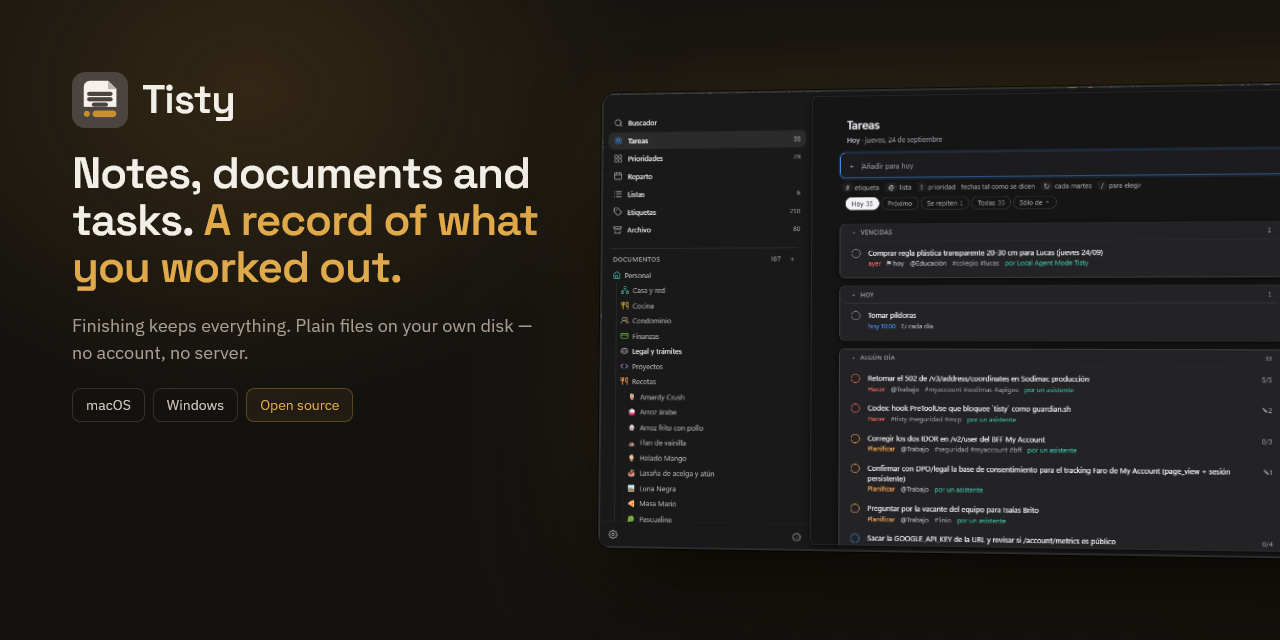
**Tisty** is Opensource. Read it, build it, run it, or take one of the stable
releases already out there. Nothing is hidden and all of it can be audited.
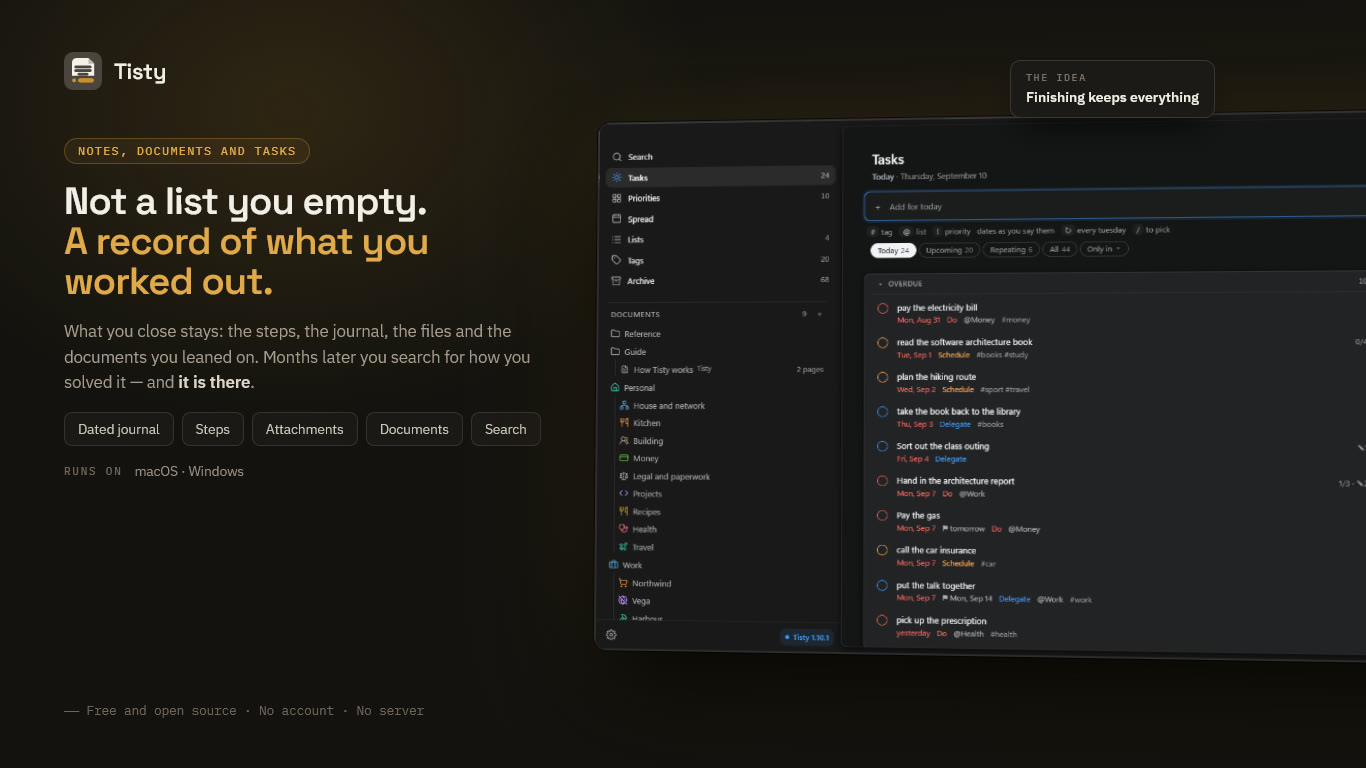
It is not a **to-do app** as you know it. A list gets emptied and forgotten. Here
what you close stays: what you did, when, and what you worked out on the way.
Months later you search for how you solved something and it is there — the
description, the journal, the steps, the documents you leaned on.
I am not a company. I am a developer who kept solving the same problem twice, so
I built the **notes, documents and task manager** I wanted and gave it away. It
is meant to stay small and useful, not to grow a thousand features nobody uses.
No ads, no telemetry, no accounts, no subscriptions — a **local-first
productivity tool** that lives on your machine and nowhere else.
**Why people choose Tisty over other task managers:**
- **100% local** — your tasks, your journal and your documents never leave your
computer. No cloud, no server, no account. If you sync two machines, you can
ask Tisty to leave the largest attachments in that shared folder instead of
carrying them onto every disk; it never does that unless you choose it.
- **Truly free** — no premium tier, no feature gates, no trial. AGPL v3, and
[commercial terms](https://github.com/rgdevment/Tisty/blob/HEAD/docs/COMMERCIAL.md) only for organisations that cannot
comply with it.
- **Your data outlives the app** — plain text and Markdown on your own disk,
readable with `cat` and searchable with `grep`.
- **Finishing keeps everything** — completing a task moves it to the archive
with its steps, its notes and its attachments intact, documents included.
- **Fast and native** — a Rust core inside a Tauri window: it starts quickly,
stays small, and looks like it belongs on both systems.
> I use Tisty every day on macOS and Windows. If something feels off,
> [open an issue](https://github.com/rgdevment/Tisty/issues) — this project
> keeps improving because of real-world use.
>
> **It is for one person, by design.** No assignees, no permissions, no boards.
> If you need to run a team, Tisty will not carry that.
## Table of Contents
- [Why I Built This](#why-i-built-this)
- [What It Is / What It Isn't](#what-it-is--what-it-isnt)
- [What Makes It Different](#what-makes-it-different)
- [Who Is This For?](#who-is-this-for)
- [The Idea It Is Built On](#the-idea-it-is-built-on)
- [Getting Started](#getting-started)
- [What It Does](#what-it-does)
- [Your Data and Privacy](#your-data-and-privacy)
- [Two Machines, If You Have Two](#two-machines-if-you-have-two)
- [A Command Line, If You Want One](#a-command-line-if-you-want-one)
- [An Assistant, If You Use One](#an-assistant-if-you-use-one)
- [What It Will Never Do](#what-it-will-never-do)
- [FAQ](#faq)
- [Alternatives](#alternatives)
- [Localization](#localization)
- [Other Tools by the Same Author](#other-tools-by-the-same-author)
- [Support the Project](#support-the-project)
- [Standing On](#standing-on)
- [Contributing](#contributing)
- [Licence](#licence)
- [Project health](#project-health)
## Why I Built This
Organising your day is harder than a list makes it look. There are more moving
parts than fit in your head, plans shift under you, and something you thought
was small turns out not to be. Which is why finishing it feels good.
But look at what the task gathered on the way. The steps it actually took. The
notes you wrote while working it out. What you looked up, what it turned out to
connect to, the documents you leaned on. That is where the effort went.
Mine looked like *"fix the intermittent timeouts on save"*. By the time it was
done it had collected the ticket, the commit, and two paragraphs explaining that
the real cause was a missing index on a table nobody was looking at.
Eight months later the same thing happened somewhere else. I remembered solving
it. I could not remember how — and the note that held the answer had gone with
the tick.
**That is the whole reason Tisty exists.** A task is not a line you cross out.
It is a tree: the steps, the journal, the files and the documents that grew
around it while you worked. Finishing it should not prune it.
I wanted it to stay mine, too. On my disk, in files I can open without asking
anyone. So I built the thing I wanted, used it until it stopped annoying me, and
put it here in case it is the thing you wanted too.
## What It Is / What It Isn't
**It is** a personal task manager where finishing something is the beginning of
its useful life. Tasks carry a description, a journal, steps and attachments;
when you complete one it moves to the archive, and search reaches all of it,
documents included.
**It is for one person.** No assignees, no permissions, no boards. If you need
to run a team, Tisty will not carry that, and you deserve to know before you
install it rather than after.
**It is not something I sell.** Nothing is locked, nothing expires, and there is
no version of this with more in it. It is a program I wrote for myself and gave
away.
**Your data is files.** Plain text on your own disk, readable with `cat` and
searchable with `grep`. If Tisty disappeared tomorrow, everything you wrote
would still be there and still make sense.
## What Makes It Different
If you are looking for a **free, open-source, offline task manager with no
account, no subscription and no AI**, this is what Tisty is:
| | |
|---|---|
| Your tasks live | in plain files on your own disk |
| Account | none, ever |
| Subscription | none. There is no paid tier and no upgrade |
| Offline | always. There is no server to be away from |
| AI inside | **none**, and none is coming |
| Your own assistant | yes, over **MCP**, if you choose to open the door |
| Priorities | the **Eisenhower matrix**, by its name |
| Sorting | lists, tags, steps and a journal on every task |
| Documents | written and searched beside the tasks, not in another app |
| Attachments | kept with the task, as themselves |
| Finished work | an **archive that keeps what each task taught you** |
| Two machines | through a folder you already sync. No server of ours |
| Natural language | dates, deadlines and repeats, parsed on your machine |
| When to do it | a spread of days you deal work onto, and a month for looking |
| Reminders | an hour you choose, that rings on this machine and nowhere else |
| Source | open, auditable, yours to fork |
**The Eisenhower matrix, not numbered priorities.** A task is urgent, important,
both or neither — *do*, *decide*, *delegate*, *drop*. That names the decision
instead of hiding it behind a number, and it is the difference between a list
that sorts and a list that helps you choose. Around it: lists for where work
belongs, tags for what cuts across, steps for the parts, and a journal for what
you learn on the way.
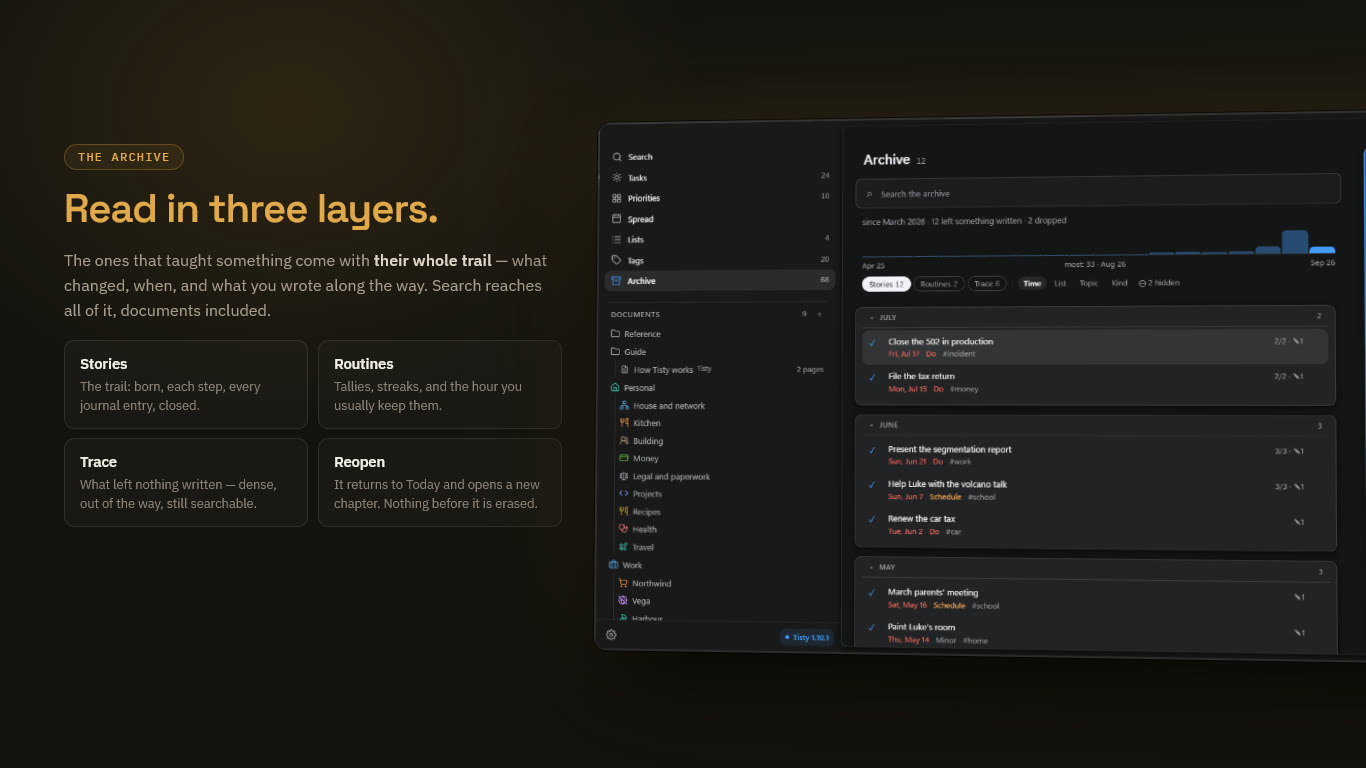
**Finishing is where it starts.** Most task managers treat a completed task as
rubbish to hide. Here it moves to an archive read in three layers: the ones that
taught something come with their whole trail — what changed, when, and what you
wrote — the routines come with their tallies and their streaks, and the rest is
the trace. Search reaches all of it, documents included. A year in, that archive
is the part you would miss.
**Your assistant, not one of ours.** Tisty has no AI in it. The natural language
that turns "call the bank at 3" into a task is rules running on your machine, no
model and no cloud. But it speaks [MCP](https://modelcontextprotocol.io), so an
assistant you already use can file work into it — with its steps, its date and
the list it belongs in, on this machine, with no account and nothing over the
network. You open that door, and you can close it.
**Two machines, no middleman.** If you already sync a folder, Tisty travels
through it. There is no server of ours in between, nothing to sign up for, and
nothing that stops working the day a company changes its mind.
**Free is not a tier here.** There is no upgrade, no seat count, no feature held
back for later. The reason is not generosity: a program that keeps your work on
your disk and never phones home has almost nothing to charge for, and asking
would make it worse.
## Who Is This For?
Someone who works alone, or mostly alone, and whose tasks leave a trail worth
keeping. Developers, sysadmins, freelancers, researchers, students — anyone who
has ever solved the same problem twice and known it the second time.
If what you want is a list to cross out and never open again, Tisty will feel
like more than you asked for. That is a fair reason to walk away.
## The Idea It Is Built On
**A completed task is not finished. It is archived.**
It stops being a reminder of what to do and becomes the record of how something
got solved. Three things follow from that, and they shaped everything else:
- **Search is the main way into the archive**, not a side feature.
- **Deleting is the exception.** The normal ending is completing, which keeps
it. Erasing something for good is only for what is closed and reads as a
trace; a story is only hidden, and converting it to a trace is the deliberate
step that lets it go.
- **Capture has to stay instant**, because most tasks are not like that at all.
The call you have to make tomorrow is born and dies within a day and leaves
nothing worth keeping — and writing it down must not cost more than one line.
## Getting Started
**Windows** — from the
[Microsoft Store](https://apps.microsoft.com/detail/9PGVWXD8X93N), which keeps
it updated for you. About asks the Store for one on the spot when you would
rather not wait. Or with the Windows Package Manager, which takes the signed
installer from the releases page and then stands aside, because Tisty keeps
itself up to date:
```console
> winget install rgdevment.Tisty
```
**macOS** — with [Homebrew](https://brew.sh). The tap is added once and never
again. After that Tisty keeps itself up to date, so Homebrew stands aside:
```console
$ brew tap rgdevment/tap
$ brew install --cask tisty
```
Or take the disk image and the installer straight from
[Releases](https://github.com/rgdevment/Tisty/releases), on either system.
On macOS there are two images: `aarch64` for Apple Silicon and `x86_64` for
Intel — Apple menu › *About This Mac* says which one yours is. Homebrew picks
by itself.
## What It Does
**The first time it opens**, Tisty asks two things — which language, and where
your copies should go — and then writes you a guide and opens it. Everything
else it decides for you and lets you change later: it starts with the computer
and waits out of the way, because those were questions with an obvious answer.
The guide is a document in your own store, in a folder of its own: yours to
read, edit, or throw away like anything else you wrote.
**Settings answers four questions rather than wearing five labels.** *General*
is how Tisty behaves towards you — language, start-up, the quick capture,
notices, updates, and the two things that happen outside the window: the command
line and the welcome. *Your data* is everything that touches your files, with
syncing as a block of its own because it has a state, a warning that depends on
who keeps your folder, and four actions. *Assistants* and *Maintenance* are what
they say.
**Three columns at most:** what you are looking at, the list, and the task you
opened. Nothing else on screen.
**The list stands where it stands.** It does not drift to the middle of whatever
room is left, so opening a task moves nothing. Where the window is wide enough,
the space that opens up is not left blank: a column tells you the day — what is
overdue, what is for today, what is ahead, the four quadrants with their counts,
the lists holding something and the tags in use. All of it counts your whole
store rather than the slice on screen, and every figure is a way in. Narrow the
window and it steps aside; a task always wins the room over it.
**It reads what you write.** You type a sentence and Tisty takes the date out of
it, leaves the sentence readable, and shows you what it understood *before*
anything is saved — as chips you can correct with one click.
```text
"ship the release tomorrow at 10" → tomorrow 10:00
"file the report before friday" → due fri
"book the flights @travel #urgent" → @travel · #urgent
```
A day, a time, or both. Names, distances, plain dates. What it cannot read it
leaves alone rather than guess. A deadline is a different thing from a plan, and
three words open one: **before**, **due**, **until**.
**A task opens beside the list**, not on top of it: dates, list, tags, priority,
a description and a journal in Markdown, steps you tick one at a time, and
whatever you dropped on it. Completing it puts none of that out of reach. Opened
to the whole page it gains a column of its own trail — how long it has been
open, how much of it is done, and every change it has been through, which until
now sat at the bottom where nobody scrolled.
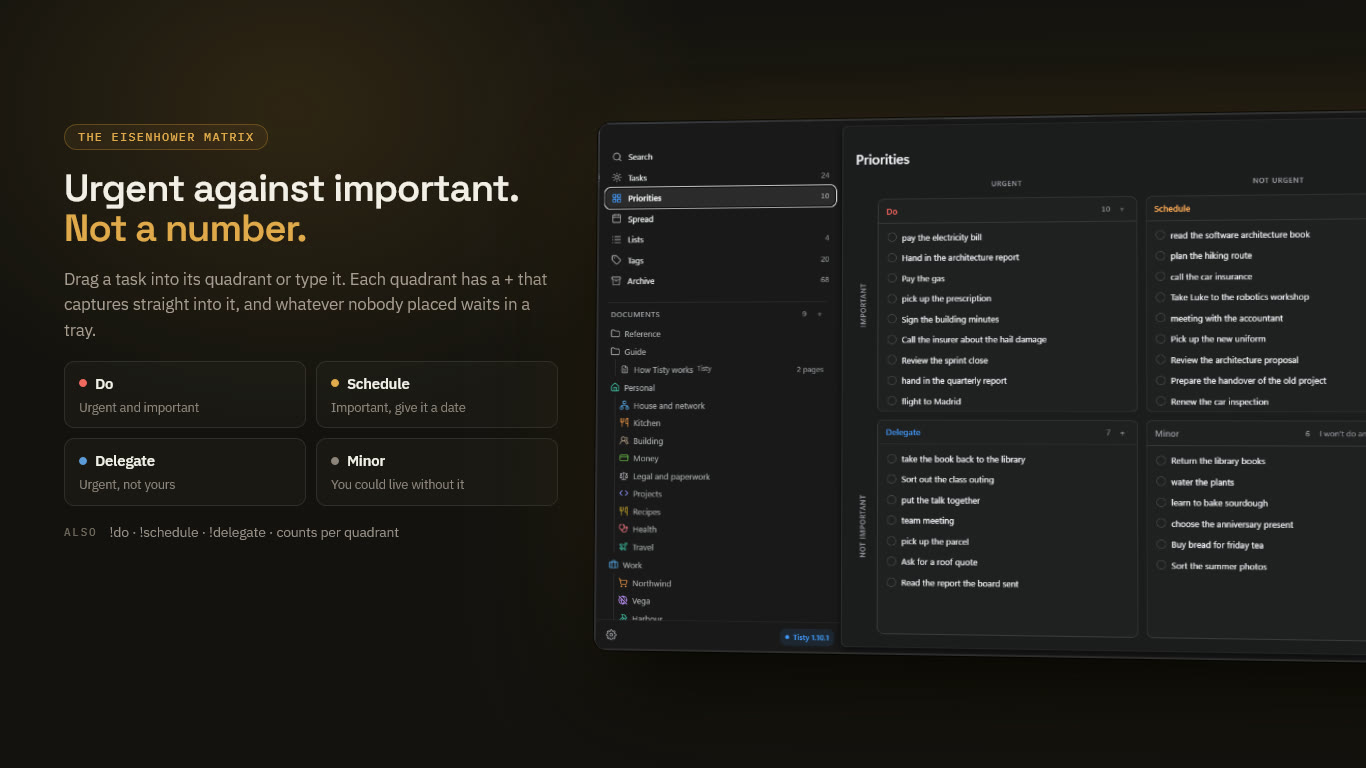
**Priorities are a matrix, not a ladder.** Tisty borrows the four quadrants
of the Eisenhower matrix — the method President Dwight D. Eisenhower is
credited with, popularised by Stephen Covey in *The 7 Habits of Highly
Effective People*: sort what you have by urgent against important, and each
quadrant tells you what to do with it. **Do** what is urgent and important,
**Schedule** what matters and is not urgent, **Delegate** what is urgent and is
not yours, and leave in **Minor** whatever you could live without — when you are
sure, one button drops the lot.
Drag a task into its quadrant, or type it: `!do`, `!schedule`, `!delegate`.
`!decide` still works, because it is what the quadrant used to be called. Each
quadrant has a **+** that opens the quick capture with that quadrant already
set, and whatever nobody has placed waits in a tray that opens the way you
left it.
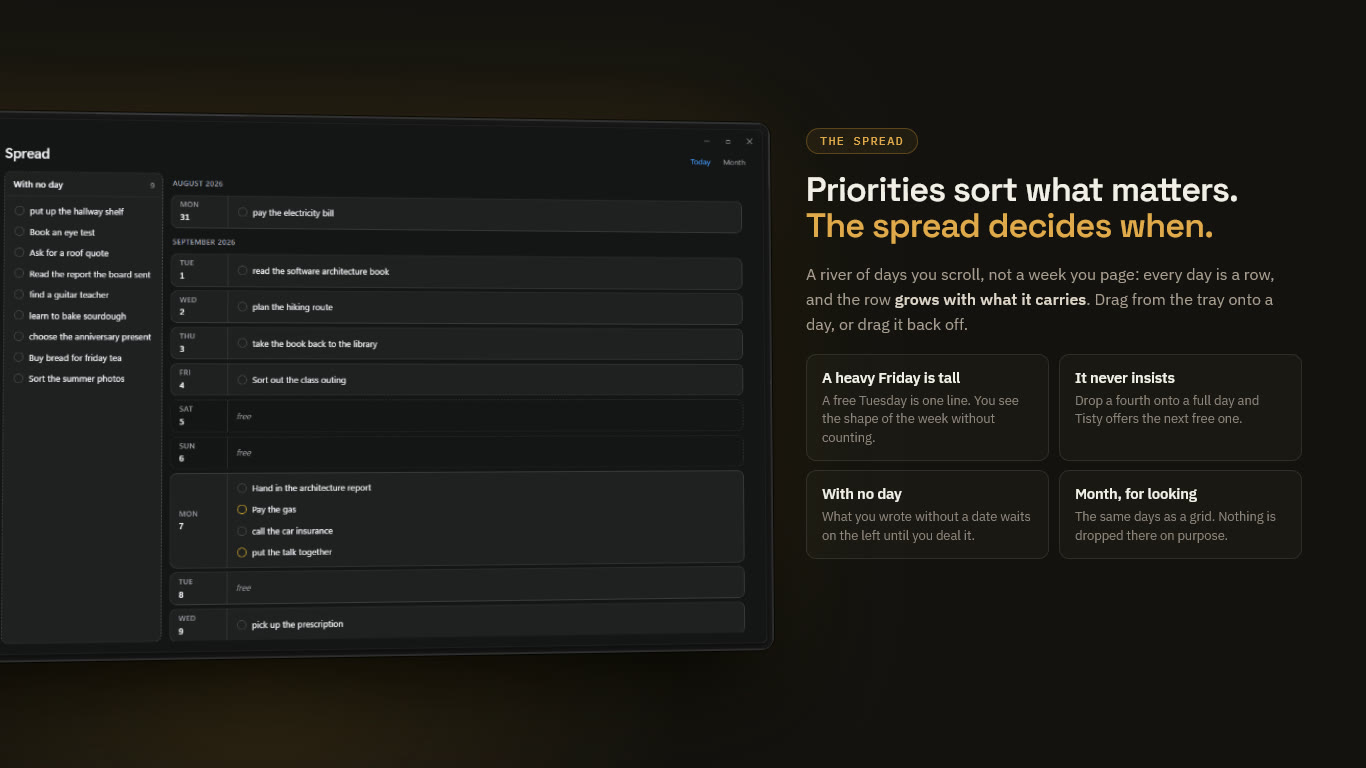
**The spread deals your days, one row at a time.** Priorities sort what matters;
the spread decides when. It runs as a river of days you scroll through rather
than a week you page: every day is a row, and the row grows with what it carries,
so a heavy Friday is tall and a free Tuesday is a line. What you wrote with no
day waits in a tray on the left, and you drag it onto a day — or drag it back to
take the day away again. Drop one onto a day that already carries three and
Tisty says so, and offers the next day that is free; it never insists.
A **month** button is there for looking, not for dealing: press it and the same
days lay out as a grid, press a day and you land on it in the river. Nothing is
dropped there on purpose. Tisty cannot see the calendar you keep somewhere else,
so a square with nothing written on it is only a square with nothing written on
it — never a promise that the day is yours.
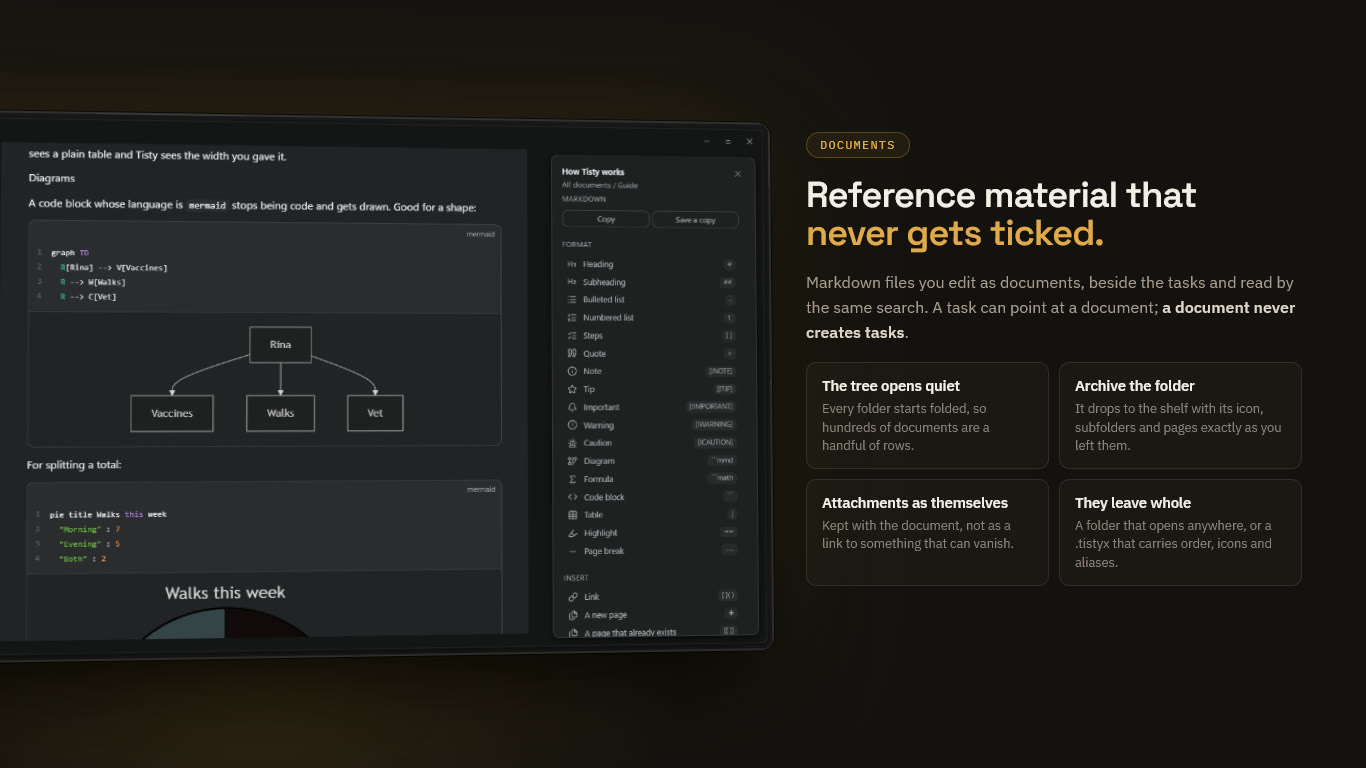
**Documents** live beside the tasks, for reference material that has no date and
never gets ticked. They are Markdown files you edit as documents — tables,
checklists, code, images — and search reads them too. A task can point at a
document; a document never creates tasks.
**The tree opens quiet and closes whole.** Every folder starts folded, so a store
with hundreds of documents is a handful of rows until you go looking. When work
is over you archive the folder itself, not its documents one by one: it drops to
the shelf at the foot of the tree with its icon, its subfolders and its pages
exactly as you left them, closed to writing and to anything new coming in. Bring
it back and it returns the same — including whichever documents you had archived
by hand in there, which stay archived because nobody said otherwise.
**A page is put away on its own without leaving its document.** A long thing in
parts — a year of minutes, a book by chapters — is one document holding pages,
and a chapter that no longer applies goes to the archive where it lives: dimmed,
with the icon of the archive, read but not written. Put the whole document away
and every page goes with it; bring it back and each one returns as it was, the
one you had set apart still apart.
**A document takes tags the way a task does** — you write `#contract` in the
middle of a sentence and the document is filed under it. The tag lives in the
sentence rather than in a hidden header, so carrying the file to another editor
carries the tag with it. Tags is where they meet: one screen, the tasks under a
tag and the documents beneath them, and pressing a tag inside a document opens
exactly that. Accents come off and case is folded, so `#camion` and `#camión`
are one word however you typed them that day. A bare number is not a tag —
`#1234` is the ticket somebody wrote down, not a subject — and neither is a
single letter: two characters, one of them a letter.
Text can be highlighted in a few colours and set apart as an aside — a plain
quote, or a callout GitHub reads too, written as `> [!WARNING]`. Tables keep how
their columns lean and how wide you drew them, and a code block says what
language it is and is coloured for it, with its lines numbered beside the text
rather than in it, so copying takes the code and nothing else. A block can carry
a name; one whose language is `mermaid` draws the diagram it describes
underneath — redrawn when you turn the light on or off — and one that says
`math` sets the formula it holds.
**A web link on a line of its own is drawn as a card**, made from the address
itself — the site's name and the words you wrote. Nothing is fetched to draw it.
Press **Bring the preview** and Tisty asks that page once for its title, its
description and the picture it offers, keeps the answer here so it never asks
again, and reads no more of it than it needs: a page cannot decide how much of
your machine it takes.
**It stays Markdown**, and that is the point rather than a detail: everything
above is syntax another reader already understands, so the file survives without
Tisty — a block's name is what Markdown keeps after the language, and a column's
width rides in how long its rule is drawn, which every other reader ignores and
draws the same. Where Markdown genuinely cannot say a thing — an icon in a line
of text — Tisty writes the small piece of HTML that can, and reads it back.
Where the editor meets a shape it is known not to keep — front matter,
footnotes, links written by reference, blocks of HTML — it says so and opens
the document read-only rather than quietly destroying it. That list is what it
checks, not a promise about everything a Markdown file can hold.
The writing sits on a lit page, and the first line with words in it is both the
name of the document and its title — reading past a fence or an alert's marker to
find it. When the window is wide enough a column opens beside it
with what the document is, the formatting the `/` menu used to hide, and its
outline. **Tisty makes its own PDF** — A4, Letter or one endless sheet, with its
own margins and the attachments carried inside — and shows it to you before you
export it.
**And they leave whole.** A document copies as Markdown, writes out into a
folder with its pages and attachments beside it, or is exported for Tisty into a
`.tistyx` file that also carries what Markdown cannot say: folders with their order,
icon and colour, which document each page hangs from, what is archived, and the
alias it was signed with. It carries a `README.txt` as well, so whoever you hand
it to can read the documents without Tisty and knows where to find it if they
want the rest. Exporting all of them asks who they
are for: open, to hand to somebody, or locked with six digits for another
machine of your own — which is what makes them arrive there as yours rather
than as a stranger's. Either way, not one line of the history travels inside.
Write an alias — optional, and yours to choose — and every document is signed
with it, while whatever arrives from somebody else keeps theirs.
**A global shortcut** opens a small field over whatever you are doing, so a task
that occurs to you mid-something does not cost you the something.
**Repeating tasks** come back one occurrence at a time, so the archive shows you
did it twelve times — and it counts what was owed rather than only what you
closed, so a routine reads 26 of 30 with four dates that have no record. Marking
one days late offers those dates back instead of calling them forgotten: tick the
ones you did and the gap closes. **Reminders** arrive as a system notification and
a short sound you can turn off. The whole window works from the keyboard.
**The archive is read in three layers.** The ones that taught something come with
their whole trail — what changed, when, and what you wrote along the way. The
routines come with their tallies, their streaks and the hour you usually keep
them. The rest is the trace: what left little or nothing written, listed dense
and out of the way, because it still happened and search still reaches it. You
decide which layer each one reads in: a story that was only noise goes to the
trace, and a trace worth keeping is kept as a story. The trace is the only layer
that can be erased, and both erasing and hiding are one task at a time; a story
is only ever hidden.
## Your Data and Privacy
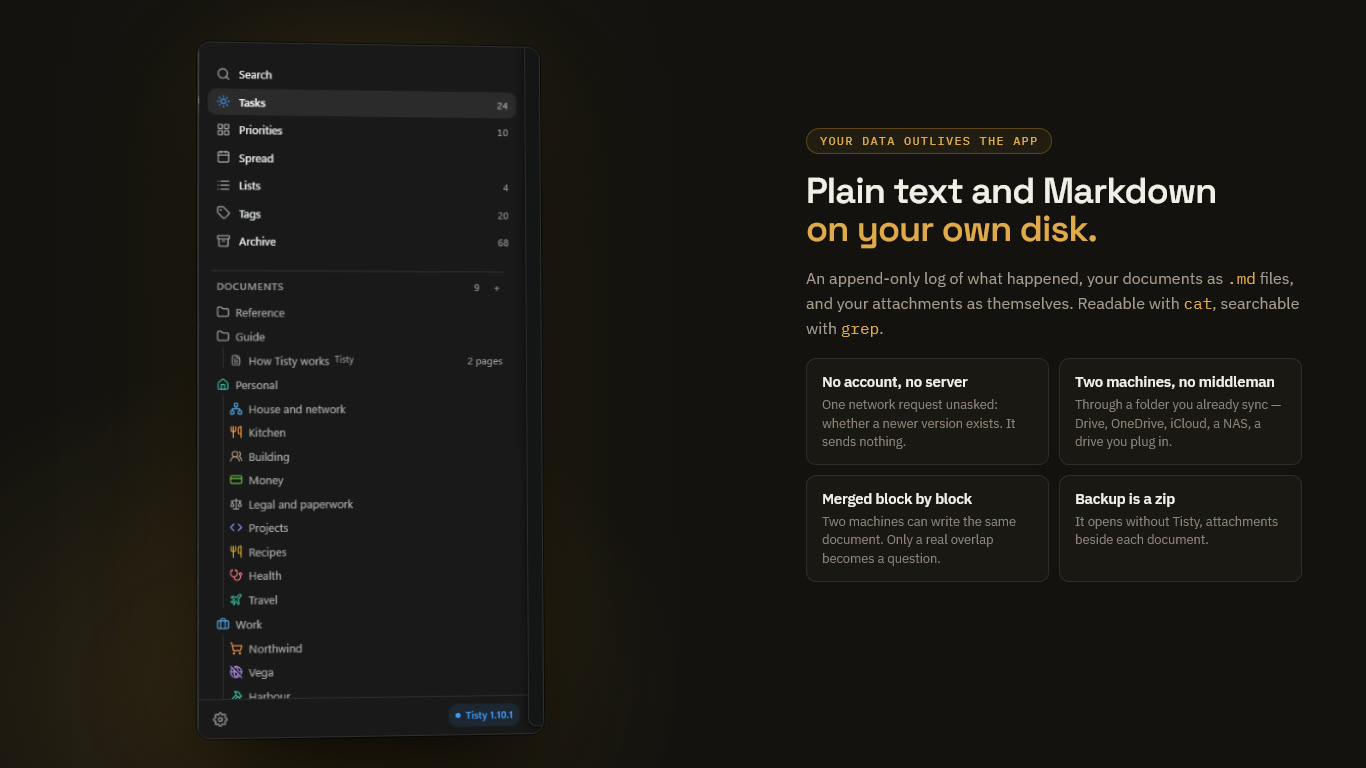
Everything lives in one folder on your disk: an append-only log of what
happened, your documents as `.md` files, and your attachments as themselves.
Nothing is obfuscated and nothing is in a format only Tisty can read.
**Nothing is encrypted at rest**, and that is a decision rather than an
oversight — your operating system's permissions are the protection, and the
files stay readable with tools you already have. It is written out in
[PRIVACY.md](https://github.com/rgdevment/Tisty/blob/HEAD/PRIVACY.md) and [SECURITY.md](https://github.com/rgdevment/Tisty/blob/HEAD/SECURITY.md), including the parts
that are not reassuring.
Tisty makes **one** network request unasked — when it opens, and once a day
after that: it checks whether a newer version exists. It sends nothing. If one
does exist and you press the button that offers it, two more follow — the file
naming the release, and the installer — and Tisty refuses to install anything
not signed with a key compiled into the copy you already have.
## Two Machines, If You Have Two
Tell Tisty where to leave the copies. It offers Google Drive, OneDrive, iCloud
and Dropbox — whichever it finds installed, folder already worked out — or any
other folder both computers reach, a NAS, a drive you plug in on Fridays. The
rest it does on its own.
There is nothing of mine in the middle: no account, no server, no daemon. Who
runs that folder is your business, not Tisty's. If you sync nothing, it never
opens a connection at all.
Two machines can genuinely write the same document at once, and there Tisty
merges them **block by block** — you edit the introduction on one, someone edits
the closing paragraph on the other, and both land with nothing to answer. Only a
real overlap becomes a question.
**Or back up by hand.** One zip, kept wherever you like.
**Where the big ones live is yours to say.** By default every machine carries
every attachment, which is why any of them can open anything with the network
off. Settings offers two other ways: keep only what this machine attached and
fetch the rest when you open it, or — above 50 MB — leave them in the shared
folder and nowhere else. That last one trades the copy on your disk for the
space it took: the file is there when your provider or your NAS is, and Tisty
says so plainly when it is not. A copy is only ever let go of after the one in
the shared folder is found to hash the same.
And because what uploads that folder is your provider's program and not
Tisty, if you ever change something on one machine and it does not turn up
on the other, [FAQ.md](https://github.com/rgdevment/Tisty/blob/HEAD/docs/FAQ.md) lists the causes worth checking, in order.
## A Command Line, If You Want One
The window is the way in. The terminal was a second one — the same store, the
same tasks, the same natural language — and it is being retired, by stages:
what it still does keeps working, no feature reaches it — only a rule the
window keeps for safety, which it obeys — and the task and document commands
go in the next major version. What stays is the `tisty`
binary itself, because it is the door your assistant comes through (`tisty
mcp`) and the place for maintenance: `doctor`, `sync`, `export`, `agent`.
```console
$ tisty doctor
$ tisty sync
$ tisty export --markdown
```
If you script against `tisty ls --json` or `tisty add`, plan to move: the
window is where Tisty happens, and the assistant's door is how a program
reaches it.
## An Assistant, If You Use One
**Tisty is not AI and has none inside.** The natural language that turns "call
the bank at 3" into a task is rules running on your machine: no model, no
request, no cloud. That is not going to change.
But if you already use an assistant, you are probably telling it things worth
keeping — the school group says card stock on Monday, the invoice is due on the
30th. So Tisty leaves a door, and you decide whether to use it.
Settings › Agents lists the assistants already installed on this computer and
connects the one you pick: it writes a single line into that assistant's own
settings, leaves the rest of that file where it was, and keeps a copy of it as
it was before. For one it does not know, a line does it:
```console
$