# surf [Health: Active]
**Category:** 💻 Developer Tools
**Repository:** https://github.com/GeckoVision/gecko-surf
**GitHub Stars:** 6
**Views:** 0
**Installs:** 0
**Upvotes:** 0
**Directory Page:** https://allmcps.com/mcp/surf
## Description
Point Gecko at an OpenAPI spec; get first-call-correct, auth-hidden agent tools.
## Claude Desktop Quick Installation
Install path detected from listing signals. Uses `npx` (confidence: high):
```json
"mcpServers": {
"surf": {
"command": "npx",
"args": ["-y","@geckovision/gecko"]
}
}
```
## Documentation & README
Stop letting your agent guess
Check the call before it counts. Gecko is open-source and runs on your machine:
one command maps any API — messy, paywalled, or on-chain — into a call graph your agent
checks instead of guesses from, and anything that spends is simulated to a
receipt first.
No wallet, no payment rail, no key held — fifteen mainnet transactions, fifteen exact
cost predictions.





Quickstart ·
Docs ·
Architecture ·
FAQ ·
Security
> **Built for the calls your agent must not get wrong.** Two axes, either one qualifies:
> a **messy surface** (paywalled, drifting, undocumented, on-chain) or a **high-stakes
> action** (your agent runs unattended with credentials or money).
## What Gecko is
Gecko is an **open-source knowledge graph built specifically for AI agents that call
APIs**. Point it at an OpenAPI spec, a docs site, or a Solana program's IDL and source,
and it reads that surface into a graph your agent traverses — every fact tagged with
where it came from, and anything it cannot establish **flagged rather than guessed**.
A specification tells your agent what a call *looks like*. It cannot tell it whether the
call will *work*. That gap is in every spec, including a perfect one, and it is where
agents fail expensively: not on the call that errors, but on the call that is accepted
and wrong. Gecko closes it by handing back one specific call — and, for anything that
spends, by simulating that call against real state first and returning a **receipt**.
It is not the agent and not an orchestrator. It holds no key, signs nothing, broadcasts
nothing, and stores no response payload — it stores surfaces and correctness metadata,
never your data.
## Quick start
No install:
```bash
npx @geckovision/gecko doctor # 1. check your environment
npx @geckovision/gecko add # 2. comprehend it — $0, no live call
npx @geckovision/gecko report # 3. get the scorecard — grade + findings
npx @geckovision/gecko serve # 4. your agent uses it over MCP
```
Or install once:
```bash
npm install -g @geckovision/gecko # prebuilt binary — no Python needed
uv tool install "gecko-surf[serve]" # or pip, if you want the Python package
gecko add
```
Plug into your agent:
```bash
# Claude Code
claude mcp add my-api -- npx -y @geckovision/gecko serve --stdio
# Cursor / VS Code / any MCP client — mcp.json
{ "mcpServers": { "my-api": { "command": "npx", "args": ["-y", "@geckovision/gecko", "serve", "", "--stdio"] } } }
```
Going live is a separate, deliberate step:
```bash
gecko auth set # key goes to your OS keychain — never mcp.json
```
Then your agent asks questions, not endpoints:
```
Which fixtures kick off in the next hour, and what are the current odds?
What is the peg state of USDC right now?
Plan a swap of SOL for USDC on Meteora, bin_step 4.
```
## Why
An OpenAPI says what exists. An IDL says what a program looks like. Neither is enough
to act:
- Docs drift. Working integrations broke twice in 2026 from silent layout changes.
- IDLs drop facts. A required Pump.fun account never appears in the IDL at all.
- Agents guess. A wrong guess posts a charge, reverts a transaction, burns fees.
Gecko replaces the guess with a graph:
- **Every edge carries provenance** — `extracted` from the surface, `recovered` from
source, or honestly `flagged` as unknown. Never fabricated.
- **Every action can be verified first** — simulated on a $0 mainnet fork to a
**receipt**: pass, or a classified revert, before any spend.
- **Every failure teaches** — outcomes land in a categorical corpus; a drift series
flags when a provider ships a change that breaks a working call.
- **Auth is invisible to the agent** — keys injected at call time from your keychain.
The model never sees a credential.
## Under the hood
Most agent-tool layers are thin wrappers. Gecko is a memory substrate, and three of
its design choices are deliberately different from the textbook:
| Choice | Why it matters |
|---|---|
| **Deterministic semantic memory** — lexical retrieval, no vector DB | the graph never "approximately" remembers; BM25 and vectors sit behind evidence gates |
| **Self-generated episodic memory** — categorical outcomes + a drift series | Gecko re-simulates to create its own episodes; no dependence on your data plane, no payloads stored |
| **Typed procedural memory** — plans as executable JSON | landing plans and derive orders a builder can run; text loses the join, ours can't |
And the depth is measured, not asserted:
- **The overlay artifact.** For every auto-comprehended program, Gecko emits the exact
list of facts that could **not** be derived from any public surface
([`overlays/`](https://github.com/GeckoVision/gecko-surf/blob/HEAD/gecko/providers/configs/orquestra/overlays/)) — the value of
comprehension, quantified per program.
- **Seven security layers, fail-closed:** spec sanitizer · per-tool quarantine · image
Skill Guard · SSRF netguard · out-of-band auth anchoring · verdict signing gate · an
AST-enforced never-sign boundary.
- **The numbers:** 2,400+ tests · 4 mainnet programs derivation-proven · 2 live
receipt-pairs · −77%/−89% measured context cuts · a 4,500-program catalog listed ·
0 auth headers exposed across 14 real specs.
**Explore the diagrams:** [architecture on docs.geckovision.tech](https://docs.geckovision.tech/architecture)
(all three views, rendered) · [the map in this repo](https://github.com/GeckoVision/gecko-surf/blob/HEAD/docs/architecture.md)
## Proof, not promises
Live, on a mainnet fork, $0:
| Case | Naive path | Gecko |
|---|---|---|
| Pump.fun buy | ❌ reverts — `AccountNotInitialized (3012)` | ✅ lands — 86,669 CU |
| Pump.fun sell | ❌ transfers the tokens, then reverts — `InvalidBondingCurveV2 (6074)` | ✅ lands — 50,783 CU |
| Meteora DLMM swap | ❌ reverts — derive-only, no ATA/wrap/bin-array preludes | ✅ wrap → swap → unwrap — 81,964 CU |
| Meteora pool derivation | ❌ stale 3-seed scheme → the wrong pool, silently | ✅ correct 4-seed derivation, differential-proven |
| Docs-only API (no spec) | agent invents endpoints | ✅ draft spec recovered, verified `VERIFIED/REFUTED` |
The facts behind those passes are not on any surface: a 4th PDA seed the SDK added in
2024, an account the IDL only mentions in prose, a fee field resolved by a refuting
simulation. That is the graph your agent traverses.
## Use cases
**TxLINE (paywalled sports odds) — without vs with Gecko**
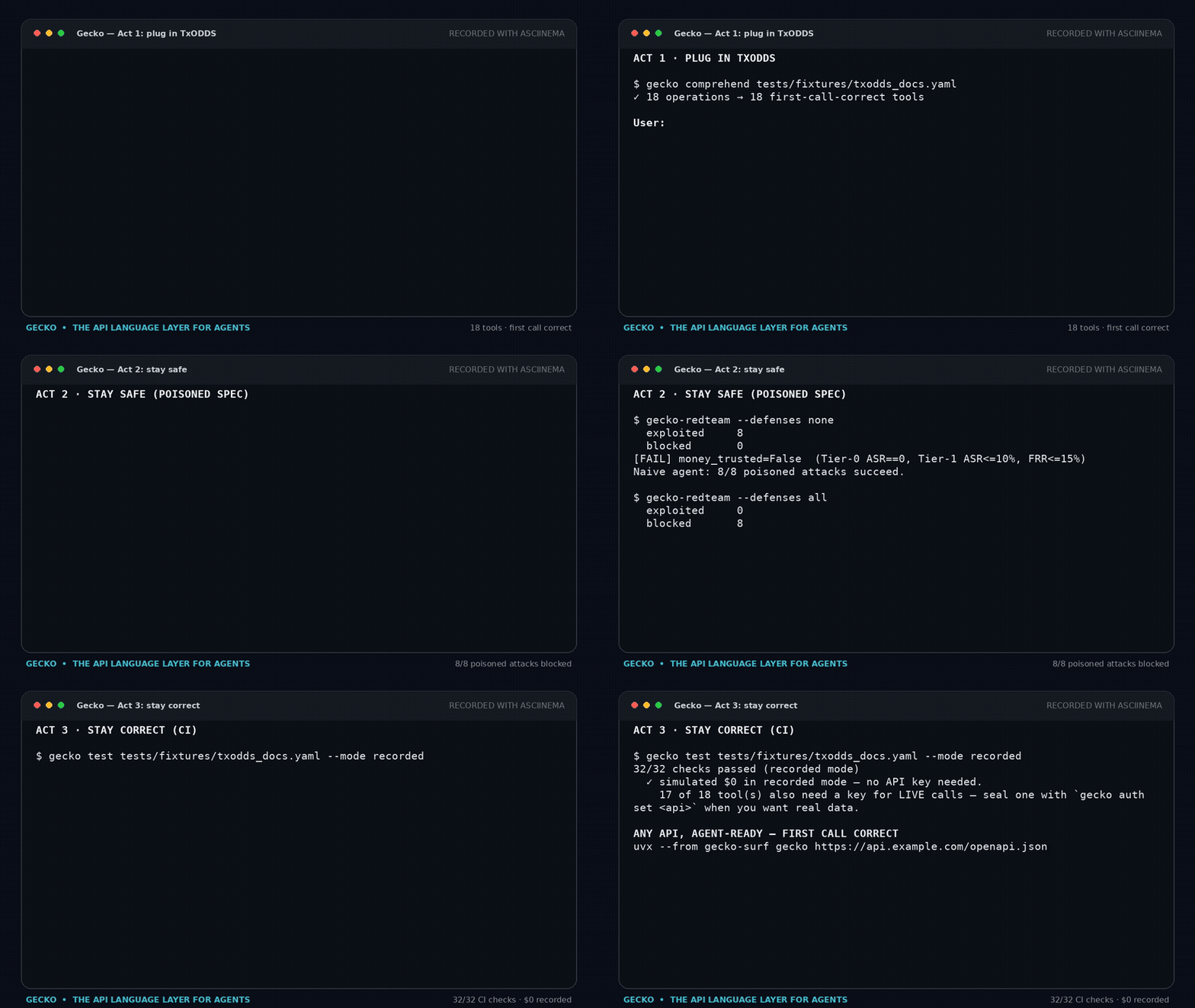 · [MP4](https://github.com/GeckoVision/gecko-surf/blob/HEAD/docs/assets/launch.mp4)
**Cross-API correlation — three APIs, one question**
Pegana × Birdeye × Jupiter joined on a declared entity; the agent plans across
surfaces first-try. Try it: `gecko graph svg ` renders any surface's call graph.
**Solana programs — buy a coffee on mainnet**
Everything above is a $0 fork. This one is not: **real mainnet, real USDC, a real
espresso.**
[`let_me_buy`](https://letmebuy.app) is a storefront program on Solana. A merchant
stands up a store and lists products priced in USDC; a buyer scans a QR code and pays.
One account per store — `PDA(["receipts", store_name])` — holds the menu, the receipts,
the running count and the merchant's authority.
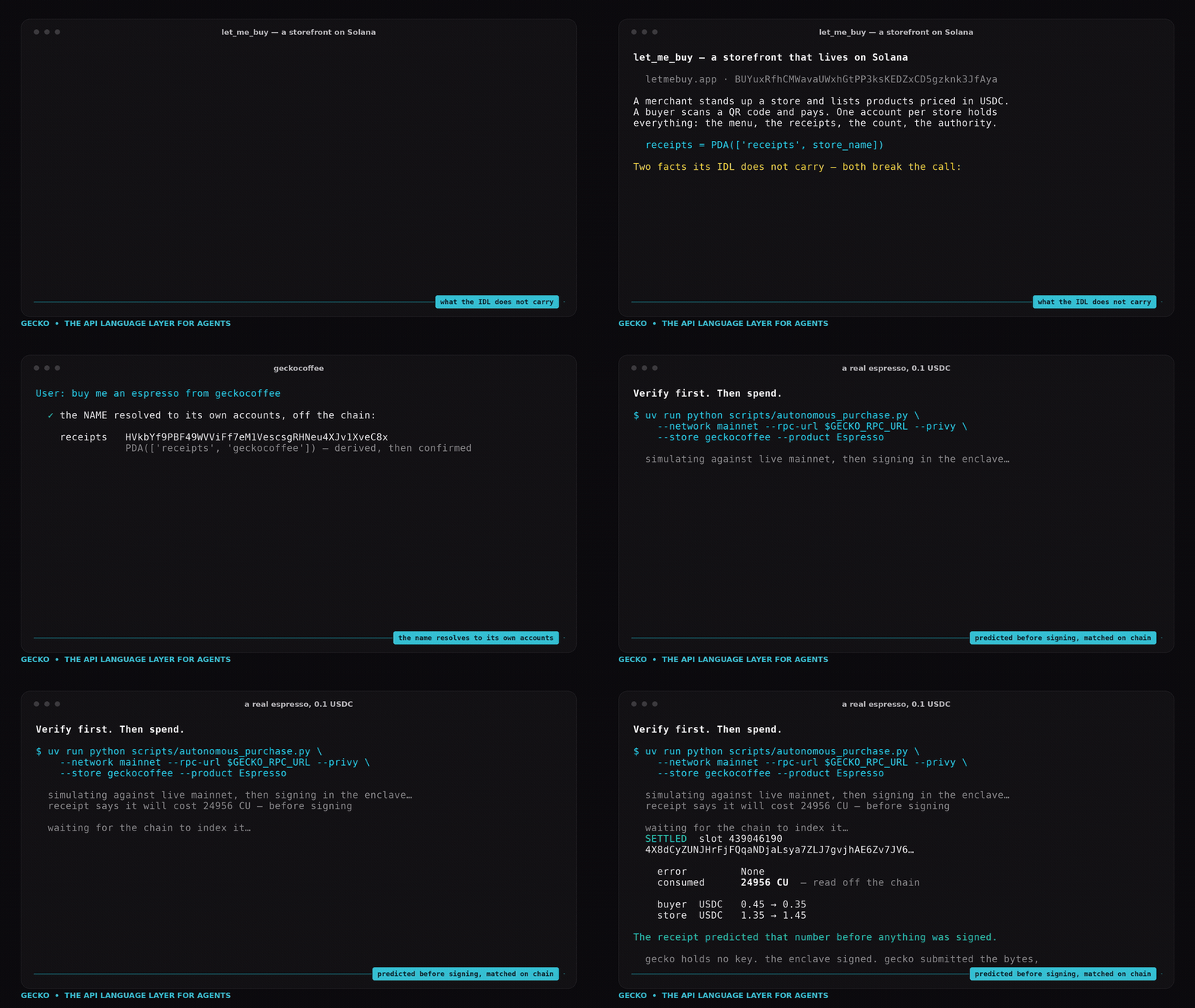
[MP4 version](https://github.com/GeckoVision/gecko-surf/blob/HEAD/docs/assets/coffee.mp4) — one unedited take. The receipt says **24,956 CU**
before anything is signed; the chain charges **24,956 CU**
([`4X8dCyZU…`](https://solscan.io/tx/4X8dCyZUNJHrFjFQqaNDjaLsya7ZLJ7gvjhAE6Zv7JV6AgeiGtGt9F5iJykJswvUb6MgdBcH5D6ERvxrjCFsbk5e),
slot 439046190). The key never leaves its enclave.
```bash
uvx --from "gecko-surf[serve,solana]" gecko-orquestra --program let_me_buy --stdio
```
**Two facts the IDL does not carry, and both break the call:**
- `mark_as_delivered` declares its `receipts` seed as `store_name`, but that
instruction's own arguments are `_store_name` and `receipt_id`. The seed names an
argument that does not exist, so a deriver resolving seeds by argument name gets
nothing for the one seed that selects the store. Gecko binds by seed **value**.
- In `make_purchase` the store's `authority` is writable but **not a signer**. The buyer
pays from `ATA(signer, mint)`; the store is credited at `ATA(authority, mint)` — same
mint, different owner. Derive both from one owner and you have built a purchase that
pays the buyer back. Gecko refuses that plan before a builder is ever asked.
**The prediction tracks state, not a memorised constant.** Three purchases at this one
storefront were charged 23,789 → 24,183 → 24,956 CU; the last two are the *same
product*. Each sale appends a receipt to the store's account, so the program does more
work — and the receipt predicted the new number each time it was asked.
Gecko recovers what the surface drops, [Orquestra](https://orquestra.dev) builds the
instruction, and the receipt says whether it lands — before any signature.
## Architecture
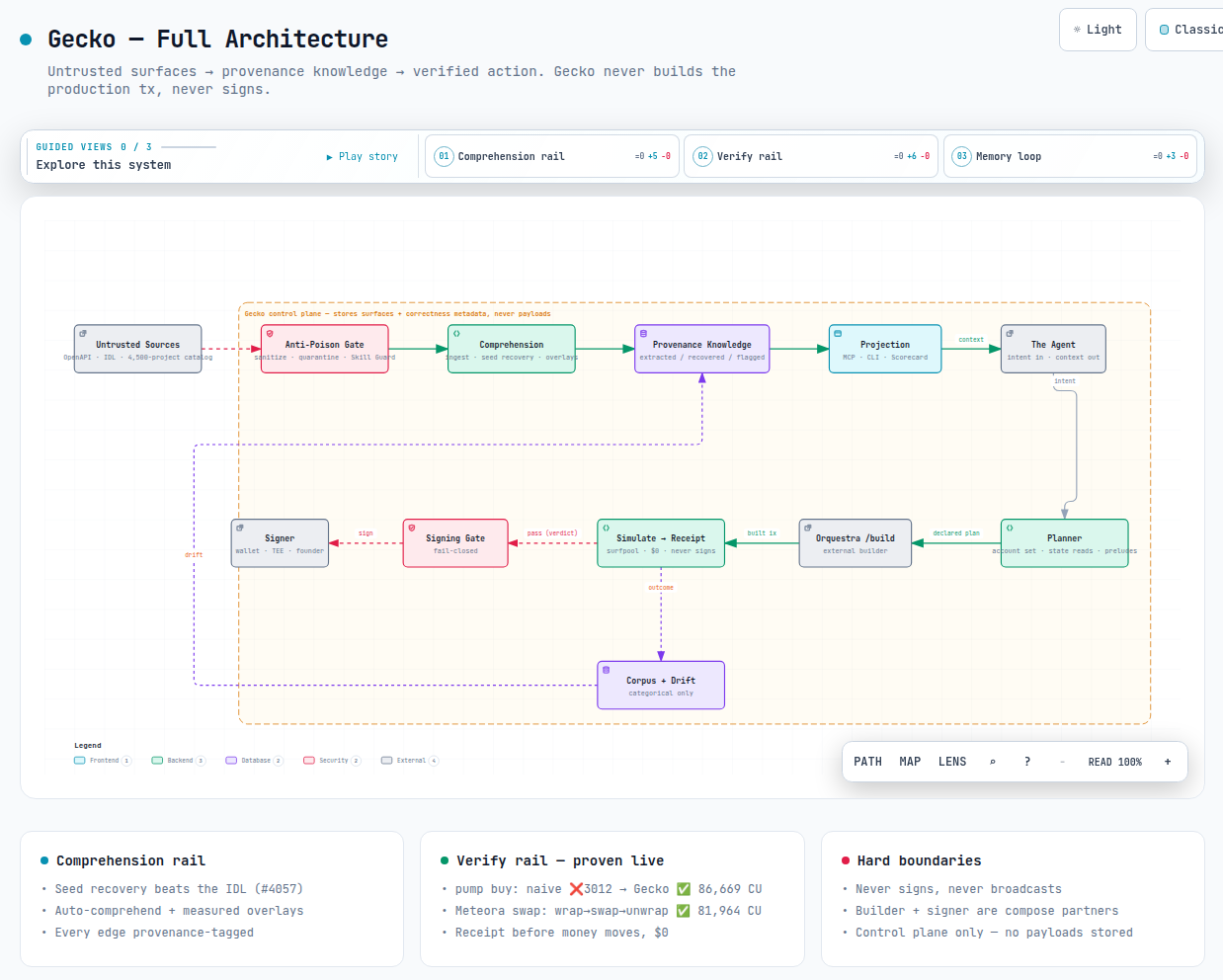
**Control plane, never data plane.** Gecko stores surfaces + correctness metadata —
never response payloads, user data, or secrets.
1. **Ingest** — OpenAPI / docs / IDL / program source → sanitized, quarantine-checked.
2. **Comprehend** — normalized ops, recovered PDA seeds, generated configs + measured
overlays.
3. **Know** — the provenance graph (surface, program, cross-API joins).
4. **Project** — question-shaped tools over MCP; auth stripped; −77%/−89% context cuts
measured on two real specs.
5. **Verify** — plan → external builder → simulate → **receipt** → fail-closed signing
gate. Gecko never signs, never broadcasts.
6. **Learn** — categorical outcomes → drift series → back into the graph.
[Interactive diagrams](https://github.com/GeckoVision/gecko-surf/blob/HEAD/docs/architecture.md) · [llms.txt](https://github.com/GeckoVision/gecko-surf/blob/HEAD/architecture.llms.txt) ·
[Receipt semantics](https://github.com/GeckoVision/gecko-surf/blob/HEAD/docs/receipt.md)
## What you get
| Capability | Entry point |
|---|---|
| Serve any API to agents over MCP | `gecko serve ` |
| Scorecard: grade + fixable findings + Playground | `gecko report ` |
| Recover a draft spec from human docs | `gecko from-docs ` |
| First-call-correctness tests for CI | `gecko test ` |
| The surface graph, rendered | `gecko graph svg ` |
| Program Surface: recovered seeds + derive plans | `gecko orquestra --program ` |
| find_start: intent → the right starting instruction | `gecko orquestra find-start "..."` |
| Simulate → receipt on a built transaction | `gecko/simulate.py` (engine) |
| Embed the SDK | `from gecko import AgentApiClient` |
| Verify docs claims against reality | `gecko verify-docs ` |
| Scan a skill image for hidden payloads | `gecko scan-image ` |
## Skills
The engine is the product; the skills are how an agent learns to drive it. Six of them
ship as one plugin — markdown the agent reads, no executable logic of its own.
```
/plugin marketplace add GeckoVision/gecko-surf
/plugin install gecko-surf@geckovision
```
| Skill | For | What it does |
|---|---|---|
| [`use-any-api`](https://github.com/GeckoVision/gecko-surf/blob/HEAD/skills/use-any-api/SKILL.md) | agent builder | Call an unfamiliar API first-call-correct — point Gecko at OpenAPI or docs, get intent-shaped MCP tools with auth hidden |
| [`read-js-docs`](https://github.com/GeckoVision/gecko-surf/blob/HEAD/skills/read-js-docs/SKILL.md) | agent builder | Extract the API surface from JS-rendered docs, when `curl` returns an empty shell |
| [`anti-poisoning`](https://github.com/GeckoVision/gecko-surf/blob/HEAD/skills/anti-poisoning/SKILL.md) | agent builder | Defend against a poisoned **spec** — one written to route your agent's arguments or exfiltrate your key |
| [`skill-guard`](https://github.com/GeckoVision/gecko-surf/blob/HEAD/skills/skill-guard/SKILL.md) | agent builder | Defend against a poisoned **artifact** — an image or convention page carrying an instruction your agent will follow and your reviewer cannot see |
| [`api-agent-ready`](https://github.com/GeckoVision/gecko-surf/blob/HEAD/skills/api-agent-ready/SKILL.md) | API provider | Make your own API's whole surface agent-usable, *alongside* whatever MCP you already ship |
| [`x402-payai-setup`](https://github.com/GeckoVision/gecko-surf/blob/HEAD/skills/x402-payai-setup/SKILL.md) | API provider | Wire pay-per-call onto your API. You keep 100% — Gecko is not the rail and takes no cut |
The two defense skills are one disease with two deliveries: a poisoned *spec* aims at
what your agent **calls**, a poisoned *artifact* aims at what your agent **does**. Full
map and status in [`skills/README.md`](https://github.com/GeckoVision/gecko-surf/blob/HEAD/skills/README.md).
## Modes
- **Recorded** (default): $0, schema-synthesized responses, fully offline. Falsify
everything before any live call.
- **Live**: same code path; credentials injected from your keychain at the edge.
`gecko auth set ` — deliberate, never implicit.
## Hosted
The engine in this repo also runs at [mcp.geckovision.tech](https://mcp.geckovision.tech)
— comprehended surfaces served over Streamable-HTTP MCP, keys injected server-side.
Developers never pay; providers pay a flat price per API.
Gecko takes no cut, holds no funds, signs nothing.
→ [docs.geckovision.tech](https://docs.geckovision.tech)
## Repo map
| Path | What |
|---|---|
| `gecko/` | the engine — ingest, catalog, tools, graphs, simulate, corpus |
| `gecko/providers/` | program surfaces (Meteora, Pump.fun, Jupiter, ORE, MetaDAO) + configs |
| `scripts/`, `gecko/cli.py` | thin transport — parse, call the package, format |
| `skills/` | the agent-facing plugin — six skills, agents, commands |
| `docs/` | architecture, receipt semantics, specs, benchmarks |
| `examples/` | forkable starters |
## Development
```bash
uv run ruff format && uv run ruff check --fix
uv run mypy gecko
uv run pytest # 2,400+ passing
uv run python -m gecko.demo # $0 recorded E2E
```
FAQ
**Is this a tool-generation wrapper?** No. Tool generation is the table stakes. The
product is the verified graph (provenance on every edge), the receipt (simulate before
money moves), and the drift series (know when a provider breaks you).
**Who is it for?** Two axes — either one qualifies: a messy surface (paywalled,
drifting, undocumented, on-chain), or a high-stakes action (your agent runs unattended
with credentials or money). Clean API + a human reviewing the diff? You may not need us
— and that's fine.
**Does Gecko sign or hold funds?** Never. Gecko never signs, never broadcasts, never
builds the production transaction — sim-only unsigned assembly is the documented
carve-out, AST-enforced at the sign/send boundary. Building belongs to builders
(e.g. Orquestra), signing to signers (wallet / TEE / you).
**What does Gecko store?** Surfaces and correctness metadata. Never payloads, balances,
pubkeys-in-outcomes, or secrets. The corpus is categorical, closed-vocabulary, audited.
**Vector database?** No — retrieval is lexical and deterministic (token-overlap; BM25
and semantic tiers both sit behind evidence gates that flip only on measured recall
failure — including one measured negative result on embeddings).
**Is it free?** The engine is Apache-2.0, complete, self-hostable. The hosted layer is
what an API provider buys. Developers never pay.
## Contributing
PRs welcome. Run the toolchain above before pushing. Security findings →
[SECURITY.md](https://github.com/GeckoVision/gecko-surf/blob/HEAD/SECURITY.md).
## License
Apache-2.0 — see [LICENSE](https://github.com/GeckoVision/gecko-surf/blob/HEAD/LICENSE).