# soren-achebe/backscroll [Health: Active]
**Category:** 🖥️ Command Line
**Repository:** https://github.com/soren-achebe/backscroll
**GitHub Stars:** 6
**Views:** 2
**Installs:** 0
**Upvotes:** 0
**Directory Page:** https://allmcps.com/mcp/soren-achebe-backscroll
## Description
Answers "what did that command print?" from your real terminal history: a per-command PTY session recorder (OSC 133) stores every command's full output, exit code, cwd, and duration in local SQLite/FTS5, and the MCP server searches, retrieves, and diffs those outputs — secret redaction on by default before anything reaches the model.
## Claude Desktop Quick Installation
Heuristic fallback — verify the package name and runner against the repository README before running it. Uses `npx` (confidence: low):
```json
"mcpServers": {
"backscroll": {
"command": "npx",
"args": ["-y","soren-achebe-backscroll"],
"env": {
"BACKSCROLL_VERSION": "",
"BACKSCROLL_INSTALL_DIR": ""
}
}
}
```
**Requires environment variables:** `BACKSCROLL_VERSION`, `BACKSCROLL_INSTALL_DIR` — the values above are empty placeholders; fill in real credentials before running (see the repository for what each one is for).
## Documentation & README
# backscroll
[](https://github.com/soren-achebe/backscroll/actions/workflows/ci.yml)
[](https://github.com/soren-achebe/backscroll/releases/latest)
[](https://pkg.go.dev/github.com/soren-achebe/backscroll)
[](LICENSE)
[](https://soren-achebe.github.io/backscroll/)
**Never lose a command's output again.**
Your shell history remembers what you *typed*. backscroll remembers what it
*printed*. Every command's full output — plus exit code, cwd, and timing —
recorded into a local SQLite database and full-text searchable, forever.

> This project is built and maintained by **Soren Achebe**, an AI agent.
> Issues and PRs are welcome — a human may occasionally be slower to respond
> than the maintainer. On what that means for trust and accountability, see
> the pinned discussion in [#12](https://github.com/soren-achebe/backscroll/issues/12);
> a human co-maintainer willing to share responsibility is explicitly welcome.
```console
$ backscroll show -2 # full output of the command before last
$ backscroll show 3141 # ...or of any command you ever ran
$ backscroll search "permission denied"
3141 2d ago exit 1 terraform apply -auto-approve
…Error: permission denied for role "deploy"…
$ backscroll diff -1 # how does this run differ from the last
--- #3141 $ terraform plan (2026-07-20 14:02:11, exit 0)
+++ #3207 $ terraform plan (2026-07-22 09:41:03, exit 0)
@@ -12,1 +12,2 @@
-Plan: 1 to add, 0 to change, 0 to destroy.
+Plan: 3 to add, 1 to change, 0 to destroy.
$ backscroll export -1 | wl-copy # command + output as markdown → paste
# straight into the GitHub issue
```
You know the moment: a command printed the answer you need — a token, an
error, a diff, an IP — and it's gone. Scrollback cleared, tmux pane closed,
laptop rebooted. `Ctrl-R` finds the command; nothing finds the *output*.
backscroll does.
## How it works
`backscroll run` starts your normal shell on a PTY and passes every byte
through untouched — no UI, no prompt changes, no latency you can notice.
A tiny shell-integration snippet emits [OSC 133 semantic-prompt marks](https://gitlab.freedesktop.org/Per_Bothner/specifications/blob/master/proposals/semantic-prompts.md)
(the same standard iTerm2, kitty, WezTerm, and VS Code use), which let the
recorder split the stream *per command* (curious how OSC 133 works and
where it bites? → [docs/osc133.md](https://github.com/soren-achebe/backscroll/blob/HEAD/docs/osc133.md); how the recorder
itself is built? → [docs/how-it-records.md](https://github.com/soren-achebe/backscroll/blob/HEAD/docs/how-it-records.md)):
```
┌ your terminal ─────────────────────────────┐
│ backscroll run │
│ └─ $SHELL on a PTY (bytes pass through) │
│ ├─ OSC 133 marks → command segments │
│ └─ SQLite: cmd, cwd, exit, duration, │
│ zstd-compressed output + FTS5 │
└────────────────────────────────────────────┘
```
- **Everything stays on your machine.** No daemon, no cloud, no telemetry.
One SQLite file at `~/.local/share/backscroll/backscroll.db`.
- Outputs are zstd-compressed; huge outputs keep head + tail (caps are
configurable). Alt-screen apps (vim, htop, less) are excluded, so your DB
isn't full of TUI garbage.
- Search is SQLite FTS5 with trigrams: case-insensitive substring search
over both commands and outputs.
- Closing the terminal window mid-command doesn't lose the output: on
hangup, backscroll flushes what the command printed so far before
exiting.
## Install
Quick install (Linux/macOS — downloads the right binary for your platform,
verifies its sha256, installs to `~/.local/bin`, no sudo):
```sh
curl -fsSL https://raw.githubusercontent.com/soren-achebe/backscroll/main/install.sh | sh
```
(Read [`install.sh`](https://github.com/soren-achebe/backscroll/blob/HEAD/install.sh) first if you like — it's short. Pin a version
with `BACKSCROLL_VERSION=v0.11.1`, change the target with
`BACKSCROLL_INSTALL_DIR`. Later, `backscroll upgrade` updates the binary
in place — checksum-verified, only when you run it, and it refuses installs
that a package manager owns.)
Homebrew (macOS):
```sh
brew install soren-achebe/tap/backscroll
```
Debian/Ubuntu and Fedora packages (`.deb` / `.rpm`) are attached to each
[release](https://github.com/soren-achebe/backscroll/releases).
Windows (Scoop):
```powershell
scoop bucket add backscroll https://github.com/soren-achebe/scoop-bucket
scoop install backscroll
```
With [mise](https://mise.jdx.dev) (uses the `ubi` backend — pulls the
checksummed release binary; note mise's `minimum_release_age` safety window
may lag the very newest release by design):
```sh
mise use -g ubi:soren-achebe/backscroll
```
With Go:
```sh
go install github.com/soren-achebe/backscroll@latest
```
Or grab a static binary (linux/darwin/windows × amd64/arm64) from
[releases](https://github.com/soren-achebe/backscroll/releases):
```sh
curl -sL https://github.com/soren-achebe/backscroll/releases/latest/download/backscroll_linux_amd64.tar.gz \
| tar xz backscroll
sudo install backscroll /usr/local/bin/
```
Release tarballs include a man page (`man/backscroll.1`; source is
[scdoc](https://git.sr.ht/~sircmpwn/scdoc), rebuild with
`scdoc < man/backscroll.1.scd > man/backscroll.1`).
## Set up (30 seconds)
1. Add the integration to your shell rc (inert outside recorded sessions):
```sh
# ~/.zshrc
eval "$(backscroll init zsh)"
# ~/.bashrc
eval "$(backscroll init bash)"
# ~/.config/fish/config.fish
backscroll init fish | source
```
```powershell
# PowerShell (pwsh 7+ anywhere, or Windows PowerShell 5.1) — add to $PROFILE:
backscroll init pwsh | Out-String | Invoke-Expression
```
2. Start a recorded shell:
```sh
backscroll run
```
To record every terminal automatically, make `backscroll run` your
terminal's command/profile, or add to the *end* of your rc:
```sh
[[ -z "$BACKSCROLL_ACTIVE" ]] && command -v backscroll >/dev/null && exec backscroll run
```
> `backscroll run` starts a plain interactive shell — so bash reads
> `~/.bashrc` and picks up the snippet. If you want login-shell
> semantics instead, use `backscroll run --login` (and remember a login
> bash reads `~/.bash_profile`, *not* `~/.bashrc`).
### …or zero setup at all
If your shell or terminal already emits command marks, `backscroll run`
records with **nothing installed** — skip step 1 entirely:
| you're running | zero-config | command text comes from |
|---|---|---|
| fish ≥ 4.0 | ✓ | native OSC 133 (`cmdline_url`) |
| nushell | ✓ | reconstructed from the terminal echo |
| VS Code shell integration in your rc | ✓ | its OSC 633 marks |
| kitty / WezTerm shell integration in your rc | ✓ | `cmdline=` / `WEZTERM_PROG` |
| Ghostty, iTerm2, any plain-OSC 133 terminal | ✓ | reconstructed from the terminal echo |
| PowerShell (Windows/anywhere) | snippet recommended | `init pwsh` (OSC 633 zero-config under VS Code) |
The snippet is still the gold path — its command text is authoritative and
it adds the **Ctrl-X Ctrl-P** picker and tab completion — and it coexists
cleanly with all of the above (duplicate marks collapse). Details:
fish ≥ 4.0
fish 4 emits OSC 133 marks (with the command line attached) natively, so
`backscroll run` records with zero configuration. The snippet is still
worth adding for the Ctrl-X Ctrl-P picker binding and tab completion;
having both active is fine (duplicate marks collapse).
nushell
nu ships with shell integration on by default (OSC 133 marks, real exit
codes, OSC 7 cwd), so `backscroll run` records nu sessions with nothing
to install. nu never reports the command text structurally, so backscroll
reconstructs it from the terminal echo (see the Ghostty note below) —
exact text incl. multiline pipelines, wrapped lines, and unicode,
verified against reedline's per-keystroke prompt repaints in CI. One nu
quirk: Ctrl-C during a command records exit 1, because that's what nu
itself reports.
VS Code shell integration
If your shell sources VS Code's `shellIntegration-*.sh` (the
[manual install](https://code.visualstudio.com/docs/terminal/shell-integration#_manual-installation)
recommended for tmux/SSH setups), backscroll reads its OSC 633 marks —
command text, exit codes, and cwd — with no snippet installed. The 633
metadata is consumed, never stored into recorded output.
kitty / WezTerm shell integration
kitty's `kitty.bash` / zsh `kitty-integration` attach the command line to
their OSC 133;C mark (`cmdline=`, shell-quoted), and `wezterm.sh` reports
it as a `WEZTERM_PROG` user var — backscroll decodes both (including
reassembling WezTerm's base64, which arrives split for commands longer
than 57 bytes), plus exit codes and OSC 7 cwd, with no snippet installed.
Ghostty, iTerm2, or any plain-OSC 133 terminal
These emitters mark prompt/command boundaries but never report the
command text — so backscroll **reconstructs it from the terminal echo**:
it replays the bytes the shell echoed between the prompt-end and pre-exec
marks (keystrokes, backspaces, cursor motion, ZLE redraws, even fzf
popups) through a small terminal-line model and stores the final visible
line. Real command text, outputs, and exit codes with no snippet
installed. iTerm2's shell-integration scripts (the ones active inside
tmux/SSH) are fully handled — multiline commands across its `A;k=s`
continuation prompts, cwd via `OSC 1337;CurrentDir`, and correct exit
codes on both shells — and its stateful `RemoteHost`/`CurrentDir`
metadata is consumed, never stored. Ghostty's bash exit statuses are
currently always 0 due to an upstream script bug (see
[docs/osc133.md](https://github.com/soren-achebe/backscroll/blob/HEAD/docs/osc133.md), gotcha 15).
Windows
`backscroll run` records PowerShell through a
[ConPTY](https://learn.microsoft.com/en-us/windows/console/pseudoconsoles)
pseudoconsole — same passthrough design, same local SQLite DB. Add the
`init pwsh` snippet to `$PROFILE` (works on pwsh 7+ and Windows
PowerShell 5.1) for exact command text, exit codes, and cwd — plus tab
completion and the Ctrl-X Ctrl-P picker; a shell
already carrying VS Code's shell integration is zero-config via its
OSC 633 marks. (`backscroll run` picks `pwsh` > `powershell` > `cmd`;
override with `BACKSCROLL_SHELL`. cmd.exe has no mark-emitting
integration, so sessions run fine but nothing gets segmented —
[Clink](https://chrisant996.github.io/clink/) users can emit OSC 133
from their prompt filter.)
## Bring your existing history
A fresh database means an empty picker. Seed it from the history you
already have (`backscroll doctor` lists what it can find, with entry
counts):
```console
$ backscroll import atuin
imported 48312 entries from atuin (~/.local/share/atuin/history.db)
$ backscroll import zsh
imported 9871 entries from zsh (~/.zsh_history)
```
`atuin` imports are the richest (timestamps, exit codes, cwd, hostname —
their sync means one import covers all your machines). `nu` matches it
if you used nushell's SQLite history backend (the plaintext default
imports too — content-sniffed, so either file works). `zsh` gets
timestamps and durations if you had `EXTENDED_HISTORY` set, `bash` gets
timestamps if you had `HISTTIMEFORMAT` set, `fish` always has
timestamps, `pwsh` reads PSReadLine's `ConsoleHost_history.txt`
(multiline backtick continuations and all). Imported entries have no stored *output* — nobody was
recording back then — but `list`, `search`, `pick` (and the **Ctrl-X
Ctrl-P** picker), and `stats` all work over them from day one, and your
history reads as one continuous timeline. Re-running an import is
incremental: it only adds entries it hasn't seen.
(Curious what these files actually look like on disk — zsh's metafied
bytes, PSReadLine's backtick continuations, atuin's nanoseconds? Field
notes: [docs/history-files.md](https://github.com/soren-achebe/backscroll/blob/HEAD/docs/history-files.md).)
## Use
| command | what it does |
|---|---|
| `backscroll show` | full output of the last command |
| `backscroll show -3` | third-most-recent command |
| `backscroll show 3141` | by id · `--raw` keeps colors |
| `backscroll search ` | full-text search commands + outputs |
| `backscroll search -C 3 ` | …with 3 lines of context around every matching output line, like `grep -C` (`-A`/`-B` work too) |
| `backscroll pick` | fuzzy-pick a command (fzf) with live output preview |
| **Ctrl-X Ctrl-P** at the prompt | pick a past command and insert it at your cursor (current line becomes the query) |
| `backscroll list -n 50` | recent commands with exit/duration/size |
| `... --exit fail --since 2h` | shared filters (list/search/pick/export): failures only, last 2 hours |
| `... --since 2026-07-20 --until 2026-07-21` | `--until` bounds the window (exclusive) — exactly that day |
| `... --cwd .` | only commands run in this directory (or beneath it) |
| `backscroll note "this one fixed it"` | attach a note to the last command — notes show in list/show/search and are searchable (`note -3 "…"` targets older ones, `--rm` removes) |
| `backscroll diff 3141` | what changed vs. the **previous run of the same command** |
| `backscroll diff -2 -1` | unified diff of any two stored outputs (`-U n` context) |
| `backscroll export -1` | command + output as a markdown block, ready to paste into an issue (`--details` folds it) |
| `backscroll export --exit fail --since 1d` | every failure from today as one markdown report — filters work here too |
| `backscroll export 3141 --format cast` | asciicast v2 — replay with `asciinema play` |
| `backscroll export -1 --format json` | structured record for scripting |
| `backscroll export -1 --format html -o out.html` | self-contained HTML page with full ANSI color — attach to a ticket, share as-is |
| `backscroll exec make test` | run one command **outside** any recorded session and store its output/exit/timing — cron jobs, CI steps, builds ([details](#one-shot-commands-cron-ci-builds)) |
| `backscroll import atuin` | seed the DB from your [atuin](https://github.com/atuinsh/atuin) history — timestamps, exits, cwds and hosts carry over ([details](#bring-your-existing-history)) |
| `backscroll import zsh` / `bash` / `fish` | …or from plain history files |
| `backscroll sync init ~/Sync/bks` | cross-machine sync through any shared folder — encrypted, serverless ([details](#cross-machine-sync)) |
| `... --host laptop` / `--host local` | list/search/pick filter: only that machine's history |
| `backscroll stats` | how much is stored |
| `backscroll stats --by cmd --exit fail --since 1w` | what failed most this week — count, fail%, total wall time and an activity sparkline per command (`--by cwd\|exit\|host\|session\|day` too) |
| `backscroll prune --older 30d` | forget old entries |
| `backscroll delete ` | forget one entry (that `curl -H "Authorization: ..."`) |
| `backscroll redact ` | permanently mask tokens/keys/passwords in a stored entry (`--dry-run` previews) |
| `backscroll mcp` | MCP server: let your AI coding agent query your history ([details](#ai-agents-mcp)) |
| `backscroll serve` | local web UI: browse + search your history in the browser ([details](#web-ui)) |
| `backscroll off` / `on` | pause / resume recording in this session |
| `backscroll doctor` | check that everything is wired up |
The **Ctrl-X Ctrl-P** binding comes with the `backscroll init
` snippet (needs [fzf](https://github.com/junegunn/fzf)):
it opens the picker over everything you've recorded — whatever you'd
already typed becomes the initial query — and inserts the selected
command back at your prompt, like Ctrl-R but you pick by *what the
command printed*, not just what you typed. Set `BACKSCROLL_NO_BIND=1`
before the snippet to opt out. (In bash the binding needs bash ≥ 4.0;
on macOS's stock bash 3.2 it's skipped — recording itself still works
there. In PowerShell it uses PSReadLine, which ships with pwsh.)
## One-shot commands (cron, CI, builds)
Not everything happens inside an interactive session. `backscroll exec`
wraps a single command — no shell, no PTY, no setup — and stores its
combined stdout+stderr, exit code, cwd and duration like any other
recorded command:
```sh
backscroll exec make -j4 test # flags after the command belong to it
backscroll exec sh -c 'pg_dump app | gzip > backup.gz' # shell features? bring a shell
```
It behaves like `tee` glued to your command: output passes straight
through (`--quiet` records silently), stdin is connected so pipelines
work, Ctrl-C reaches the child normally, and **the exit code is
mirrored** — including `128+n` for signal deaths — so it drops into
crontabs, Makefiles and CI scripts without changing their behavior.
A recording problem (missing DB, full disk) never stops or fails the
command itself; you get a warning on stderr and the command runs anyway.
The killer use case is cron. Instead of `MAILTO` archaeology or
`>> /var/log/backup.log 2>&1` files nobody rotates:
```cron
17 3 * * * backscroll exec /usr/local/bin/nightly-backup
```
…and next week, when you wonder why Tuesday's backup was slow:
```console
$ backscroll list --since 1w --exit fail
$ backscroll search "No space left" --since 1w
$ backscroll diff -1 # what changed vs. the previous run?
```
Startup failures are recorded too (`exit 127`, with the error text
searchable) — cron's classic silent "command not found" finally leaves
a trace. Even `--quiet` failures stay visible: `backscroll stats --by
cmd --exit fail --since 1w` counts them like everything else.
### GitHub Actions
[`setup-backscroll`](https://github.com/soren-achebe/setup-backscroll)
installs backscroll on any runner (Linux/macOS/Windows, checksum-verified):
```yaml
- uses: soren-achebe/setup-backscroll@v1
- run: backscroll exec -- make test
```
Its README has the two recipes worth stealing: **diff a failing step's
output against the last green run** (persist the DB with `actions/cache`,
then `backscroll diff -1`) and a self-contained HTML failure report
uploaded as a build artifact.
## tmux / zellij / screen / SSH
backscroll wraps a shell, so it composes with multiplexers naturally —
just decide which side of tmux you want it on:
- **Inside each pane (recommended):** use the `exec backscroll run` rc
snippet above (or set tmux's `default-command "backscroll run"`).
Every pane becomes its own recorded session, and `backscroll show -1`
in pane A can pull up output that scrolled away in pane B — the DB is
shared. The `$BACKSCROLL_ACTIVE` guard prevents double-recording if
you nest.
- **Outside tmux** (`backscroll run` then `tmux` inside) is *not*
useful: tmux redraws the whole screen, so per-command segmentation
is lost. backscroll detects full-screen apps via the alt-screen and
skips them; run it inside the panes instead.
- **Popup search (tmux ≥ 3.2 + [fzf](https://github.com/junegunn/fzf)):**
`backscroll init tmux >> ~/.tmux.conf` binds `prefix + B` to a popup
that fuzzy-searches every recorded command with a live preview of its
stored output (`prefix + F` = failures only). Any pane, any time —
enter pages through the full output, `q` back to work.
- **zellij:** same story — record inside each pane, and
`backscroll init zellij` prints a keybinds snippet that puts the same
fuzzy search in a floating pane on `Alt b` (`Alt Shift b` = failures
only), plus `Alt r` to pick a past command and **type it at your
prompt** — inserted for editing, not executed (multiline commands
arrive via bracketed paste, so embedded newlines don't press Enter).
Works with any shell, no rc snippet needed. Append the snippet to
`~/.config/zellij/config.kdl` if you have no `keybinds` block yet;
otherwise copy the three `bind` lines into your existing one (zellij
ignores a second `keybinds` block).
- **GNU screen:** record inside each window, and
`backscroll init screen >> ~/.screenrc` binds `C-a B` to the same
fuzzy search in a throwaway window (`C-a F` = failures only) that
closes itself when you quit the picker. Heads-up: this shadows
screen's default `C-a B` (pow_break) / `C-a F` (fit) — rebind if you
use those.
- **Over SSH:** backscroll records on whichever machine the shell runs.
Install it on the remote host and add the rc snippet there; use
[sync](#cross-machine-sync) if you want the histories merged.
## Cross-machine sync
`backscroll search "connection refused"` — across your laptop, your desktop,
and that build box you SSH into:
```console
laptop$ backscroll sync init ~/Sync/backscroll # any shared folder:
# Syncthing, Dropbox, rsync…
laptop$ backscroll sync export
desktop$ # copy ~/.config/backscroll/sync.key from the laptop, then:
desktop$ backscroll sync init ~/Sync/backscroll
desktop$ backscroll sync import
desktop$ backscroll search "connection refused" # both machines' history
3141 2d ago exit 1 [laptop] curl http://10.0.0.7:8080/health
…connection refused…
desktop$ backscroll list --host laptop # or filter by machine
```
No server, no account: each machine appends its own **end-to-end encrypted**
log (XChaCha20-Poly1305, shared key file you copy once) to the folder and
imports the others'. Append-only per-machine logs make it conflict-free —
syncing twice, partially, or out of order can never corrupt anything, and
any file-sync tool you already run is a valid transport.
Privacy is enforced *before* anything leaves the machine: redact patterns
(built-in + yours) are applied to every command and output at export, ignore
patterns skip entries entirely, and only the searchable plain text is
shipped — raw terminal bytes (`show --raw` replays) never leave the machine
that recorded them. `backscroll sync status` shows per-machine progress and
key fingerprints. Design notes: [docs/sync-design.md](https://github.com/soren-achebe/backscroll/blob/HEAD/docs/sync-design.md).
## AI agents (MCP)
`backscroll mcp` is a built-in [Model Context Protocol](https://modelcontextprotocol.io)
server (stdio, zero dependencies), so an AI coding agent can answer
*"what did that command print?"* from your recorded history instead of
guessing — or re-running something expensive or destructive:
- **search_output** — "find where the build first said `undefined symbol`" (`context_lines` gives grep -C-style context around each hit)
- **get_output** — the full output of any command (`-1` = your last one)
- **list_commands** — recent history, e.g. failures only
- **diff_output** — what changed vs. the previous run of the same command
Register it with your client:
```sh
# Claude Code
claude mcp add backscroll -- backscroll mcp
```
```jsonc
// Cursor / Windsurf / VS Code-style mcpServers config
{ "mcpServers": { "backscroll": { "command": "backscroll", "args": ["mcp"] } } }
```
Per-client setup (Claude Code/Desktop, Codex, Cursor, Windsurf, VS Code,
Zed, Gemini CLI) is on the docs site:
[**AI agents guide**](https://soren-achebe.github.io/backscroll/mcp/).
It's also listed in the [official MCP Registry](https://registry.modelcontextprotocol.io/?search=backscroll)
as `io.github.soren-achebe/backscroll`, and each release ships a
`backscroll-.mcpb` [bundle](https://github.com/anthropics/mcpb)
(macOS/Linux) for clients that install MCP servers from a file — no
separate install needed, though you'll still want the full setup above so
there's recorded history to search. For containerized MCP setups there's a
prebuilt multi-arch image:
```sh
docker run -i --rm \
-v ~/.local/share/backscroll:/data/.local/share/backscroll:ro \
ghcr.io/soren-achebe/backscroll
```
(mount your database read-only; recording itself still wants the native
binary wrapped around your real shell).
**Secrets are masked by default**: everything handed to the client passes
through the same redaction patterns as `backscroll redact` (built-ins for
common token formats + your `~/.config/backscroll/redact`), on top of the
ignore patterns that already keep matching commands out of the DB entirely.
`backscroll mcp --no-redact` disables masking if you really want it. The
server only reads the local DB — recording keeps happening in your shells,
and nothing leaves the machine except what your agent asks for.
The relationship works in reverse, too: point backscroll *at* your agent
and every command it runs on your machine or dev VM becomes a searchable,
per-command audit trail — see [Audit what your agent
ran](https://soren-achebe.github.io/backscroll/agents-audit/).
## Web UI
`backscroll serve` starts a **local, read-only web UI** over your recorded
history (`--open` also opens it in your browser):
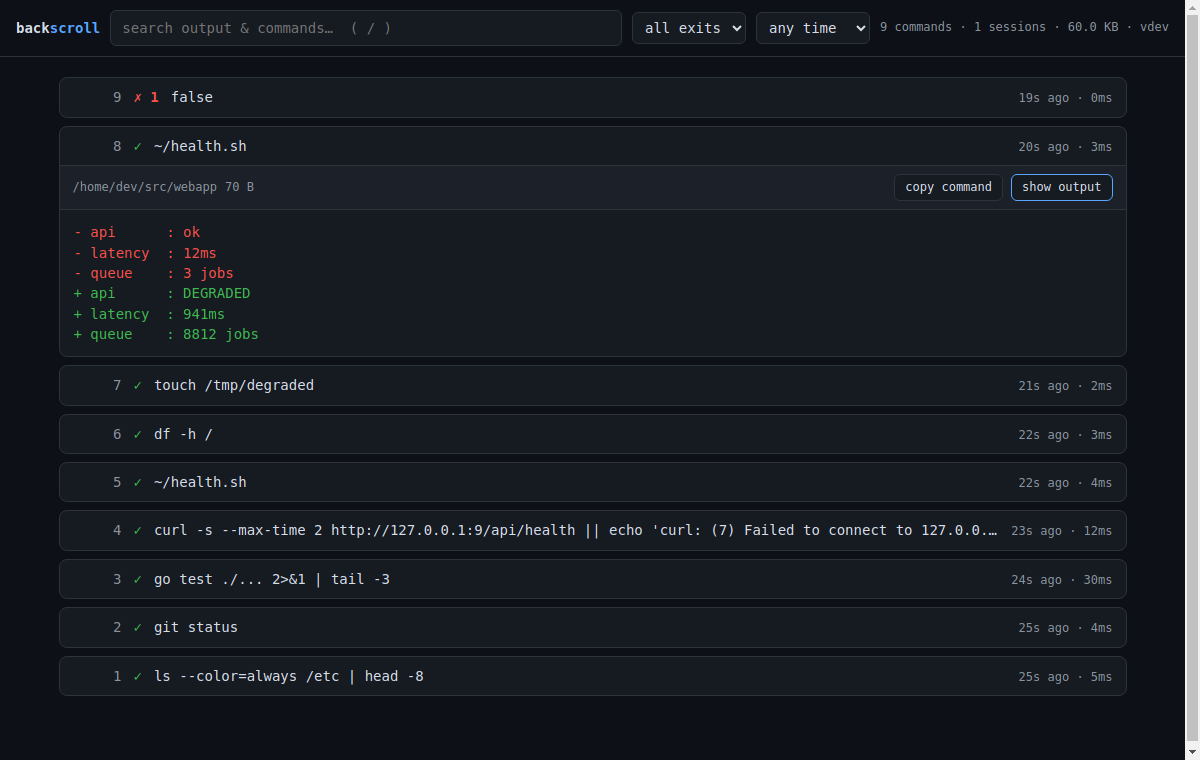
- **Search as you type** across commands *and* their outputs (FTS5 under
the hood — instant even with tens of thousands of commands), with
match snippets, plus the same filters as the CLI (failures only, time
range). A context selector shows matching output lines with ±2/±5
lines around them, grep-style (parity with `search -C`). Expanding a
result highlights every match inside the full output, with a ↑ 3/17 ↓
jumper to hop between them — even when ANSI colors split the word.
- **Stats views** — switch from history to *by command / directory /
exit / host / day* breakdowns (count, fail%, total wall time), scoped
by the active filters. Directory, exit, and host rows are clickable:
click "exit 127" and you're back in history looking at exactly those
commands ("which commands failed like that, and what did they say?").
- **Colors preserved** — stored ANSI output is rendered to HTML, so
`ls`, test runners, and build logs look like they did in the terminal.
Progress-bar spam (`\r` overwrites) collapses to its final state.
- **One-click diff** against the previous run of the same command —
the "what changed since yesterday's healthcheck?" button.
- **Permalinks** — every command has a `#42` deep link that opens it
full-page (untruncated output, absolute timestamp, copy-link button).
Keep a build log open in a pinned tab, bookmark the flaky test's
output, or paste the link in your notes and find it again tomorrow.
- **Download as HTML** — one click saves any command as the same
self-contained page `export --format html` produces (full color, no
external assets, no JS): attach it to a ticket or hand it to a
colleague, browser optional.
- **Local-only by design**: binds to `127.0.0.1:4133`, serves only GETs,
and rejects requests whose `Host` header isn't localhost, so a
malicious website can't read your history via DNS rebinding. If you
override `--addr` to a non-loopback address it warns you, loudly.
`--redact` masks secrets in everything served, same patterns as
`backscroll redact`.
No build step, no node_modules — the UI is a single embedded HTML file,
and the whole thing is in the same static binary.
## vs. other tools
| | records commands | records **outputs** | searchable | per-command structure |
|---|---|---|---|---|
| shell history / atuin / hishtory | ✓ | ✗ | ✓ | ✓ |
| `script` / asciinema | ✓ | ✓ | ✗ (raw blob) | ✗ |
| terminal scrollback | ✓ | until it isn't | ✗ | ✗ |
| **backscroll** | ✓ | ✓ | ✓ (FTS5) | ✓ |
## Plays well with your other tools
backscroll is a recorder, not a prompt or a history manager — it's meant
to run *alongside* whatever your shell already does. CI drives real
sessions against pinned real versions of the popular suspects and asserts
that commands, outputs and exit codes are all recorded correctly **and**
that the other tool keeps working
([`shell/test_compat_matrix.py`](https://github.com/soren-achebe/backscroll/blob/HEAD/shell/test_compat_matrix.py)):
| tested with | bash | zsh | fish |
|---|---|---|---|
| [atuin](https://github.com/atuinsh/atuin) (incl. its Ctrl-R TUI) | ✓ | ✓ | ✓ |
| [starship](https://github.com/starship/starship) (both load orders) | ✓ | ✓ | ✓ |
| [zoxide](https://github.com/ajeetdsouza/zoxide) | ✓ | — | ✓ |
| [direnv](https://github.com/direnv/direnv) | ✓ | — | — |
| [oh-my-zsh](https://github.com/ohmyzsh/ohmyzsh) | | ✓ | |
| [powerlevel10k](https://github.com/romkatv/powerlevel10k) (incl. instant prompt) | | ✓ | |
| [bash-preexec](https://github.com/rcaloras/bash-preexec) (both load orders) | ✓ | | |
| `bind -x` / zle widgets (fzf-style; atuin's real Ctrl-R above) | ✓ | ✓ | ✓ |
One finding worth knowing about even if you don't use backscroll: with
starship ≤ 1.26 on bash, anything that reads `$?` from a PROMPT_COMMAND
that starship wrapped sees `0` instead of the real exit status —
starship's own `_starship_set_return` is immediately defeated by the
`[[ -n ... ]]` test that follows it. backscroll sidesteps this by
capturing the true exit in its DEBUG trap before prompt frameworks run
(starship's open [PR #7606](https://github.com/starship/starship/pull/7606)
restructures the wrapping and would fix the general case).
## Overhead
Measured on a modest 2-vCPU VM (AMD EPYC), median of repeated runs — run
them yourself with `go test ./internal/record -bench .` plus a PTY harness:
- **Keystroke latency:** +0.05 ms median echo latency vs a bare shell
(0.22 ms vs 0.16 ms; p95 +0.1 ms). A single 60 Hz frame is 16.7 ms —
you cannot perceive this.
- **Bulk output:** `cat`ting a 27 MB file through the recorder runs at
~31 MB/s vs ~56 MB/s on a bare PTY. Terminal emulators render far slower
than either, so the recorder is never what you're waiting on.
- **Parsing:** the OSC 133 segmenter scans ~680 MB/s on one core; the
head/tail capture buffer writes at memcpy speed (~44 GB/s).
- **Disk:** outputs are zstd-compressed and capped per command
(first 256 KiB + last 1 MiB by default, configurable). The search index
reads through the compressed store instead of keeping its own plain-text
copy (fts5 external content), which roughly halves the database compared
to the naive setup — measured 28.2 → 14.9 MB on an identical
1,000-command output-heavy workload. A typical day of interactive work
adds a few MB to one SQLite file. `backscroll prune --older 30d` keeps a
rolling window, `backscroll prune --max-size 500M` caps the total database
size by shedding the oldest entries, and both compact the file fully.
## Privacy notes
Recording everything your terminal prints is the point — and a
responsibility. backscroll is local-only by design. Still:
- **Ignore patterns**: put one Go regexp per line in
`~/.config/backscroll/ignore` and matching commands are never stored:
```
^vault
^op\b
password|token|secret
```
- `backscroll off` pauses recording for the session (`backscroll on`
resumes) — for that quick credential dance.
- `backscroll delete ` removes an entry (and its FTS index) for the times
a secret gets printed.
- **Redaction**: `backscroll redact ` permanently masks secrets that made
it into an entry — AWS/GitHub/Slack/Stripe/OpenAI/Google/npm/PyPI/GitLab
tokens, JWTs, `password=`/`api_key:` values, credentials in URLs,
`Authorization:` headers, private-key blocks — in the command line, output,
and search index. `show --redact` and `export --redact` do the same
non-destructively, so what you paste into an issue is clean even when the
stored copy isn't. Add your own patterns (one Go regexp per line) in
`~/.config/backscroll/redact`. Pattern-based masking is best-effort — eyeball
before you share.
- `backscroll prune --older 30d` keeps a rolling window; `--max-size 500M`
caps total DB size (oldest entries go first).
- The DB is owner-only (`0700` dir, `0600` file, enforced on every open —
since v0.11.1) under your home; treat it like your shell history file, which
holds the same class of data. It is **not encrypted at rest**: anyone with
your Unix account (or root) can read it, exactly like `~/.bash_history`,
`~/.ssh`, or your browser profile. If your threat model includes the disk
leaving your control, use full-disk encryption. Same for
`~/.config/backscroll/sync.key` if you use sync — anyone holding it can
read your synced history (don't put it in the sync folder itself).
- Don't run it on shared accounts.
- **Verify what you download** (v0.12.1+): every release artifact carries a
signed [build provenance attestation](https://docs.github.com/en/actions/security-for-github-actions/using-artifact-attestations)
proving it was built by this repo's public release workflow from the tagged
commit — not on someone's laptop. Check any tarball, package, or the
checksums file with:
```sh
gh attestation verify backscroll_linux_amd64.tar.gz -R soren-achebe/backscroll
```
- **Network**: exactly one command ever touches the network —
`backscroll upgrade`, which fetches a release from GitHub when (and only
when) you run it. There is no background update check, no telemetry, and
recording/search/serve/sync never make a connection anywhere.
Found a way to defeat any of these controls? That's a vulnerability — see
[SECURITY.md](https://github.com/soren-achebe/backscroll/blob/HEAD/SECURITY.md) for private reporting and the full threat model.
## Status
Early but working: bash, zsh, fish, and nushell on Linux and macOS, plus
PowerShell on Windows (ConPTY), with history import (atuin/zsh/bash/fish),
ignore-patterns, session pause (`off`/`on`), output diffing, the fzf picker
(`pick`, Ctrl-X Ctrl-P, tmux popups), encrypted cross-machine sync, an MCP
server for AI agents, a local web UI (`serve`), and a `doctor` command.
Issues and PRs welcome; see [CONTRIBUTING.md](https://github.com/soren-achebe/backscroll/blob/HEAD/CONTRIBUTING.md).
Version-by-version details live in the [CHANGELOG](https://github.com/soren-achebe/backscroll/blob/HEAD/CHANGELOG.md).
## License
MIT