






Works with






Languages


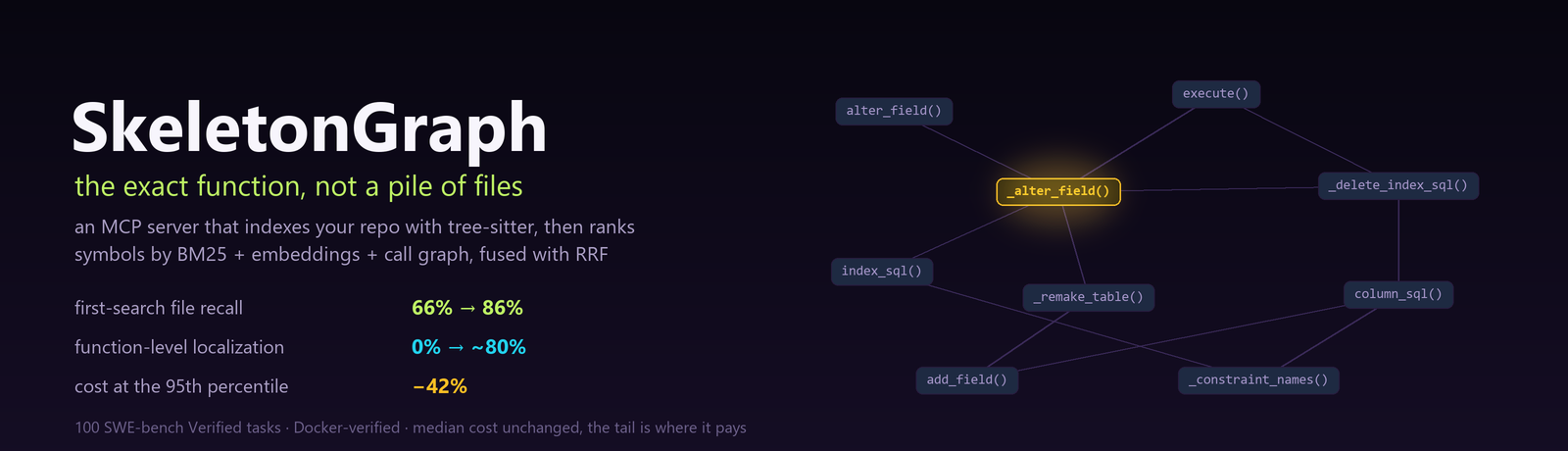
Index once with tree-sitter (no LLM) → three signals rank the same symbols → reciprocal-rank fusion returns the exact function, served to your agent over MCP.
The answer is rank 2, 3, and 2 across the three signals — top of none of them. Fusing is what puts it first.
SkeletonGraph is a retrieval engine purpose-built for coding agents, not a general RAG library retrofitted onto code. It parses a repository into function-level structure, a cross-file call graph, and PageRank centrality with **zero LLM calls** — deterministic, cheap, and instant to rebuild after every edit. At query time it resolves the symbols an issue names, walks the call graph outward, and reranks a BM25 recall pool by structural confirmation so the agent lands on the **right function** on the first try, instead of grepping and re-reading its way there. Its leaner operating point, **`sg-rerank`** (the product default), skips the dense leg entirely and still delivers the best file *and* function recall of any method we benchmarked it against — at the lowest token cost of any of them. The thesis: code-context tools have mostly been validated as a **token-optimization** game — how few tokens can you spend. SkeletonGraph re-centers the question on **retrieval quality** — did the agent land on the correct function — of which lower token cost turns out to be a *consequence*, measurable only end-to-end inside a real agent loop, not in an offline benchmark. ## Results All numbers below are regenerated from the released run artifacts (`python -m eval.scripts.make_paper_figures`). The full verified ledger, including withdrawn claims, is in [`docs/paper/FINDINGS.md`](https://github.com/yashdoke7/skeletongraph/blob/HEAD/docs/paper/FINDINGS.md). ### 1. Controlled retrieval ablation (react loop, open-weight model, 100 tasks) Identical action space for every arm; **only the retrieval backend changes**. The `none` arm gets no code access at all and establishes the memorization floor. | arm | pass@1 | file recall@1 | function hit | tokens (k) | turns | $/task | |---|--:|--:|--:|--:|--:|--:| | **`sg-fusion`** | **42.0%** | .737 | **57%** | **180** | 21.9 | **.052** | | `bm25` | 41.0% | .642 | 43% | 264 | 24.6 | .074 | | `graphify` (knowledge graph) | 41.0% | .223 | 9% | 275 | 25.6 | .078 | | `grep` | 39.0% | .647 | 0% | 282 | 22.4 | .079 | | `aider` (repo-map) | 36.7% | — | — | 1,126 | 18.1 | .160 | | `none` (no retrieval) | 35.0% | — | — | 345 | 23.6 | .066 | **`sg-fusion` is the top arm, the cheapest arm, and the only one that localizes to the function** (57% vs grep's 0% — lexical search is file-granular by construction). Against the closed-book floor of 35.0%, retrieval is worth **+7 points** here. `sg-rerank`'s recall/cost profile is reported separately in the agent-free intrinsic retrieval ablation in [the paper](https://github.com/yashdoke7/skeletongraph/blob/HEAD/docs/paper/ResearchPaper.pdf) (Table 2, §5.1) — best MRR/recall@10 short of full fusion, at the lowest index cost. ### 2. Deployment: SkeletonGraph vs native Claude Code (MCP, Docker-verified) The product itself — SG as an MCP server driving **Claude Code (sonnet)** against Claude Code on its own tools. 100 paired SWE-bench Verified tasks: | arm | pass@1 | file recall@1 | turns | $/task | |---|--:|--:|--:|--:| | `native` (Claude's own Grep/Read) | 74/100 | .663 | 14.5 | .434 | | **`sg-fusion`** (SkeletonGraph MCP) | 75/100 | **.862** | **11.4** | **.371** | SG's first-search recall excludes 3 tasks where the agent never called SG at all — those are adoption events, not retrieval failures. Including them gives .836. **Equivalent solve rate at −14.6% cost and −21.4% turns.** The saving is not spread evenly — it lives almost entirely in the tail: | cost percentile | native | +SG | change | |---|--:|--:|--:| | 50th (median task) | $0.255 | $0.260 | **+1.9%** | | 90th | $1.010 | $0.752 | −25.6% | | 95th (worst tasks) | $1.559 | $0.896 | **−42.5%** | Retrieval does nothing for the typical task and removes over 40% of the cost of the worst ones. Paired bootstrap 95% CI on the mean: [−25.3%, −1.2%]; McNemar on pass@1: p = 1.0 (no difference). ### 3. What the numbers don't cover 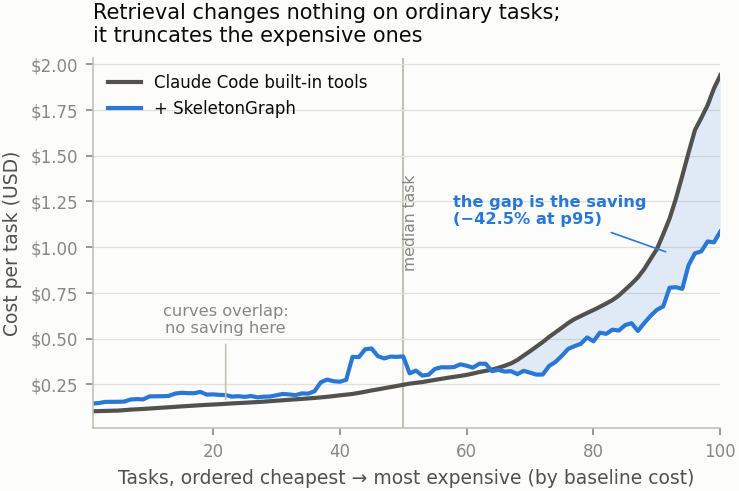 That tail effect is where the chart above comes from. Retrieval quality itself holds up under real stress-testing: it survives having all the location cues (tracebacks, code blocks) stripped from the issue text, and it survives on a decontaminated benchmark of repos the model hasn't memorized. But better retrieval doesn't move the solve rate (McNemar p=1.0), and an agent given enough turns to explore on its own eventually learns a repo about as well as a ranked list tells it — retrieval buys speed and cost, not a ceiling past what patient exploration reaches. Full methodology — the n=15→50 revision, the dose-response check, the cumulative-recall mechanism, and every withdrawn claim — is in [the paper](https://github.com/yashdoke7/skeletongraph/blob/HEAD/docs/paper/ResearchPaper.pdf) and [`docs/paper/FINDINGS.md`](https://github.com/yashdoke7/skeletongraph/blob/HEAD/docs/paper/FINDINGS.md). SkeletonGraph is wrapper-first: it returns a full context packet or exposes a retrieval index (AST skeletons + call graph + local summaries + optional embeddings) so the IDE agent or CLI can choose targets. SkeletonGraph has two product surfaces: - **SG IDE**: MCP context server for Cursor, Claude Code, Copilot, Codex, Antigravity, Windsurf, and other agentic IDEs. - **SG CLI**: terminal pipeline for route, prepare, dry-run, provider execution, and cost-aware model selection. ## Why SkeletonGraph Most coding agents spend expensive turns discovering the repo: ```text search -> read file -> read neighbor -> read tests -> realize the target ``` SkeletonGraph moves that work into a deterministic graph pipeline: ```text prompt -> (optional) retrieval planner -> classify task -> find target nodes -> expand graph -> assemble packet ``` The goal is not only lower token cost. The useful product outcomes are: - fewer exploratory file reads - faster first useful answer - better target/test/blast-radius context - transparent routing reasons - lower model overkill for routine tasks - reusable packets for IDEs, CLIs, and other agents ## Install ```bash pip install skeletongraph # core: indexing, MCP server, CLI (no API key needed) pip install "skeletongraph[llm]" # + litellm for sg run --execute / sg summarize --tier cloud pip install "skeletongraph[all]" # everything ``` ## Quick Start: SG IDE Use this path when you already work inside Cursor, Claude Code, Copilot, Codex, Antigravity, or another MCP-capable coding environment. ```bash cd your-project sg init sg build sg doctor ``` `sg init` writes the MCP config and the agent instruction file for the selected IDE. SG IDE does not require an API key. Your IDE subscription/model still does the reasoning and editing; SkeletonGraph supplies the packet or retrieval signals for efficient target selection. Supported IDE setup targets include: | IDE | Integration | Model switching | | --- | --- | --- | | Cursor | MCP + rules | manual in IDE | | Claude Code | MCP + `CLAUDE.md` | `/model` command | | GitHub Copilot | MCP + instructions | manual in IDE | | Codex | MCP + `AGENTS.md` | manual in agent | | Antigravity | MCP + rules | manual in IDE | | Windsurf | MCP + rules | manual in IDE | ## Quick Start: SG CLI Use this path when you want a terminal-first context and model-routing pipeline. ```bash cd your-project sg build sg route "fix the auth token validation bug" sg prepare "fix the auth token validation bug" --out .skeletongraph/context.md sg run "fix the auth token validation bug" --dry-run ``` `sg route`, `sg prepare`, and `sg run --dry-run` do not need an API key. To call a provider: ```bash sg config --cli-provider anthropic $env:ANTHROPIC_API_KEY = "..." sg run "fix the auth token validation bug" --execute ``` To test locally without a paid provider key: ```bash ollama pull qwen3-coder:latest ollama serve sg config --cli-provider local sg run "fix the auth token validation bug" --dry-run sg run "fix the auth token validation bug" --execute ``` Local execution is intended for cheap pipeline testing. Use provider models for quality benchmarks unless the benchmark is specifically for local models. ## Model Dependency, Prewarming, and Keeping the Index Fresh SG downloads **two** small embedding models on first use, both via `sentence-transformers` (a hard dependency, not optional): - **`jinaai/jina-embeddings-v2-base-code`** (`SG_DENSE_MODEL`) — the semantic leg of `fusion`/`sg_search`. Loaded on `sg warm` or on an agent's first dense-retrieval query. Loads with `trust_remote_code=True` (Jina ships custom modeling code on the HF Hub) — this executes code from that model repo, same as any `trust_remote_code` model. - **`all-MiniLM-L6-v2`** (`SG_EMBED_MODEL`) — a smaller, separate model used only as a confidence-score tiebreaker at index time. Downloads automatically on the **first `sg build`**, not on `sg warm`. Both need internet access the very first time each is used on a machine — after that, both are cached locally (Hugging Face's model cache, plus SG's own content-hash caches: `.skeletongraph/dense_cache` for the dense leg, `.skeletongraph/embeddings.npz` for the confidence tiebreaker) — so later builds are incremental: only functions whose text actually changed get re-embedded. **Prewarm before launching an agent**, so that cost lands during setup instead of on the agent's first real search: ```bash sg build # parse + structural index (no LLM, fast) sg warm --path . # prebuild BM25 + dense caches (one-time; minutes on CPU) sg warm --path . --mode rerank # skip the dense leg entirely (no embedding cost) ``` Without this, the first `sg_search` call an agent makes pays the cold-encode cost inline — on a large repo this can exceed the dense retrieval leg's internal timeout (`SG_DENSE_TIMEOUT_S`, 20s by default), in which case it silently degrades to a 2-signal (lexical + structural) result rather than failing outright. Prewarming avoids relying on that fallback altogether. **Keeping the index current as files change** — two options, pick based on how you work: ```bash sg update --path . # one-shot: re-index only files that changed since last build sg watch --path . # background daemon: auto-reindexes on save (needs `pip install "skeletongraph[daemon]"`) ``` `sg watch` is the hands-off option for active development — it debounces rapid saves and calls the same incremental update path as `sg update`, so editing a file is reflected in the index without a manual rebuild. ## Model Routing SkeletonGraph separates IDE-facing model labels from CLI provider model names. For IDEs, model tiers are recommendations: | Tier | Typical use | | --- | --- | | SLM | docs, explanations, simple lookup | | MLM | normal coding, debugging, tests, review | | LLM | architecture, broad migrations, low-confidence tasks | For CLI execution, SkeletonGraph can route to provider model names: ```bash sg config --cli-provider anthropic sg config --cli-provider openai sg config --cli-provider google sg config --cli-provider local ``` Dynamic routing uses task mode, confidence, candidate count, token size, and complexity. Code-changing work keeps an MLM floor by default so cost savings do not come from making weak models edit code unsafely. Retrieval planning can use small models to propose targets over AST/summaries before the heavy model runs. ## IDE Integration After `sg init` and `sg build`, register SG as an MCP server and write IDE hooks: ```bash sg install --ide claude-code # Claude Code: hooks + MCP server + CLAUDE.md rules sg install --ide cursor # Cursor: MCP + .cursor/rules/skeletongraph.mdc + hooks sg install --ide cline # Cline: MCP config + rules block sg install --ide roo # Roo: MCP config + rules block sg install --ide copilot # GitHub Copilot: MCP + copilot-instructions.md sg install --ide windsurf # Windsurf: MCP + .windsurfrules sg install --ide zed # Zed: MCP config + rules block sg install --ide continue # Continue: MCP config + rules block sg install # auto-detect all installed IDEs ``` `codex` and `antigravity` are accepted as aliases and currently route through the Copilot-style MCP installer. For any other MCP-capable client, or to configure it by hand, see [`mcp.example.json`](https://github.com/yashdoke7/skeletongraph/blob/HEAD/mcp.example.json) for the raw server config (`sg serve --path /path/to/your/project`). After install, restart your editor. SkeletonGraph runs as a background MCP server (`sg serve --path .`) that the IDE connects to automatically. ## MCP Tools Seven tools are exposed to the IDE agent. Use these **instead of** grep/glob/file reads: | Tool | When to call | Returns | | --- | --- | --- | | `sg_overview` | Session start — once per session | Constraints + top-N functions (by PageRank) + recent turns + index stats | | `sg_search "query"` | **Primary retrieval** — almost every prompt | Top-3 matches with body excerpts + summaries + 1-hop callers; top-4..N as signatures + summaries. One call usually enough — no need to chain. | | `sg_get "fqn"` | When the exact FQN is known | Signature + summary + 1-hop callers + callees | | `sg_expand "target"` | When more body is needed than `sg_search` returned | Full function body / file / line range (token-capped) | | `sg_constraint list` / `propose` | Before proposing changes | Confirmed + proposed project rules | | `sg_log` | Reviewing recent session turns | Last-N turn summaries with files touched | | `sg_decision` | A design/implementation choice is made (picked or rejected, and why) | Recorded so it survives context compaction — recall later with `sg_log(kind="decision")` | **Smart context routing.** On each `UserPromptSubmit`, SG classifies the prompt (architecture / explain / decision / debug / test / review / general) and includes the matching MD file from `.skeletongraph/` — e.g. `architecture.md` only for design/refactor queries, `project.md` only for "what is this codebase" queries. Constraints + session digest + relevant functions are always injected. **Cold start.** If no `.skeletongraph/` index exists when an MCP tool is called, SG auto-builds on first invocation (see `auto_build_on_query` in config). ## CLI Reference **Indexing & status** | Command | Purpose | | --- | --- | | `sg init [--agent cursor]` | Configure project, IDE preset, MCP, constraints | | `sg index` | Full index (alias for `sg build`) | | `sg index --incremental` | Only re-index changed files | | `sg build` | Full index with detailed output | | `sg update` | Incremental update | | `sg status` | Show index status | | `sg doctor` | Check index, routing, provider, Ollama readiness | | `sg overview` | Project skeleton: top functions, constraints, session | | `sg install [--ide